
Blog
Woraiyur Cotton Sarees: Tamil Nadu’s Traditional Weaving and Minimalist Borders

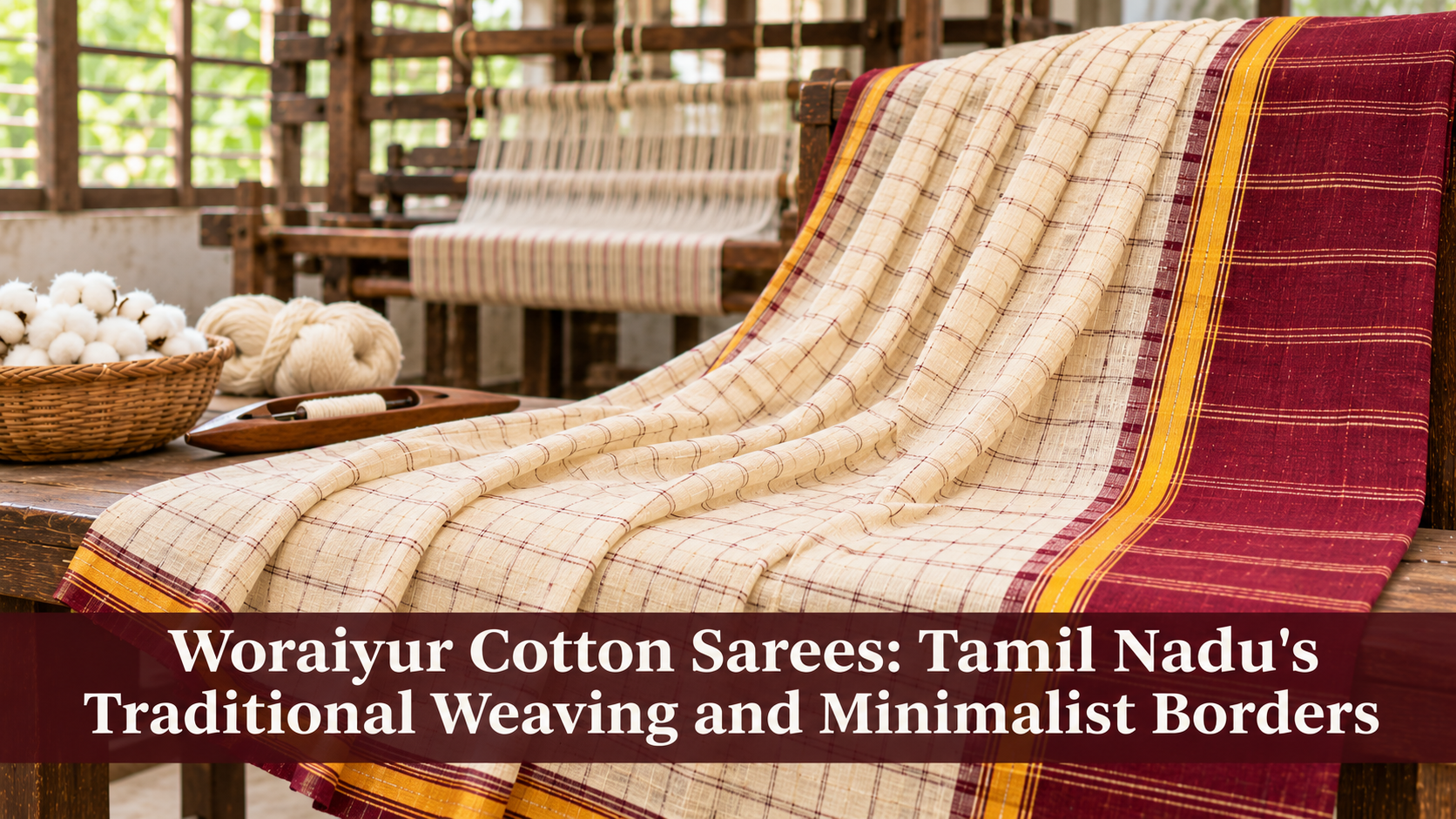
A Woraiyur cotton saree does not try to impress you from across the room. The body is usually plain or lightly striped or checked, the border is narrow and sharply coloured, and the pallu is small. The appeal sits in how the cloth feels, how it falls, and how clearly the weaver’s contrast between body and border has been planned.
This guide explains where Woraiyur weaving comes from, who weaves it, how a Woraiyur handloom saree is made, what the 2025 Geographical Indication (GI) tag covers, and how it differs from other Tamil Nadu cotton traditions. If you are still deciding which fabric and style suit you, our saree for women buying guide is a good place to start before you read about this one weave in depth.
One caution applies throughout. Woraiyur is a small, cooperative-driven craft, and published descriptions vary between sources and between years. Where details differ, this article says so rather than presenting a single tidy pattern.
Where Woraiyur is and why it matters
Woraiyur (also written Uraiyur) lies in the Tiruchirappalli district of Tamil Nadu, on the Cauvery river. It is one of the oldest settlements in the region and is described in several sources as an ancient Chola capital. Its textile reputation is old too: news coverage of the GI award notes that the Tamil epic Silappathikaram mentions the fineness of Woraiyur’s cotton cloth.
The geography needs a careful reading, because the cluster is wider than the name suggests. Press coverage of the GI registration says the saree is produced in Woraiyur and nearby handloom clusters, with Kottathur and Paithamparai named in one report. The Hindu’s GI coverage and the registration summaries describe a division of work in the modern craft: yarn is sourced through the National Handloom Development Corporation in Coimbatore, dyeing is done at Jayamkondan, and weaving takes place at Manamedu on the banks of the Cauvery. Manamedu is itself a documented weaving village of the Tiruchirappalli district, so a saree described as “from Manamedu” and one described as “Woraiyur” can overlap. For buyers, the safest way to read the label is as a Tiruchirappalli-district cotton tradition whose registered identity is Woraiyur.
It is also worth keeping Woraiyur apart from other Tamil Nadu centres. Thirubuvanam is a silk cluster near Kumbakonam. Kandangi belongs to the Chettinad region around Karaikudi. Negamam is near Pollachi in Coimbatore district. None of these is Woraiyur, and the differences are covered in the comparison section below.
The weaving community and the cooperative
The Devanga community, often written as Devanga Chettiar in cooperative records, is repeatedly named as the driving force behind Woraiyur cotton weaving. The Woraiyur Devanga Handloom Weavers’ Co-operative Society was formed in 1936, and it is the body that applied for the GI tag. Reports on the society give membership figures that moved sharply over time: one account says there were 656 members into the 1990s, and about 330 now, while a 2023 report mentions over 300 members with only around 50 active weavers, mostly senior.
Those numbers do not agree on how many looms are working today. A December 2025 report speaks of very few looms running, while the GI registration summary reported that 86 of 100 looms were active. The two likely count different things (members versus household looms, or different parts of the cluster), so the sensible reading is that the active weaving base is small and ageing, not that any single count is exact.
The cooperative’s own account of why numbers fell is consistent across reports. The society did well until the 1990s, then lost ground when powerlooms and synthetic fabrics entered the market. Weavers interviewed in local press describe learning the loom from their fathers and, in one case, being a fifth-generation weaver.
How a Woraiyur saree is made
Specific, documented detail on Woraiyur weaving is thinner than for famous silk centres, so this section separates what the sources say about Woraiyur from general handloom practice.
What is documented for Woraiyur
- Yarn: Cotton yarn comes from Coimbatore and Rajapalayam. The Hindu’s report on the cooperative describes the modern saree as a composite product, with yarn arranged through the National Handloom Development Corporation.
- Dyeing: Colour is applied to the yarn before weaving. Dyes are procured from Jayamkondam (also spelled Jayamkondan).
- Warp preparation: The same reporting lists rice starch application and the preparation of the warp among the steps handled before weaving.
- Loom: The GI application, as reported by The Hindu, says the sarees are traditionally woven on the korvai loom.
- Where it is woven: Manamedu, by the Cauvery, is the weaving village named in the GI coverage.
Warp, weft and loom setup in plain terms
On any handloom the warp is the set of lengthwise threads held under tension and the weft is the thread carried across them by the shuttle. For a cotton saree, the weaver or a helper typically winds the dyed yarn, arranges the warp to the required width and length, coats it with a starch-based size so it can withstand the friction of weaving, and then threads it through the loom’s heddles and reed. This is the general sequence on Indian handlooms. Woraiyur’s sources confirm the starch and warp preparation steps but do not publish a loom-by-loom set-up manual, so treat the finer mechanics as common practice rather than a Woraiyur specification.
The term korvai deserves a brief explanation. In Tamil weaving it generally refers to a border woven separately and joined to the body by interlocking threads at the edge. One summary of the GI coverage describes the Woraiyur border as a korvai border with continuous geometric motifs and bold colour contrast. Whether a particular saree is korvai-joined or has a continuous border is something to ask the seller, as practice may differ between weavers.
Finishing
After weaving, the cloth is cut into saree lengths and the ends are finished. Reports on the GI describe the sarees as typically around 5.5 metres, and a weaver quoted in local press speaks of a six-yard saree. The long length per loom run also matters economically: a weaver quoted in December 2025 said a single loom run produces 30 yards, which can be divided into five sarees.
Texture, weight, drape and construction
Published descriptions of Woraiyur cloth use the same few words: lightweight, soft, fine, durable. The GI summaries call it a light-weight, soft handloom cotton, and a weaver quoted by DT Next said the saree’s character comes from its texture and its plain body with lines and checks. One weaver described the standard cloth as an 80/80 specification, which in loom language points to a fine count in both warp and weft, though the figure comes from a single interview rather than a registered standard.
No source consulted for this article publishes a verified weight in grams or a thread count per inch for Woraiyur sarees, so none is stated here. If a seller quotes a figure, ask how it was measured. What you can expect from a handloom cotton of this kind is a cloth that is airy rather than crisp, softens with washing, and drapes in a relaxed, slightly structured way. Because it is handwoven, small variations in density along the length are normal.
This soft, breathable behaviour is the reason cotton suits Tamil Nadu’s climate. If you want a straight comparison of cotton against silk on comfort, care and cost, see our cotton saree vs silk saree comparison.
Borders, checks, stripes and pallu
The word “minimalist” in the title describes the dominant look, not a rule. Based on what local reporting and cooperative accounts describe, these are the features that recur:
- Body: Plain, or lightly woven with lines and checks. A DT Next report describes the sarees as valued for their plain design with lines and checks, and notes that some families still choose them for weddings.
- Border: Narrow and clearly contrasted with the body. One field account from 2021 describes the single traditional design as a two-inch border with a five-inch pallu, with later designs evolving from it. A weaver quoted in 2025 describes a small zari line on a plain body.
- Pallu: Small and often a single colour, according to the same weaver.
- Motifs: Geometric rather than pictorial. GI coverage mentions continuous geometric motifs in the border. Separate documentation of Manamedu cotton sarees mentions geometric motifs such as the peacock eye and the mango, woven with silk and mercerised cotton alongside minimal thread work. Since Manamedu is part of the Woraiyur weaving geography, these are plausible design references, but they should not be assumed on every saree.
Because the craft is handwork shared among several households, no two Woraiyur sarees are guaranteed to match. Some carry a thin zari line, some rely on contrasting cotton thread, and some have patterned checks across the body. Treat the list above as a set of tendencies.
Colour combinations
Colour is where the border earns its place. The documented pattern is a body in one colour with a border in a clearly different shade, which gives the saree its graphic outline when draped. Specific colourways vary by season and by what the cooperative and weavers produce, and no authoritative palette has been published, so look at the piece in natural light and judge the contrast for yourself.
For wearing ideas, particularly for everyday use, our guide to cotton sarees for daily wear covers fabric weights, care and draping choices that apply well to a light handloom cotton like this one.
What the GI tag protects
A Geographical Indication is a form of intellectual property protection for products whose qualities or reputation come from a specific place. In India it is administered by the Geographical Indications Registry in Chennai under the Geographical Indications of Goods (Registration and Protection) Act, 1999.
For the Woraiyur cotton sari, the key facts from news coverage are these:
- The application was filed by the Woraiyur Devanga Handloom Weavers’ Co-operative Society, with the work led by IPR attorney P. Sanjai Gandhi. One report dates the application to March 2022.
- The tag was granted around early December 2025, three years after the filing, and took Tamil Nadu’s GI count to 74.
- It was granted alongside Kavindapadi nattu sakkarai, Namakkal makkal pathirangal, Thooyamalli rice and Ambasamudram choppu saman.
- A GI registration is generally valid for 10 years and can be renewed.
What the tag does is tie the name “Woraiyur cotton sari” to a defined origin and method, so that sellers outside the registered area or using a different process cannot legitimately sell their product under that name. It does not guarantee that every piece is flawless, nor that every saree sold with the word Woraiyur in the listing is genuine. Enforcement depends on registered authorised users and on buyers and regulators noticing misuse. Weavers in other GI clusters have said awareness of the tag among customers is still low, so it is reasonable to expect that gap here too.
Why the craft matters to the local economy
Woraiyur weaving supports household income in a cluster where handloom has competed for decades with powerloom cloth. Figures from press reports illustrate the scale and the strain:
- A December 2025 report puts the earnings from a full 30-yard loom run, split into five sarees, at about Rs 2,000.
- A 2021 field account lists weaving charges of Rs 175 to Rs 200 per saree, and another older account gives Rs 700 to Rs 900 per saree with about three days of work, so figures differ by period and by what is counted.
- Prices of finished sarees quoted by a Woraiyur weaver in 2025 run from Rs 650 to Rs 3,000.
- The Woraiyur cooperative has reported steady demand of up to 500 sarees a month against a production capacity of about 300, constrained by labour.
The GI is expected to help in two ways according to those quoted: wider recognition in exhibitions and export markets, and a shift from occasional-wear to regular-wear use. Both are hopes stated by the people involved, not yet measured outcomes.
How to tell handwoven Woraiyur from imitations
No single check settles it, so combine several.
- Ask where and by whom. A genuine piece should trace back to a weaver, cooperative society, or authorised outlet in the Tiruchirappalli district. The Woraiyur Devanga Handloom Weavers’ Co-operative Society runs a showroom, and Co-optex, the state handloom cooperative, also sells handloom cotton.
- Ask for GI documentation. Since the tag is recent, ask whether the seller is a registered authorised user and whether the piece carries a GI mark or tag.
- Look at the selvedge. A Co-optex-linked account notes that tell-tale pin-holes at the edges distinguish handloom cloth from machine-made clones. Not every handloom shows them, but their presence is a useful sign.
- Expect small irregularities. Slight variation in the weave along the length is a handwork characteristic, not a defect. Perfectly identical repeats across many pieces point towards a machine.
- Check the reverse. Border junctions, loose ends and the way the pallu is attached should look like handwork, not printed or digitally generated design.
- Weigh the price. Co-optex’s managing director has said a handloom saree takes about 24 times longer to weave than a machine-made one. A price far below the Rs 650 to Rs 3,000 range quoted by a local weaver deserves questions.
- Read the listing carefully. Fibre content, handloom versus powerloom, and weaving location should be stated, not implied.
If you are buying online, our online saree shopping guide lists what to check in descriptions, photographs and seller details before you pay.
Woraiyur compared with other Tamil Nadu cotton traditions
Tamil Nadu has several cotton weaving traditions, and three of them appear together on its list of GI-registered sarees. They share a loom-based craft and often a weaving community, but their looks differ.
| Feature | Woraiyur | Chettinad (Kandangi) | Negamam |
| Location | Woraiyur and Manamedu, Tiruchirappalli district | Karaikudi and the Chettinad villages, Sivaganga district | Negamam and nearby villages near Pollachi, Coimbatore district |
| GI status | Registered 2025 | Registered 2019 to 2020 | Registered 2023 |
| Body | Plain or lightly lined and checked | Bold checks or stripes, from which the name derives | Often plain or with small checks, with fine-count cloth |
| Border | Narrow, strongly contrasted, geometric, korvai described | Broad borders, in some cases covering up to two-thirds of the saree, with temple or check designs | Contrasting borders, reported with half fine zari in Co-optex material |
| Fabric feel | Light, soft, fine | Traditionally thick and coarse, 40s count, in the GI document | Described as thick and durable, with 86 to 90 picks per inch in one report |
| Colour approach | Single body colour against a bold border | Traditionally mustard, maroon and black, with vivid stripes | Contrasting colours, with traditional motifs reported in some accounts |
| Community link | Devanga weavers | Devanga Chettiars | Devanga weavers named in the 1961 Census handbook |
Two readings follow from the table. Kandangi is the bolder and heavier of the three, with a design identity built on checks. Woraiyur is lighter and quieter, with the contrast concentrated in a narrow border. Negamam sits between them in appearance but is a Coimbatore-region tradition with its own loom set-up and its own registration. Other Tamil Nadu cotton traditions exist, and they also vary, so avoid assuming that “Tamil Nadu cotton” means one style.
Caring for a Woraiyur handloom saree
The sources do not publish a Woraiyur care protocol, so the advice here is general handloom cotton care. Wash gently in cold water with a mild detergent, wash a new saree separately the first time because yarn-dyed cotton can release colour, dry in shade, and iron on the reverse while slightly damp. Starch is used in weaving, so the first wash will soften the cloth noticeably. This is expected.
Conclusion
Woraiyur cotton sarees are a small, old and fragile craft with a recently strengthened legal identity. The cloth is light and soft, the body is usually plain or finely checked, and the border does the visual work with a sharp colour contrast. The GI tag granted in December 2025 gives the name formal protection, but a buyer still has to ask about origin, loom and price. Because the details vary between weavers and between sources, the most reliable approach is to treat every saree as its own piece, check it for the signs described above, and buy from sellers who can tell you who wove it.
Frequently asked questions
1. What is a Woraiyur cotton saree? It is a handloom cotton saree from the Woraiyur and Manamedu weaving area of Tiruchirappalli district in Tamil Nadu. It received a GI tag in December 2025. It is generally described as light, soft and plain-bodied, with a narrow contrasting border.
2. Is Woraiyur the same as Manamedu? They are closely linked. Weaving for the Woraiyur cotton sari is reported to take place at Manamedu on the Cauvery, and the GI coverage names both places. Treat Manamedu as part of the cluster rather than a separate saree type.
3. Who weaves Woraiyur sarees? The Devanga community has been the main weaving community, and the Woraiyur Devanga Handloom Weavers’ Co-operative Society, formed in 1936, is the organisation behind the GI application.
4. Do all Woraiyur sarees look the same? No. A plain body with lines or checks, a narrow contrasting border and a small pallu are common, but individual weavers vary the border, zari use and checks. One weaver describes a plain body with a small zari line, while other accounts describe geometric border motifs.
5. What does the GI tag actually guarantee? It protects the use of the name “Woraiyur cotton sari” for products made in the registered area by the registered method. It does not guarantee quality on its own, and it works best when buyers ask for proof of origin.
6. How can I tell if a Woraiyur saree is really handloom? Look for small natural irregularities, pin-holes along the edges, a hand-finished border join and a price that reflects the labour. Ask for the weaver or society name and for GI documentation.
7. How does Woraiyur differ from Kandangi and Negamam? Kandangi from Chettinad is bolder, with prominent checks and stripes on traditionally coarse cloth. Negamam, from near Pollachi, is a thicker, durable cotton with contrasting borders. Woraiyur is lighter and quieter, with the contrast concentrated in a narrow border.
8. Can a Woraiyur cotton saree be worn daily? Yes. Weavers quoted in local press say the GI tag could help move it from occasional wear to regular wear, and the lightweight cotton cloth is well suited to warm weather. Wash gently and dry in shade.
