
Blog
Udupi Cotton Sarees: Karnataka’s Lightweight Handloom, Checks and Contrast Borders

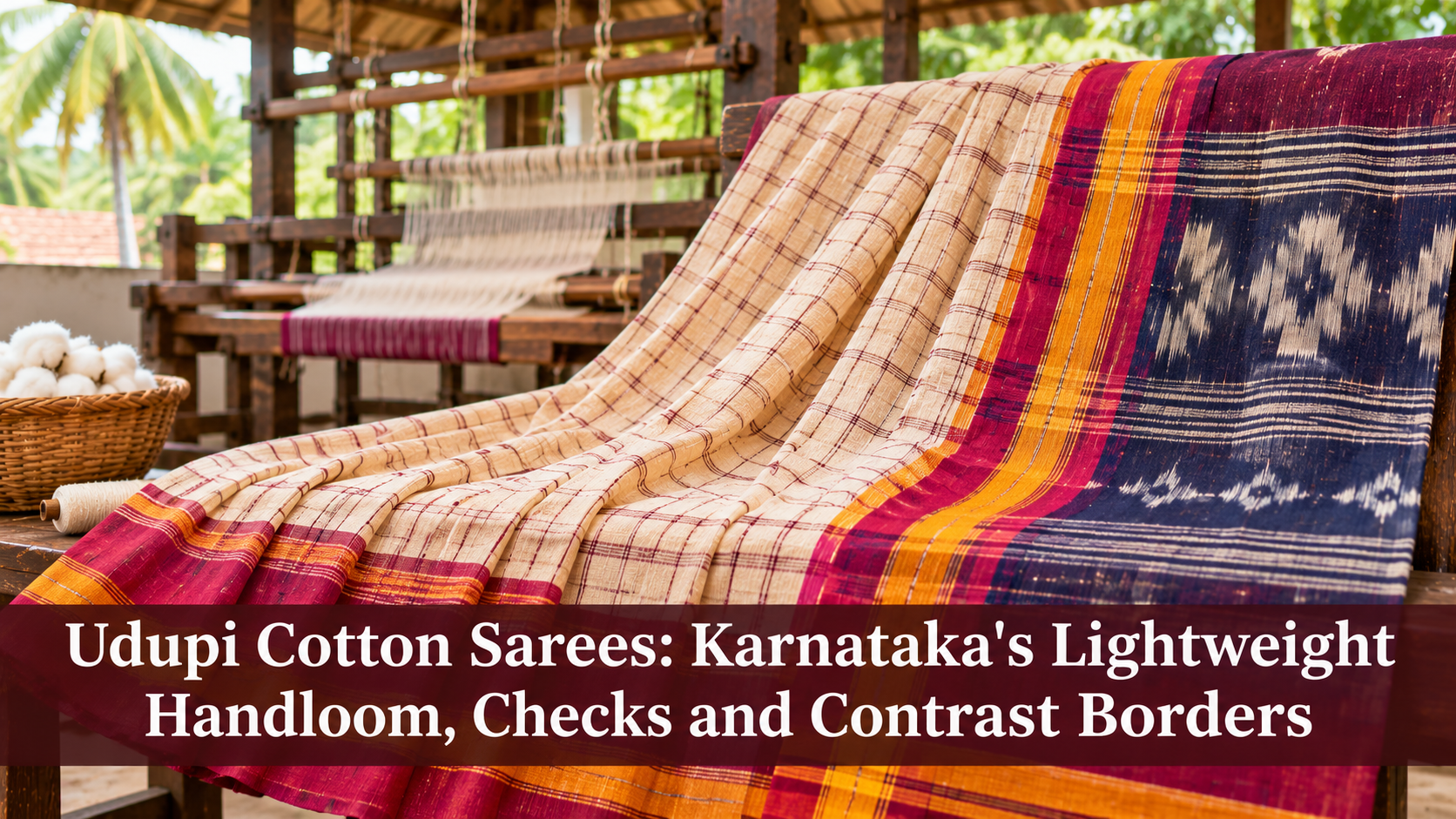
An Udupi cotton saree is easy to overlook in a shop. It has a light-shaded body, often in checks, and a bright border and pallu that carry most of the colour. There is no heavy zari and no dense pattern. What it has is a construction that weavers in coastal Karnataka describe as impossible to copy on a power loom, and a history of near disappearance followed by a small, documented revival.
This guide covers what is on record about the weave: where it comes from, who makes it, how the yarn is prepared and woven, which designs the GI documentation names and what weavers face today. It also separates documented Udupi features from general features of Karnataka cotton sarees, because the two are often mixed together in product listings. If you are new to buying sarees in general, our complete guide to buying sarees for women covers fabrics, quality checks and price factors first.
What is an Udupi cotton saree?
The Udupi saree is a handwoven cotton saree made from hank-dyed yarn in the Udupi and Dakshina Kannada districts of Karnataka. That description comes from the Geographical Indication (GI) record. The same record names two broad types: a saree with a check design in the body and a solid border, and a plain saree with butta (small motif) designs. NABARD’s GI page for the product says the sarees date back to the 1800s and are made from fine pure cotton yarn dyed in calm shades.
Locally, these sarees are sometimes called magga sarees, after the Kannada word for loom. Mamatha Rai of the Kadike Trust, who leads the revival work, has said that many locals knew the sarees only as everyday wear for labourers and grandmothers.
One caution applies throughout this article. The GI record describes the product in general terms, and individual weavers and societies make different choices about yarn count, border construction, dyes and finishing. A saree sold as “Udupi cotton” may not match every detail below, and a listing that claims identical construction for every piece is claiming more than the sources support.
Geographical identity and GI status
The weaving belt covers the coastal districts of Udupi and Dakshina Kannada. Udupi district was carved out of Dakshina Kannada in 1997, which is why older records, including those from the cooperative period, refer to the larger South Canara region. Villages named in the sources include Salikeri near Udupi, Kinnigoli (home of the Talipady Weavers Cooperative Society), and Haleangadi near Mangaluru, where the Padupanambur society is based.
The GI Registry lists Udupi Sarees under application number 224, filed on 3 November 2010 and now registered. NABARD, Deccan Herald and Udayavani all report the registration as 2016. Nine applicants, led by the Commissioner of Textile Development and Director of Handlooms and Textiles, are named in the registry entry. Kadike Trust says it also helped the Talipady Weavers Society obtain GI authorised user registration, which is the step that lets a producer use the name legally.
A short history of Udupi weaving
Until the nineteenth century, weaving in the region was done on pit looms. In 1844 the Basel Mission, a Christian missionary organisation, introduced frame looms to coastal Karnataka, and these became known as Malabar looms. The News Minute reports that this may have been one of the first places in India to weave on frame looms, which differ from the pit looms common in northern Karnataka.
Cooperative weaving followed. As part of the freedom movement led by Mahatma Gandhi, eight cooperative handloom societies were formed in undivided Dakshina Kannada after 1930. Kadike Trust says more than 5,000 families from several communities were weaving at that point. Because the Udupi Weavers Society represented the others, buyers began calling the cloth “Udupi sarees”.
Demand held until the 1980s. Deccan Herald reports that power looms and other pressures then led to a steep decline. By the time the Kadike Trust started its survey work in 2018, it found only 42 active Udupi saree weavers and none below 50.
Weaving communities and traditional practices
Kadike Trust describes the major weaving community as people believed to have come from Andhra Pradesh or Tamil Nadu, known in Udupi as Padmashali or Shettigar. The Malabar loom, with its bench-like seating position, later drew weavers from other communities, according to the same interview. Societies such as Shivalli, whose senior weaver George Amman spoke at a 2023 Manipal handloom workshop, carry the tradition in the present day.
Weaving here was a household enterprise. The News Minute’s 2019 profile of Salikeri, a village whose name comes from the Kannada words for weavers and colony, describes families where one person winds thread into smaller rolls on a charaka while another wraps it around the warping frames. At its peak the village had around a hundred looms, and by 2019 two sisters, Vijayashree and Mohini Shettigar, were its last weavers. They were making towels, not sarees.
Kadike Trust lists the household changes that undermined this system: nuclear families with fewer hands for pre-loom work, smaller living spaces and weavers moving to better-paid unskilled jobs.
Looms and weaving techniques
The documented loom is the Malabar frame loom fitted with a fly shuttle. The GI summary describes it as a strong loom suited to sarees with plain borders, extra warp and cross-border designs. NABARD and Garland magazine both repeat that Udupi sarees are woven on Malabar frame looms.
The body of the saree is a simple plain weave. Kadike Trust says some weavers use a dobby mechanism to weave extra patterns on the border and pallu, and small butta motifs can be woven on the pallu and body with or without dobby. The GI description, as reproduced on a Karnataka GI blog, adds that single yarn is used for the body and double yarn for the border.
From yarn to finished saree
Cotton yarn
Udupi sarees use single-ply combed cotton yarn for both warp and weft. Kadike Trust lists the historic counts as 120, 100, 80, 60 and 40, and says 100 and 120 are no longer used. Deccan Herald names 40, 60 and 80 counts. When Kadike Trust began its work in 2018, the weavers at Talipady were weaving only 60 count sarees.
Societies buy their yarn through a yarn bank held by the Padupanambur Weavers Society, which sources it from the National Handloom Development Corporation (NHDC).
Dyeing and pre-loom work
The yarn is dyed as hanks before the pre-loom stage, which includes bobbin winding. The pallu section is treated separately: after the warp is prepared and before weaving starts, that part of the yarn is dyed in a darker shade using tie-and-dye. This gives the pallu its bright contrast against the body. Artificial zari or cotton yarn is used for designs in the body, border and pallu.
Sizing
Udupi weavers practise what Kadike Trust calls loom sizing. The sizing material is applied to the yarn while weaving is in progress, and a special brush made from the fishtail palm is used to apply it. The sizing cuts yarn breakage and gives the saree its stiffness and sheen. Both Deccan Herald and Kadike Trust note that the fishtail palm is under threat.
A different pre-weaving routine appears in the Salikeri account, where Mohini Shettigar describes dipping the yarn in water, drying it for three or four days and using maida (wheat flour) to strengthen it. That was for her towel work, but it shows that sizing practice varies between weavers.
Warp preparation and loom set-up
The sources describe the steps in outline. Yarn is wound into rolls, passed through the warping frames and then loaded onto the loom. Beyond this, I did not find a published step-by-step account of drafting, reed setting or tie-up for Udupi sarees. In handloom weaving generally, the warp must be set and tied to the heddles before the ground cloth can be woven.
Weaving
The weaver builds the plain-weave body, changes colour for the border and uses the shuttle and, where used, the dobby for border and pallu patterns. Checks in the body come from the way coloured yarns are arranged in warp and weft.
Finishing
The loom sizing already gives the saree its finish, so the documented finish is that stiffness and sheen. I did not find a source describing post-loom washing or calendering for Udupi sarees.
Fabric weight, texture, drape and breathability
No source I found publishes the weight or air permeability of an Udupi saree. What is documented is qualitative. The News Minute describes Udupi sarees as cotton sarees known for lightness and flexibility. Kadike Trust attributes stiffness and sheen to the loom sizing. The GI summary says the sarees are famous for lustre and colour fastness.
From general textile knowledge, a fine-count single-ply cotton in a plain weave tends to be light and to breathe well, and a sized saree tends to feel crisper when new. These are general properties of cotton and are not measurements of Udupi cloth. Yarn count, sizing and weaver all affect the result, so two Udupi sarees can feel different in the hand.
If you are comparing cotton with silk for hot weather, our cotton vs silk saree comparison explains the general differences in comfort, care and cost.
Documented checks, borders, pallu and colours
The documented designs are narrow and clear:
- A check design in the body with a solid border.
- A plain body with butta designs.
- Light shades in the body, with bright and contrasting colours in the border and pallu (Kadike Trust).
- A tie-and-dye pallu in a darker shade, which Deccan Herald says gives a vibrant contrast.
- Borders in dobby or plain construction, with extra-warp patterns on some pieces.
Deccan Herald reports that some sarees use zari in traditional styles, while checked sarees in particular now use cotton bands in place of art silk. This change has led to softer colours and new designs. Kadike Trust says the contemporary designs it introduced stay within GI specifications.
The sources do not document a fixed list of stripe patterns, and they do not describe named traditional colour pairings, so I have not invented any. What they do document is the principle: a light body and a strongly coloured border and pallu.
Natural dyes are part of the revival. Deccan Herald lists chogaru (a reddish-brown liquid from unripe arecanuts, usually discarded by farmers), manjistha (madder), discarded temple marigolds, pomegranate peels, indigo, wild almond leaves, golden shower leaves and coconut husks. The paper notes that arecanut dye is little known and lacks standardisation.
Everyday wear and traditional occasions
Udupi sarees were everyday cloth. Kadike Trust says the locals’ own view was that they suited daily labourers and older women. That view held back demand, though Kadike Trust reports growing interest across India and abroad after its branding work.
The GI description, as reproduced online, says the sarees are socio-culturally associated with the southern coastal region of Karnataka through religious and other festivities. A 2020 Swarajya feature on the revival carries a photograph, credited to the Udupi Saree Revival project, of the Udupi Krishna idol wearing the handloom weave. These are the only documented ceremonial uses I found, and I did not find a detailed account of ritual or wedding use.
For daily wear, the practical questions are fabric weight, washing and rotation. Our guide to choosing a cotton saree for daily wear covers those for cotton sarees in general, including other handloom types.
Challenges and revival
The challenges are documented with unusual clarity:
- Power-loom cloth and fake handloom products undercut weavers on price.
- Unskilled jobs in the region pay better than weaving.
- Young people avoid weaving because of low pay.
- Pre-loom work needs household labour that many families no longer have.
- Supply of raw materials was unreliable, and departmental policies were unsupportive or poorly implemented.
- Fashion shifted towards salwar-style workwear.
- Locals were unaware of the sarees, and no one knew how many weavers were active.
Kadike Trust started the Udupi Saree Revival programme in early 2018 with the Talipady Weavers Society at Kinnigoli. The trust built the “Udupi Saree” brand, with a “Know Your Weaver” label carrying weavers’ names and photographs, ran training for new and returning weavers, assured minimum wages and set up natural dyeing. It later received NABARD grants for training, and Garland magazine reports that NABARD also supported marketing, including an online event.
The numbers moved. At the start of the project there were eight weavers at Talipady, and 42 in the two districts. Deccan Herald reports 36 at the society and more than 72 across the districts, while Kadike Trust’s own 2021 interview gives 35 and 74. Weaver counts in a 2019 News Minute report (52 weavers, with over 85 percent above 65) differ again because they come from different surveys at different dates. The direction is the same in every source: a sharp fall followed by a modest recovery, with trainees aged 20 to 55 joining.
Udupi cotton compared with other Karnataka and South Indian cotton handlooms
Karnataka and its neighbours have several cotton handloom traditions. Their details differ in loom, border construction and finish.
| Tradition | Region | Typical base | Documented loom and technique | Signature look | GI |
| Udupi saree | Udupi and Dakshina Kannada, Karnataka | Single-ply combed cotton, hank dyed | Malabar frame loom with fly shuttle; loom sizing with a fishtail palm brush; tie-and-dye pallu | Light plain or checked body, bright contrast border and pallu, or plain body with buttas | Registered; reported as 2016 |
| Ilkal saree | Ilkal, Bagalkot, Karnataka | Cotton body with art silk or silk border and pallu | Pit loom; the Tope Teni technique joins body warp to pallu warp with loops | Red pallu with temple-tower patterns is typical; stripes and checks in the body | Reported as 2007 |
| Kandangi (Chettinad cotton) | Karaikudi and Chettinad, Tamil Nadu | Coarse cotton | Handwoven; recorded by the GI report as made with winding machine, loom, shuttle and bobbin | Broad checks and stripes, bold contrast borders, earthy colours | 2019 to 2020 |
| Kuthampully saree | Kuthampully, Thrissur, Kerala | Fine kora (unbleached) cotton, 80s and 100s counts | Throw-shuttle pit looms | Off-white body with kasavu (gold zari) border | Reported as 2011 |
Three differences stand out. Ilkal combines cotton with silk and uses a pit loom, while Udupi uses cotton throughout on a frame loom. Kandangi relies on coarse yarn and bold checks, while Udupi uses fine single-ply yarn. Kuthampully is defined by undyed cotton and a gold border, while Udupi is defined by dyed yarn and contrast colour.
A note on the sources behind this table: Ilkal and Kerala details come from the Indian Culture portal, NABARD, the India Handloom Brand and press reports, and the Kandangi row relies on the GI report (number 422) and press coverage. GI years for Ilkal and Kuthampully are reported by secondary sources, not by the registry entries.
How to distinguish handloom cotton from machine-made alternatives
No single check settles it. The following points give a more reliable picture together.
- Ask for the weaver or society. Udupi handloom comes from societies such as Talipady, Padupanambur and Shivalli, and the Talipady Weavers Society holds GI authorised user registration. A genuine seller should be able to name the society or weaver.
- Look for “Know Your Weaver” labels. The revival brand uses labels with weavers’ names and photographs. This is one brand’s practice, not a legal requirement.
- Check the yarn dyeing. Because the yarn is dyed as hanks before weaving, the colour should appear throughout the cloth and on the reverse, not only on the surface as in a print.
- Compare the pallu with the body. Documented practice dyes the pallu yarn separately, in a darker shade, after the warp is prepared, so a clear colour change between body and pallu is expected.
- Expect small irregularities in a handloom cloth, such as slight variations in density or border edges. A perfectly uniform finish can mean powerloom or mill cloth.
- Ask about the fibre and count. The seller should state cotton, the thread count if known and whether the border uses cotton bands, art silk or zari.
- Ask about the dye. Natural dyes and synthetic dyes both exist, and a seller who says “natural” should be able to name the source.
- Be wary of “Udupi style” or “Udupi pattern” listings that do not name a weaver or society. Kadike Trust says fake handloom products flooded the market.
If you are buying online, our online saree shopping guide lists what a listing should state, including fibre, weave method and blouse piece, and which questions to put to a seller.
Frequently asked questions
1. What is an Udupi cotton saree? It is a handwoven cotton saree made from hank-dyed yarn in the Udupi and Dakshina Kannada districts of Karnataka. The GI record describes two types: a check body with a solid border, and a plain body with butta designs.
2. Where is Udupi weaving done? In the coastal districts of Udupi and Dakshina Kannada. Weavers’ societies in places such as Kinnigoli (Talipady), Haleangadi (Padupanambur) and Shivalli produce the sarees, and Salikeri near Udupi was historically a weaving village.
3. Does the Udupi saree have a GI tag? Yes. The GI Registry lists “Udupi Sarees” under application number 224, filed in 2010 and registered, and sources report the registration as 2016.
4. Is an Udupi cotton saree light and breathable? Reports describe it as light and flexible, and fine-count cotton in a plain weave generally breathes well. No published measurement of weight or air permeability exists for Udupi sarees, so treat the comfort claim as a general property of cotton and check each saree in hand.
5. Are all Udupi sarees checked? No. The GI description names two types: a check body with a solid border and a plain body with butta designs.
6. How does an Udupi saree differ from an Ilkal saree? Udupi sarees are cotton throughout and woven on Malabar frame looms. Ilkal sarees use a cotton body with a silk or art silk border and pallu, woven on pit looms with the Tope Teni joining technique.
7. How can I tell if an Udupi saree is handwoven? Ask for the weaver or society, check that the yarn colour runs through the cloth, look for small hand-made variation and ask the seller to state the fibre, count and border material. A listing that names no maker and promises perfect uniformity deserves caution.
8. How should I care for an Udupi cotton saree? Follow the seller’s care label first. As a general precaution for dyed handloom cotton, wash it separately in cold water the first few times, avoid long soaking, dry it in the shade and press it on the reverse side. Natural-dyed pieces in particular may release colour at first.
Conclusion
The Udupi cotton saree is a modest piece of cloth with a well-documented craft behind it. It comes from coastal Karnataka, it is woven on Malabar frame looms from hank-dyed single-ply cotton, and its look rests on a light body and a bright border and pallu. The history runs from pit looms to a missionary-introduced frame loom, then to cooperative societies, a long decline and a revival led by Kadike Trust, with NABARD training support.
If you are looking at one, ask who wove it, check how the yarn is dyed and read the listing for fibre, count and border. Those answers tell you more than the name on the label.
