
Blog
The Complete Guide to Buying Sarees for Women: Fabrics, Styles, Prices and Selection Tips

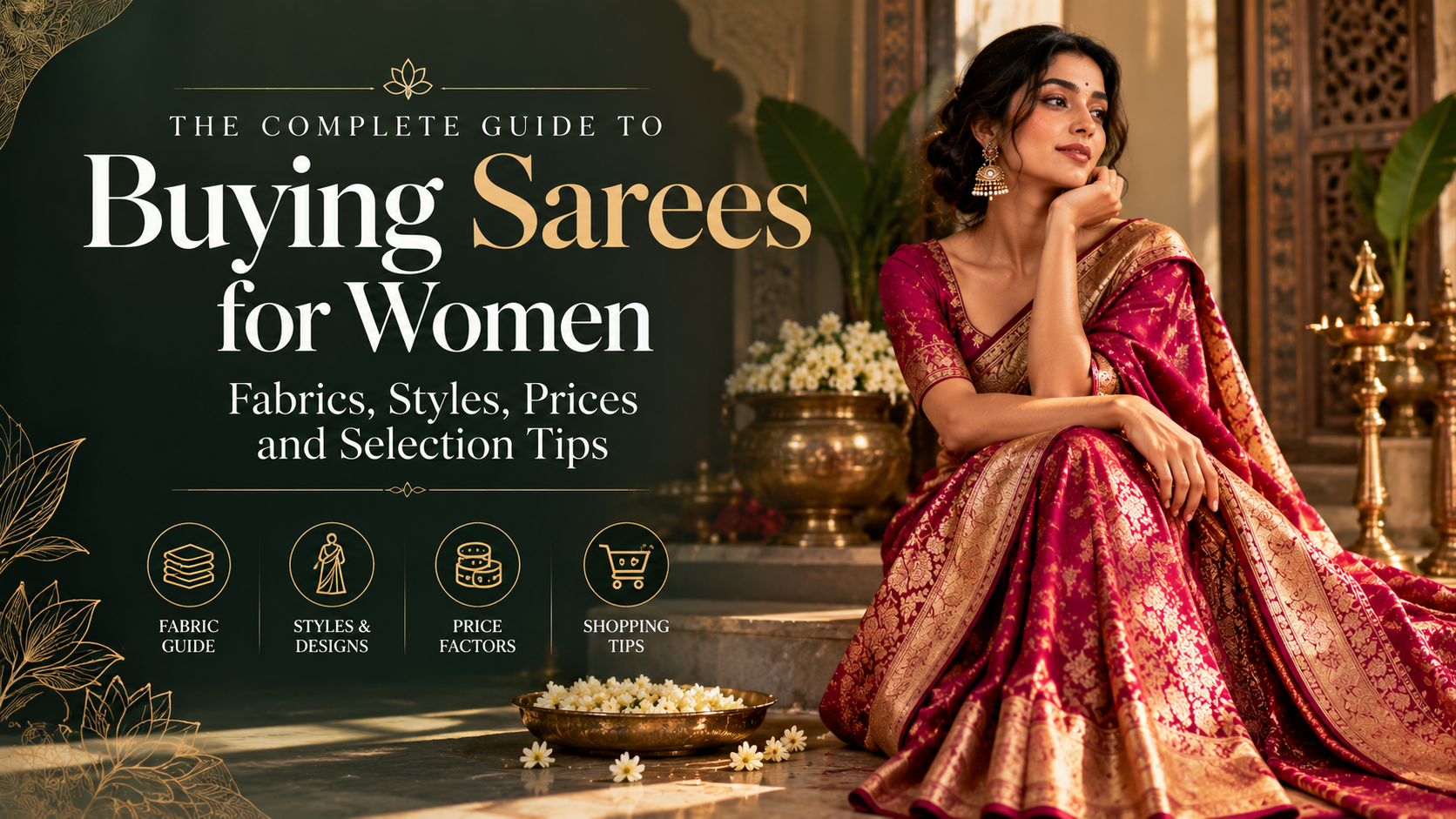
Buying a saree looks simple until you are standing in front of a wall of them, or scrolling through hundreds of listings that all look similar in photographs. The right saree for women depends on far more than colour. Fabric decides how it drapes and how it feels after six hours. The occasion decides how formal it should be. Weave, finishing and craftsmanship decide how long it lasts. Price depends on all of these together.
This guide brings those decisions into one place. It explains the main types of sarees, how common fabrics differ, how to choose for weddings, festivals, work and daily wear, how to judge quality, what affects price and how to shop confidently online and in stores. Use it as a starting point, then follow the linked guides when you want more detail on a particular topic.
Start with four questions
Before looking at a single saree, answer these:
- Where will you wear it? A wedding, a festival puja, an office function or everyday errands each call for a different weight, finish and level of embellishment.
- How long will you wear it, and in what weather? A heavy silk feels very different at an afternoon outdoor function than at an air-conditioned evening reception.
- How much care can you give it? Some sarees can be washed at home; others need dry cleaning and careful storage.
- What is your budget range? Knowing this early helps you focus on fabrics and techniques that fit, rather than comparing everything.
Your answers narrow the options quickly and make the rest of this guide easier to apply.
Types of sarees and their characteristics
Sarees can be grouped in several ways. These three groupings are the most useful when shopping.
By how the fabric is made
- Handloom sarees are woven on hand-operated looms. They often show small irregularities that are a natural part of handwork, and many traditional weaves are made this way.
- Powerloom sarees are woven on mechanised looms. They are usually more uniform and often more affordable, and some reproduce traditional designs.
- Printed sarees have designs applied to finished fabric through block printing, screen printing or digital printing.
- Embroidered or embellished sarees have decoration added after weaving, such as thread embroidery, sequins, zari work, mirror work or stone work.
Product listings do not always say which method was used. If it matters to you, ask the seller.
By weight and drape
- Lightweight sarees such as chiffon, georgette, mulmul and fine cotton are easy to manage and drape closely.
- Medium-weight sarees such as cotton silk, chanderi and crepe balance structure with comfort.
- Heavy sarees such as many pure silk weaves, brocades and heavily embellished sarees hold their shape and look rich but need more care.
By purpose
- Daily wear sarees prioritise comfort, breathability and easy care.
- Office and formal sarees are polished, usually with minimal embellishment.
- Festive and party wear sarees have more colour, shine or decoration.
- Bridal and occasion sarees are often the richest in weave or embellishment.
Common saree fabrics and how to choose between them
Fabric is the single biggest factor in how a saree looks, feels and behaves.
| Fabric | Feel and drape | Typical use | Care considerations |
| Cotton | Breathable, structured, softens with wear | Daily wear, summer, office | Often washable at home; may need starch or ironing |
| Linen and linen blends | Crisp, airy, textured | Office, daytime events | Wrinkles easily; usually easy to wash |
| Pure silk | Rich, lustrous, holds shape | Weddings, festivals, formal events | Usually dry clean; careful storage |
| Art silk and silk blends | Silk-like sheen, often lighter | Festive wear on a budget, gifting | Care varies by blend; check label |
| Chiffon | Very light, sheer, fluid | Parties, evening events | Delicate; snags easily |
| Georgette | Light, slightly grainy, flowing | Parties, festivals, travel | Fairly easy to maintain |
| Crepe | Soft, matte, wrinkle-resistant | Office, travel, evening wear | Generally easy care |
| Chanderi | Light, slightly sheer, subtle sheen | Festive daywear, formal events | Gentle handling |
| Organza | Crisp, sheer, structured | Parties, contemporary looks | Can crease; handle carefully |
| Net | Sheer and decorative | Parties, embellished designs | Snag-prone; store carefully |
How to choose between fabrics
- For comfort and heat: cotton, linen, mulmul and light chanderi.
- For a rich, formal look: pure silk, silk blends and brocades.
- For easy drape and travel: georgette, crepe and chiffon.
- For a budget-friendly festive sheen: art silk and silk blends.
Many shoppers ask how pure silk and art silk differ in look, feel and value. Our detailed comparison, pure silk vs art silk sarees, explains how to tell them apart and when each makes sense.
Choosing a saree for women by occasion
Weddings
Weddings are where most people invest in heavier, richer sarees. Pure silks, brocade weaves, zari borders and embellished georgettes are common choices. Consider how long the event lasts, the venue’s temperature, how much you will move and the jewellery you plan to wear. Brides have additional considerations around design, budget, fittings and day-long comfort; our bridal saree buying checklist walks through them step by step.
For guests, a silk, silk blend or embellished georgette is usually appropriate. If you are attending several functions, choose different weights for different events, such as lighter sarees for daytime and richer weaves for the main ceremony.
Festivals
Festival sarees often lean on colour and tradition. Bright silks, cotton silks, bandhani, block prints and zari borders all suit festive settings. If you will sit on the floor for puja or move around a lot, choose a fabric that is comfortable and not too delicate.
Formal occasions and office
Office functions, conferences and formal events suit polished, understated sarees. Cotton, linen, crepe, chanderi and lightweight silks in solid colours or subtle patterns work well. Simple borders and minimal embellishment keep the look professional.
Everyday wear
For daily use, comfort and easy care come first. Cotton, mulmul, linen blends and soft synthetics that resist wrinkling are practical. Choose sarees you can wash easily and that will stand up to regular wear.
Parties and evening events
Evening events allow more shine and drama: georgette and chiffon with sequins, organza with embroidery, satin finishes and contemporary designs.
Popular saree styles and traditional designs
India has a wide range of regional weaves and traditional saree for women designs. Each varies by maker, region and technique, so treat these descriptions as general introductions.
Silk weaves
- Kanjivaram (Kanchipuram): known for heavy silk and contrasting borders, often with zari.
- Banarasi: known for rich brocade work, often with zari motifs.
- Paithani: associated with Maharashtra, recognised for distinctive borders and pallus.
- Patola: a double-ikat tradition associated with Gujarat.
- Mysore silk: typically lighter silk with a smooth finish.
Cotton and handloom traditions
- Chanderi: light, slightly sheer, often with fine motifs.
- Maheshwari: lightweight, often with reversible borders.
- Tant: a Bengal cotton tradition, crisp and airy.
- Ikat (including Pochampally): patterns created by resist-dyeing threads before weaving.
- Kota doria: light, with a distinctive checked weave.
Prints and dyeing techniques
- Bandhani and leheriya: tie-dye traditions from Gujarat and Rajasthan.
- Block prints: hand-printed with carved wooden blocks, such as Bagru and Sanganeri.
- Kalamkari: hand-painted or block-printed narrative and floral designs.
Contemporary styles
- Pre-stitched sarees: ready-pleated sarees that are quicker to wear.
- Printed georgettes and crepes: modern prints that are easy to style.
- Embellished party sarees: sequins, stones and embroidery for evening wear.
- Lightweight silk blends: a festive look without the weight of traditional silks.
A popular saree style is not the same as the right saree for you. Choose based on fabric, occasion and comfort first, then style.
Evaluating fabric quality, finishing, colour and craftsmanship
Fabric
- Feel the fabric. It should feel consistent across the length, without thin or rough patches.
- Check density. Hold it up to light. Unevenly woven areas may show as lighter or patchy.
- Read the label or description. Look for fabric composition. Terms like “silk”, “silk blend” and “art silk” mean different things.
Weave and design
- Check motifs and borders for consistency along the length.
- Look at the reverse of woven designs. Loose floats of thread on the back are common in some weaves but should not be snagged or broken.
- Expect natural variation in handloom and handwork. Small irregularities are not defects.
Finishing
- Edges and selvedges should be straight and finished.
- Pallu and border should be attached cleanly if they are separate pieces.
- Embellishments such as sequins, stones and mirrors should feel secure.
- Fall and pico (edge finishing) may or may not be done; ask if it is included.
Colour
- View the saree in natural light where possible. Shop lighting can change how colours look.
- Check colour consistency across the length and between the body, border and blouse piece.
- Ask about colour fastness if you plan to wash the saree at home.
Blouse piece
- Check whether a blouse piece is included, its length and whether it matches the saree.
Saree price factors and budget planning
Saree prices vary widely, and two sarees that look similar in a photograph can differ significantly in price. These are the main factors:
- Fibre: pure silk, fine cotton and other natural fibres generally cost more than synthetics or blends.
- Weaving method: handloom weaving usually takes longer than powerloom weaving, which can affect price.
- Design complexity: intricate motifs, dense borders and complex patterns take more time and skill.
- Zari type: real, tested and metallic zari differ in material and price.
- Embellishment: hand embroidery, mirror work and stone work add labour and materials.
- Weight and length: heavier sarees and those with more fabric may cost more.
- Brand and seller: retail costs, certification and seller reputation can influence price.
Budget planning tips
- Set a range, not a single number. This leaves room to compare.
- Prioritise by occasion. Spend more on sarees you will wear for significant events or many times; save on sarees for one-off or casual use.
- Think in cost per wear. A versatile saree you wear often may be better value than a cheaper one worn once.
- Include extras. Blouse stitching, fall and pico, and dry cleaning add to the total cost.
- Watch for sales, but check quality. Discounts can be good value if the saree meets your quality standards. Our saree sale shopping guide explains how to spot genuine value deals.
Tips for buying sarees online and in physical stores
Buying online
- Read the full description for fabric, length, blouse piece, weight and care instructions.
- Zoom into photos to see weave, borders and finishing.
- Remember screens vary, so colours may look slightly different in person.
- Check reviews for comments on colour, fabric and quality.
- Check seller details, return policies and exchange options before ordering.
- Inspect on arrival before removing tags.
Our online saree shopping guide covers checking fabric, colour, quality and seller details in more depth.
Buying in stores
- Ask to see the saree unfolded, including the pallu and border.
- Drape it over your shoulder in front of a mirror to see the colour against your face.
- Check in natural light near a window or doorway.
- Feel the fabric and look at the reverse of woven designs.
- Ask questions about fabric composition, weaving method, care and returns.
- Compare a few options before deciding.
Common mistakes to avoid when purchasing a saree
- Choosing only by colour or photograph. Fabric and drape matter just as much.
- Ignoring the occasion. A heavy silk at a summer afternoon event can be uncomfortable.
- Not reading fabric details. “Silk look” and “silk” are not the same.
- Forgetting care requirements. A dry-clean-only saree may not suit everyday use.
- Overlooking the blouse piece. Check whether it is included and matches.
- Not budgeting for extras. Blouse stitching, fall and pico add to the cost.
- Skipping the return policy. Especially important when buying online or on sale.
- Buying in a hurry. Allow time to compare, especially for important occasions.
Frequently asked questions
1. How do I choose a saree for women for the first time? Start with a lightweight, easy-to-drape fabric such as cotton, georgette or crepe, in a colour you like. These are easier to manage while you get comfortable with draping.
2. Which saree fabric is best for summer? Breathable fabrics such as cotton, linen, mulmul and light chanderi are usually more comfortable in warm weather.
3. What is the difference between handloom and powerloom sarees? Handloom sarees are woven on hand-operated looms and may show natural irregularities. Powerloom sarees are woven on mechanised looms and tend to be more uniform.
4. Which sarees are suitable for weddings? Pure silks, silk blends, brocade weaves and embellished georgettes are common choices. Consider comfort, venue and event length.
5. How can I tell whether a saree is good quality? Check fabric consistency, weave, borders, finishing and embellishments, and view the colour in natural light. Read the fabric description carefully.
6. Why do saree prices vary so much? Price depends on fibre, weaving method, design complexity, zari type, embellishment and seller factors.
7. Is it safe to buy sarees online? It can be, if you read descriptions carefully, check reviews and seller details, and understand the return policy before ordering.
8. What extras should I budget for? Blouse stitching, fall and pico, a petticoat if needed and dry cleaning for delicate sarees.
Conclusion
Choosing a saree for women becomes much easier when you work through a few clear steps: decide where and how long you will wear it, choose a fabric that suits the occasion and weather, check quality and finishing, plan your budget including extras, and shop carefully whether online or in a store. Traditional saree for women weaves and contemporary styles can both have a place in your wardrobe; what matters is that each saree fits your occasion, comfort and care preferences.
When you are ready to explore, browse the saree collection at Mahavir Cloth Center and use this guide to compare fabrics, styles and finishes before you choose.
