
Blog
Bandhani Sarees Explained: Tie-Dye Techniques, Patterns and Regional Traditions

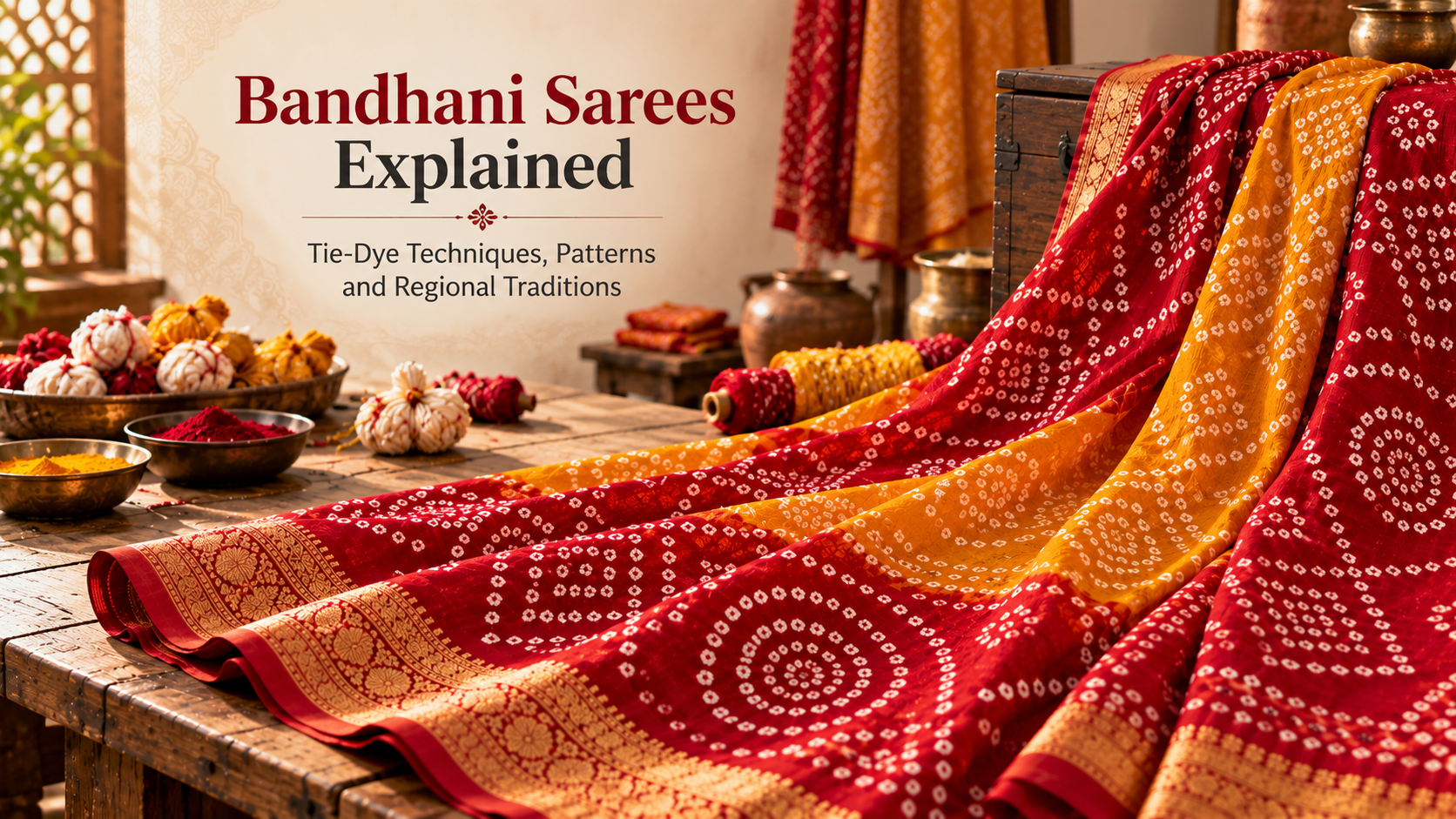
A Bandhani saree is recognised by the tiny dots, clusters and intricate patterns that emerge when fabric is carefully tied and dyed. At first glance, the design can look like a print, but traditional Bandhani is created through a resist-dyeing process: selected parts of the cloth are tightly bound so that dye cannot reach them in the same way as the exposed fabric. When the ties are removed, the protected areas appear as small dots or other shapes against the coloured ground.
Known in different contexts as Bandhani, Bandhej or Bandhni, this textile tradition is strongly associated with Gujarat and Rajasthan. It is not one fixed design. The placement of ties, the size of each resist point, the number of dye baths and the colours chosen can produce an extraordinary range of visual effects—from fine dotted fields to large floral forms, diamonds, grids and figurative designs.
Understanding a Bandhani saree means looking beyond its colour. The pattern records a sequence of skilled decisions: how the cloth was marked, where it was pinched, how tightly it was tied, which parts were protected during each dye bath and how the design was revealed. This guide explains the technique, its regional traditions, common pattern vocabulary and the details shoppers can use to understand a product description more clearly.
What Is a Bandhani Saree?
Bandhani is a traditional Indian tie-dye technique in which sections of fabric are pinched or gathered and tied with thread before dyeing. The tied sections resist the dye, leaving lighter dots or shapes when the knots are removed. The Sanskrit root commonly associated with the name relates to tying or binding. The craft is also widely called Bandhej, particularly in western India.
The technique is used on different textiles and garments, including sarees, odhnis, dupattas, turbans and dress materials. A Bandhani saree may have a simple all-over dotted pattern, a carefully arranged central motif, a more complex composition of dots and geometric forms, or multiple colours built up through repeated tying and dyeing.
It is important to distinguish the technique from a particular fabric or fibre. “Bandhani” describes how the pattern is made, not whether the saree is silk, cotton, georgette or another material. Nor does the word alone guarantee that a piece was tied entirely by hand. Product descriptions should clarify whether the design is traditional hand-tied Bandhani, another form of resist dyeing, or a printed imitation.
A Brief History and Cultural Context
Bandhani belongs to a long history of resist-dyed textiles in South Asia. Textile and craft references point to early visual evidence of speckled or resist-patterned clothing in Ajanta paintings, while the seventh-century Sanskrit work Harshacharita is often cited in discussions of tie-dyed textiles associated with a royal wedding. These references support a long history of patterned cloth, but they do not mean that every modern Bandhani design or regional style can be dated to a single ancient origin.
Gujarat and Rajasthan became especially important centres for the craft. In Gujarat, Kutch and Saurashtra are notable Bandhani regions, with Jamnagar and Bhuj often mentioned in craft documentation. The Khatri community has played a significant role in the region’s Bandhani production and knowledge. Rajasthan also has a substantial tie-dye tradition, with centres including Jaipur, Jodhpur, Udaipur and Sikar. The precise styles vary across towns, communities and workshops; the states should not be treated as if each had one uniform design language.
Bandhani textiles have been used in everyday dress as well as ceremonial and community contexts. In some traditions, particular garments, colours and layouts are associated with weddings, auspicious occasions or community identity. Gharchola or Gharcholu, for example, is a Gujarati ceremonial textile commonly associated with bridal use; it may combine a checked layout and woven gold-toned elements with tie-dyed motifs. Such associations are meaningful, but customs differ by community and family. A colour or motif should not be presented as a universal rule for every wearer.
The craft has also changed over time. Natural dyes were historically used, while contemporary production may use a range of synthetic dyes and modern materials. Designs now appear on traditional textiles as well as contemporary fashion. This evolution does not automatically make a piece less valuable, but it makes clear product information—about process, fibre and dye—especially useful.
How the Bandhani Tie-Dye Process Works
Traditional Bandhani is labour-intensive because the design is built into the fabric through numerous small ties. The exact method differs by workshop, fabric and pattern, but the broad process usually includes preparation, marking, tying, dyeing, drying and untying.
1. Selecting and preparing the fabric
The artisan begins with a fabric suitable for the intended design and dye. Cotton, silk, muslin and other fabrics have been used in Bandhani; contemporary products may also use georgette, chiffon and blends. The cloth is inspected and may be washed to remove starch, finishes or impurities that could interfere with dye uptake. Some fabrics require additional preparation according to their fibre and the dye system being used.
Preparation matters because the same tying pattern can look different on different fabrics. A fine, light fabric can support delicate dots and fluid drape, while a more structured textile may make the pattern appear sharper or more substantial. Fibre content also affects how the dye behaves, so a dye recipe suitable for cotton may not be suitable for silk or a synthetic blend.
2. Marking the design
Before tying begins, the artisan plans where the dots and motifs will sit. A design may be mapped using a template, perforated guide, block or other marking aid. The layout must account for the folds and gathering of the fabric, since a mark on a folded section can correspond to a particular position in the final spread-out design.
This stage is central to pattern quality. Closely spaced marks can create a dense field; carefully arranged groups can outline flowers, circles or diamonds. Larger motifs require a broader plan, while complex compositions need the artisan to anticipate how the fabric will be folded and how colours will develop across multiple dye stages.
3. Pinching and tying the cloth
The artisan lifts small points of fabric and binds them tightly with thread. These ties form the resist areas: dye has difficulty penetrating the tightly bound sections, so the protected fabric retains a lighter colour or a previous dye shade. The size, shape and tightness of each tie influence the final dot.
Fine Bandhani can involve thousands of tiny ties in a single length of fabric. The work demands patience and a steady hand because uneven spacing or inconsistent tying can alter the rhythm of a motif. Different tying approaches are used to create different visual effects; not every Bandhani design is made by exactly the same knotting method.
4. Dyeing the fabric
The tied fabric is immersed in a dye bath or otherwise dyed using a process appropriate to the material. The tied points resist the colour while exposed areas take it up. For a single-colour design, one dye stage may be enough. Multicolour designs can require several rounds of tying and dyeing, with selected sections protected again before a later colour is applied.
Colour order is important. In many multicolour processes, lighter shades are applied before darker ones because a dark dye can dominate or obscure a lighter colour. The artisan must plan which areas remain tied, which are opened and which are retied for the next stage. The precise sequence varies by design and dye chemistry, so it is not accurate to claim that every Bandhani saree follows one universal order.
5. Rinsing, drying and repeating the process
After a dye stage, the cloth may be rinsed and dried. For a layered design, the artisan repeats some combination of tying, dyeing, rinsing and drying. Each repetition adds complexity and requires the previous pattern to remain legible. Careful handling helps avoid unwanted colour transfer or damage to the tied sections.
6. Removing the ties and revealing the pattern
Once the dyeing stages are complete and the fabric is ready, the ties are loosened or removed. The protected areas emerge as pale dots or shapes against the dyed background. This is when the design becomes fully visible. The fabric is then checked and finished according to its intended use, which may include washing, drying, pressing or other finishing steps appropriate to the fibre and dye.
A finished Bandhani saree is therefore not simply a printed imitation of dots. In traditional tie-dye, the pattern is produced by controlling dye access to the fabric. However, visual appearance alone cannot prove a piece’s production method: printed versions can imitate the look convincingly. When the method matters, seek clear seller information rather than relying only on a photograph.
How Dots Become Patterns
The signature dot is the building block of many Bandhani designs. A dot may be small and delicate, broad and prominent, or shaped by how the cloth was pinched and tied. By arranging dots in deliberate groups, artisans can create patterns that read as flowers, rings, diamonds, grids, waves or figurative motifs.
Fine dots and dotted fields
Closely spaced tiny dots create an even, textured field. The overall effect depends on dot size, spacing and contrast between the resist marks and the dyed ground. A fine dotted pattern can look subtle from a distance and highly detailed up close. On a saree, the dot field may cover most of the body or be concentrated in selected panels.
Clusters and circular motifs
When dots are arranged around a centre or in repeated groups, they can create flower-like forms, circles and medallions. The artisan does not necessarily dye a flower outline directly; rather, the placement of protected points creates the impression of the motif once the fabric is opened. The scale of the cluster and the spaces between groups influence how clearly the design reads.
Geometric patterns
Grids, diamonds, squares and repeated diagonal arrangements are produced through planned placement and folding. Some Gujarati ceremonial textiles combine tie-dyed details with a checked layout and woven supplementary elements. In a product listing, words such as “diamond,” “grid” or “geometric Bandhani” describe the visible layout, but the seller should clarify whether the design is tied and dyed, printed or combined with weaving.
Floral, animal and figurative designs
More elaborate Bandhani compositions may use dots to form flowers, leaves, birds, animals or human figures. The shapes are built from clusters of resist points, often with careful spacing and contrasting colours. A dense figurative design usually demands more planning than a simple all-over dot pattern, although the amount of labour depends on the actual tying and dyeing process, not just how complicated the motif looks in a photograph.
Multiple colours and layered effects
Repeated tying and dyeing can create different colours within one design. An artisan may protect selected areas during one dye stage, open other ties and then bind new sections before applying another colour. This layered process allows a design to contain several tones and sharper contrasts. It also raises the risk of colour bleeding or muddy results if the process is not controlled well.
Gujarat and Rajasthan: Regional Traditions
Bandhani is practised across western India, but regional traditions are diverse. The distinctions below are broad tendencies drawn from craft documentation, not strict rules that apply to every saree made in a state.
Gujarat: Kutch, Saurashtra and Jamnagar
Gujarat is strongly associated with Bandhani, especially the regions of Kutch and Saurashtra. Jamnagar is a recognised centre in Saurashtra, while Bhuj and other parts of Kutch are also important. Craft references describe variations in knot fineness, design layout and colour use between centres. Some Kutch work is known for fine tying, while Jamnagar is often associated with bright, distinctive Bandhani textiles; these are useful reference points, not guarantees about every item from those places.
Gujarati Bandhani may feature fine dots, clustered motifs, floral or geometric arrangements and vivid contrasts. Gharchola is a notable ceremonial textile associated with Gujarati weddings, often using a grid-like layout and combining tie-dyed motifs with woven gold-toned details. When shopping, do not assume that every red checked saree is a Gharchola or that every Gujarati Bandhani includes zari. Look for the specific construction and product description.
Rajasthan: Bandhej and related tie-dye styles
Rajasthan has a rich tie-dye tradition, often referred to as Bandhej or Bandhani depending on the place and context. Jaipur, Jodhpur, Udaipur and Sikar are among the centres discussed in regional craft sources. Rajasthani designs can use vivid contrasting colours, fine dots and motifs built from floral, geometric, bird, animal or human forms. Some traditions are associated with turbans and odhnis as well as sarees.
Rajasthan is also known for Leheriya, a related but distinct tie-dye technique that typically produces long diagonal or wave-like stripes. Mothra can create crossing diagonal lines and a diamond or checked effect. These techniques belong to the broader family of resist dyeing, but they are not interchangeable with Bandhani’s characteristic tied-point dots. A saree may combine influences or use contemporary interpretations, so the description should specify the technique used.
Why regional labels need care
A regional name can tell you something about craft tradition, but it is not by itself proof of where a particular item was made. Designs move between regions, artisans travel, and modern production can reproduce familiar visual features elsewhere. If provenance is important, ask for the maker, production location, fibre details and any relevant certification or documentation. Geographic labels should be used accurately, especially where a recognised geographical indication applies to a specific product category.
Bandhani, Leheriya, Shibori and Ikat: What Is the Difference?
These textile techniques are sometimes grouped together because they control colour through resist methods, but the way the resist is created differs.
| Technique | Where the resist is applied | Typical visual result | Key distinction |
|---|---|---|---|
| Bandhani / Bandhej | Small points of woven fabric are pinched and tied before dyeing | Dots, clusters, floral or geometric patterns | The tied points resist dye on the finished cloth |
| Leheriya | Fabric is rolled diagonally and tied at intervals before dyeing | Long diagonal, wave-like stripes | The resist layout creates stripes rather than primarily dotted motifs |
| Mothra | A related diagonal tie-dye arrangement, often crossing directions | Crossed diagonals, diamonds or checks | The intersecting stripe layout distinguishes it from a simple Bandhani dot field |
| Shibori | A broad family of Japanese resist techniques using folding, binding, stitching, compression or other methods | Varied geometric, linear or irregular resist patterns | The term refers to a range of Japanese techniques, not one single pattern |
| Ikat | Warp yarns, weft yarns or both are tied and dyed before weaving | Motifs with characteristic softened or feathered edges | The yarn is resist-dyed before it becomes woven cloth; Bandhani ties the cloth itself |
| Block printing | Colour is applied to the surface using carved blocks | Repeated printed motifs with defined or variable edges | The design is printed onto fabric rather than created by tying resist points |
The most useful distinction between Bandhani and Ikat is the stage at which the resist work happens. In Bandhani, the woven fabric is tied and dyed. In Ikat, yarns are resist-dyed before weaving, so the motif emerges as those yarns are woven together. Leheriya, by contrast, uses a different tying arrangement to make stripes. All can be highly skilled craft processes, but they are not the same technique.
Fabrics Used for Bandhani Sarees
Bandhani is a surface-patterning technique, so the base fabric changes the final appearance and feel.
Cotton
Cotton can give Bandhani a breathable, relatively matte appearance with a clear, graphic pattern. Depending on its weave and finish, cotton may feel crisp or soft. It can suit everyday and festive textiles, but care instructions still depend on the dye, finishing and construction.
Silk
Silk often adds lustre and a fluid or rich drape, making the contrast between the dyed ground and resist dots especially noticeable. The term “silk” covers different fibres and qualities, however. A listing should identify whether the saree is pure silk, a silk blend or another material with a silk-like finish.
Georgette and chiffon
Georgette and chiffon are lightweight fabrics that can create a flowing silhouette. Their surface and transparency differ from cotton and many silks, so the same pattern may look softer or more diffuse. Because these fabrics can be delicate, check the care instructions and avoid assuming that every Bandhani saree can be washed in the same way.
Muslin and other fine fabrics
Fine fabrics can support delicate ties and small motifs, but the final result depends on the material’s weave, thickness and dye response. Wool and other textiles have also been used in some Bandhani traditions, although they are less commonly encountered in saree listings than cotton, silk and lightweight fabrics.
How to read fabric claims
A useful product description names the fibre composition clearly and separates the base fabric from the decorative technique. “Bandhani silk saree” suggests a silk base with Bandhani work, but it is still worth checking whether “silk” means pure silk or a blend. “Bandhani print” may describe a printed imitation rather than hand-tied resist dyeing. If the listing does not specify the process, ask the seller before assuming it is handmade.
A Practical Guide to Reading Bandhani Saree Designs
Use these details to understand what you are looking at without treating any one visual cue as proof of authenticity.
- Dot size: Fine, closely spaced dots can indicate a detailed tying layout, but printed designs can imitate fine dots. Check close-up photographs and ask about the process.
- Spacing and rhythm: Repeated clusters and deliberate negative space show how the design has been planned. Small variations can occur in handwork, but there should be a coherent overall composition.
- Colour layers: Several distinct colours may indicate repeated dye stages. They do not prove handwork on their own, since prints can also use multiple colours.
- Pattern placement: Check whether the body, pallu and other sections use different layouts. Product photos should show enough of the saree to understand the placement.
- Fabric and finish: Look for the exact fibre content, length, blouse-piece details, care guidance and information about the dyeing method.
- Origin and maker: If a seller claims a specific regional origin or traditional process, ask for supporting details where those claims matter to your purchase.
A close-up image can help you assess design clarity, but no photograph can conclusively establish the fibre, dye chemistry or production method. Reliable product information and transparent seller communication matter as much as appearance.
Comparing Major Bandhani Design Characteristics
| Design or tradition | Common visual characteristics | What to look for in a saree description | Important note |
|---|---|---|---|
| Fine-dot Bandhani | Small, closely spaced resist dots across the body | Dot scale, density, fabric and whether it is hand-tied | Fine dots alone do not prove handwork |
| Clustered or floral Bandhani | Dots arranged into circular, floral or medallion-like forms | Motif placement, repetition and colour contrast | Motif names can vary by maker and region |
| Geometric Bandhani | Dots organised into diamonds, grids, squares or repeated lines | Layout, symmetry and any woven or printed elements | A checked look may combine tie-dye with weaving or print |
| Kutch and Saurashtra traditions | Diverse fine-dot, clustered and multicolour designs | Specific town or craft origin, if claimed | Regional style is varied; avoid treating one look as universal |
| Jamnagar Bandhani | Often associated with vivid, distinctive colour and patterned layouts | Whether the maker identifies Jamnagar as the production centre | The label should be supported by seller information |
| Rajasthani Bandhej | Vivid contrasts and varied dotted, floral, geometric or figurative designs | Technique, motif layout and production location | Rajasthani craft traditions differ from town to town |
| Gharchola / Gharcholu | Often a checked ceremonial layout with tie-dyed motifs and woven gold-toned details | Whether it is described specifically as Gharchola and what elements are woven or dyed | Not every red checked Bandhani is Gharchola |
| Leheriya (related technique) | Diagonal or wave-like stripes | Whether the piece is Leheriya rather than Bandhani | Related resist-dyeing, but a different layout and tying method |
Care and Handling: Follow the Fabric and Dye Instructions
Bandhani sarees should be cared for according to their fibre, dye and finish rather than by a single rule for all pieces. Some may be suitable for careful hand washing; others, especially delicate silk or embellished textiles, may require professional cleaning. Strong colour contrast can be beautiful, but it also makes it sensible to ask about colour fastness before washing.
Keep these precautions in mind:
- Read the seller’s care label before cleaning.
- If washing is permitted, avoid mixing a strongly coloured new saree with pale garments.
- Do not scrub or wring delicate fabric aggressively, as this can distort the weave or damage the tied-dye surface.
- Dry according to the care instructions and avoid prolonged harsh sunlight if it may fade the colour.
- Store the saree clean and completely dry, away from dampness and direct sunlight.
- For valuable silk, ceremonial textiles or pieces with additional embellishment, seek professional advice rather than experimenting with cleaning products.
These are general precautions, not a substitute for the product’s specific care instructions.
Frequently Asked Questions About Bandhani Sarees
1. What does Bandhani mean?
Bandhani is associated with the idea of tying or binding. It describes a resist-dyeing technique in which selected points of fabric are tied before dyeing so that they resist the colour and form dots or other patterns when opened.
2. Is Bandhani the same as Bandhej?
The terms are often used for the same broad tie-dye tradition, especially in western India. Usage varies by region and context, and a product listing may use either term. Check the actual technique and material details rather than relying only on the name.
3. Are Bandhani sarees only made in Gujarat?
No. Gujarat and Rajasthan are major centres, and related tie-dye traditions are practised elsewhere in India under different regional names. The design and technique vary among centres and makers.
4. How is a Bandhani pattern created?
An artisan marks the design, pinches small points of fabric and ties them tightly. The fabric is dyed, and the tied areas resist the dye. For multicolour designs, tying and dyeing may be repeated before the ties are removed to reveal the pattern.
5. How can I tell whether a Bandhani saree is hand-tied or printed?
Look for detailed close-up images and a clear product description, and ask the seller how the pattern was made. The appearance of dots alone is not conclusive because printed designs can imitate Bandhani. No single visual check guarantees authenticity.
6. What fabrics are used for Bandhani sarees?
Cotton, silk, muslin, georgette and chiffon are among the fabrics used. Fabric choice affects sheen, drape, transparency and the appearance of the dots. Always check the stated fibre composition, especially where a listing uses terms such as “silk” or “silk blend.”
7. What is the difference between Bandhani and Leheriya?
Both are resist-dyeing traditions, but they use different tying layouts. Bandhani is especially associated with dots and clusters made by tying small points of cloth. Leheriya typically uses diagonal rolling and tying to create long wave-like stripes.
Conclusion: Understanding the Craft Behind a Bandhani Saree
A Bandhani saree brings together design planning, precise tying, dye knowledge and a strong regional textile heritage. Its dots may look small, but each one is part of a larger composition shaped by the artisan’s choices. The differences between fine-dot patterns, clustered motifs, geometric layouts and multicolour designs reveal how a single resist-dyeing method can create many visual languages.
Gujarat’s Kutch and Saurashtra traditions and Rajasthan’s Bandhej practices each contribute to the broader story of Bandhani, while related techniques such as Leheriya show the variety within Indian resist-dyed textiles. These traditions continue to evolve, and modern sarees may combine established motifs with contemporary fabrics or production methods.
When exploring sarees at Mahavir Cloth Center, read beyond the design name. Check the fabric composition, whether the pattern is hand-tied or printed, the stated origin, care requirements and the details shown in product photographs. Clear descriptions help shoppers appreciate the craft and choose a saree with a better understanding of what makes it distinctive.
