
Blog
Navratri Colour Guide 2026: How to Match Sarees, Suits and Kids’ Outfits

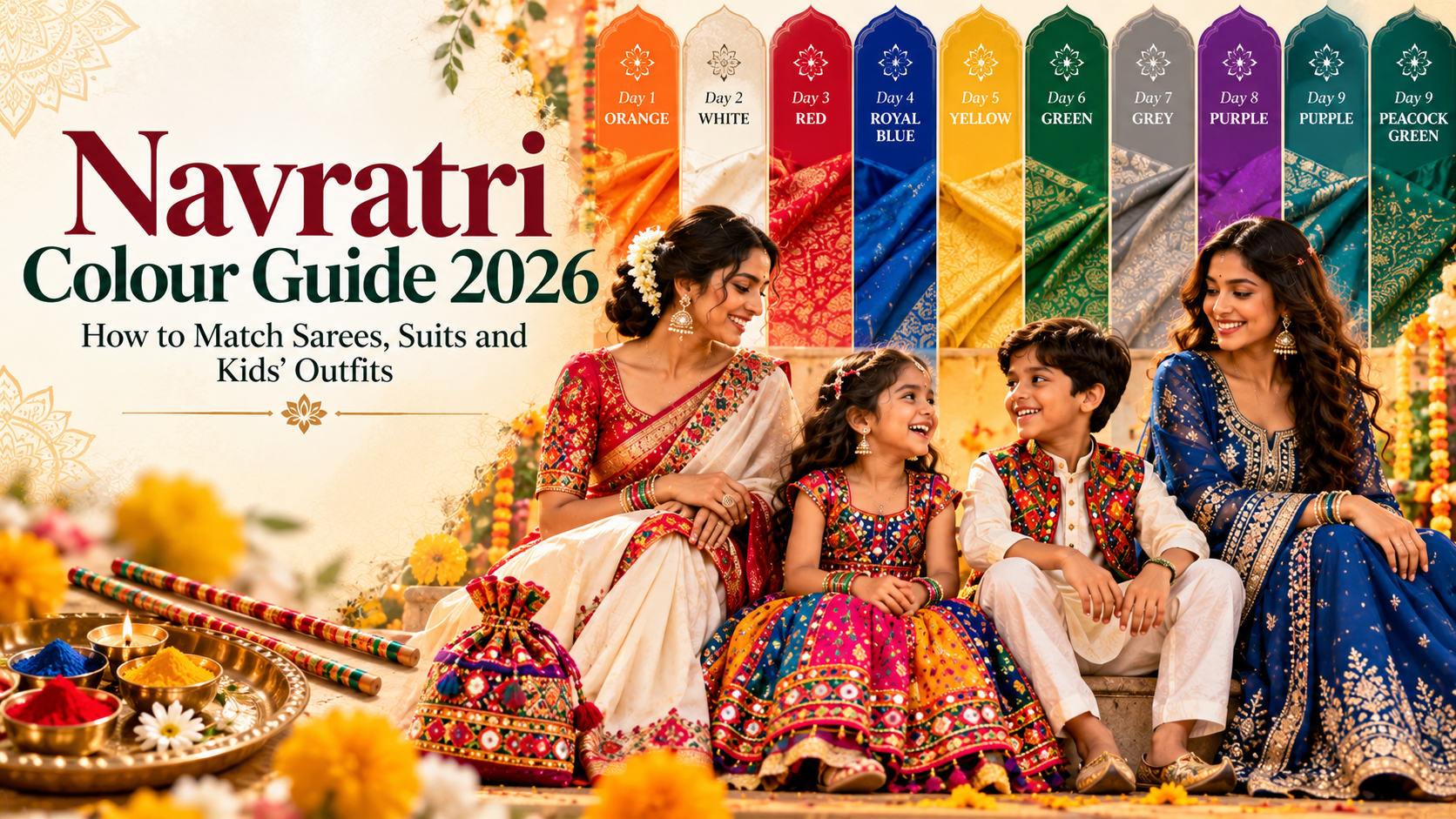
Every Navratri, the same question goes around the family group chat: what are we wearing today? Many households follow a colour for each of the nine days, and planning ahead makes the festival easier, because you can build a small wardrobe that works across several evenings instead of buying nine separate outfits. This guide explains the Navratri colours 2026, what they are traditionally linked with, and how to match sarees, suits and kids’ outfits without everyone looking identical.
One timing note first. Sharad Navratri 2026 began on Sunday, 11 October, and runs to Monday, 19 October, with Dussehra on Tuesday, 20 October, according to published panchang-based sources. If you are reading this during the festival, the days ahead are still planned below. If you are reading it afterwards, keep the table for next year’s planning, because the sequence changes with the starting weekday. For a wider set of looks, see our Navratri Outfit Ideas 2026 pillar page.
What Navratri Colours Mean
Navratri is a nine-night festival in honour of the goddess Durga in nine forms, known together as Navadurga. Wearing a particular colour each day is a popular modern tradition connected to the festival. It is not a religious requirement, and sources are clear on that point.
Two ideas help you understand it.
- The sequence changes every year. It depends on which weekday Navratri begins, so the same date can carry a different colour from one year to the next.
- It varies by region, community and family. Some households follow their own colour order, and many people do not follow a sequence at all. In Gujarat and parts of western India, coordinated colours for each night are especially popular for Garba, while other regions have different practices.
The meanings people attach to each colour, such as warmth for orange or purity for white, are popular associations and not fixed rules. Treat them as inspiration, and wear colours because they add to your celebration. The devotion at the centre of the festival does not depend on your outfit.
The Navratri Colours 2026, Day by Day
Navratri 2026 starts on a Sunday, so the commonly published sequence opens with orange. The list below follows widely published sources, including a Gulf News guide dated 30 September 2026. Regional dates and colours can differ, so check with your family, community or local panchang.
- Day 1, Sunday 11 October: orange
- Day 2, Monday 12 October: white
- Day 3, Tuesday 13 October: red
- Day 4, Wednesday 14 October: royal blue
- Day 5, Thursday 15 October: yellow
- Day 6, Friday 16 October: green
- Day 7, Saturday 17 October: grey
- Day 8, Sunday 18 October: purple
- Day 9, Monday 19 October: peacock green
These are the commonly followed 2026 colours, and not a universal schedule. Vijayadashami, the day after, is marked on 20 October in most sources, though dates can vary by region and location.
Matching Sarees, Suits and Kids’ Outfits by Colour
You can follow the day’s colour in three ways. Wear it head to toe, wear it as the main garment with a contrasting dupatta, or wear it as an accent through a dupatta, border or jewellery. The third option gives you the most flexibility if you do not want to buy something new each day.
Warm Shades: Orange, Red and Yellow
Orange, red and yellow suit puja and daytime gatherings, and they photograph well. A red saree is a classic choice for Day 3, in a cotton silk or georgette with a gold or contrast border. Pair an orange or yellow festive suit with a white or cream dupatta for a lighter look. For kids, a yellow kurta set or an orange lehenga choli in soft cotton works well in the daytime, and a plainer outfit stays easier to move in.
Cool Shades: White, Royal Blue and Green
White suits morning puja, and it is easy to dress up with a coloured border or dupatta. Royal blue and green work for both day and evening, and they pair well with gold jewellery. A green saree with a contrast border is a strong choice for Day 6. Kids’ outfits in white can be a good base for photographs, but pick a fabric that hides marks, and carry a spare.
Deeper Shades: Grey, Purple and Peacock Green
Grey is the trickiest colour for a festival. Pair a grey suit or saree with a bright dupatta, mirror work or colourful jewellery so it does not look flat. Purple and peacock green are rich and dramatic, and they suit evening Garba, particularly with silver or oxidised jewellery. For kids, a purple lehenga or a peacock green kurta set with a lighter accent keeps the look festive.
For more on the suit styles themselves, our guide to Navratri suits for women covers sharara, Anarkali and straight-cut options, and our Navratri saree ideas cover fabrics and draping.
Planning Table: Colours, Sarees, Suits and Kids’ Outfits
| Day and date | Colour | Saree idea | Women’s suit idea | Kids’ outfit idea |
| Day 1, 11 Oct | Orange | Orange cotton silk with a cream border | Orange suit with a white dupatta | Orange kurta set or frock |
| Day 2, 12 Oct | White | White cotton or chanderi with a coloured border | White straight-cut suit with a bright dupatta | White kurta pyjama or frock |
| Day 3, 13 Oct | Red | Red saree with a gold border | Red sharara with a plain dupatta | Red lehenga choli or kurta set |
| Day 4, 14 Oct | Royal blue | Blue silk blend with a contrast border | Blue palazzo suit with a printed dupatta | Blue kurta with a jacket |
| Day 5, 15 Oct | Yellow | Yellow cotton silk with a green border | Yellow Anarkali with a white dupatta | Yellow frock or kurta set |
| Day 6, 16 Oct | Green | Green saree with a gold or red border | Green suit with a bandhani dupatta | Green lehenga choli or kurta set |
| Day 7, 17 Oct | Grey | Grey saree with a bright blouse | Grey suit with a bright mirror work dupatta | Grey kurta with a coloured jacket or dupatta |
| Day 8, 18 Oct | Purple | Purple saree with silver detail | Purple sharara with a light dupatta | Purple lehenga choli or kurta set |
| Day 9, 19 Oct | Peacock green | Peacock green saree with a contrast border | Peacock green suit with a gold dupatta | Peacock green kurta set or frock |
Treat the table as a starting point. These are ideas, not rules, and fabrics and embellishments can change the feel of any colour.
Coordinating Family Outfits Without Matching Exactly
Matching family outfits look best when they feel related and not identical. A few simple approaches keep everyone comfortable.
- Share a palette, not a garment. Pick the colour of the day and let each person wear a different shade or style of it.
- Repeat a detail. Echo the dupatta colour, the border, the embroidery or the print across outfits.
- Balance bold and plain. If one adult wears a heavily embroidered outfit, keep the others simpler.
- Use a contrast. If an adult wears red, a child can wear a cream or mustard outfit that sits well beside it.
- Let comfort lead. Children rarely wear what is uncomfortable for long, so choose outfits they can move in. Our guide to Navratri outfits for kids covers fabrics, closures and fit for traditional kids’ outfits.
If someone in the family does not want to follow the colour, let them. A neutral outfit with a coloured dupatta or accessory keeps the group looking coordinated.
Colour Combinations for Puja, Garba and Dandiya
Daytime puja suits softer, lighter combinations: orange with cream, white with a coloured border, yellow with green, or a plain kurta with a bright dupatta. These feel calm and are easy to sit in.
Evening Garba and Dandiya reward bolder contrasts, such as red with green, royal blue with orange, purple with gold or peacock green with pink. Mirror work, bandhani and bright prints catch the light, and flared shapes suit the dance. Choose a lighter fabric so you can move comfortably.
For photographs, pick one anchor colour for the family and add contrast through dupattas and jewellery. Take pictures early in the evening, before outfits crease.
Accessories, Footwear and Contrasting Colours
Accessories are the easiest way to change a look without changing the outfit.
- Dupatta. A contrasting dupatta can change the feel of the same suit or kurta from one day to the next. Pin it so it stays put while dancing.
- Jewellery. Gold tones suit warm shades, and silver or oxidised pieces suit blue, purple, green and grey. Keep pieces light for dancing.
- Footwear. Flat juttis, kolhapuris or cushioned sandals work well. Some venues ask guests to leave footwear outside, so carry a small bag. Avoid high heels for Garba.
- Bags and bangles. A potli in a contrasting colour, or bangles in a complementary shade, add colour without extra weight.
- Contrasts. Orange and blue, yellow and purple, and red and green are classic pairings. Use a small amount of the contrasting colour, such as a border, a dupatta or earrings.
For children, keep accessories soft and secure, and avoid small detachable pieces for toddlers.
Frequently Asked Questions
What are the Navratri colours for 2026?
The commonly published sequence is orange, white, red, royal blue, yellow, green, grey, purple and peacock green, starting on Sunday, 11 October. Regional and family traditions can vary.
Why do the Navratri colours change every year?
The sequence depends on the weekday on which Navratri begins. A Sunday start opens with orange, and other starting days give a different order.
Do I have to wear the day’s colour?
No. Following the colours is a popular tradition and not a religious requirement. Wear them if they add to your celebration.
Which colours should I wear for puja and which for Garba?
Softer combinations such as white, yellow, orange and green suit daytime puja. Deeper or contrasting shades with mirror work or bright prints suit evening Garba and Dandiya.
Can I wear black during Navratri?
Black is not part of the commonly published sequence. Customs differ, and some families avoid it for puja, so check what is expected where you are.
How do I match my family’s outfits without wearing the same thing?
Choose the colour of the day as a shared palette, and vary the styles and shades. Repeat a detail such as a dupatta or border, and keep children’s outfits comfortable.
Conclusion
The Navratri colours 2026 follow the Sunday start, beginning with orange and ending with peacock green, but they remain a tradition people adapt to their own household. Use the list as a planning tool, build outfits around dupattas and accessories you can reuse, and let comfort and family custom guide your choices. If a day’s colour is not in your wardrobe, a coloured border or dupatta is enough.
