
Blog
Best Cotton Saree For Daily Wear

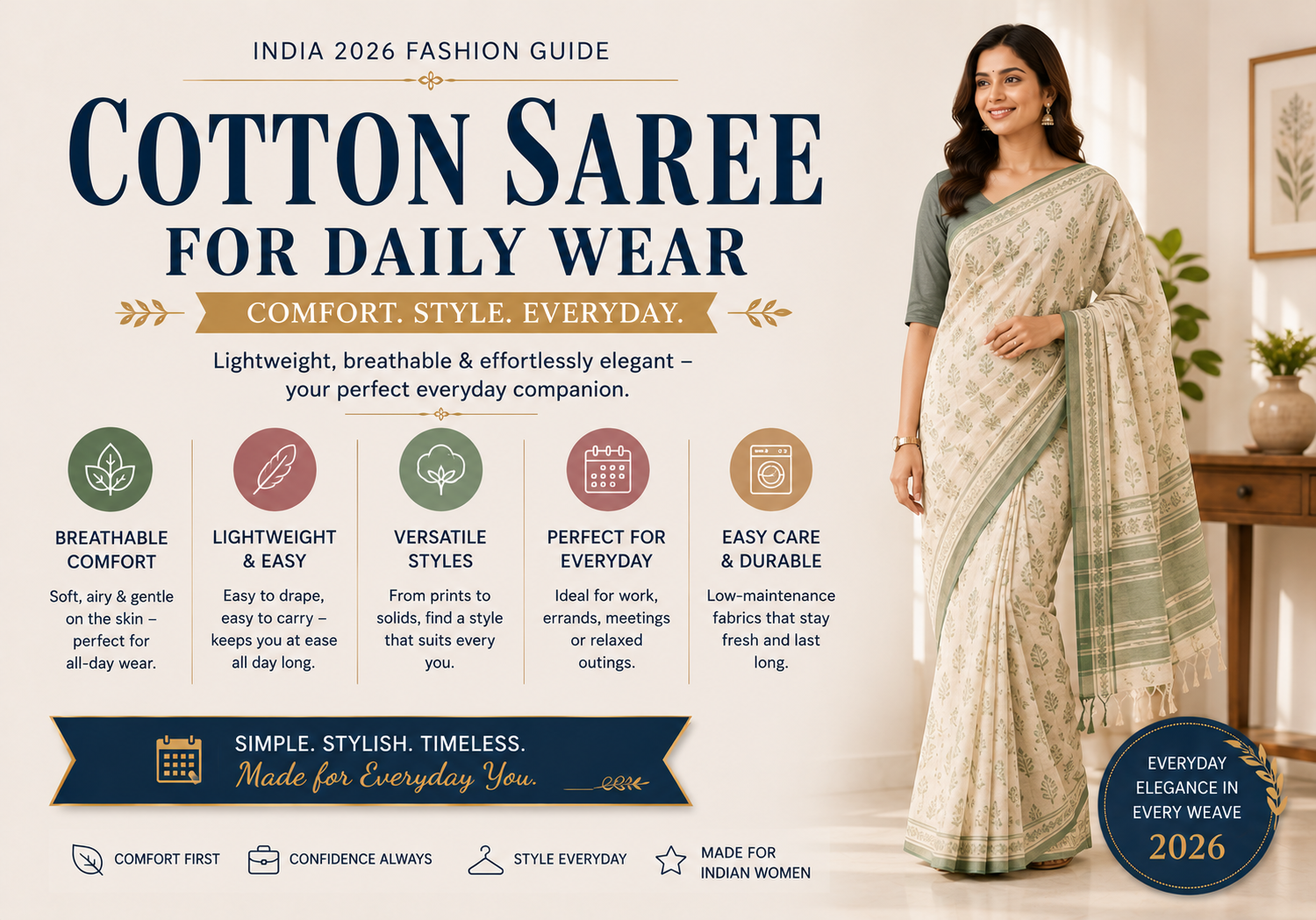
Cotton sarees are the most practical, breathable, and versatile sarees you can own for daily wear in India — and in 2026, they are also among the most fashionable. The best cotton fabrics for daily wear include Chanderi cotton, Kota Doria, Bengal cotton, Jamdani, Sambalpuri, Mangalagiri, and handloom block-printed cotton. When picking a daily wear cotton saree, prioritise breathability, easy draping, minimal maintenance, and a style that suits your lifestyle — whether you are a working professional, a homemaker, a student, or someone who simply wants to look elegant every single day without effort.
There is a particular kind of woman who understands the cotton saree. She is not dressing for an occasion — she is dressing for her day. She knows that elegance does not require heavy silk or elaborate embroidery. She knows that the right cotton saree, draped well and styled with intention, is one of the most sophisticated things she can wear anywhere in India at any time of year.
In 2026, that understanding has gone completely mainstream.
Cotton sarees have had an extraordinary resurgence — driven by a growing appreciation for handloom traditions, sustainable fashion, slow living, and the simple fact that nothing keeps you cooler, more comfortable, or more effortlessly elegant during an Indian summer than a beautifully woven cotton saree. Social media has amplified this shift dramatically, with handloom enthusiasts, working professionals, and fashion-forward women across India making the cotton saree a daily style staple rather than a compromise.
This guide tells you everything you need to know — the best cotton fabrics for daily wear, the styles that are trending in 2026, how to pick the right one for your lifestyle and body type, and how to care for it so it lasts for years.
Why Cotton Sarees Are the Best Choice for Daily Wear
| Reason | What It Means for Daily Wear |
|---|---|
| Breathability | Cotton allows air circulation, keeping you cool even at 40°C+ — essential for India’s climate |
| Moisture absorption | Absorbs sweat without clinging to the body — far more comfortable than synthetic fabrics all day |
| Easy maintenance | Most cotton sarees can be hand-washed or machine-washed — no dry-clean bills for daily wear |
| Lightweight | Weighs a fraction of silk or heavy embroidered sarees — comfortable to wear and carry for a full day |
| Durability | High-quality cotton sarees last for years and often decades with proper care |
| Drape versatility | Drapes in multiple styles — Nivi, Bengali, Gujarati — without complex technique |
| Price accessibility | Available from ₹300 to ₹10,000+ — the widest price range of any saree category |
| Skin friendliness | Natural fibre causes no allergies or skin irritation — ideal for sensitive skin and all-day wear |
| Sustainability | Natural, biodegradable, supports Indian handloom weavers — aligns with 2026 sustainable fashion values |
| Occasion flexibility | Styles range from casual daily wear to semi-formal office and festival wear |
Best Cotton Saree Fabrics for Daily Wear: Complete Guide
Not all cotton is the same. The weave, the thread count, the region of origin, and the finishing technique create dramatically different fabrics that suit different lifestyles, climates, and occasions. Here is everything you need to know about each major cotton saree fabric.
1. Chanderi Cotton Saree
What it is: Chanderi is woven in Chanderi, Madhya Pradesh, using a silk warp with a cotton weft — creating a fabric that has the breathability of cotton with a subtle silken sheen. It is feather-light, slightly translucent, and features woven bootis (small traditional motifs) in the body. Chanderi cotton is GI-protected since 2005 and represents over five hundred years of continuous weaving tradition.
✔ Best For
- Office and professional daily wear
- Semi-formal daily occasions
- Summer and warm weather all year
- Women who want a slightly dressy daily saree
- First-time daily saree wearers — easy to drape
✘ Not Ideal For
- Very physically active or outdoor daily tasks
- Machine washing — needs gentle hand wash
- Women who prefer fully opaque fabric
Key Facts: Weight — very light (under 400g). Transparency — slightly sheer. Drape — excellent, falls beautifully. Price range — ₹800 to ₹25,000. Care — gentle hand wash in cold water, dry in shade. GI Protected — Yes, since 2005.
Styling Tip: A pastel or jewel-toned Chanderi cotton saree with woven bootis, paired with a short matching blouse and simple gold studs, is one of the most effortlessly elegant daily wear saree looks possible. It requires almost no styling effort and reads as polished and intentional immediately.
2. Kota Doria Cotton Saree
What it is: Kota Doria is woven in Kota, Rajasthan, using a distinctive square check weave pattern (called khat) created by alternating cotton and silk threads. The result is an extraordinarily lightweight, crisp fabric with a subtle texture and a characteristic translucency. It is one of the lightest sarees in India and considered among the most comfortable for extreme summer heat. Kota Doria is GI-protected since 2005.
✔ Best For
- Extreme summer heat — the most breathable daily saree
- Rajasthan, Gujarat, and hot-climate regions
- Women who prioritise maximum comfort over structure
- Daily casual and semi-formal wear
- Travel sarees — extremely light and compact to pack
✘ Not Ideal For
- Cooler climates — very thin fabric offers no warmth
- Women who prefer opaque, structured sarees
- Very formal occasions — too casual in appearance
Key Facts: Weight — extremely light (lightest cotton saree available). Transparency — semi-sheer (wear a matching slip). Drape — very easy, flows naturally. Price range — ₹600 to ₹8,000. Care — gentle hand wash, dry flat in shade. GI Protected — Yes, since 2005.
Styling Tip: Because Kota Doria is semi-transparent, always wear a matching full-length slip or petticoat underneath. The characteristic khat (square) texture of Kota Doria is its most identifiable feature — let it do the talking with a simple blouse and minimal jewellery. Block-printed Kota Doria in indigo or natural dyes is particularly stunning for daily wear in 2026.
3. Bengal Cotton Saree (Tant Saree)
What it is: Bengal cotton sarees — locally called Tant sarees — are woven on traditional fly-shuttle looms by weavers across West Bengal. They are made from pure cotton and are known for their fine, crisp weave, lightweight body, and characteristic broad contrast borders. The motifs are drawn from nature — fish, conch shells, paisleys — and are woven directly into the fabric. Tant sarees are the everyday saree of Bengal and are worn by women across all ages and walks of life.
✔ Best For
- True daily wear — the most authentic everyday cotton saree
- Women in humid, hot climates — especially eastern India
- Home wear and casual daily tasks
- Women who want traditional Bengali weave patterns
- Budget-conscious daily wear — excellent value
✘ Not Ideal For
- Very formal office environments
- Festive or wedding occasions — too casual in plain versions
- Women who prefer very structured, stiff drape
Key Facts: Weight — light to medium. Transparency — mostly opaque. Drape — relaxed and flowing. Price range — ₹300 to ₹5,000. Care — machine washable on gentle cycle or hand wash. GI Protected — Yes (Tant saree, 2008).
Styling Tip: The broad contrast border of a Bengal Tant saree is its signature — choose a saree where the border colour is bold and distinct from the body. A white body with a deep red or black border, paired with a matching red or black blouse, is a timeless daily wear combination that looks elegant at every age.
4. Jamdani Cotton Saree
What it is: Jamdani is one of the finest and most ancient handloom traditions in the world — a UNESCO Intangible Cultural Heritage. Woven primarily in Dhaka (Bangladesh) and West Bengal, Jamdani sarees are made from very fine cotton muslin with supplementary weft patterns — intricate geometric and floral motifs created by weaving additional threads into the fabric. The result is a delicate, translucent saree with designs that appear to float on the fabric surface.
✔ Best For
- Women who want a premium daily wear saree
- Office and professional daily wear — reads as refined
- Special daily occasions — meetings, celebrations, events
- Saree collectors and handloom enthusiasts
- Hot and humid climates — very breathable
✘ Not Ideal For
- Budget-conscious daily wear — genuine Jamdani is expensive
- Very rough or physically demanding daily tasks
- Machine washing — requires careful hand washing only
Key Facts: Weight — very light. Transparency — sheer to semi-sheer. Drape — extremely elegant, flows beautifully. Price range — ₹3,000 to ₹50,000+. Care — very gentle hand wash or dry clean for premium pieces. UNESCO Heritage — Yes.
Styling Tip: Genuine Jamdani sarees deserve simple, understated styling — the weave itself is the luxury. Pair a white or ivory Jamdani with a contrasting border and a plain blouse in a deep complementary colour. Let the motifs speak. Avoid heavy embellished blouses or elaborate jewellery — they compete with the delicacy of the weave.
5. Mangalagiri Cotton Saree
What it is: Mangalagiri sarees are woven in Mangalagiri, Andhra Pradesh, and are known for their characteristic striped or checked patterns woven using a nizam border technique — a distinctive gold or silver zari line running along the border. They are made from pure cotton, are medium-weight, have a beautiful natural lustre, and drape very cleanly. Mangalagiri cotton is a GI-protected fabric and is beloved across South India for daily and semi-formal wear.
✔ Best For
- Office and daily professional wear — structured and polished
- South Indian daily wear traditions
- Women who want a slightly formal daily saree
- Year-round wear — medium weight suits most seasons
- Women who prefer a saree with natural structure and crispness
✘ Not Ideal For
- Extreme summer heat in dry climates — medium weight can feel warm
- Very casual or home wear occasions
- Women who prefer very soft, fluid drape
Key Facts: Weight — medium. Transparency — opaque. Drape — clean and structured. Price range — ₹500 to ₹6,000. Care — gentle machine wash or hand wash. GI Protected — Yes.
Styling Tip: Mangalagiri sarees in dual-tone combinations — a body in one colour and a contrast zari-bordered border — are the most versatile for daily wear. Pair with a matching plain blouse or a blouse in the same colour as the border for a cohesive, polished look. The natural crispness of Mangalagiri cotton means it holds the drape all day without constant readjustment.
6. Sambalpuri Cotton Saree
What it is: Sambalpuri sarees are woven in Sambalpur and surrounding districts of Odisha using the traditional ikat (bandha) technique — where threads are tie-dyed before weaving so the pattern emerges naturally during the weaving process. The result is a characteristic blurred, vibrant pattern that cannot be replicated by printing. Sambalpuri sarees are made in both silk and cotton versions — the cotton versions are ideal for daily wear. GI-protected since 2010.
✔ Best For
- Women who love bold, colourful patterns for daily wear
- Office and semi-formal daily wear
- Eastern and central India daily wear traditions
- Handloom enthusiasts who want authentic ikat weave
- Year-round daily wear — medium weight suits most seasons
✘ Not Ideal For
- Women who prefer minimal, subtle prints for daily wear
- Very casual home wear — the vibrant patterns deserve to be seen
Key Facts: Weight — medium. Transparency — opaque. Drape — good structure with natural flow. Price range — ₹800 to ₹12,000. Care — gentle hand wash, first wash separately to check colour fastness. GI Protected — Yes, since 2010.
Styling Tip: The ikat pattern of a Sambalpuri saree is naturally eye-catching — keep the rest of the outfit very simple. A plain blouse in one of the dominant colours of the saree, minimal jewellery, and simple sandals is all you need. The saree does all the work.
7. Block-Printed Cotton Saree
What it is: Block-printed cotton sarees are not from a single weaving tradition but represent a printing technique applied to cotton fabric — using hand-carved wooden blocks dipped in natural or chemical dyes to create repeating patterns across the saree. The most celebrated block-print traditions include Bagru (Rajasthan), Dabu printing (Rajasthan), Kalamkari (Andhra Pradesh and Telangana), and Ajrakh (Gujarat and Sindh). Each tradition has its own distinctive colour palette, motifs, and printing technique.
✔ Best For
- Casual and bohemian daily wear styling
- Women who want artistic, handcrafted daily sarees
- Summer and all-season daily wear
- Sustainable fashion lovers — natural dye block prints especially
- Budget-friendly daily saree options — wide price range
- Young women and those building their first saree wardrobe
✘ Not Ideal For
- Very formal office environments — too artistic in feel
- Grand festive occasions — too casual in appearance
- Women who prefer solid or minimal-print daily wear
Key Facts: Weight — light to medium (depends on base cotton). Transparency — mostly opaque. Drape — good for soft cotton bases. Price range — ₹400 to ₹8,000. Care — cold hand wash, first wash separately, dry in shade. Most affordable everyday option.
Styling Tip: Natural dye block-printed sarees in indigo, terracotta, madder red, and earthy tones are the defining daily wear aesthetic of 2026. Pair with a plain blouse in the dominant background colour of the saree. Wear with terracotta or natural-material jewellery — wooden beads, terracotta earrings, or simple brass jewellery — for a completely cohesive, handcrafted look.
Cotton Saree Fabrics: Complete Comparison for Daily Wear
| Fabric | Weight | Breathability | Drape | Maintenance | Price Range | Best Season |
|---|---|---|---|---|---|---|
| Chanderi Cotton | Very light | Excellent | Flowing, slightly sheer | Gentle hand wash | ₹800–₹25,000 | All year |
| Kota Doria | Extremely light | Best in class | Very fluid, semi-sheer | Gentle hand wash | ₹600–₹8,000 | Summer |
| Bengal Tant | Light | Excellent | Relaxed and flowing | Machine washable | ₹300–₹5,000 | All year |
| Jamdani | Very light | Excellent | Elegant, fluid | Gentle hand wash only | ₹3,000–₹50,000+ | All year |
| Mangalagiri | Medium | Good | Structured and crisp | Machine or hand wash | ₹500–₹6,000 | All year |
| Sambalpuri Cotton | Medium | Good | Good structure | Gentle hand wash | ₹800–₹12,000 | All year |
| Block-Print Cotton | Light–medium | Good–excellent | Soft and natural | Cold hand wash | ₹400–₹8,000 | All year |
Cotton Saree Trends for Daily Wear in 2026
In 2026, the cotton saree is not just a practical choice — it is a fashion statement. Here are the six biggest trends defining how Indian women are wearing cotton sarees every day this year.
✦
Natural Dye Cotton Sarees
Sarees dyed with plant-based natural dyes — indigo, madder, turmeric, pomegranate rind, and iron-mud — are the defining daily wear aesthetic of 2026. The colours are soft, earthy, and uniquely beautiful in a way synthetic dyes cannot replicate. Brands and weavers across Rajasthan, Gujarat, and Bengal are reviving natural dye traditions to meet surging demand.
✦
Minimal Handloom Cotton for Office Wear
Working women across Indian cities are increasingly choosing solid or subtly patterned handloom cotton sarees as their daily office outfit. The trend is clean, structured, and polished — a Mangalagiri or Chanderi cotton saree in a single colour or thin stripe, paired with a crisp matching blouse, has become a sophisticated alternative to formal Western office wear.
✦
Block-Print Cotttons in Earthy Tones
Bagru, Dabu, and Ajrakh block-print cotton sarees in terracotta, rust, sage green, natural white, and indigo are dominating daily wear feeds in 2026. The handcrafted, imperfect beauty of block printing — no two sarees are exactly the same — resonates deeply with the slow fashion movement that has taken root among conscious Indian consumers.
✦
Contrast Blouse Pairings
In 2026, the blouse is as important as the saree in daily wear styling. Deep contrast blouses — a mustard saree with a navy blouse, an ivory saree with a forest green blouse — have replaced the safe same-colour-matching approach. The contrast blouse adds visual interest to a simple cotton saree and gives it a fashion-forward edge without any additional effort.
✦
Drape Experimentation
Women wearing cotton sarees daily are experimenting with drape styles beyond the standard Nivi. The Bengali drape (pallu over both shoulders), the Gujarati drape (pallu in front), and the seedha pallu drape are all gaining popularity in 2026 as women look for ways to make their daily cotton saree look distinct and personal. Lightweight cotton fabrics enable these experiments far more easily than heavier silk sarees.
✦
Handloom Heritage Appreciation
The #VocalForLocal and #HandloomIndia movements that began post-2020 have matured into a genuine lifestyle shift by 2026. Consumers are actively seeking out GI-tagged handloom cotton sarees, understanding the weaving traditions behind them, and choosing them as an act of cultural pride and economic support for India’s weaving communities. The daily cotton saree has become a statement of values, not just aesthetics.
How to Pick the Right Daily Wear Cotton Saree in 2026
With so many beautiful options available, choosing the right cotton saree for your daily life comes down to five key decisions. Answer these honestly and the right saree will become obvious.
1
Match the fabric to your climate and season first.
This is the most important and most overlooked decision. If you live in a hot, humid city like Chennai, Kolkata, or Mumbai, choose the lightest cotton available — Kota Doria or Bengal Tant. If you live in a drier, hotter climate like Rajasthan or interior Maharashtra, Chanderi cotton or block-printed cotton are ideal. If you experience all four seasons, invest in a range — lighter weights for summer, slightly heavier Mangalagiri or Sambalpuri for cooler months. Wearing the wrong fabric weight for your climate will make even the most beautiful saree feel like a burden by noon.
2
Choose a style that matches your daily lifestyle honestly.
Be realistic about how you spend your day. If you sit at a desk in an air-conditioned office, a slightly more structured Mangalagiri or Chanderi works beautifully. If you are on your feet all day — teaching, housework, outdoor work — choose the most lightweight, wash-friendly option like Bengal Tant or a block-print cotton in a dark colour that hides daily wear. If you meet people socially all day, invest in a slightly dressy Chanderi or Jamdani that reads as polished without any additional effort.
3
Prioritise easy maintenance for a truly daily saree.
A daily wear saree must be washable without anxiety. Before buying, always ask — or check — whether the saree can be machine-washed on a gentle cycle, or at minimum hand-washed easily at home. If a saree requires dry cleaning, it is not a true daily wear option regardless of how beautiful it is. Bengal Tant and most block-print cotton sarees are the most machine-friendly. Chanderi, Kota Doria, and Jamdani need gentle hand washing. Sambalpuri and Mangalagiri can usually be hand-washed at home without issue.
4
Build a colour rotation for daily wear — not just a single saree.
A functional daily saree wardrobe has at least five to seven sarees in rotation so that you are not washing and re-wearing the same saree repeatedly, which accelerates wear. Choose a range of colours that work together with two or three versatile blouses — you do not need a dedicated blouse for every saree. For example, a deep navy blouse, a natural white blouse, and a terracotta blouse can cover most earthy-toned daily cotton sarees without needing individual matched blouses for each.
5
Always check the border quality and colour fastness before buying.
In a daily wear cotton saree, the border takes the most handling — it is where the saree is gripped, tucked, and adjusted throughout the day. Check that the border stitching is even and secure, and that the border colour will not bleed into the body after washing. For handloom sarees with woven borders, check that the weave is tight and will not fray with regular washing. Run a damp white cloth over the border before purchasing to check for colour bleed — a small test that can save you from a significant disappointment.
Best Cotton Saree Styles for Every Body Type
| Body Type | Best Cotton Fabric | Best Print / Pattern | Border Width | Styling Tip |
|---|---|---|---|---|
| Petite (below 5’3″) | Chanderi cotton, Kota Doria | Small motifs, vertical stripes | Narrow to medium | Pair with heeled sandals, keep the pallu neat and short. Single-colour sarees elongate best. |
| Tall and Slim | Mangalagiri, Sambalpuri, block-print | Bold ikat, large block prints | Wide and prominent | Go for bold patterns and wide borders. Heavy block-print and ikat add visual presence to a lean frame. |
| Curvy (Hourglass) | Chanderi cotton, Kota Doria, Jamdani | Solid colour or tone-on-tone | Contrast border | Fluid fabrics that drape over curves are most flattering. Solid or minimal-print cotton highlights the silhouette naturally. |
| Athletic / Rectangular | Block-print cotton, Sambalpuri | Bold, all-over print | Wide and decorative | Bold prints and wide borders add feminine volume. Pair with an embellished or statement blouse to add structure at the shoulder. |
| Plus Size | Mangalagiri, Bengal Tant, Chanderi | Vertical stripes, small motifs | Medium contrast border | Choose dark or medium tones for the body with a lighter or contrasting border. Vertical patterns elongate. Avoid very wide horizontal borders. |
Cotton Saree Occasion Guide for Daily Wear
| Daily Occasion | Best Cotton Type | Recommended Style | Accessories |
|---|---|---|---|
| Office / professional setting | Chanderi cotton or Mangalagiri | Solid or subtle stripe, crisp drape | Simple gold studs, structured bag, block heels |
| Home and daily household | Bengal Tant or block-print cotton | Easy-wash, comfortable drape | Minimal — simple bindi, light bangles |
| Casual outdoor outing | Block-print cotton or Kota Doria | Printed or colourful, easy drape | Kolhapuri sandals, oxidised earrings, cloth bag |
| School / college teaching | Mangalagiri or Bengal Tant | Neat, structured, easy to move in | Simple chain, stud earrings, comfortable flats |
| Religious ceremony / temple | Jamdani, Chanderi, or Bengal Tant | Traditional drape, contrast border | Gold bangles, bindi, simple jewellery |
| Market / daily errands | Block-print cotton or Tant | Dark or printed — practical colours | Minimal — functional and comfortable |
| Casual social gathering | Chanderi cotton or Sambalpuri | Slightly dressy, beautiful print | Jhumkas, thin necklace, embroidered juttis |
| Summer travel | Kota Doria or Chanderi cotton | Light, compact, wrinkle-resistant | Minimal — practical and light |
How to Care for Your Daily Wear Cotton Saree
| Care Step | Chanderi / Kota / Jamdani | Bengal Tant / Mangalagiri | Block-Print / Sambalpuri |
|---|---|---|---|
| Washing method | Gentle hand wash only | Gentle machine wash or hand wash | Cold hand wash |
| Water temperature | Cold water only | Cold to lukewarm | Cold water only |
| Detergent | Mild liquid detergent or reetha powder | Mild detergent or saree-specific wash | Mild liquid — harsh detergent fades natural dyes |
| First wash | Wash separately — slight colour release possible | Wash separately first time | Always first wash separately — natural dyes may run |
| Wringing | Never — gently press water out | Never — roll in towel to absorb water | Never wring — gently squeeze |
| Drying | Flat in shade — never direct sun | Flat or hang in shade | Flat in shade — sun fades natural dyes |
| Ironing | Low heat, slightly damp, reverse side | Medium heat, slightly damp | Low heat on reverse side only |
| Storage | Folded in cotton muslin, re-fold every 3 months | Folded in cotton cloth | Folded in cotton cloth, away from direct light |
Universal Cotton Care Tip: Never use fabric softener on handloom cotton sarees — it breaks down the natural fibre structure over time and can cause the weave to loosen. A teaspoon of white vinegar added to the final rinse water instead will keep cotton fibres soft, fresh, and colour-bright naturally. This is a traditional care practice that genuinely works and costs almost nothing.
Cotton Saree Price Guide for Daily Wear 2026
| Budget Level | Price Range | Best Options | What to Expect |
|---|---|---|---|
| Entry level | ₹300 – ₹800 | Bengal Tant, plain block-print cotton | Basic weave, limited colour options, machine-friendly |
| Mid-range daily | ₹800 – ₹3,000 | Chanderi cotton, Kota Doria, Mangalagiri, Sambalpuri | Good quality handloom, wider colour and print range, excellent daily wear value |
| Premium daily | ₹3,000 – ₹8,000 | Fine Chanderi, natural dye block-print, quality Jamdani | Artisan-made, natural dyes, heirloom-quality weave, investment in craft |
| Collector grade | ₹8,000+ | Genuine fine Jamdani, master weaver Sambalpuri, rare Chanderi | Museum-quality handloom, UNESCO heritage weaves, significant craft investment |
| Be suspicious if below | Below ₹300 for any handloom claim | — | At under ₹300, genuine handloom cotton is not possible — likely mill-made imitation |
Best Value for Daily Wear in 2026: The ₹800 – ₹2,500 range offers the best combination of quality, variety, and daily wearability. A Chanderi cotton saree in this range from a reputable handloom store or government emporium will give you beautiful daily wear that lasts for years, drapes effortlessly, and feels extraordinary to wear — for less than the cost of most synthetic alternatives.
Frequently Asked Questions
Which cotton saree is best for daily wear in summer?
Kota Doria is the single best cotton saree for extreme summer heat — it is the lightest and most breathable cotton saree available. Chanderi cotton is the second best option, offering a beautiful balance of lightness and elegance. Both allow maximum air circulation and are comfortable even above 40°C. For humid coastal cities, Bengal Tant is also an excellent summer daily wear choice because of its light weight and complete machine-washability.
Can cotton sarees be worn to a professional office setting?
Absolutely — and increasingly, they are the preferred choice for professional Indian women who want ethnic daily wear. A Chanderi cotton or Mangalagiri saree in a solid colour or subtle stripe, draped neatly in the Nivi style and paired with a well-fitted blouse, looks completely professional and polished. The key is choosing the right fabric weight and print — avoid very casual prints like large block florals or very bright, busy patterns for formal office environments.
How do I prevent a cotton saree from looking dull after washing?
Three practices make the biggest difference. First, always wash in cold water — hot water fades cotton faster than anything else. Second, add a teaspoon of white vinegar to the final rinse water — it brightens colours naturally and prevents dullness. Third, dry in shade rather than direct sunlight — UV exposure is the primary cause of colour fading in cotton sarees. Follow these three practices consistently and your cotton sarees will hold their colour for years.
What is the difference between Chanderi silk and Chanderi cotton?
Both are woven in Chanderi, Madhya Pradesh, and both use a silk warp thread. The difference is in the weft — Chanderi cotton uses a cotton weft thread, while Chanderi silk uses a silk weft. The result is that Chanderi cotton is more breathable, slightly more matte in finish, and more practical for daily wear and regular washing. Chanderi silk has a brighter sheen, a slightly richer feel, and is better suited for festive and semi-formal occasions. For daily wear, Chanderi cotton is the more practical and equally beautiful choice.
How many cotton sarees should I have for a daily wear rotation?
A functional daily wear cotton saree rotation has a minimum of five sarees and ideally seven to ten. This allows each saree to rest and be washed properly between wears — washing and re-wearing the same saree daily degrades the fabric significantly faster. With five sarees, you have a different saree for each workday without repetition. With seven, you have a full week’s rotation. Invest in a range of weights for different seasons and a range of colours that share two or three common blouses for maximum wardrobe flexibility.
Final Thoughts
A daily cotton saree is not a compromise.
It is a choice — a deliberate, beautiful, deeply Indian choice
to wear something that has clothed generations of women
with grace, comfort, and quiet, extraordinary dignity.
In 2026, the cotton saree for daily wear is having its moment — not because it is new, but because the world has caught up to what Indian women have always known. That breathable natural fabric, handwoven with craft that took years to learn, worn with a simple blouse and a confident drape, is one of the most beautiful things a woman can put on in the morning.
Choose your fabric thoughtfully. Care for it well. Build your rotation slowly and deliberately. And wear your cotton saree every day — not as a tradition you are maintaining, but as a joy you are choosing.
At Mahavir Cloth Center, our cotton saree collection spans every weaving tradition, every fabric weight, every occasion, and every budget — because every woman deserves a daily saree that she genuinely loves to wear.
Visit Us & Explore the Collection →
Explore our full range of Sarees, Kurta Suit Sets, Sharara Sets, and Kids Ethnic Wear at mahavirclothcenter.com.