Blog
Straight kurta vs Anarkali kurta: which silhouette suits which body type?

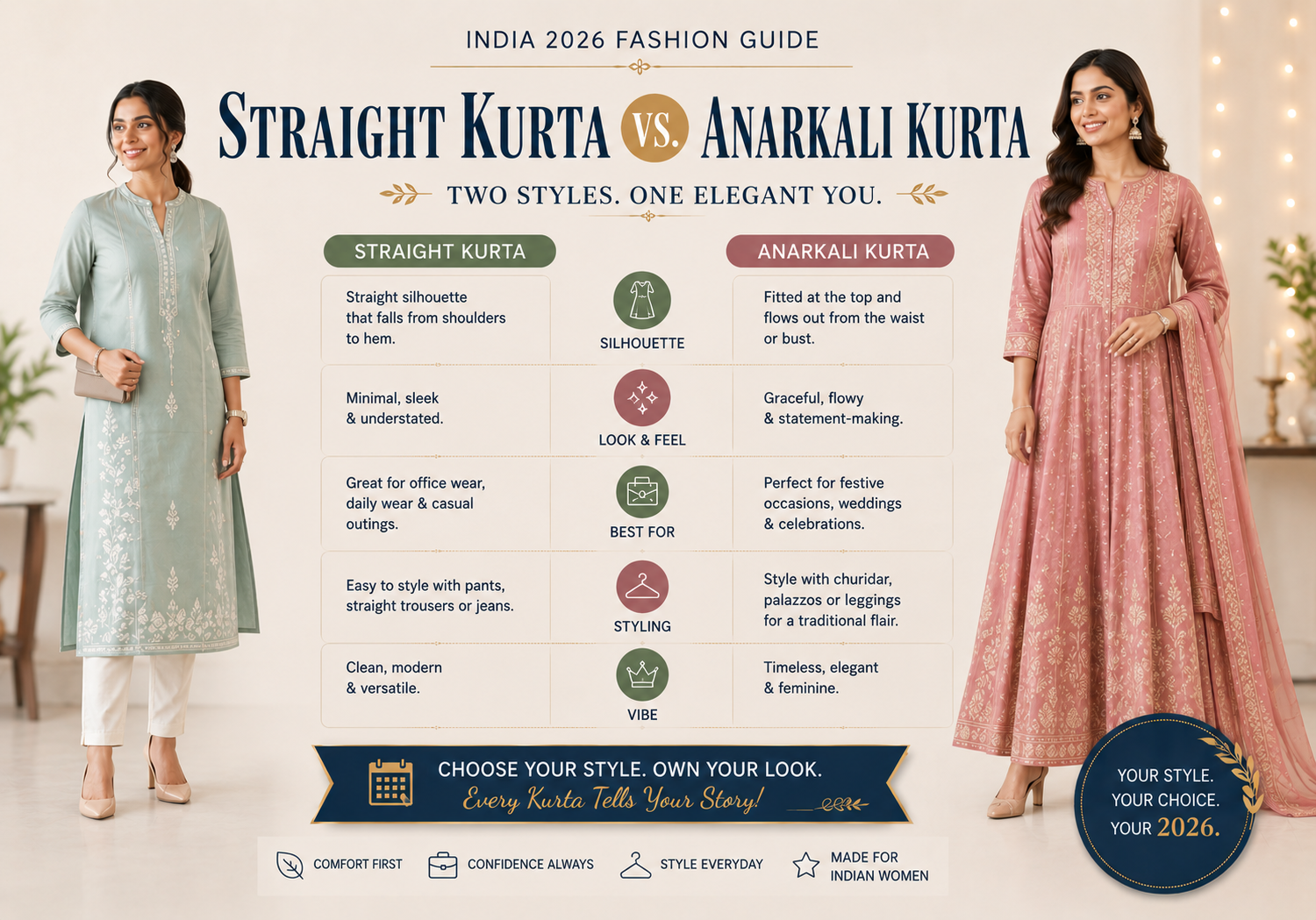
Walk into any ethnic wear store in India — or scroll through any online collection — and you will be confronted with these two silhouettes more than any other. The straight kurta. The Anarkali kurta. Both are kurtas, both are deeply traditional, and both are extraordinarily beautiful in their own right.
But they are not interchangeable.
The difference between wearing a silhouette that flatters your body and wearing one that does not is not subtle — it is visible, it is immediate, and it makes the difference between looking like you stepped out of a magazine and looking like you are wearing someone else's outfit. Understanding your silhouette and matching it to the right kurta style is one of the most valuable things you can know about ethnic fashion.
This guide covers both silhouettes in complete detail — what they are, where they come from, who they flatter, how to wear them for each occasion, and exactly which one you should choose for your body type and lifestyle.
Straight Kurta vs Anarkali Kurta: At a Glance
| Feature | Straight Kurta | Anarkali Kurta |
|---|---|---|
| Silhouette | Straight, structured, falls flat from shoulder to hem | Fitted bodice with dramatically flared skirt-like bottom |
| Length | Hip-length to calf-length | Knee-length to floor-length |
| Origin | Modern Indian ethnic wear evolution | Mughal-era court fashion, named after Anarkali |
| Silhouette effect | Slimming, elongating, structured | Feminine, flowing, dramatically graceful |
| Best body type | Tall, athletic, plus-size, rectangular | Petite, curvy, hourglass |
| Best occasion | Office, casual, daily wear, semi-formal | Weddings, festivals, formal events, celebrations |
| Paired bottom | Straight pants, churidar, palazzo, leggings | Churidar, leggings, or worn alone as a dress |
| Fabric range | Cotton, linen, georgette, silk, rayon | Georgette, silk, net, velvet, chiffon |
| Embellishment level | Minimal to moderate | Moderate to heavily embellished |
| Ease of movement | Very easy — unrestricted | Graceful but requires some practice |
| Dupatta | Optional | Almost always recommended |
| Price range | ₹400 – ₹15,000 | ₹1,200 – ₹40,000+ |
The Straight Kurta: Everything You Need to Know
A straight kurta is a kurta cut with a clean, vertical silhouette that falls straight from the shoulders to the hem with little to no flare. It creates a long, unbroken vertical line from top to bottom — which is why it is so consistently flattering and so widely worn. It can be hip-length, knee-length, or calf-length, and is the most versatile and occasion-agnostic kurta silhouette available. It is the kurta equivalent of a well-cut blazer — it works almost everywhere, for almost everyone.
- The most universally wearable kurta silhouette
- Exceptionally comfortable for all-day wear
- Works perfectly in professional and office settings
- Very easy to pair with any bottom — pants, palazzo, leggings
- Available in every fabric, print, and price range
- Creates a slimming, elongating vertical line
- Can be dressed up or down with accessories
- Less dramatic — not the first choice for grand formal events
- Very plain versions can look flat on petite frames
- Needs the right bottom pairing to look balanced
- Does not create the dramatic feminine flare of an Anarkali
- May feel too casual for very grand bridal or wedding occasions
| Straight Kurta Style | Best Fabric | Best Paired With | Best Occasion |
|---|---|---|---|
| Classic straight with embroidery | Cotton, silk cotton | Straight churidar or leggings | Office, daily wear, family gatherings |
| Printed straight kurta | Rayon, georgette | Palazzo or solid straight pants | Casual outings, travel, festivals |
| Embellished straight kurta | Georgette, chanderi | Churidar or slim pants | Semi-formal events, Diwali, Eid |
| Asymmetric or high-low | Crepe, cotton blend | Dhoti pants, slim trousers | Contemporary fashion events, college |
| Long straight (knee-calf) | Silk, chanderi | Churidar, straight pants | Weddings as guest, formal functions |
The Anarkali Kurta: Everything You Need to Know
An Anarkali kurta is named after the legendary Mughal court dancer Anarkali, whose costume — a fitted bodice with a dramatically flared, flowing skirt — became the template for this iconic silhouette. A true Anarkali has a fitted or semi-fitted upper section (from shoulder to hip or waist) that then flares outward in a wide, sweeping circle or arc, creating a silhouette that is simultaneously structured at the top and dramatically flowing at the bottom. It is the most feminine, graceful, and visually commanding kurta silhouette in Indian ethnic wear.
- The most dramatically beautiful kurta silhouette
- Hides the hip and thigh area completely — very forgiving
- Creates an hourglass illusion through the fitted bodice and flared skirt
- Adds height and elegance to petite frames
- Photographs exceptionally well — always looks grand
- Works as a standalone outfit without a separate bottom
- The most occasion-appropriate kurta for weddings and formal events
- Too formal and grand for everyday or office wear
- Can add visual bulk to plus-size women if the wrong fabric is chosen
- Floor-length versions require heels and careful walking
- Heavy versions can be warm and restrictive in summer
- More expensive than straight kurtas at equivalent quality levels
| Anarkali Style | Best Fabric | Best Paired With | Best Occasion |
|---|---|---|---|
| Floor-length classic Anarkali | Silk, velvet, heavy georgette | Churidar, worn alone | Weddings, grand formal events |
| Midi Anarkali | Georgette, chanderi, cotton | Churidar or slim leggings | Festivals, semi-formal, family functions |
| Printed Anarkali | Georgette, chiffon, rayon | Slim leggings or churidar | Casual to semi-formal occasions |
| Embroidered Anarkali | Net, silk, organza | Churidar, worn as a dress | Weddings, receptions, Diwali parties |
| Jacket Anarkali | Georgette + brocade jacket | Churidar, slim pants | Weddings, reception, Eid |
| Double-layer / sheer Anarkali | Chiffon over silk or satin | Churidar, worn alone | Evening events, receptions, sangeet |
Which Silhouette Suits Which Body Type?
This is the core question — and the answer is more nuanced than simply saying one silhouette is universally better. Both work across body types when styled correctly. The key is understanding what each silhouette does to your proportions, and choosing accordingly.
Petite Women (Below 5'3")
| ✔ What Works for Petite Women | ✘ What to Avoid |
|---|---|
| Hip-length straight kurta with vertical prints or embroidery | Very long calf-length straight kurta that shortens legs |
| Midi Anarkali (falls to mid-calf) with a fitted bodice | Floor-length Anarkali with excessive fabric volume |
| Small, delicate motifs on both silhouettes | Large, oversized prints or heavily embellished lower halves |
| Anarkali with a deep V-neck or elongated neckline | High necklines that shorten the upper torso |
| Heeled footwear with both silhouettes | Flat footwear with long or heavy kurtas |
| Single-colour or tonal outfits that create one long line | Heavy contrast between top and bottom that cuts the body in half |
Tall and Slim Women (Above 5'6")
| ✔ What Works for Tall and Slim Women | ✘ What to Avoid |
|---|---|
| Long calf-length or floor-length straight kurta with bold prints | Very short, plain straight kurtas that look too casual |
| Floor-length classic Anarkali — the most dramatic silhouette | Very lightweight, minimal Anarkali with no structure |
| Wide borders, heavy embroidery, and bold design elements | Very small, barely visible motifs that disappear on a tall frame |
| Rich, heavy fabrics — silk, velvet, brocade, heavy georgette | Very flimsy fabrics that look flat without body |
| Jacket Anarkali or double-layer Anarkali for maximum presence | Plain, unembellished versions of either silhouette |
| Bold jewel tones and rich colours | Very pale, washed-out colours that reduce presence |
Curvy Women (Hourglass Silhouette)
| ✔ What Works for Curvy Women | ✘ What to Avoid |
|---|---|
| Fitted straight kurta in fluid fabric that skims curves beautifully | Very boxy, oversized straight kurta that hides the waist |
| Anarkali with a well-fitted, structured bodice that defines the waist | Anarkali with a very loose, shapeless bodice that adds bulk at the top |
| Fluid fabrics — georgette, crepe, satin silk — that drape over curves | Very stiff, structured fabrics that fight the natural body shape |
| Solid colours or tone-on-tone prints for both silhouettes | Very busy all-over prints that make the silhouette look cluttered |
| Contrast or embroidered borders that highlight the hemline | No contrast at all — looks unfinished and shapeless |
| A-line or fitted straight kurta with side slits | Straight kurtas with no shape or darts — look like a sack |
Athletic or Rectangular Body Type
| ✔ What Works for Athletic Women | ✘ What to Avoid |
|---|---|
| Anarkali with flared skirt — adds volume to the lower half beautifully | Plain, boxy straight kurta with no shape or structure |
| Straight kurta with embellishment concentrated on the lower half | All embellishment only at the neckline — draws eye to broad shoulders |
| Fabrics with body and volume — organza, net, structured georgette | Flat, clingy fabrics that emphasise straight lines |
| Straight kurta with wide palazzo — adds hip volume | Slim churidar with a plain straight kurta — emphasises straightness |
| Layered Anarkali or tiered Anarkali — maximises lower body volume | Minimal, flat Anarkali with no volume in the skirt |
| Statement sleeves on the straight kurta — bishop, bell, or puff sleeves | Very plain, simple sleeve cuts with no design interest |
Plus-Size Women
| ✔ What Works for Plus-Size Women | ✘ What to Avoid |
|---|---|
| Long straight kurta with vertical embroidery or print — most elongating | Short straight kurta that ends at the widest part of the hip |
| Anarkali in fluid georgette or crepe — flare begins below the hip | Anarkali in heavy, stiff fabric that adds visual bulk |
| Single-colour or dark-toned outfits for both silhouettes | Very bright all-over prints that add visual weight |
| Straight kurta with a defined neckline that draws attention upward | Very high neckline on a straight kurta — shortens and widens |
| Anarkali with a well-fitted bodice and lighter fabric skirt | Heavily embellished all-over Anarkali — adds bulk throughout |
| V-neck or U-neck straight kurta — elongates neck and chest area | Round crew neck on a wide kurta — adds width to the upper body |
The Master Guide: Straight Kurta vs Anarkali at a Glance
| Style Element | Petite | Tall & Slim | Curvy | Athletic | Plus Size |
|---|---|---|---|---|---|
| Best silhouette | Midi Anarkali | Floor-length Anarkali | Anarkali (fitted bodice) | Anarkali (tiered / layered) | Long straight kurta |
| For daily wear | Hip-length straight kurta | Long straight kurta | Fitted straight (A-line) | Straight + wide palazzo | Knee-length straight kurta |
| Best fabric | Lightweight georgette, chanderi | Silk, velvet, heavy georgette | Georgette, crepe, satin | Organza, net, georgette | Georgette, crepe, silk cotton |
| Best print | Small motifs, vertical | Bold, large patterns | Solid or tone-on-tone | Embellished lower half | Vertical, single colour |
| Best neckline | V-neck or sweetheart | Any — boat neck, square | V-neck or princess cut | Statement sleeves | V-neck or U-neck |
| Best bottom | Slim churidar with Anarkali | Churidar or worn alone | Churidar or slim pants | Churidar with Anarkali | Slim churidar or leggings |
| Best footwear | Heeled juttis | Flat juttis or kolhapuris | Block heels or wedges | Heeled sandals | Block heels or wedge sandals |
Occasion Guide: Which Silhouette to Wear When
| Occasion | Straight Kurta | Anarkali Kurta |
|---|---|---|
| Daily casual wear | Perfect — most comfortable silhouette | Too elaborate for everyday |
| Office ethnic day | Ideal — professional and polished | Too formal for most workplaces |
| College or casual outing | Best choice | Midi Anarkali works for college events |
| Daytime festival | Good with embellishment | Ideal — midi Anarkali perfect |
| Religious ceremony / puja | Ideal — respectful and elegant | Ideal — graceful and traditional |
| Mehndi / Sangeet | Good if embellished | Perfect — festive and dramatic |
| Wedding as guest | Long embellished version works | Perfect choice |
| Reception / Evening event | May feel underdressed | Perfect — floor Anarkali ideal |
| Diwali party | Good if heavily embellished | Ideal — embroidered Anarkali perfect |
| Eid celebration | Good — chikankari straight kurta | Ideal — classic Anarkali silhouette |
| Travel ethnic wear | Best choice — easy and compact | Impractical for travel |
| Bridal or semi-bridal | Too casual for bridal occasions | Definitive choice — most bridal silhouette |
5 Universal Rules That Apply to Both Silhouettes
Frequently Asked Questions
What is the main difference between a straight kurta and an Anarkali kurta?
The defining difference is the silhouette shape. A straight kurta falls in a clean, vertical line from shoulder to hem with little to no flare — it is structured, slim, and elongating. An Anarkali kurta has a fitted bodice that then flares dramatically outward into a wide, circular skirt-like bottom — creating a silhouette that is simultaneously structured at the top and dramatically flowing below. The straight kurta reads as modern and versatile; the Anarkali reads as traditional and grand.
Can plus-size women wear an Anarkali kurta?
Absolutely yes — with the right choices. A midi Anarkali in a fluid fabric like georgette, where the flare begins at or just below the hip rather than at the waist, is very flattering for plus-size women. The key is to avoid heavy, stiff fabrics like velvet or thick brocade that add visual bulk, and to choose an Anarkali with a well-fitted bodice rather than a loose, shapeless top section. A single-colour or tonal Anarkali in a deep jewel tone is always a beautiful and flattering choice.
Which kurta is better for an office setting — straight or Anarkali?
A straight kurta is almost always the better choice for a professional office setting. It is structured, non-dramatic, easy to move in, and pairs cleanly with straight pants or churidar for a polished ethnic professional look. A floor-length or heavily embellished Anarkali is too grand and dramatic for most office environments. However, a simple, mid-length Anarkali in a muted colour and lightweight fabric — without heavy embellishment — can work in creative or fashion-forward professional settings.
What should I pair with an Anarkali kurta?
A churidar bottom is the most traditional and flattering pairing for an Anarkali kurta — the slim, gathered fit at the ankle perfectly balances the wide flare of the Anarkali above. Slim leggings are also a good alternative. Many Anarkali kurtas are also worn as standalone dresses without any bottom, particularly floor-length or heavily structured versions. Always add a dupatta draped over one or both shoulders to complete the traditional look.
Which is better for a wedding — straight kurta or Anarkali?
For a wedding as a guest, both can work depending on how they are styled. A long, embellished straight kurta in silk or georgette with heavy embroidery and a dupatta is a dignified and elegant wedding guest outfit. An Anarkali kurta — particularly a floor-length embroidered or net version — is more traditionally associated with weddings and reads as more grand and occasion-specific. For the bride herself, a heavily embroidered floor-length Anarkali in silk or velvet is a stunning and increasingly popular choice as an alternative to a lehenga for pre-wedding functions and reception events.
Final Thoughts
An Anarkali is a declaration of timeless grace.
Both deserve a place in every woman's wardrobe —
and every woman deserves to wear both beautifully.
The straight kurta and the Anarkali kurta are not rivals — they are the two foundational silhouettes of Indian ethnic wear, each with a distinct purpose, a distinct character, and a distinct occasion where it shines without equal. Understanding which one to reach for — and why — is not vanity. It is the simple, powerful knowledge of what makes you look and feel your most extraordinary.
Invest in at least one excellent straight kurta for your daily and professional life, and at least one beautiful Anarkali for your festive and celebratory occasions. Together, they give you an outfit for every chapter of the Indian calendar — and for every version of yourself that shows up to live it.
At Mahavir Cloth Center, our kurta collection spans every silhouette, every fabric, every occasion, and every budget — because we believe every woman deserves to find the kurta that makes her feel completely extraordinary.
Visit Us & Explore the Collection →Explore our full range of Sarees, Kurta Suit Sets, Sharara Sets, and Kids Ethnic Wear at mahavirclothcenter.com.