
Blog
Ajrakh Sarees: Gujarat and Kutch’s Traditional Block Printing, Natural Dyes and Geometric Patterns

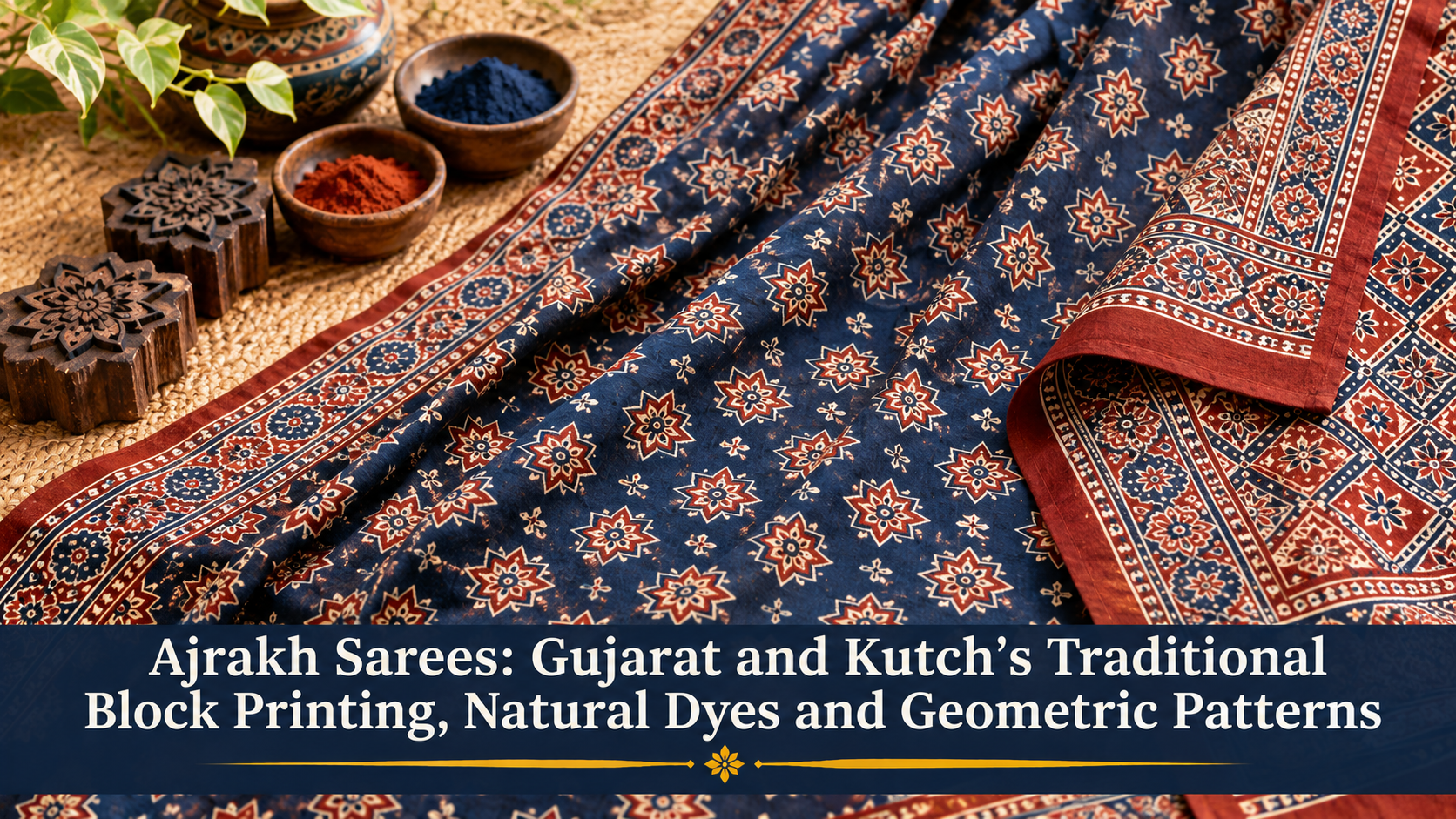
Ajrakh sarees stand out in a crowd of printed fabrics, and not only because of the colour. Look closely and the cloth is built from tiny repeating shapes, laid out in a grid and printed in deep blue, brick red and black against a pale ground. Turn it over and, on a traditionally made piece, the pattern is on the back as well.
That look comes from a demanding craft, and it also explains why the word “ajrakh” is used loosely in shops and online listings. Some sarees sold under the name are made by hand over many days with natural dyes. Others borrow the pattern and are screen printed or digitally printed in a day. This guide explains the traditional process, where the craft is documented, how to tell the versions apart, and how to choose, style and care for an ajrakh saree. If you are new to buying sarees in general, our complete guide to buying sarees for women is a good companion to this article.
What Is Ajrakh Printing?
Ajrakh is a traditional form of resist block printing. Wooden blocks are used to stamp a paste onto cloth that protects (resists) certain areas from dye. The cloth is then dyed, washed and printed again, and the cycle repeats until the full design appears. Sources describe the craft as practised in Kutch in Gujarat and in Sindh in Pakistan, and also in parts of Rajasthan such as Barmer.
Several features are repeatedly used to describe traditional ajrakh:
- It uses resist and mordant printing with carved wooden blocks.
- It passes through many stages of printing, dyeing and washing. Accounts give different counts, from about 12 to 16 stages, and some describe more.
- Its classic palette is indigo blue, madder red and black, with off-white or natural ground.
- The printing is done on both sides of the cloth.
- The patterns are built from geometry, often described as grids, stars and lattices.
How Ajrakh Differs From Ordinary Block Printing
Plain block printing presses a coloured ink or dye directly onto cloth. Ajrakh works backwards in many stages, using resists and mordants to control where colour will take. This table summarises the usual differences.
| Feature | Traditional ajrakh | Ordinary block print |
| Method | Resist and mordant printing, repeated with dyeing | Colour usually applied directly by block |
| Stages | Many (commonly described as 12 to 16 or more) | Often far fewer |
| Printing sides | Typically both sides | Usually one side |
| Typical palette | Indigo, madder red, black, with a pale ground | Wide range of colours |
| Time | Days to around two weeks per batch, by some accounts | Often much faster |
| Pattern structure | Dense geometric grids and borders | Varies widely |
Not every block-printed saree is ajrakh, and not every saree labelled ajrakh follows the full traditional method.
History and Regional Heritage
The history of ajrakh is partly documented and partly told through craft tradition, and it helps to separate the two.
Craft institutions and documentation of Kutch describe a long-standing printing tradition in villages such as Dhamadka, Khavda and Ajrakhpur. An article in Deccan Herald notes that Dhamadka, on the banks of the Saran river, was long a centre of ajrakh printing, and that a community later established Ajrakhpur, which has become a major hub of Kutch ajrakh. Printing near a river mattered because the process needs a lot of clean water for washing and rinsing.
Popular accounts go further back. Some sellers and websites say the craft is thousands of years old and link it to the Indus Valley, and some connect the name to an Arabic word for blue or indigo. These explanations are widely repeated, but they are not firmly settled in the sources we reviewed, so treat them as traditions and not as confirmed dates. We have avoided giving a founding date for that reason.
Kutch is also known for other textile crafts, including embroidery in which mirrors are stitched into cloth. If you are curious about that side of Gujarat’s textile heritage, our guide to mirror work sarees and shisha embroidery explains how it differs from printing.
The Geographical Indication Tag
A report in Deccan Herald states that Gujarat’s ajrakh block print has earned a Geographical Indication (GI) tag. A GI tag links a product to a region and to defined methods, and it can help buyers ask better questions. We recommend checking the registration details on the official GI registry before treating any seller’s GI claim as proof, since a tag attaches to registered products and producers, not to every saree called ajrakh.
Artisans and Communities
Most documentation of Kutch ajrakh names the Khatri community as the traditional printers and dyers. A conference paper from the Textile Society of America describes the Khatris as a hereditary community of dyers and printers, with the Khatris of Dhamadka and Ajrakhpur continuing to print resist-dyed ajrakh, and notes that artisans from the Gajjar community have also been involved in the region. Deccan Herald quotes a Dhamadka printer saying the craft was traditionally done by men, mainly from the Khatri community.
Some practical cautions apply. Craft families vary in what methods they use today, and not every producer in Kutch follows every traditional step. The same academic paper describes artisans who have changed dyes, techniques or fabrics in response to the market. Describing ajrakh as a single uniform tradition would be inaccurate.
How Ajrakh Is Made: The Traditional Process
Accounts differ on the number and exact order of steps, so the outline below is a general sequence and not a strict recipe. It draws on descriptions from Khamir, a Kutch craft organisation, and on other craft accounts.
- Preparing the cloth. Undyed cloth is washed to remove starch and other finishing, and is treated with myrobalan (harda), which helps the cloth take dye.
- First resist printing. A wooden block carved with traditional designs is coated with a paste of lime and gum (Khamir mentions acacia gum) and pressed onto the cloth. This paste acts as a resist.
- Further resist and mordant printing. Other blocks print additional resists and mordants, which control where later dyes will bond. Some accounts describe a mud-based resist, sometimes dusted with other materials, applied to protect areas.
- Dyeing. The cloth goes into dye baths. Indigo is classically fermented in a vat, and madder gives the reds.
- Washing and repeating. The cloth is washed repeatedly between stages to remove resists and set the colour, and the cycle is repeated with new blocks.
- Black and other tones. Black is associated with iron-based preparations, and some accounts mention pomegranate and myrobalan for yellow and cream tones.
- Finishing. The cloth is washed and dried to its final form.
Wooden printing blocks, resist paste and block-printed cloth in an Ajrakh workshop
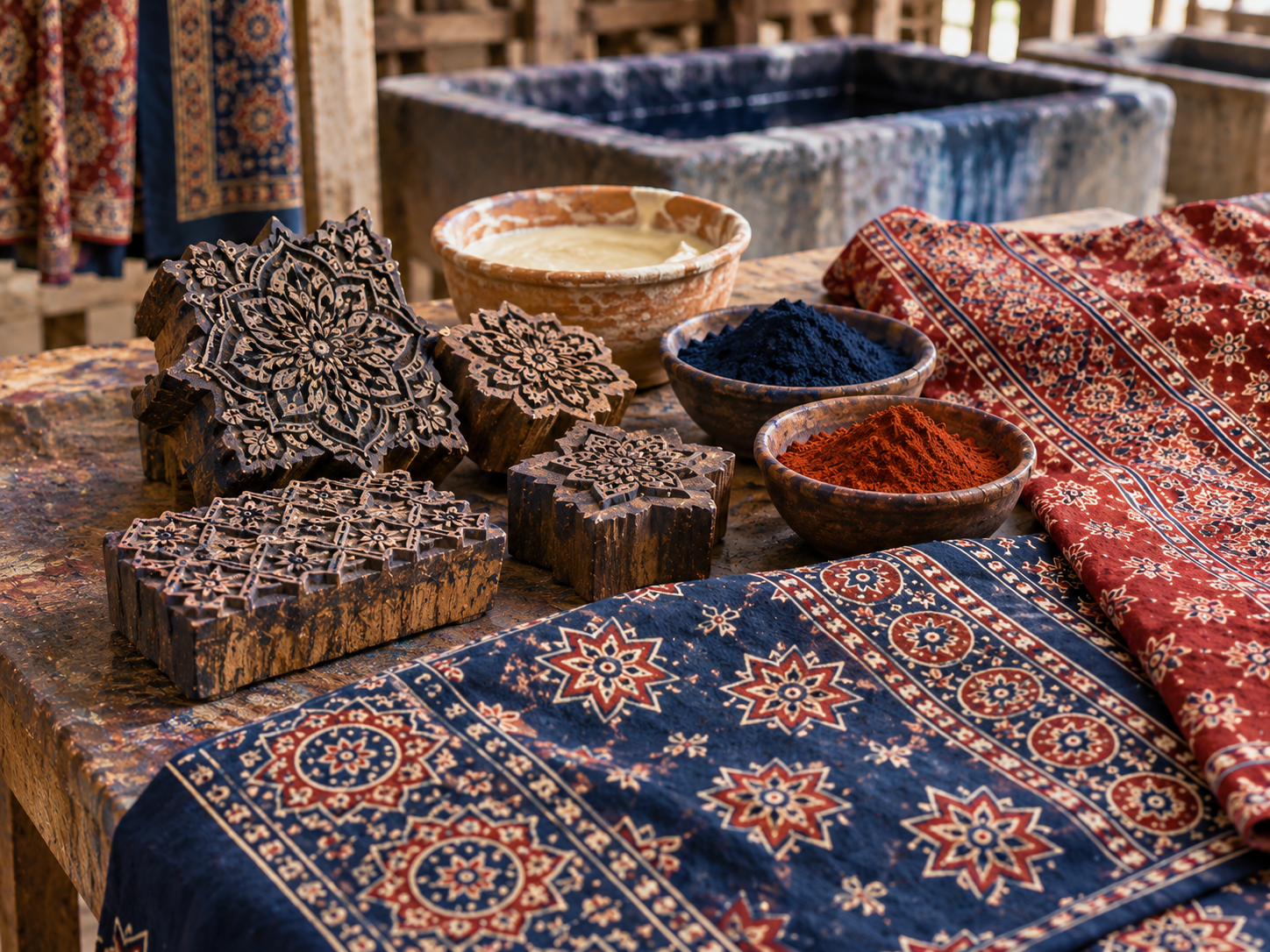
The whole sequence can take many days. One craft account describes the process as taking up to around two weeks, and another says up to 16 times of printing. Different workshops and designs vary.
Wooden Blocks
Blocks are hand-carved from wood, with fine lines and repeating motifs. Khamir notes that artisans may choose blocks from a collection that can be very old, and that different blocks are used for different stages, such as the first resist block. Each block must register exactly with the next, which is why alignment matters so much in the finished cloth.
Natural Dyes and Traditional Colours
The classic ajrakh palette is small but deep. Craft sources describe the following.
| Colour | Traditional source | Notes |
| Blue | Indigo | Fermented in a vat. Repeated dips deepen the blue. |
| Red | Madder root (alizarin) | Used with mordants. The shade can range from brick to deep red. |
| Black | Iron-based preparation | Often used for outlines and detail. |
| Yellow and cream tones | Plant materials such as pomegranate and myrobalan | Mentioned in some craft accounts. |
Not Every Ajrakh Saree Is Naturally Dyed
This matters for buyers. The conference paper on ajrakh in transition describes some artisans who continue block printing but have changed dyes, and others who use different base fabrics. Many commercial pieces use synthetic dyes, screen printing, digital printing or a mix of methods, and are sold as ajrakh print or ajrakh inspired. Treat any claim of natural dyes as something to ask about, not something to assume.
Common Motifs and Patterns
Ajrakh designs are built on geometry. Craft descriptions mention complex arrangements that create starry, lattice-like patterns, along with stylised floral forms. These are the elements you will usually see:
- Grids and lattices that divide the cloth into repeating cells
- Star and diamond shapes arranged in rows
- Stylised flowers and leaves, often reduced to geometric forms
- Borders made of narrow repeating bands
- A pallu that repeats or elaborates the body pattern
Meanings attached to individual motifs vary by source and by family, and we have not found reliable documentation to assign fixed meanings to specific shapes, so we do not list any.
Fabrics Used for Ajrakh Sarees
Cotton is the traditional base for ajrakh and it suits the dyes well. Today you will also find ajrakh prints on other bases, which changes how the saree feels and how it should be cared for.
| Fabric | What to expect | Best for |
| Cotton | Breathable, matte, softens with wear | Daily wear, summer, daytime events |
| Mulmul (fine cotton) | Very light and soft | Hot weather |
| Modal and cotton blends | Smoother drape, slightly more fluid | Office and city wear |
| Silk and silk blends | Richer, with some sheen | Festive and formal occasions |
| Linen and linen blends | Crisp, textured | Daytime and work |
The fabric changes the experience as much as the print. If you are weighing cotton against silk for an ajrakh saree, our comparison of cotton and silk sarees covers comfort, price, care and occasions.
Authentic Handcrafted Ajrakh Versus Machine-Printed Imitations
The word ajrakh is used for a wide range of products, so it helps to know what separates them. The table below is a guide, not a test, since no single feature proves how a saree was made.
| Feature | Traditionally made ajrakh | Machine or screen-printed imitation |
| Printing method | Hand-carved wooden blocks, resist and mordant | Screen, roller or digital printing |
| Both sides | Pattern usually appears on both faces | Often only one side clearly printed, or the back is paler |
| Alignment | Tiny natural variations between block impressions | Perfectly uniform repeats |
| Colour depth | Deep, slightly uneven indigo and madder | Flat or very bright, more uniform colour |
| Process claims | Seller can describe stages, dyes and village | Vague wording such as “ajrakh style” or “ajrakh print” |
| Provenance | Named artisan, workshop or village | Often unnamed |
| Price | Usually higher, reflecting time and labour | Usually lower |
An imitation is not automatically poor quality. A well-made printed saree can be a good buy if it is described honestly and priced fairly. The issue arises when a printed piece is presented as handcrafted or naturally dyed.
How to Identify a Quality Ajrakh Saree
Use these checks together. No single one is conclusive.
- Turn it over. On traditional work, the reverse should carry the pattern, with similar clarity.
- Look for hand-block marks. Small variations in alignment and slight overlaps between impressions are normal on block-printed cloth.
- Study the colours. Natural indigo and madder usually look deep and a little muted, not neon.
- Check the cloth. A fabric with a firm, even weave holds the print better. Run a hand over it to check for stiffness from heavy finishing.
- Check the borders and pallu. Bands should be even and clean, and the pallu design should match the body in style.
- Ask about the process. A genuine seller should be able to say whether the saree is hand block printed, which dyes were used and where it was made.
- Ask about GI or provenance. If a seller mentions GI certification or a named artisan, ask for the details.
- Read the listing carefully. Words like “inspired”, “style” or “print” often signal a non-traditional method.
Styling Ajrakh Sarees for Different Occasions
Ajrakh has a strong visual presence, so styling is mostly about balance.
Daily wear and work
A cotton or modal ajrakh saree with a plain blouse is a comfortable daytime choice. Let the print carry the look and keep accessories simple.
Festive and family occasions
A silk or silk blend ajrakh adds a richer finish. A solid blouse in one of the saree’s own colours, such as indigo or deep red, ties the look together.
Blouse and accessories
- Plain or very lightly patterned blouses let the print stand out.
- Silver and oxidised jewellery suits the earthy palette.
- Keep embellishment light, since the saree already has a lot of pattern.
- Natural-toned footwear and a simple bag suit most looks.
Ajrakh is not usually worn as a bridal saree, and it works best at events where a handcrafted, textile-led look is welcome.
Care Instructions
Always read the care label first, because fabric and dye methods differ.
- First wash: wash separately, since dyed cloth can release excess colour. Natural-dye textiles are often described as needing gentle handling.
- Washing: use cool water and a mild detergent, and avoid bleach and harsh scrubbing.
- Drying: dry in shade, not in direct sun, because sunlight can fade dyes. Craft sources specifically advise shade drying.
- Ironing: use a moderate heat setting while the cloth is slightly damp, and iron the reverse side where possible.
- Storage: fold loosely and keep it in a breathable cotton cover. Refold along different lines from time to time.
- Silk bases: many silk sarees need dry cleaning, so follow the label.
How to Choose and Buy an Ajrakh Saree
Start with the questions that matter most: how it was made, what it is made of and how you plan to wear it.
- Decide the use. Daily wear and festive use call for different fabrics.
- Choose the fabric. Cotton suits heat and everyday wear, while silk suits formal events.
- Decide how much the method matters to you. If handcrafted and naturally dyed work matters, ask direct questions. If you want the look at a modest price, a printed ajrakh-style saree can be perfectly reasonable when honestly described.
- Ask the right questions. Is it hand block printed? Which dyes were used? Where was it made? Is it printed on both sides?
- Check the listing. Look for fabric content, length, blouse piece details and care instructions.
- Compare price with method. Handcrafted work takes time and is usually priced accordingly. A very low price for a claimed hand block print is a reason to ask more.
If you are buying online, our online saree shopping guide explains how to read descriptions, judge photographs and assess sellers before you pay.
Buying Checklist
| Check | What to look for |
| Fabric | Fibre content stated clearly |
| Method | Hand block, screen or digital print stated |
| Dyes | Natural or synthetic stated, not implied |
| Pattern | Printed on both sides if sold as traditional |
| Provenance | Region, village or artisan named where claimed |
| Blouse piece | Included or not, with length |
| Care | Wash and dry instructions listed |
| Policy | Return and exchange terms clear |
Frequently Asked Questions
1. What are ajrakh sarees?
Ajrakh sarees carry a traditional resist block-printed design, usually in indigo, madder red and black. The craft is documented in Kutch in Gujarat and in parts of Sindh and Rajasthan. The name is also used for modern prints that imitate the look.
2. Is every ajrakh saree naturally dyed?
No. Traditional ajrakh uses natural dyes such as indigo and madder, but many commercial pieces use synthetic dyes or printing methods. Ask the seller to state the dyes and the printing method.
3. How can I tell if an ajrakh saree is hand block printed?
Check whether the pattern appears on both sides, look for small natural variations in alignment, and study the colour depth. Ask for details of the process and where it was made. No single sign is proof.
4. Where does ajrakh come from?
Kutch in Gujarat is the region most often associated with it, particularly villages such as Dhamadka, Khavda and Ajrakhpur. The craft is also practised in Sindh and in parts of Rajasthan.
5. Which fabric is best for an ajrakh saree?
Cotton is the traditional base and suits daily wear and warm weather. Modal, linen blends and silk are also used, so choose by occasion and comfort.
6. How do I wash an ajrakh saree?
Follow the care label. In general, wash separately in cool water with a mild detergent, avoid bleach and dry in shade. Silk bases usually need dry cleaning.
7. Why are handcrafted ajrakh sarees expensive?
The process involves many stages of printing, dyeing and washing, often over days, so the labour and materials add up. Prices for printed imitations are usually lower because the process is shorter.
8. Does the GI tag guarantee a saree is authentic?
A GI tag links a product to a region and to defined methods, but it applies only to registered products and producers. If a seller mentions a GI tag, ask for the details and check them against the official registry.
Conclusion
Ajrakh sarees reward a closer look. The traditional craft combines carved wooden blocks, resist printing and natural dyes in a long, repeated process, and it is documented most strongly in Kutch. At the same time, many sarees sold under the name use faster, cheaper methods. Ask how the saree was made, check the fabric and finishing, and match your choice to how you plan to wear it. A clear answer from the seller is the best sign you are buying what you think you are buying.
