
Blog
Pattachitra Sarees: Odisha’s Traditional Painting Art, Mythological Motifs and Textile Craft

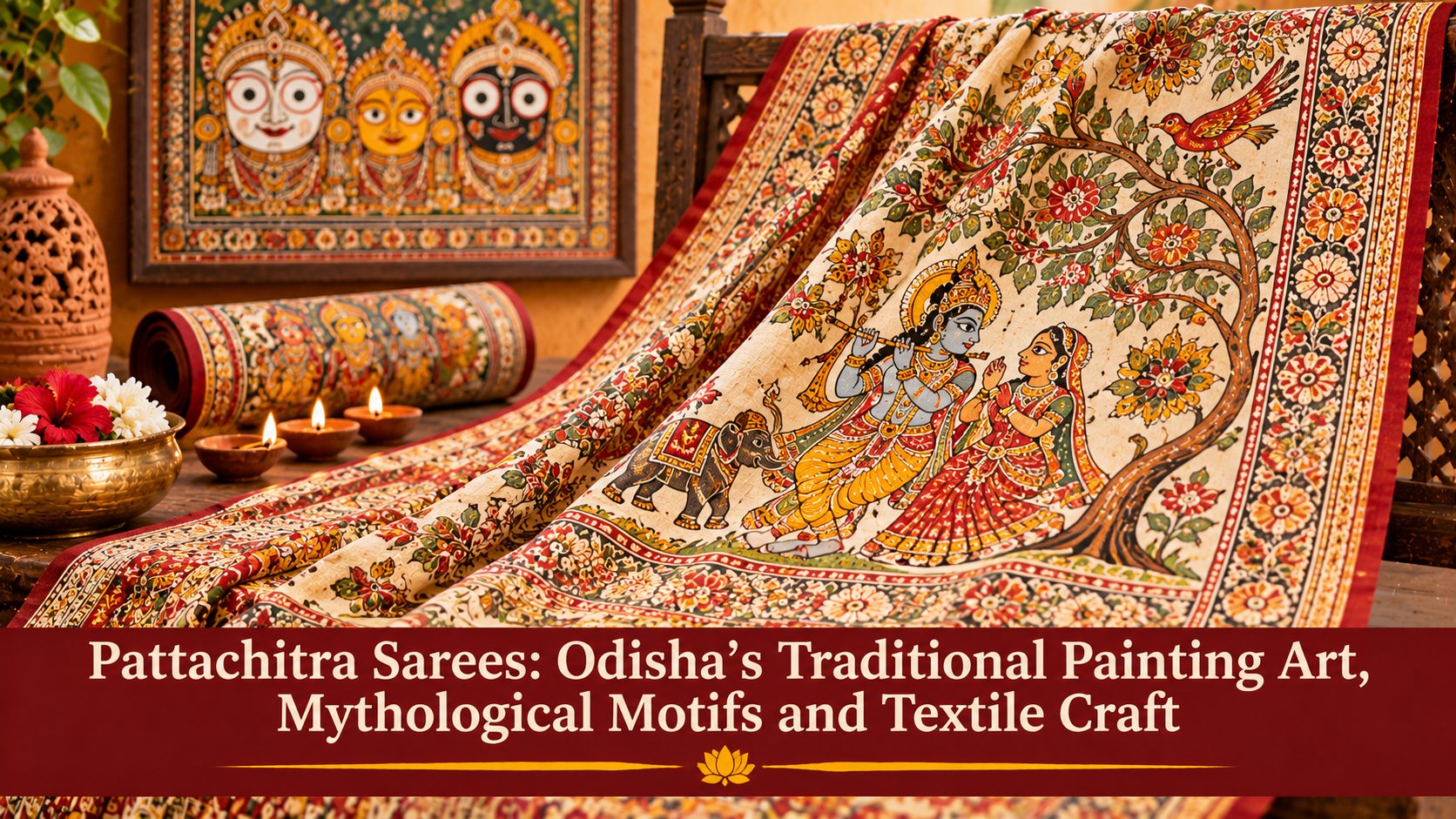
A pattachitra saree usually begins with a painting tradition, not a weaving one. That single fact explains most of the confusion buyers run into. Pattachitra is a centuries-old form of Odisha cloth painting, made on a specially prepared surface and tied closely to the temple life of Puri. A saree that carries its imagery is an adaptation: the art has been moved onto a draped garment through painting, printing or digital reproduction.
This guide separates the two. It explains what Pattachitra art is, where it comes from, what it depicts and how it is made, and then looks at how those designs appear on sarees today. It also covers how to judge quality, when to wear one and how to care for it. For wider help with fabrics, price factors and quality checks across all saree types, our complete saree buying guide is a useful companion.
What Is Pattachitra Art?
The word comes from Sanskrit. “Patta” means cloth and “chitra” means picture, so Pattachitra is, literally, a cloth painting. It is one of Odisha’s best-known traditional arts, and it is also associated with West Bengal, where a separate Patachitra tradition exists. This article is about the Odisha tradition.
Several features recur across descriptions of Odisha Pattachitra:
- It is painted on cloth, and related traditions use palm leaf.
- The cloth is prepared as a hard, smooth painting surface before any colour is applied.
- Colours are traditionally made from natural materials such as minerals, shells, soot and plant extracts.
- Figures are drawn with bold outlines and filled with flat colour, usually without shading.
- Compositions are framed with detailed borders.
- Subjects are largely religious and mythological.
A related Odisha craft, Talapatra or palm leaf work, uses a palm leaf base where designs are engraved with a stylus and then inked. It is a separate technique, and it is not painted cloth.
History and Cultural Background
Odisha Pattachitra developed around the temple town of Puri and the cult of Jagannath. Several sources describe it as originally made for ritual use and as souvenirs for pilgrims visiting Puri and other temples in Odisha.
The dates attached to the tradition vary widely. Some websites call it more than a thousand years old, others place its roots in the twelfth century, when the present Jagannath temple in Puri is linked to the Ganga dynasty, and some give much earlier dates. One reference summary notes that the oldest record of the paintings probably does not go beyond the establishment of the present shrine at Puri. Since the sources disagree and most are popular accounts, we do not give a firm founding date.
Raghurajpur and Other Craft Centres
Raghurajpur, a heritage craft village near Puri in Odisha, is the centre most often named. Other places listed in reference sources include Puri, Danda Sahi, Parlakhemundi, Chikiti, Digapahandi, Sonepur and Dharakote in Odisha. Painters are commonly described as belonging to hereditary Chitrakar families, and a study of Raghurajpur notes that both men and women of the painter community take part in the work. Surnames such as Mahapatra and Maharana are mentioned in some accounts.
Odisha Pattachitra has also been reported as holding a Geographical Indication (GI) registration, with one reference source giving the date as 10 July 2008. If you see a GI claim on a product page, ask for the details and check them against the official GI registry, because registration does not mean every item using the name is a traditional painting.
Pattachitra and Jagannath Culture
Writers on the subject consistently link Odisha Pattachitra to the Jagannath tradition at Puri and to Vaishnava devotion more broadly. The paintings are described as having served ritual and devotional purposes, and many surviving works depict the deities of the Puri temple.
We should be careful about detail here. Temple practices are specific and carry religious meaning, and craft websites sometimes repeat claims about particular rituals that we could not verify in reliable sources. We therefore describe the connection in general terms: the art grew up around the temple and its festivals and continues to depict its deities. A saree that uses these images borrows from a sacred context, which is worth bearing in mind when choosing where and how to wear one.
Traditional Themes and Mythological Subjects
Common subjects in Odisha Pattachitra include:
- Jagannath, Balabhadra and Subhadra: the deities of the Puri temple, painted in a distinctive, stylised form.
- Krishna Leela: stories from the life of Krishna.
- Dashavatara: the ten incarnations of Vishnu.
- Epic scenes: episodes from the Ramayana and Mahabharata.
- Symbolic motifs: the Tree of Life is often cited, along with Navagunjara, a composite creature mentioned in Odisha art.
- Temple and everyday scenes: some works show temple activities or local life.
These subjects change how a saree design feels. A narrative panel on a pallu works like a small painting, while a border with repeating figures or vines reads more like decoration.
Motifs, Borders, Colours and Composition
Composition
Descriptions of the style mention flat planes of colour, strong outlines and a lack of shading. Figures face the viewer or are shown in profile, and scenes are arranged within framed panels. Because the work was traditionally viewed in dim temple interiors and ritual settings, the forms are graphic and easy to read from a distance.
Borders
Borders are a defining feature. They typically frame the central scene with repeating floral bands, vines and geometric patterns, and they carry as much visual weight as the main subject. On a saree, these borders are often adapted into the saree’s own border and pallu edging.
Colour
The traditional palette is restrained and earthy. Sources describe white from ground conch shell, black from lamp soot, yellow from a stone called harital, and reds and greens from minerals and plant extracts. A bold, saturated look comes from the use of flat colour, not shading.
Traditional Materials and Painting Methods
Craft accounts describe the traditional process in broadly similar terms, with some variation between families and centres.
| Stage | What sources describe |
| Canvas preparation | Cotton cloth is layered and treated with a paste of chalk and tamarind seed gum, then dried and polished until the surface becomes hard and smooth |
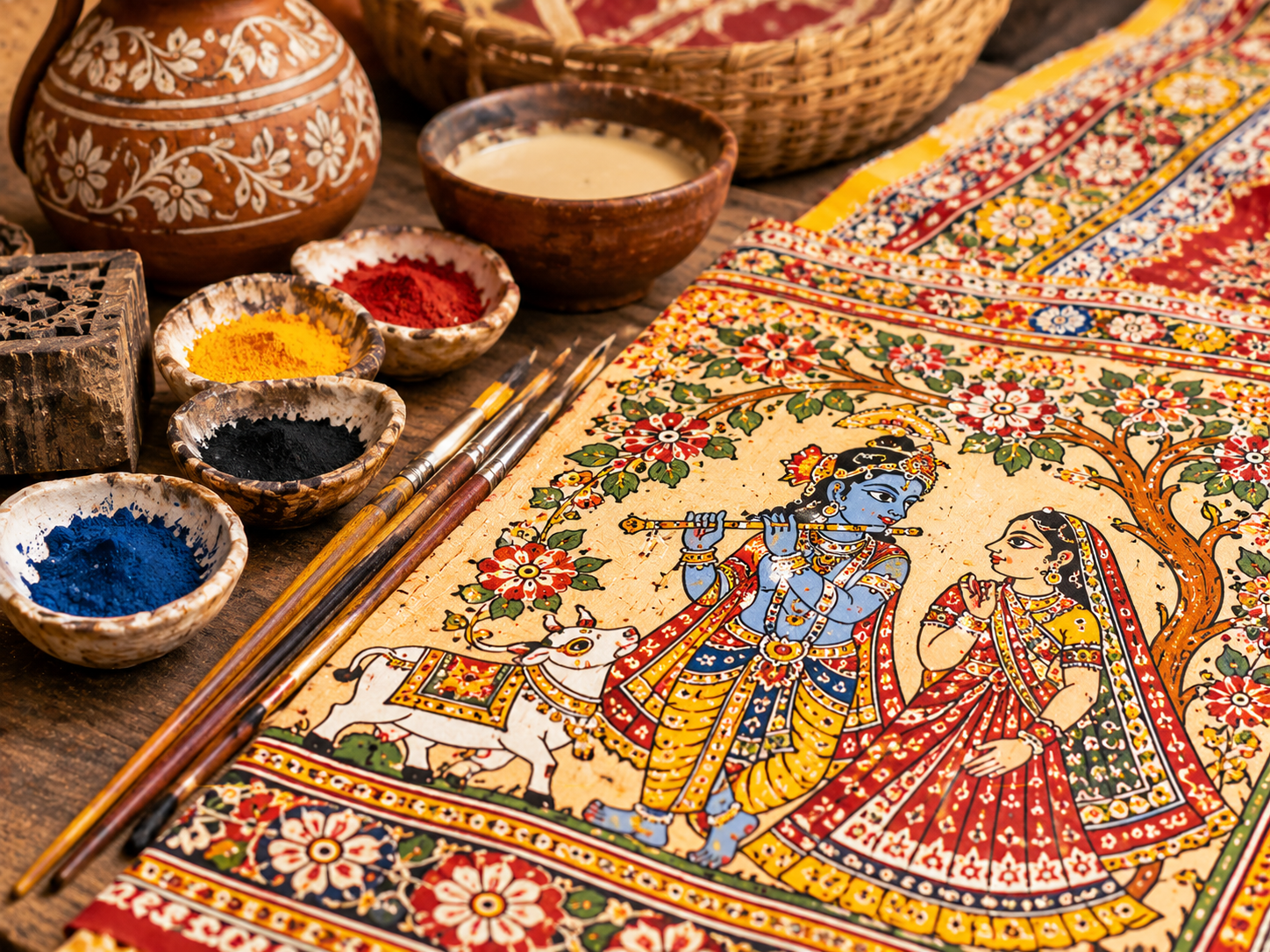
| Pigments | Colours are made from natural materials such as ground conch shell, lamp soot, stones, leaves and plant extracts, mixed with a natural binder |
| Brushes | Fine brushes made by the artisans themselves are used for outlines and details |
| Painting | Painters work directly on the cloth, and some accounts say they begin without a preliminary pencil sketch |
| Finishing | Some accounts describe a final coating or polish to protect the surface |
Cotton is the base most often named for Odisha Pattachitra, and silk, including tussar silk, is also mentioned in some descriptions and studies of the craft. A reference summary notes that Odisha work is usually on cotton or silk cloth and sometimes on palm leaf.
Pattachitra painting materials, fine brushes and detailed artwork
An Important Point About Sarees
The traditional canvas is made to be hard, so it can hold fine detail. That is ideal for a framed or rolled painting, but it would make a draped garment stiff. Painting on a saree therefore generally means adapting the method. Cloth made for wearing is usually painted or printed with colours suited to fabric, and the exact materials differ from one maker to another. Do not assume a painted saree uses the traditional chalk and tamarind canvas or the traditional pigments. Ask the seller.
How Pattachitra Artwork Is Applied to Sarees
Several approaches exist, and they are very different products.
- Hand painting on fabric. An artisan paints the motifs directly on the saree cloth, often on a silk or cotton base. It is slow, no two pieces are exactly alike and the price reflects the labour.
- Hand-drawn or hand-outlined work. Outlines or details are drawn by hand, sometimes with printed or pre-marked areas filled in by hand.
- Block or screen printing. Designs are transferred by blocks or screens. Repeats are consistent, and the process is faster and more affordable.
- Digital printing. An image of a painting is printed onto the cloth by machine. It can reproduce fine detail but has no hand involvement.
None of these is a handloom weave. Odisha also has distinct woven and ikat traditions, such as Sambalpuri and Bomkai sarees, in which patterns are created on the loom or in the yarn. A saree with Pattachitra imagery is a painted or printed textile, and listings that call it a weave or handloom should be questioned.
Hand-Painted, Printed and Digital: Key Differences
| Feature | Hand-painted | Block or screen printed | Digitally printed |
| Made by | Artisan with brush | Printer with blocks or screens | Machine |
| Uniformity | Small variations in every piece | Consistent repeats | Identical every time |
| Detail | Brushwork visible, slight irregularities | Limited by the block or screen | Can be extremely fine |
| Reverse side | Colour may show through softly | Often lighter or plain | Often paler on the back |
| Time and price | Slowest, usually highest | Moderate | Fastest, usually lowest |
| Best described as | Hand-painted | Printed | Digital print |
The method is not a measure of quality in itself. A well-made printed saree can be an excellent purchase. The issue is honesty in description.
How to Identify a Quality Pattachitra Saree
Because “Pattachitra” is used loosely online, use these checks together.
- Read the listing. Look for words such as hand painted, block printed or digital print. Phrases like “Pattachitra inspired” or “Pattachitra style” usually mean an adaptation.
- Check the base fabric. The listing should state fibre content, for example cotton, silk, tussar or a blend.
- Examine the artwork up close. On hand-painted work, outlines should be steady and colours should fill the shapes cleanly. On printed work, check for blurred edges or visible pixelation.
- Look at the reverse. Painted and printed fabrics behave differently on the back, so compare it with the front.
- Check colour fastness. Ask whether the colours are fabric-safe and how to wash the saree.
- Check composition. Motifs should be placed with care, with borders and pallu designs that match in style.
- Ask about provenance. A seller who says the saree was painted by a named artisan or in a named centre should be able to explain it.
- Beware of overclaims. Be cautious of listings that say traditional, natural-dye and handloom all at once without detail.
Styling Ideas and Suitable Occasions
Pattachitra imagery is detailed, so styling works best when the saree remains the focus.
- Daytime and cultural events: a cotton or silk-blend saree with painted borders suits art exhibitions, family gatherings and festivals.
- Festive occasions: a richer silk base with a narrative pallu makes a strong festival saree.
- Work and formal settings: a saree with a subtle border and a plain body suits an understated look.
- Blouse: a solid blouse in one of the saree’s own colours keeps the focus on the art.
- Jewellery: simple silver or antique-style jewellery pairs well, while heavy jewellery competes with the artwork.
Because deity imagery is part of the tradition for many wearers, some people prefer motifs such as floral borders, trees and decorative panels for everyday wear. This is a matter of personal and community preference. If you plan to wear a saree with a particular drape, our guide to saree draping styles for beginners shows how pleats and pallu arrangement affect how the design is displayed.
Fabrics, Care and Buying Considerations
Fabric Choices
Painted and printed sarees appear on cotton, cotton silk, tussar and other silk bases, and on some synthetic blends. The base affects drape, comfort and how well the colour holds. If you are deciding between a cotton and a silk base, our comparison of cotton and silk sarees explains the differences in comfort, price and care.
Care Instructions
Always follow the care label first, because painted and printed products vary.
- Washing: hand wash gently in cool water with a mild detergent, or dry clean if the label says so. Avoid bleach and hard scrubbing over painted areas.
- First wash: wash separately, since some colours can bleed.
- Drying: dry in shade and avoid direct sun, which can fade colour.
- Ironing: iron on the reverse side at a suitable heat, and avoid pressing directly over thick paint or print.
- Storage: fold loosely in a breathable cotton cover and refold along different lines occasionally.
Buying Considerations
| Check | What to look for |
| Method | Hand painted, hand drawn, block printed or digitally printed, clearly stated |
| Fabric | Fibre content and weave stated |
| Dyes and colours | Fabric colours described honestly, not assumed to be natural |
| Artwork | Subject, border and pallu shown in close-up photos |
| Provenance | Region or artisan named where claimed |
| Blouse piece | Included or not, with length |
| Care | Wash and dry instructions listed |
| Policy | Return and exchange terms clear |
When you buy from a website, read the whole listing and ask questions before paying. Our online saree shopping guide walks through how to read descriptions, judge photos and assess sellers.
Frequently Asked Questions
1. What is a pattachitra saree?
A pattachitra saree carries designs inspired by Odisha’s Pattachitra cloth painting tradition. The imagery may be hand painted, block printed or digitally printed onto the saree. It is usually a painted or printed textile, not a woven one.
2. Is a pattachitra saree handloom?
Not necessarily. Pattachitra is a painting tradition, and the saree it appears on may be handloom or power-loom fabric with art added on top. Ask the seller how the base cloth was made and how the design was applied.
3. Are pattachitra sarees hand painted?
Some are, but many are printed. Check whether the listing says hand painted, block printed or digital print, and be cautious of vague terms such as style or inspired.
4. What do the motifs on a pattachitra saree represent?
Traditional subjects include Jagannath and the deities of Puri, scenes from the lives of Krishna and Vishnu, episodes from the Ramayana and Mahabharata, and symbols such as the Tree of Life. Floral and geometric borders are also common.
5. Where does Pattachitra come from?
Odisha Pattachitra is associated with Puri and the heritage craft village of Raghurajpur, along with other centres such as Danda Sahi, Parlakhemundi and Sonepur. A separate Patachitra tradition exists in West Bengal.
6. Are the colours on a pattachitra saree natural?
Traditional Pattachitra paintings use natural pigments, but sarees often use fabric colours chosen for wearability. Do not assume natural pigments unless the seller says so and explains how.
7. How do I wash a pattachitra saree?
Follow the care label. In general, wash gently by hand in cool water with mild detergent or dry clean, wash separately at first and dry in shade.
8. Is a pattachitra saree suitable for weddings and festivals?
It can suit festivals, cultural events and family functions, especially on silk or silk-blend bases. For a formal wedding, choose the fabric and the weight of the artwork to suit the ceremony and your comfort.
Conclusion
Pattachitra is a living painting tradition from Odisha, rooted in the temple culture of Puri and carried on by hereditary painter families in places such as Raghurajpur. A pattachitra saree borrows that imagery for a garment, and the way it does so can range from careful hand painting to simple digital printing. The most useful habit for a buyer is to ask how the design was made and what the cloth is, then choose the version that fits your budget and your occasion. With clear answers, you can enjoy the art without confusing the painting tradition with the textile that carries it.
