
Blog
Parsi Gara Sarees: The Heritage of Intricate Embroidery, Chinese Motifs and Zardozi Influences

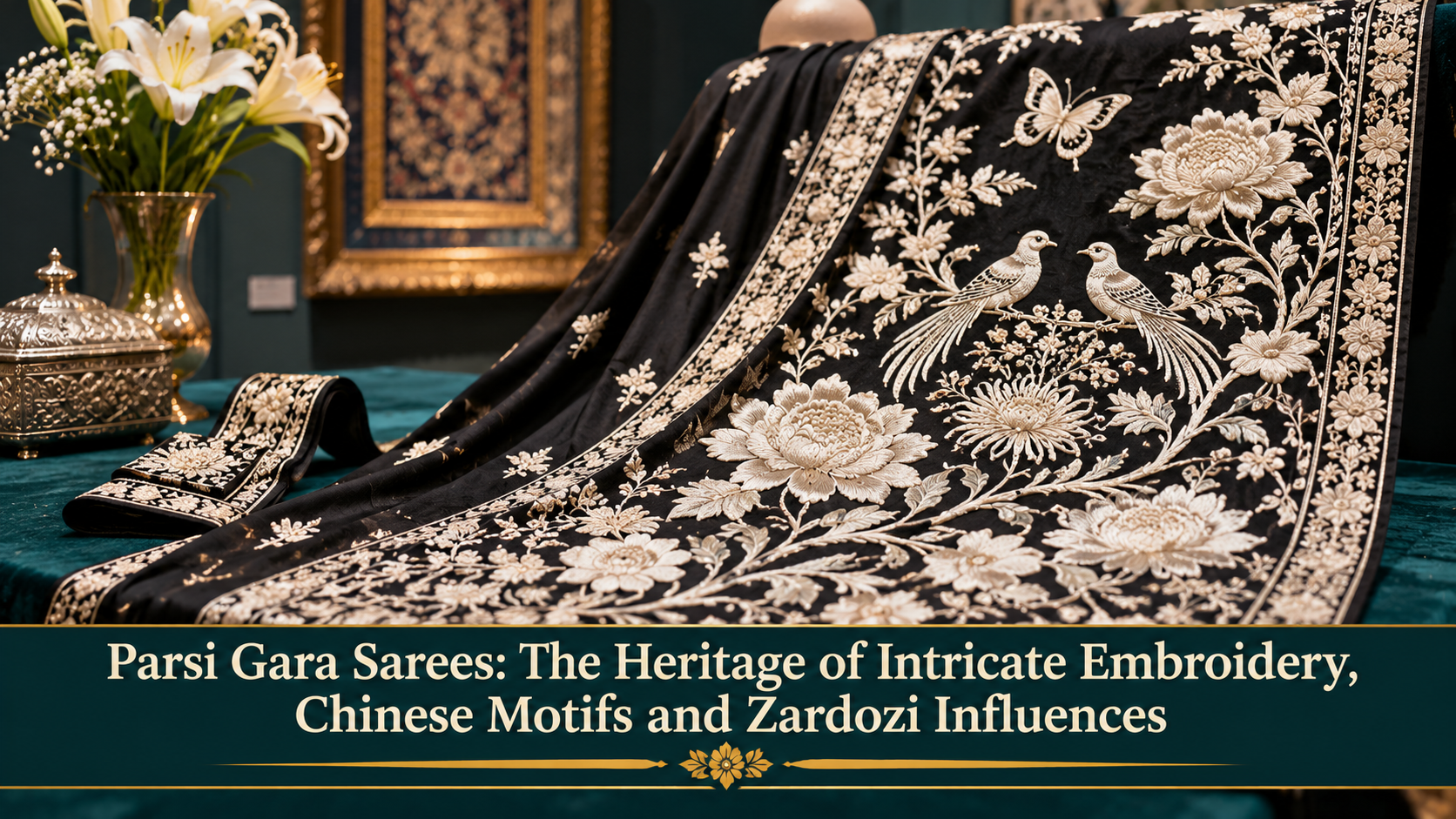
Few saree traditions have as layered a history as the Parsi gara. It is a silk saree covered in fine embroidery that looks Chinese in its flowers, birds and butterflies, was first worn by women of a Zoroastrian community in western India, and reached them through sea trade between Bombay, Surat and Guangzhou. A single border can hold motifs from China, Persia, India and Europe at once. That mix is the reason a parsi gara saree cannot be treated as generic Indian embroidery, and it is also why the term gets used loosely in shops.
This guide explains what a gara is, how it came to the Parsi community and what its motifs and stitches are. It also explains how it differs from Zardozi and other embroidery traditions, how hand-embroidered, machine-embroidered and printed versions compare, and what to check before buying. If you are still comparing saree types in general before narrowing down to one, our complete guide to buying sarees for women covers fabrics, occasions and price factors, and you can come back here for the Gara specifics.
What a Parsi Gara saree is
The word and the garment
According to the RISD Museum in Providence, which has exhibited and researched Parsi embroidery, the word gara comes from the Gujarati word garo, meaning a width of cloth. The museum says gara refers specifically to the sarees first worn by the wives of Parsi merchants from the 1700s. Over time the word has also come to describe the embroidery style and, loosely, any saree or border worked in it.
The Parsis are the Zoroastrian community of India, descended from people who left Iran and Central Asia for India after the 7th-century Arab conquest of Persia, with the first settlers arriving in Gujarat. Their clothing was largely Indian in form, but women’s and children’s garments were often embroidered. The Textile Research Centre in Leiden notes that Parsi women might wear a gara, an embroidered tunic called a jubla (also spelled jhabla), or separate embroidered bands called kor that were sewn onto saree edges.
Gara, kor and do-patti: a short vocabulary
- Gara: a complete embroidered saree, historically made of silk.
- Kor: an embroidered border band, sewn onto a plain saree by the wearer or her family.
- Jubla: an embroidered tunic worn by girls.
- Do-patti: a saree made of two strips of cloth joined by a lengthwise seam. The Textile Research Centre explains that Chinese looms were narrower than Indian ones, so Chinese-woven silk used for Parsi sarees often needed an extra half-width piece sewn on.
These terms matter when you read a listing. A saree described as “gara work” might be a full embroidered silk saree, a plain saree with a gara border, or a saree with a few gara-style motifs.
The history of Gara embroidery and the Parsi community
How the trade began
The first Parsi merchant recorded sailing from Bombay to Guangzhou (then called Canton by the British) was Hirji Jivanji Readymoney, who made the voyage in 1756, according to the RISD Museum. Guangzhou was the only Chinese port open to foreign merchants at the time. Parsis were involved in shipbuilding and textiles around Bombay from early on and worked closely with the British East India Company. They also took part in the opium trade into China from its early years.
This part of the history is often left out when gara is discussed as pure heritage. The RISD Museum’s research presents the gara as tied to the opium trade, whose consequences included addiction in China and forced poppy cultivation in India. The embroidered silks that Parsi merchants brought home, often in emptied opium chests as gifts for their wives, were a by-product of that commerce. Naming this does not diminish the craft. It explains where the money, the contacts and the demand came from.
From Chinese workshops to Parsi wardrobes
Guangzhou had a well-developed export embroidery industry. Workshops there made embroidered goods for foreign buyers and adapted their designs to what those buyers wanted. The RISD Museum notes that as Parsi merchants grew in number and wealth, they commissioned sarees, saree borders, tunics and other Indian-style garments from these workshops.
Women were not allowed to enter the port of Guangzhou, so orders were placed through husbands and male relatives. The workshops quickly learned the structure of the saree. The pallu, the end piece most visible when draped, was often embroidered more densely than the pleated section, and the corners that would be tucked or tied were often left plain. That made the saree easier to wear and gave buyers cheaper options.
Little is documented about the early workshops. A few early sarees carry stamps in English and Gujarati showing they were made in China, but most have no maker’s mark. That is why museum catalogues so often describe gara pieces as “probably Chinese makers for the Parsi market” rather than naming a workshop.
Production moves to India
Parsi women soon began commissioning Indian embroiderers to copy the Chinese silks. The RISD Museum records that wives of wealthy Parsi merchants were seen as tastemakers in Indian society, and artisans across the subcontinent began producing gara-style silks for other buyers too. Workshops making “Chinese” embroidery appeared in Surat, and oral tradition suggests that some Chinese embroiderers settled there to serve this demand. Many Parsi women in smaller towns also took up the embroidery themselves, as a source of income.
The Textile Research Centre notes that the Chinese trade in embroidered garments ended in the late 1940s and early 1950s, when China’s borders closed. By the mid-20th century gara pieces were being made only in India, usually using the same Chinese-derived motifs. The craft is now supported by the Parzor Foundation, working with UNESCO and the Indian government, and by contemporary designers such as Ashdeen Lilaowala, who has spent years researching its origins in Iran and China.
India, China and the international textile trade
The gara belongs to a longer story of textile exchange. The UNESCO Parzor Project’s director, Dr Shernaz Cama, has described how the China connection with Persia was first an overland link that later became a sea link through Indian Parsis, and notes that China had been exporting fine embroidery to Europe since the 13th century. Parsi traders from India sold raw cotton in China and brought back silk goods.
European fashion shaped the same market. The RISD Museum observes that in the 1800s Western consumers developed a strong taste for “oriental” styles, and Chinoiserie became fashionable in Europe. Chinese export workshops therefore made goods for several markets at once. Their designs were often a mix of Chinese and older European export patterns, as the Textile Research Centre notes, and museum labels at RISD point out that some motifs on export pieces are not ones you would find on traditional Chinese garments. The workshops were adapting to foreign expectations of what Chinese embroidery should look like.
That context explains a point that matters for buyers. A gara is not a copy of a single Chinese tradition, and it is not a purely Indian craft either. It grew out of commissioned, cross-cultural production, and its look was shaped by customers as much as by makers.
How Chinese-inspired motifs entered Parsi embroidery
Two routes brought Chinese motifs into Parsi dress. In the first, Chinese workshops embroidered sarees, borders and tunics to order, using their own export repertoire. In the second, Parsi women commissioned Indian embroiderers to imitate those pieces, and the motifs were then repeated, adapted and mixed with new ones.
The RISD Museum argues that Parsi interest in Chinese designs went beyond fashion. Parsi and Chinese visual symbols overlap in part because of the community’s Central Asian origins and the long exchange between India and China. Its example is the Chinese phoenix, which Parsis embraced as Simurgh, the auspicious Persian mythical bird. Many Chinese designs became identified with Parsi culture and are still copied.
The Textile Research Centre, citing the textile historian Linda Lynton, describes a more hybrid style that developed as Parsi women began copying the originals. It added the cypress tree and the chakla chakli, a pair of opposing birds, both said to recall the community’s Iranian roots. It also added the lotus and the peacock, which recall their home in India, while keeping Chinese peonies, roses and chrysanthemums.
Common Parsi Gara motifs
The table lists motifs documented in museum and research sources. Meanings are interpretations, and they differ between writers.
| Motif | Where it comes from | Notes |
| Peonies, roses, chrysanthemums | Chinese export embroidery | Recorded by the Textile Research Centre as Chinese flowers kept in the hybrid Parsi style. Designer Ashdeen Lilaowala points out that the chrysanthemum has long been linked to Chinese emperors |
| Birds | Chinese export embroidery, adapted by Parsis | Common on both Chinese-made and Indian-made pieces |
| Chakla chakli (opposing pair of birds) | Parsi development | Said to recall Iranian origins |
| Phoenix and Simurgh | Chinese phoenix, read by Parsis as the Persian Simurgh | Described by the RISD Museum |
| Cypress tree | Parsi development | Said to recall Iranian origins |
| Lotus and peacock | Indian setting | Said to recall the community’s life in India |
| Butterflies | Chinese embroidery | Lilaowala notes that Parsis adopted birds and butterflies from Chinese embroidery |
| Figures in Chinese dress, bridges over water, scenes | Chinese export embroidery | Recorded on Chinese-made sarees and tunics |
| Leaves, vines, trees | Chinese and Indian | Often arranged as a spreading vine or branch with flowers and birds |
A saree with a bird and a flower is not automatically a gara. Look for the combination: white or pale silk thread on a coloured silk ground, Chinese-derived flowers and birds, and a dense pallu or border.
Traditional embroidery techniques and stitches
Traditional gara embroidery is thread embroidery, mainly in silk. The Textile Research Centre records designs embroidered on a coloured ground of purple, red or black, using white silk thread. The stitches include Peking stitch, satin stitch and several types of knots.
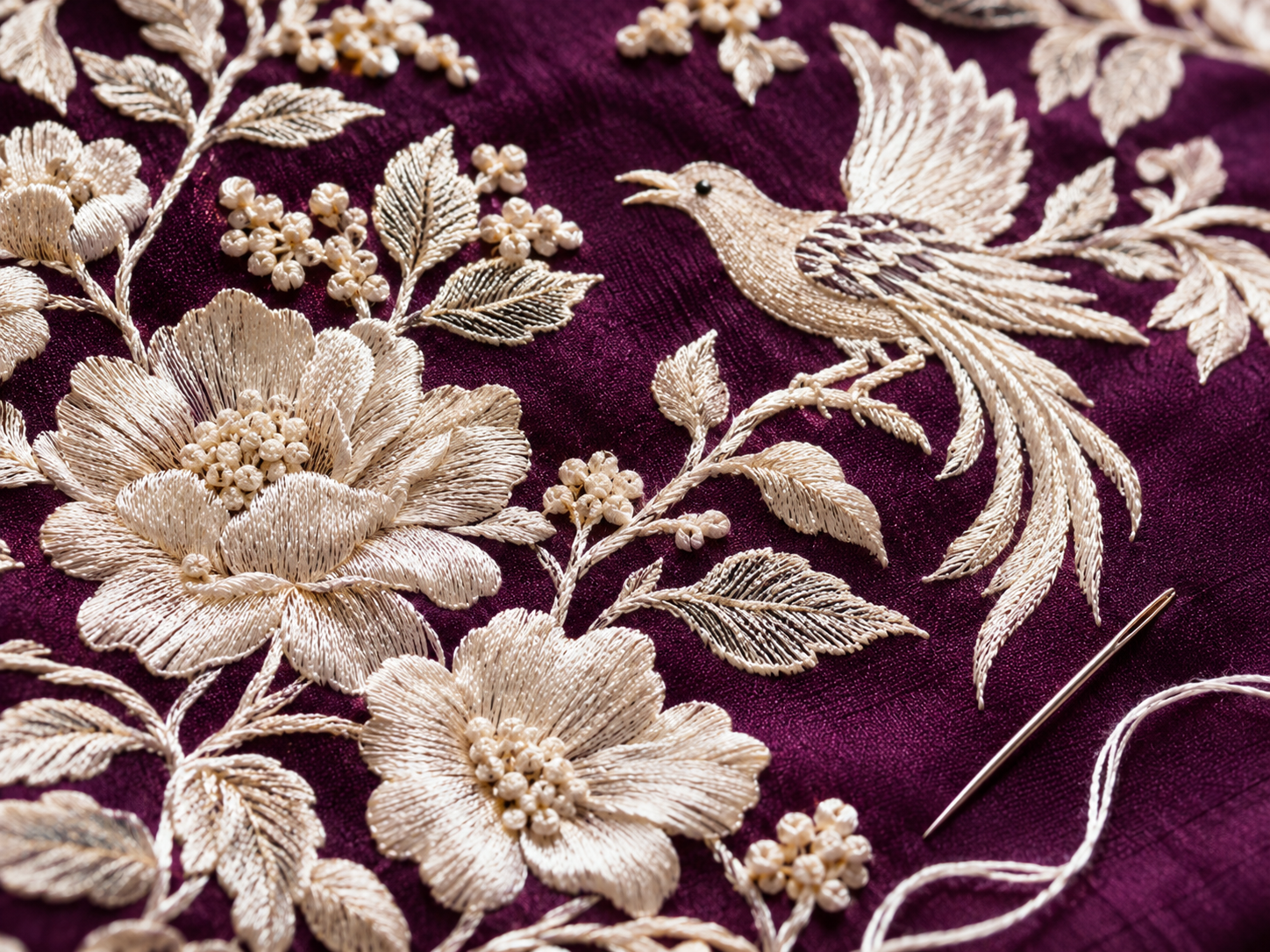
Satin stitch fills an area with closely laid parallel stitches, so petals and leaves read as smooth, shining surfaces. Knot stitches build small raised dots, often for flower centres, eyes and textured areas. The Textile Research Centre adds that as Parsi women took over the craft, they changed the technique and used different stitches, including a knot known as the “forbidden stitch” (khakha stitch), more widely called the Peking knot. A Deccan Herald feature by a writer who learned the embroidery reports that satin stitch, now so central to the gara, came to India from China.
The RISD Museum also notes that stitches can sometimes suggest where a Parsi garment was made. A tunic in its collection uses tuan chen, or knot stitch, which the museum describes as a specialty of Chinese workshops.
Gara and Zardozi are not the same
Because gara sarees are sometimes described as “Zardozi-influenced”, the terms need separating.
Zardozi is a Persian word meaning sewing with gold thread (zar means gold and dozi means embroidery), according to Sahapedia. It is a metal-thread embroidery associated with the Mughal period and with Lucknow, where the traditional gold and silver wire is now commonly replaced by gold-plated, silver-plated or copper-plated thread. The Indian Culture portal lists its typical materials as flat badla wire, spring-like dabka, and sequins and beads. Gara embroidery is mainly silk-thread work, in the stitches described above.
The two overlap in some 20th-century pieces. The Textile Research Centre records that in the early to mid 20th century, gold-coloured badla decoration on navy and other plain fabrics, and sequins on net, became popular in the Parsi wardrobe. A saree with metal-thread work may therefore be a gara-style piece with added metalwork, but that does not make it Zardozi, and a plain silk-thread gara contains no Zardozi at all.
| Feature | Parsi Gara | Zardozi | Chinese export embroidery | Chikankari |
| Main thread | Silk, usually white or pale on a coloured ground | Metal thread (gold, silver or plated copper), with sequins and beads | Silk | Cotton or silk thread, traditionally white on fine cloth |
| Typical stitches | Satin stitch, Peking stitch and knots | Couched metal thread, worked with an aari needle on a frame | Satin stitch and knot stitch | Flat, shadow and knot stitches |
| Origin of the style | India-China trade, adopted by the Parsi community | Persian technique developed in Mughal India | Guangzhou workshops making export goods | Lucknow tradition |
| Typical motifs | Chinese-style flowers, birds, butterflies, Parsi additions | Floral and geometric patterns | Flowers, birds, figures, landscapes | Floral vines and buti |
| Relationship to Gara | The subject here | Separate technique; metalwork may appear on some gara-style pieces | Origin of early gara embroidery | Separate tradition |
Fabric choices and the role of silk
Silk is central to gara. The RISD Museum records that until the 1940s the most desirable garas were embroidered on jewel-toned Chinese silk in leno, satin or damask weaves. To save money, plain Chinese silk was sometimes imported and dyed in India in the classic purples, reds and blacks before embroidery. Later, Chinese silk yarn was woven and dyed in India, and by the late 1890s silks were also imported from Japan. After 1947 the import of Chinese goods stopped. Indian-made fabrics such as gajji silk and tanchoi were then used, and Chinese silk yarn became common again after India’s economic liberalisation in the 1990s.
Silk takes embroidery well. Its smooth surface lets satin stitch catch the light, and its strength supports dense thread work. The Textile Research Centre also lists chiffon, gauze and satin sarees among those historically embroidered in China, so silk was not the only base. For readers comparing a silk gara with lighter everyday sarees, our guide on cotton versus silk sarees and how they differ in comfort, care and price explains why silk costs more and needs more careful handling.
A fabric description should say what the base is. “Silk” and “silk blend” or “silk look” are different, and the base fibre decides price, drape and care far more than the embroidery label does.
Traditional colours, composition and layout
The classic gara palette is small. Black and violet were common grounds, according to the Textile Research Centre, and sarees made for wedding occasions were in bright red or orange-red. Embroidery was usually in white or pale thread. The Centre also records that red silk sarees with white Chinese embroidery were worn by Parsi brides during their wedding festival, though apparently not for the ceremony itself. In the early to mid 20th century, gold-coloured badla work on navy and other plain fabrics and sequins on net also became popular. Contemporary designers use a wider range of colours, including pastels.
Composition follows the shape of the saree. The pallu is the most densely worked area, as the RISD Museum notes, and the pleated section is lighter or plain. Borders (kor) run along the edge, sometimes as separate bands. A typical design spreads a flowering branch or vine across the field, with birds and butterflies placed among the blooms and a stronger concentration of motifs near the edge.
Authentic Gara embroidery, machine embroidery and printed imitations
The RISD Museum notes that more affordable gara-inspired sarees made with machine embroidery or synthetic materials exist, while traditional hand-embroidered silk garas remain the most coveted. All three categories exist in the market, and they are not equal in labour, finish or longevity.
| Feature | Hand-embroidered gara | Machine-embroidered gara-style | Printed imitation |
| How it is made | Stitched by hand, thread by thread | Stitched by a computerised machine | Pattern printed on the surface |
| Surface | Raised stitches, visible thread direction, satin stitch with a soft sheen | Uniform, flatter, perfectly even stitches | Flat, no raised thread |
| Reverse side | Thread ends and some carried threads, usually tidy | Even, machine-like lines, often with backing | Pattern shows through or fades on the reverse |
| Variation | Small differences between repeated motifs | Identical repeats | Identical repeats |
| Time and cost | Slowest and usually most expensive | Faster and cheaper | Cheapest |
| Heirloom use | Traditionally kept as an heirloom | Wearable but not usually treated as one | Occasional wear |
| Claim to check | Who embroidered it and where | Whether it is sold as machine work | Whether it is sold as print |
There is one subtlety to keep in mind. “Authentic” does not require that the saree was made in China or by a Parsi embroiderer. The RISD Museum records that by the mid 20th century garas were made only in India, and that artisans across the country copied them. What matters to a buyer is that the listing says truthfully how the saree was made, what the base fabric is and, where known, who made it. No one can verify the origin of an individual saree from a photograph.
How to identify a quality Parsi Gara saree
If you are buying on screen, our online saree shopping guide on checking fabric, colour, quality and seller details covers how to read listings, judge close-up photographs and ask the right questions. For a gara in particular, add these checks.
Look at the stitches
- Satin stitch areas should look smooth and evenly filled, with threads lying in one direction. Gaps or bunching suggest poor work.
- Knot stitches should be small, firm and evenly spread, not loose or flattened.
- Outlines should be clean around flowers, leaves and birds.
- Check the reverse where possible. Hand work usually shows thread ends and small variations, and machine work looks uniform.
Look at the design
- The motifs should make sense together: Chinese-style flowers, birds or butterflies in a considered arrangement, not scattered elements in unrelated sizes.
- The density should follow the saree’s structure, with the heaviest work on the pallu and border.
- Colour should be even, and white or pale thread should look clean against the ground.
Look at the fabric
- Read the fibre content. Silk should be described as silk, and a blend or synthetic should be named as such.
- Hold the saree to the light. The ground should be evenly woven, with no thin patches.
- Check how any seams are finished, particularly on a do-patti saree.
Questions to ask a seller
- Is the embroidery done by hand or machine?
- What is the base fabric?
- Who made it and where, if known?
- Is any metal thread or sequin work included, and what is it made of?
- What are the care instructions and the return policy?
Be wary of listings that call every embroidered saree “authentic Parsi gara”, or that describe machine work as handwork. A clear and specific answer is a better sign than a confident label.
Cultural and ceremonial importance of Gara textiles
Within Parsi families, the RISD Museum says, garas are among the most treasured heirlooms, passed down through generations of women, and traditional hand-embroidered silk garas are kept for parties, festivals, weddings and other special occasions. The Museum also says the gara came to symbolise the community’s reputation for being educated, outward-looking, cosmopolitan and commercially successful. Photographs of Parsi families often show women wearing garas, and Lilaowala notes that this embroidery was embraced by the community as part of its own identity.
The Textile Research Centre records the wedding use: red silk sarees with white Chinese embroidery worn by brides during the wedding festival. Many garas also carry family stories, and a published study of Parsi embroidery describes oral accounts of how different families came to acquire particular garas.
The gara also affected Indian dress more widely. The RISD Museum says the contemporary nivi style of draping the saree is said to have been created in the 1860s by Jnanadanandini Tagore, who was inspired by the way Parsi women in her social circle in Bombay wore their Chinese embroidered silks. The museum frames this as a claim about origin, and it is worth repeating that way.
Buyers who are not Parsi can enjoy and wear gara-style sarees. It is respectful to describe them accurately, to credit the community when discussing their history, and to avoid presenting a Parsi family heirloom tradition as a generic “Chinese embroidery” trend.
Styling ideas and occasions
A gara saree suits weddings, festive functions, receptions and celebrations, in line with its traditional use. A lighter silk with restrained embroidery can work for daytime events. Because the pallu usually holds the heaviest work, keep the rest of the outfit simple.
- Choose a plain blouse in a colour from the saree, such as black, deep violet, ivory or wine, so the embroidery stays the focus.
- Keep jewellery light if the embroidery is dense. Pearl or small gold pieces work with white thread.
- Let the pallu show. The tribune.com.pk feature on the gara suggests wearing a traditional gara in the Parsi style to display the embroidery fully, and the Parsi drape is commonly described as bringing the pallu from the back over the right shoulder to the front so the embroidery faces forward. If you want to try that or any other arrangement, our guide to saree draping styles for beginners explains how to pleat and place a pallu, and you can adapt it for a heavily worked piece.
- Practise before the event, especially with a silk that has a firm hand and dense embroidery, and use pins only where the fabric will not be damaged.
Care and preservation of embroidered sarees
Care depends on the base fabric, thread and dyes, so follow the label or ask the seller. These are general practices for embroidered silk.
| Area | Practice |
| Washing | Dry clean silk garas. White thread on a deep ground carries a risk of colour bleeding if wet-washed |
| Wearing | Avoid perfume, deodorant or oils on the embroidery. Remove pins carefully so threads are not pulled |
| Drying and ironing | If pressing is needed, iron on the reverse at low heat over a cloth. Never press on the stitched surface |
| Storage | Fold in muslin or soft cotton. Refold along different lines from time to time. Keep away from damp and direct light |
| Heirloom storage | Avoid long storage in plastic. Check periodically for moths and humidity |
| Repairs | Take loose or snagged threads to a specialist rather than cutting them |
An old gara carries wear that is part of its history. Museums keep repairs and patches on textiles where they can, because they record how the piece was used. If you inherit one, ask a textile conservator before cleaning.
What to consider when buying a Gara saree
- How it is made. Hand-embroidered work costs far more than machine work, and the listing should say which it is.
- Base fabric. Silk, silk blend and synthetic bases differ in price, drape and care.
- Amount and placement of embroidery. Full-body embroidery takes much longer than a gara border on a plain saree.
- Metal thread and extras. Note whether any gold-coloured work or sequins are included and what they are made of.
- Care needs. Silk garas usually need dry cleaning and careful storage.
- Budget. Compare sarees of the same base fabric and making method rather than comparing price alone.
- Claims. Treat a claim of heritage or “pure Parsi gara” as something to check, not as a feature.
Mahavir Cloth Center’s range changes over time, so check the product pages for what is currently available and read each listing for the fabric and the embroidery method.
Frequently asked questions
1. What is a Parsi gara saree? A Parsi gara saree is an embroidered saree associated with the Parsi community of western India. The word comes from the Gujarati garo, meaning a width of cloth. Traditional garas are silk sarees with fine silk-thread embroidery, often in white on a coloured ground, with Chinese-derived flowers, birds and butterflies.
2. Why do Parsi gara sarees have Chinese motifs? Because the style grew out of trade between India and China. From the 1700s, Parsi merchants travelling to Guangzhou brought home embroidered silks and later commissioned sarees and borders from Chinese workshops. Parsi women then had Indian embroiderers copy the designs and added motifs of their own.
3. Is a gara saree the same as Zardozi? No. Gara is mainly silk-thread embroidery in satin stitch, Peking stitch and knots. Zardozi is a metal-thread technique associated with Mughal-era Persian influence and with Lucknow. Some 20th-century gara-style pieces added gold-coloured badla or sequins, but that does not make them Zardozi.
4. What stitches are used in Gara embroidery? Research records satin stitch, Peking stitch and several types of knots. Parsi embroiderers also used a knot called the khakha stitch, known more widely as the Peking knot and sometimes described as the “forbidden stitch”.
5. How can I tell hand-embroidered gara from machine embroidery? Look for raised, slightly varied stitches, visible thread direction and thread ends on the reverse for hand work. Machine embroidery is usually flatter and perfectly uniform. Ask the seller directly and look at close-up photographs.
6. Does every gara saree have to be made in China or by a Parsi embroiderer? No. Garas were first made in China, but by the mid 20th century they were made only in India, and artisans across the country copied them. What matters is that the maker and method are described honestly.
7. What colours are traditional for gara sarees? Black and violet grounds were common, with red or orange-red for wedding occasions, usually embroidered in white or pale thread. Gold-coloured badla on navy grounds and sequins on net became popular in the 20th century, and modern designers use wider palettes.
8. How should I care for a gara saree? Dry clean silk garas, avoid perfume on the embroidery, iron only on the reverse at low heat, and store folded in muslin away from damp, refolding along different lines from time to time.
Conclusion
The Parsi gara combines Chinese export embroidery, Persian symbolism and Indian making, shaped by merchants and their families rather than by a single workshop or region. Its identity lies in silk-thread embroidery, a small set of grounds and colours, Chinese-derived flowers, birds and butterflies, and a long life as a Parsi family heirloom. It is not Zardozi, and it is not generic Indian embroidery. When you shop, ask how the embroidery was made, what the base fabric is and who made it. A saree that is described plainly as hand-embroidered, machine-embroidered or gara-inspired is easier to trust than one that claims authenticity without saying how.
