
Blog
Coorgi Sarees: Karnataka’s Kodava Draping Tradition, Cultural Heritage and Styling

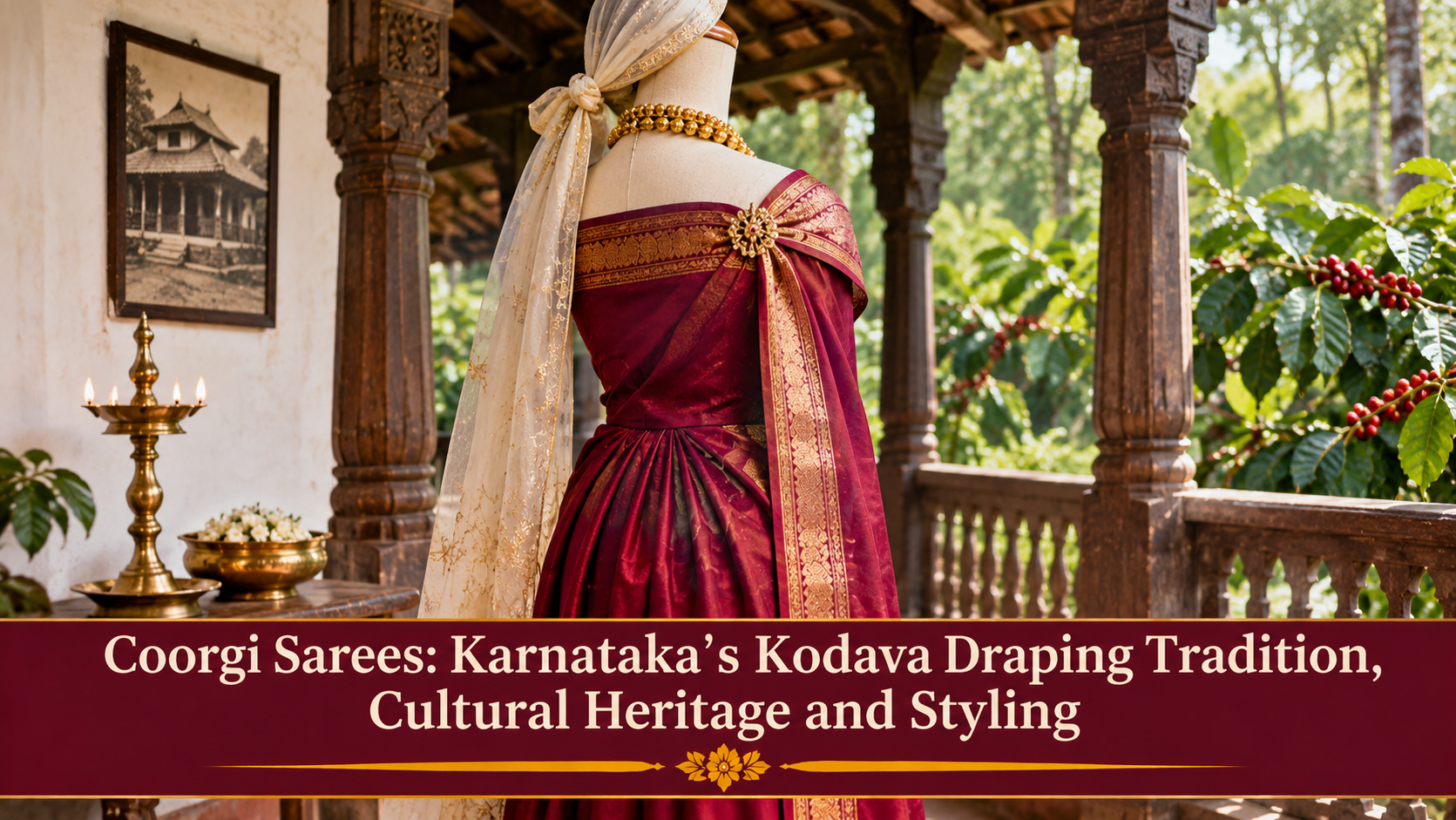
Most sarees are pleated at the front. The Coorg style saree is not. The Kodava women of Kodagu in Karnataka tuck their pleats at the back of the waist and bring the pallu to the front over the right shoulder, a silhouette that is easy to recognise once you know what to look for. Searches for a Coorg style saree usually come from three kinds of reader: someone who has seen it at a wedding or in the news and wants to learn the drape, someone buying a saree to wear this way, and someone curious about the community behind it.
This guide treats the Coorgi saree for what it is, a regional draping and dress tradition of the Kodava community. It is not a weave, and no single loom technique, fabric or motif makes a saree “Coorgi”. The guide explains where Kodagu and the Kodavas are, how the drape works and how it differs from other drapes, what is documented about fabrics, jewellery and ceremonial use, how to drape it step by step, and how to choose and care for a saree for the style. If you are still deciding on fabric, budget and occasion more generally, our complete guide to buying sarees for women covers the basics.
What a Coorgi or Kodava saree is
“Coorgi” is the older, anglicised form of the community and region’s name. Kodagu is the native name of the district, and Kodava is the name of the people, their language and their culture. A Kodava woman’s way of wearing the saree is what people usually mean by “Coorgi saree”, “Kodava saree” or “Kodagu style saree”.
Three features define it in the sources I reviewed:
- The pleats are tucked at the back of the waist, not at the front.
- The pallu comes around the body and is secured over the right shoulder, with the end brought to the front.
- A long veil is traditionally worn on the head and tied at the back of the neck.
That is a description of how a saree is worn. The Kodava community’s own cultural writing, such as a page by Kodava authors Boverianda Nanjamma and Chinnappa on a Coorg heritage website, identifies the community’s traditional dress as the first thing that strikes an outsider as different, and describes the drape as convenient for agricultural and other work because it leaves the hands free. Neither that source nor the others I found identifies a Kodava-specific weave, and no source describes the drape as a textile technique. A saree worn in this way can be silk, cotton, cotton silk or anything else.
Kodagu and the Kodavas: geographical and cultural background
The land
Kodagu, the British “Coorg”, is the smallest district in Karnataka. The Coorg heritage page describes it as perched on the Western Ghats at about 1,000 metres above sea level, with hills, dense forest, coffee estates and paddy fields in the valleys. About a third of the district is forested, and the monsoon lasts nearly four months. The River Kaveri (Cauvery), which rises in Kodagu, is revered by the people of the district as a mother goddess.
The same source gives the district a documented political history. Parts of Kodagu were ruled by chieftains owing allegiance to different dynasties. The Haleri Rajas ruled from 1600 to 1834, the British removed them and made Kodagu a separate province, and in 1956 it became part of Karnataka under the linguistic reorganisation of states.
The Kodava community
The Kodavas are among the earliest inhabitants of Kodagu. The Coorg heritage page notes that very little is known about their origins and that none of the many theories about them has been substantiated, a point echoed in India Currents, which says speculation about descent from soldiers of Alexander the Great or from pre-Islamic West Asian groups has never been proven. This article does not repeat any of those theories as fact.
What the sources do document:
- The Kodavas number roughly a lakh and a half worldwide, and since the 1871 census have never made up more than 20 per cent of Kodagu’s population, though the community has long been culturally prominent in the district.
- Kodava thakk, their language, is regarded by linguists as an independent Dravidian language with no script of its own. It has been written in the Kannada script.
- Society is organised in patrilineal clans called okkas, each tied to an ancestral house called an ainmane.
- The Kodavas are primarily ancestor and nature worshippers, with Kaveri, the sun, fire and sacred groves central to their practice, and they do not use Brahmin priests for birth, marriage or death ceremonies.
- Weapons have ceremonial importance. The community has a martial tradition, and men’s formal dress includes a dagger and a war knife.
Other communities in Kodagu also use Kodava dress. Reference works note that groups such as the Tulu-speaking Gowdas of western Kodagu wear Kodava ethnic dress during ceremonies, so the drape belongs to a regional culture and is not restricted to a single group in every context.
The distinctive Kodava draping style
The core of the drape is consistent across community-authored writing, journalism and fashion coverage:
- Pleats at the back. The Coorg heritage page says the Kodava woman drapes her sari with the pleats tucked at the back of the waist.
- Pallu under the left arm, secured on the right shoulder. The same page says the pallu is drawn under the left shoulder and secured over the right. India Currents puts it as one end wrapped under the left arm and pinned over the right shoulder.
- A veil at the back of the head. The heritage page describes a long veil (vastra) tied back at the nape of the neck. India Currents names the bridal veil a musku.
Accounts differ on small points, such as how the pallu is arranged before it is pinned. The differences are in how guides describe the sequence, not in the finished look.
How the pleats and pallu are arranged
The pleats are made in the usual way, with even folds, and then tucked at the centre back instead of the front. Instructional accounts report between five and seven pleats. The front of the saree is left smooth, and the fabric that would normally form the front pleats instead crosses the body.
The remaining saree is brought across the chest, so the border shows as a horizontal band at chest level. It then runs under the left arm to the back and comes up over the right shoulder, where it is pinned, usually with a brooch. The pallu falls in front. Some fashion accounts add that a pleat of the pallu can be pinned on the left shoulder, creating a double drape, but that detail is less consistently documented than the main arrangement.
Why the pleats are at the back
Two kinds of explanation exist. One is practical. Writers on the Kodava dress describe the style as suited to hill terrain and active work because the pleats are out of the way and the hands are free. India Currents says that with pleats safely behind and all corners pinned, the saree allows unhindered movement.
The other is a legend. In the popular story, the sage Agastya’s wife Kaveri left him to become the river, and in the force of her departure the pleats of the women’s sarees were blown to the back. India Currents and other accounts repeat the story. It is a legend associated with the drape, and none of the sources treat it as documented history. I found no reliable source that dates the origin of the drape, so any claim that it is “centuries old” or began in a particular period is unsupported here.
How the Coorgi drape differs from other saree drapes
| Feature | Kodava (Coorgi) drape | Nivi drape | Gujarati (seedha pallu) drape |
| Pleats | Tucked at the back of the waist | Tucked at the front | Tucked at the front |
| Pallu | Under the left arm, then over the right shoulder to the front | Over the left shoulder | From the back over the right shoulder, brought forward across the chest |
| Front of the body | Smooth, with the border crossing the chest | Pleated at the centre, pallu hanging behind | Pallu displayed across the front |
| Typical veil | Long veil tied at the nape (vastra or musku) | None | None |
| Associated with | Kodava community, Kodagu, Karnataka | Widely worn across India | Gujarat and parts of north and west India |
Two of these drapes bring the pallu forward over the right shoulder, which is why the Kodava drape is sometimes mistaken for the Gujarati one. They are different because the Gujarati drape keeps the pleats at the front, and the Kodava drape does not. Journalists describing the Nivi drape note that its pallu goes over the left shoulder with pleats at the front, so a saree draped that way with a pin on the right shoulder is not Kodava.
Traditional fabrics, colours and borders
This is the area where documentation is thinnest, so it is worth being precise.
- No Kodava-specific weave is documented. The sources describe a drape and an attire, not a loom tradition.
- Bridal sarees are documented. India Currents says Kodava brides wear their sarees in this style with a long-sleeved blouse and a veil, and that elaborate Benarasi silks embroidered with motifs, in shades from red to magenta, are preferred. It is customary for a bride to wear her mother’s or grandmother’s saree, many of which are preserved carefully over the years.
- Everyday fabrics are not systematically documented in the sources I found. Fashion writers report that younger Kodava women wear the drape in lighter fabrics such as chiffon, georgette and organza, but this is a fashion observation, not a documented tradition.
- Borders matter visually, because the drape shows a horizontal band of border across the chest and a visible pallu. This is a consequence of the draping, and no particular border type is documented as Kodava.
Any listing that ties a particular weave, motif, border or colour to “authentic Coorgi” should explain its basis. The drape is documented. A fixed Coorgi textile is not.
Cultural and ceremonial importance of Kodava attire
The Coorg heritage page calls the traditional dress the first thing that looks different about the Kodavas. Dress is closely tied to identity and to the martial tradition. Men wear the kupya, a long wrap-around tunic that is black for most occasions, with a red embroidered sash called a chele, into which a dagger (peechekathi) is tucked. White kupyas are worn only for special occasions, such as by bridegrooms. The bridegroom also carries a war knife (odikathi), and in the past kupyas could be of different colours with seams embroidered by Kodava women, who were known for their embroidery.
Weddings are where women’s attire is most visible. India Currents describes the bride in the drape, with the long-sleeved blouse, the veil and heirloom jewellery, at a two-day wedding with rituals at each family’s okka and a final gathering of family, clan and community to bless the couple. The same account says the attire is a throwback to days when people walked long distances through forests, and that the drape suits that way of life.
Preservation matters in this community. Sarees and veils are passed down, and the India Currents author writes that her family still uses her great-grandmother’s veil, a tissue-thin fabric that has witnessed many family weddings.
Traditional jewellery and accessories
Kodava jewellery is part of the attire and is described in the same sources. Its main features:
- Nature-inspired designs. The Coorg heritage page lists the moon, flowers, fruits and the snake, and India Currents adds the sun, flora and fauna.
- Repoussé work. Small amounts of gold are beaten thin and moulded into hollow forms, and a lac filling gives weight and shape.
- Gold for most pieces. India Currents says silver is used mainly for ornaments for the hands and feet.
| Ornament | Description (from the sources) |
| Kokke thathi | A long chain of hollow gold beads with a large crescent-shaped pendant, set with graduated rubies, with pearls hanging along the lower edge and a cobra hood at the top |
| Pathak | A necklace of gold and coral beads with a gold coin pendant framed by rubies and topped with a cobra hood. The heritage page calls it the symbol of a married woman |
| Jomale | Two long rows of grooved hollow gold beads strung on black cord |
| Paavale maala | A coral and gold necklace placed on the bride by her mother the evening before the wedding, according to India Currents |
| Jodi kadaga and pounchi | Hinged bracelets with two hollow gold bands, and bracelets of gold flower buds strung on elastic |
| Silver anklets and toe rings | Finely worked silver for the feet, with toe rings of different designs linked by chains to an anklet. The heritage page says this constrains the bride’s steps so she walks slowly |
India Currents also reports a tradition of seven ornaments for each part of the body for the bride, linked to the seven rishis who did penance at Talakaveri, while noting that it is increasingly rare for a bride to wear all seven sets.
Occasions when the traditional drape is worn
- Weddings. Documented for brides, who wear the drape with the veil and traditional jewellery.
- Ceremonies and family gatherings. The community gathers at the ancestral house for festivals and rituals such as the harvest festival Puthari. The sources I reviewed do not list the attire worn at each festival, so they should not be overstated.
- Everyday and working life. The heritage page’s description of the style as convenient for farm work suggests regular use, but this article does not claim that every Kodava woman wears the drape daily today.
- Weddings and receptions beyond the community. Fashion and news outlets have described brides and guests wearing Coorg-style sarees, usually in silk, at events in Kodagu and elsewhere.
Contemporary adaptations and modern styling
Contemporary use is wide, and much of it comes from outside the community. Commercial listings sell “Coorgi sarees” and “Coorg style” drapes, and fashion writers describe younger Kodava women experimenting with lighter fabrics. Two points are worth separating.
| Traditional Kodava attire | Commercial “Coorgi saree” listings | |
| What defines it | The drape, veil, jewellery and occasion, within Kodava custom | A saree marketed for the drape, or with a regional label |
| Fabric | Varied. Bridal Benarasi silks are documented | Any, often silk, cotton silk or lightweight synthetics |
| Weave or motif claims | None documented | Check the listing, since the drape is not a weave |
| Use | Within community ceremonies and customs | General wear, events, themed styling |
Both are legitimate in their place. The problem comes when a listing implies that the saree itself is a Kodava heritage textile.
Modern styling choices that follow the documented drape include:
- Choose a saree with a clear border or pallu, because the drape shows a band across the chest and the pallu in front.
- Keep jewellery in conversation with the community’s own: crescent pendants, gold bead chains and coral accents, treated with respect rather than as costume.
- Wear a long-sleeved or jacket-style blouse, which the sources associate with the traditional look.
- Add a long veil only when the occasion is ceremonial or you are following the community’s style closely.
How to drape a saree in the Kodava style
The steps below follow the sequence in Kodava community writing and widely used instructional accounts, which agree on the finished look. If you are new to pleating and securing a saree in general, our guide to saree draping styles for beginners covers petticoat fit, pleat width and pinning. Try the drape once before an event, because the pleats are at the back and a mirror or a helper makes it easier.
What you need: a saree, a petticoat tied firmly at the waist, a blouse (long-sleeved for a traditional look), a brooch or strong pin for the shoulder, and a few safety pins.
- Start at the back. Tuck one end of the saree into the petticoat at the back on your right side. Bring the saree around the front and complete a full round from the left.
- Make the pleats. Make five to seven even pleats, as for a regular drape. Many guides suggest pleating at the front first, pinning them together, and then moving the bunch to the back, because pleating behind your own back is hard.
- Tuck the pleats at the back. Place them at the centre back of the waist and tuck them in firmly so they sit flat and point backwards.
- Cross the torso. Take the rest of the saree from your right side across the front, horizontally over the chest, so the border shows as a band at chest level.
- Bring it to the back. Continue the fabric under your left arm to the back.
- Bring the pallu over the right shoulder. Lift the end from the back over your right shoulder so it falls at the front.
- Pin it. Fasten the pallu on the right shoulder with a brooch. Check that the pin goes through a secure layer and does not pull on the fabric.
- Adjust. Check the hem, make sure the front is smooth, and walk and sit to confirm the drape is comfortable. Tie a long veil at the nape of the neck if you are wearing one.
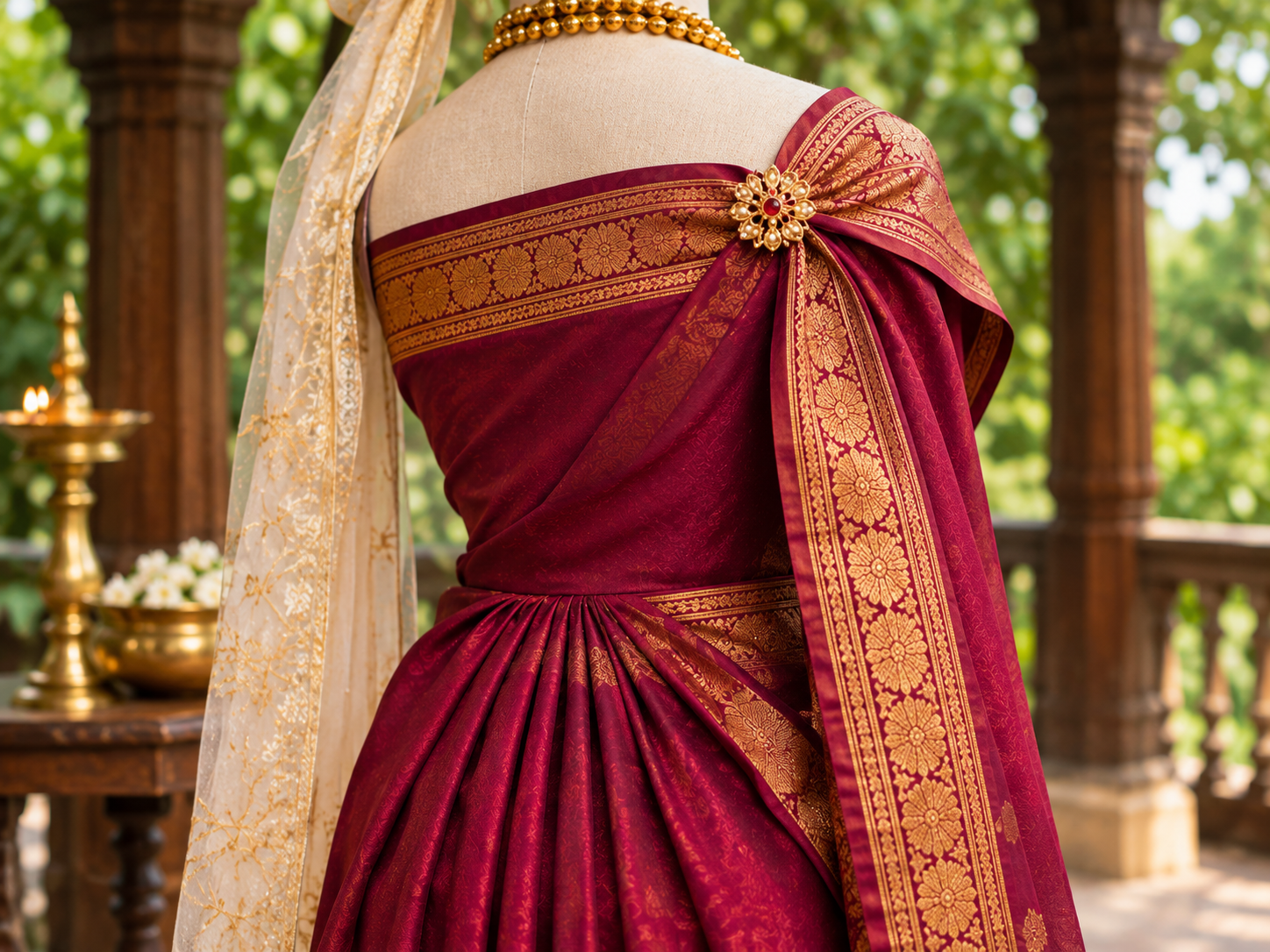
Guides differ on small details, such as the number of pleats and the exact route of the pallu before it is pinned, so use the steps as a starting point. For a ceremonial occasion, such as a Kodava wedding, ask someone from the community how it is worn in that family.
Common mistakes when attempting the drape
- Pleating at the front out of habit. The defining feature is the back pleats, and a front-pleated drape with the pallu on the right shoulder is a different drape.
- Making the pleats too bulky. Seven wide pleats of heavy silk can sit awkwardly at the back, so narrower folds or a lighter fabric help.
- Tucking the pleats loosely. They are out of sight, and a loose tuck can slip without you noticing.
- Pulling the cross-body fabric too tight under the left arm. That restricts movement, which the drape is meant to allow.
- Not securing the pallu. Pin the shoulder end firmly, particularly with slippery fabrics.
- Hiding the border. The border across the chest is part of the look, so do not let it twist or fold under.
- Treating it as costume. If you are not from the community, wear the drape with attention to its meaning, and do not copy ceremonial jewellery as a novelty.
How to choose a saree for the Kodava drape
Because the drape is the tradition, choose for the drape.
- Fabric that holds a clean pleat without bulk. Silk, cotton silk and crepe tend to hold pleats well, while very heavy brocades add weight at the back. For a clear picture of how cotton silk blends feel and behave, see our guide to cotton silk sarees, their price factors and care.
- A visible border and pallu. The drape displays the border across the chest and the pallu at the shoulder, so a plain body with a defined border works well.
- Colour for the occasion. Brides in the community prefer reds and magentas in Benarasi silk, according to India Currents, and everyday choices are open.
- Comfortable length and weight. You will move in it, so avoid an overly stiff or very short saree.
- Honest labelling. Be wary of a saree that is sold as “authentic Coorgi” because of its weave. Look at the fabric, the border and how it is described.
If you are shopping on screen, our online saree shopping guide on checking fabric, colour, quality and seller details explains how to read listings and which questions to ask a seller.
Saree care and preservation
Care depends on the fibre, so follow the label first.
| Area | Practice |
| Washing | Dry clean silk and zari borders. Wash cotton and cotton blends gently if the label allows |
| Pleats | Press on the reverse at a setting for the most delicate fibre, and avoid hard creases at the back pleats |
| Pins | Use pins and brooches through secure layers, and avoid pulling threads on delicate borders |
| Drying | Dry in shade, away from direct sun |
| Storage | Fold in muslin or soft cotton, refold along different lines from time to time, and keep away from damp |
| Heirlooms and veils | Store flat or loosely folded in cloth, avoid long storage in plastic, and take advice from a textile conservator before cleaning very old pieces |
Because Kodava families pass sarees and veils down, careful storage is part of the tradition.
Frequently asked questions
1. What is a Coorg style saree? It is a saree worn in the draping style of the Kodava community of Kodagu (Coorg) in Karnataka. The pleats are tucked at the back of the waist, and the pallu is brought under the left arm and pinned over the right shoulder, usually with a brooch.
2. Is a Coorgi saree a special weave or fabric? No. It is a draping and dress tradition, and no Kodava-specific weave is documented. A Coorg style saree can be silk, cotton, cotton silk or another fabric. Documented bridal sarees are often Benarasi silks in reds and magentas.
3. How is the Kodava drape different from the Nivi drape? In the Nivi drape the pleats are at the front and the pallu goes over the left shoulder. In the Kodava drape the pleats are at the back and the pallu is secured over the right shoulder.
4. Why do Kodava women tuck the pleats at the back? Community writing describes the drape as practical for hill terrain and farm work because it keeps the hands free. A popular legend links it to the river goddess Kaveri, but it is a legend, and no reliable source dates the drape’s origin.
5. How many pleats are used in the Coorgi drape? Instructional accounts mention five to seven pleats, tucked at the centre back. The number depends on the saree’s fabric, width and length, so aim for even folds that sit flat.
6. What jewellery goes with the Kodava saree? Traditional pieces include the kokke thathi crescent pendant chain, the pathak, the jomale and gold bangles such as the jodi kadaga. Brides also wear silver ornaments on the hands and feet. These are community heritage pieces, so approach them with respect.
7. Can anyone wear a saree in the Coorgi style? Yes, the drape is widely worn as a fashion style. For ceremonial occasions within the community, follow its customs, and credit the Kodava tradition when you describe the look.
8. How do I care for a saree worn in the Kodava style? Dry clean silk and zari borders, press on the reverse and avoid hard creases at the back pleats. Store folded in muslin, refold occasionally, and keep away from damp.
Conclusion
The Coorgi saree is a way of wearing a saree rather than a kind of saree. It belongs to the Kodava women of Kodagu, whose drape puts the pleats at the back, crosses the border over the chest and fastens the pallu on the right shoulder, and it sits within a wider set of customs that includes the veil, nature-inspired gold jewellery and heirloom bridal silks. The sources describe this attire well but do not date it, and they do not tie it to any particular weave. When you choose a saree for the drape, look at how it holds a pleat, how its border will show, and how honestly it is described. A seller who calls it a drape-ready saree is on firm ground. One who sells a “Coorgi weave” has to show where that claim comes from.
