
Blog
Leheriya Sarees: Rajasthan’s Traditional Wave Tie-Dye Technique, Patterns and Colours

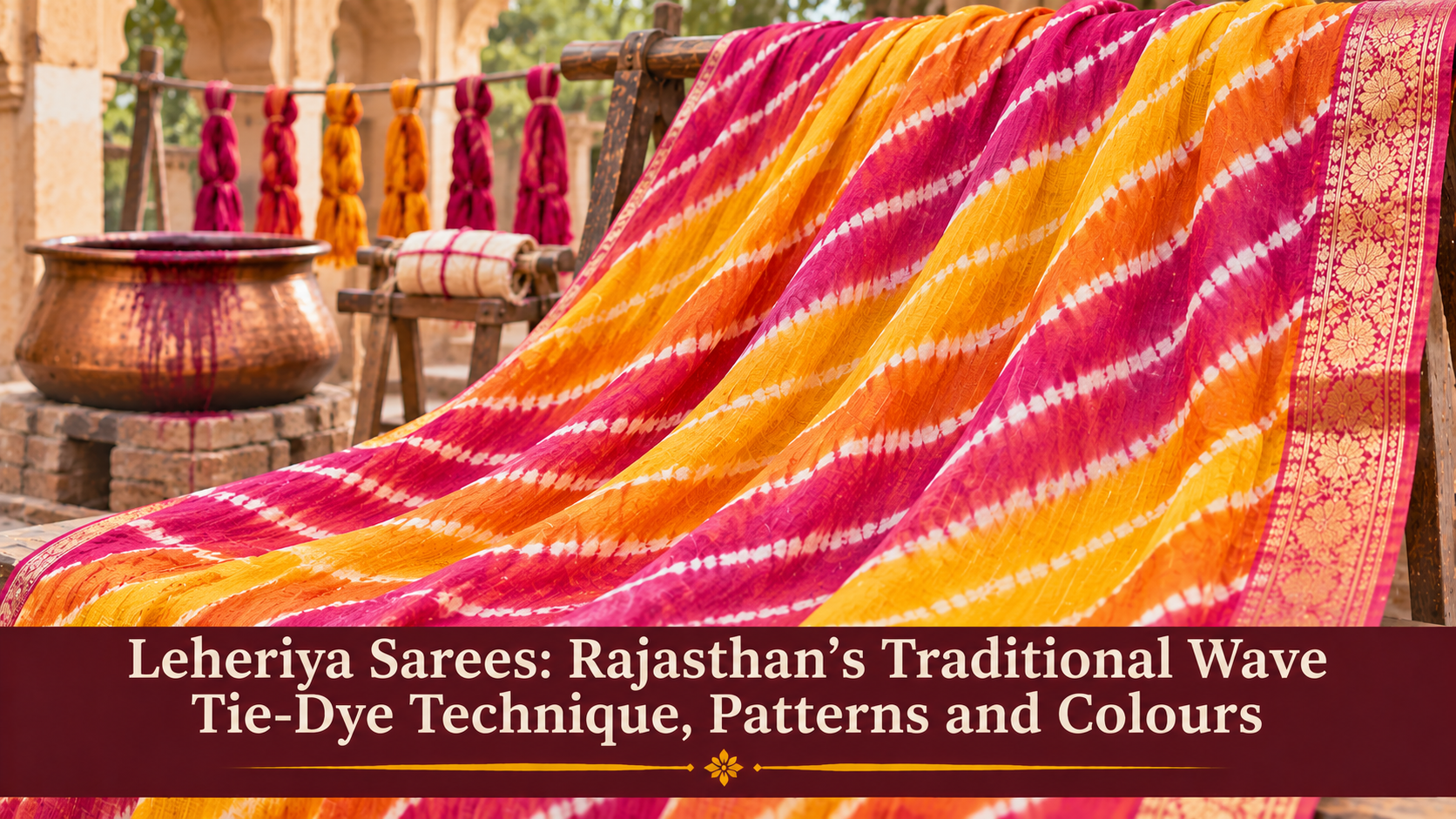
Hold a leheriya saree up to the light and the stripes seem to move. They run on the diagonal in bands of different widths, each edge slightly soft where dye crept toward the part of the cloth that was tied. That softness is the signature of the technique. It comes from rolling a whole length of fabric, binding it at intervals and dipping it in dye, and it is very hard to fake convincingly with a printing screen.
This guide explains what leheriya is, where it comes from, how a Jaipur leheriya saree is made, how it differs from mothara and bandhani, what the traditional colours are associated with, and how to check a saree before you buy. If you are still comparing saree types in general, our complete guide to buying sarees for women covers fabrics, occasions and price factors before you narrow down to one craft.
What leheriya means and where it comes from
Leheriya is a resist-dyeing technique from Rajasthan that produces diagonal or chevron stripes. The name is generally traced to a word meaning “wave” (lahara in Sanskrit, lehar in Hindi), and craftspeople describe the designs as inspired by the ripples that wind makes across desert sand. Different spellings appear in sources, including leheria, lehariya and lahariya. They all refer to the same craft.
Google Arts and Culture material prepared with the Dastkari Haat Samiti describes leheriya as exclusive to Rajasthan, with Jaipur and Jodhpur as the main centres. Other sources add Udaipur and Nathdwara as places where it is still produced. This is why “Jaipur leheriya saree” is a common search phrase. Jaipur is a documented centre, though it is worth remembering that a saree sold in Jaipur is not automatically dyed there.
A court craft before it was a saree
The same material notes that textile fragments in leheriya and dotted tie-dye, used as royal turban cloths, date to the 17th century. Rajput rulers patronised the craft, and each royal house is said to have had its own signature patterns and colours. Turban cloths for the court were made on fine Bengal muslin, woven on narrow looms, by artisans attached to the household. Difficult designs could use up to nine tints and take as long as a month, and favoured artisans could be rewarded with land or grain.
Leheriya turbans were also a standard part of men’s business dress in Rajasthan in the 19th and early 20th centuries. Sarees, veils and dupattas are made with the same technique today, which is why many people now meet leheriya first as a saree, though its history is closely tied to the turban.
How leheriya is made
Leheriya is a wrap-resist technique. Unlike bandhani, where small points of fabric are pinched and tied one by one, leheriya involves rolling up a long length of cloth and binding it at intervals. Dye cannot reach the bound sections, so they stay lighter, and the exposed sections take the colour.
| Stage | What happens | Why it matters |
| Preparing the cloth | The fabric is soaked in a degumming solution, often overnight and boiled if needed, to remove starch and impurities | Clean cloth takes dye evenly |
| Folding or rolling | The cloth is folded diagonally and rolled, or folded like a fan | The way it is folded decides whether stripes run straight or form chevrons |
| Tying | The roll is tied at intervals with multi-ply untwisted yarn, in documented practice by women artisans called bandhere, often working at home | The tie spacing sets the width of the stripes |
| Soaking | The tied cloth is soaked in water before dyeing | Damp cloth absorbs dye more evenly |
| Dyeing | Dye is mixed in a large vessel, and salt is added to fix colour on cotton | Exposed parts take colour while tied parts resist it |
| Spinning and drying | Excess water is spun out and the cloth is dried | Ties are removed only once the cloth is dry |
| Untying | The ties are removed and the cloth is opened out | The stripes appear |
Repeated dyeing and layered colour
To get stripes in more than one colour, dyers loosen some ties and leave others, then dye again. Colours are generally built up in stages, and the Dastkari Haat Samiti notes that fugitive colours are used so that unwanted colour can be removed to leave cleaner lines. Craft sources also describe traditional leheriya using natural dyes, with indigo or alizarin used at a late stage. Modern production may use other dyes, and the saree label rarely says which, so it is a fair question to ask the seller.
Why the fabric has to be fine
Leheriya works best on very fine cotton and silk. The Dastkari Haat Samiti explains that thin cloth lets dye reach the inner layers of the roll, and that its translucency lets colour and pattern interact when the cloth is worn. Georgette and chiffon leheriya sarees are also sold widely now. These are modern commercial variations, and the dyeing method is the same wrap-resist principle when they are genuinely tie-dyed.
Leheriya, mothara and bandhani: the technical differences
These three are often mixed up in shops and listings, so it helps to put them side by side.
| Feature | Leheriya | Mothara | Bandhani |
| Resist method | Whole cloth rolled and tied at intervals | Leheriya dyeing repeated after re-rolling along the opposite diagonal | Tiny points of cloth pinched and tied individually |
| Pattern | Diagonal stripes or chevrons running in one direction | Checks or diamonds formed by two sets of diagonals crossing, with small undyed squares | Dots, clusters and figurative shapes |
| Name | From “wave” | From moth, “lentil,” after the small undyed spots | From a word meaning “to tie” |
| Where it is strongly associated | Rajasthan, mainly Jaipur and Jodhpur | Rajasthan, as an extension of leheriya | Rajasthan and Gujarat |
Mothara deserves a closer look because it is the most misunderstood of the three. In making mothara, the original resists are removed and the fabric is re-rolled and tied along the opposite diagonal, then dyed again. The result is a checkered pattern with small undyed areas at regular intervals, roughly the size of a lentil. The Textile Research Centre describes it as a small checked pattern with diagonal lines in two directions. So a saree with stripes in a single direction is leheriya, and one with crossing diagonals and tiny pale squares is mothara.
Bandhani is a separate craft and should not be used as a synonym. Dotted patterns belong to bandhani, even when a retailer’s listing mentions “tie-dye” for both. A saree that combines stripes and dots exists in some regional traditions, but it should be described as a combination and not simply as leheriya.
Traditional colours and what sources say about them
Colour meanings in textile writing are easy to overstate, so this section sticks to what craft documentation supports.
- Red, yellow and orange: The Dastkari Haat Samiti notes that leheriya in red, yellow and orange is popularly bought for the male members of a wedding party, mostly as turban cloth.
- Rani pink: A vivid pink leheriya saree is considered auspicious and is made specially for brides to wear at the first Teej after marriage. The deep pink is locally called “rani pink,” linked to the queens of Rajasthan.
- Festival association: More ornamented leheriya pieces are kept for weddings and festivals such as Gangaur and Teej, which herald spring and the monsoon.
Some retailers attach meanings to other colours, such as green for the monsoon. Museum and craft-body sources reviewed for this article do not document those links, so treat them as popular custom and not as a rule. Today leheriya is made in a very wide range of colours, and a modern palette does not make a saree any less genuine.
How the pattern appears across the body, border and pallu
Documentation of leheriya saree layouts is thinner than documentation of the technique, so the following describes what commonly appears on sarees and not a fixed tradition.
- Body: Stripes usually run diagonally across the full length, in bands of varying width. Chevron arrangements, where stripes meet in a V, come from the fan fold.
- Border: Many sarees are finished with a plain, contrast or applied border, such as a thin gota or zari strip. Some have none.
- Pallu: The pallu usually continues the stripes, and sometimes carries wider bands or a deeper colour. Alignment between body stripes and pallu stripes is a useful quality check, since long rolls are tied as one piece.
Because the cloth is rolled and tied as a length, the pattern is continuous. If a saree shows stripes that abruptly change angle or spacing at a seam, ask whether it was joined from separate pieces.
Cotton, silk and other fabrics
| Fabric | How it behaves with leheriya | Typical use |
| Fine cotton | Takes dye well, breathable, softens with wear | Daytime, warm weather, everyday festive wear |
| Silk | Gives deeper colour and a soft sheen | Weddings and formal festivals |
| Georgette and chiffon | Light and fluid, common in modern commercial leheriya | Parties, festive evenings |
| Blends and synthetics | Dye uptake and colour clarity vary widely | Budget festive wear; check fibre details and ask about the method |
Fibre details matter because dye behaves differently on each. If you want to understand how cotton and silk differ in feel, weight and care before choosing, the fabric tables in our pillar guide are a good reference. For light, slippery fabrics such as georgette, a drape guide helps. Our saree draping styles for beginners explains pleating and pinning for fabrics that slip.
Hand-dyed leheriya, machine-dyed lookalikes and printed imitations
Many sarees are sold as leheriya because the stripe pattern is popular. They fall into three groups.
| Type | How the pattern is made | What to look for |
| Hand tied and dyed leheriya | Cloth rolled, tied and dipped in dye, as described above | Soft, slightly irregular stripe edges, dye visible on both sides, small variations in width |
| Machine or mass-dyed stripe | Cloth dyed in bulk, sometimes with mechanical resist or dip dyeing | More even bands, less variation, pattern may lack the soft edge |
| Printed leheriya lookalike | Stripes printed on the surface with ink | Crisp, uniform edges, pattern can look faded or different on the reverse, repeats look identical |
These are general tendencies. Some machine-assisted dyeing is well finished and honestly sold, and a printed stripe saree can still be attractive. The point is accuracy. A listing that calls a printed saree “hand tied leheriya” is not describing the craft truthfully, and not every striped tie-dye pattern is authentic leheriya.
The Gillow and Sentance reference book World Textiles notes that leheriya is traditionally offered for sale with most of its resist ties still in place, with a small section unrolled to show the pattern, as proof of authenticity. That practice applies mainly to cloth sold in lengths, such as turban cloth, but it shows how closely the tie marks are associated with real wrap-resist work.
Styling for festivals, weddings and everyday wear
Leheriya has a long festive history, so it works well for celebrations, though lighter versions suit daily wear too.
- Festivals: Teej and Gangaur are the traditional festival associations. Bright colours with a contrast blouse in a plain shade are a common choice. For nine-night festivals, our Navratri accessories guide explains jewellery, dupattas and footwear that hold up through long evenings of dancing.
- Weddings: Silk leheriya or a deep rani pink piece suits family functions. Pair with gold or kundan jewellery and a silk or brocade blouse.
- Everyday wear: Cotton or soft georgette leheriya in lighter colours is easy to wear to the office or a family lunch.
Blouse and accessory combinations
| Saree colour | Blouse idea | Accessory idea |
| Rani pink with orange or yellow bands | Plain deep green, gold or maroon | Gold jhumkas, a simple kada |
| Red, yellow and orange stripes | Solid cream or a dark shade drawn from one stripe | Oxidised silver or temple jewellery |
| Blue and white stripes | White, navy or a bright contrast | Silver or pearl pieces |
| Pastel mixed stripes | A plain blouse in one of the pastels | Light studs and a thin chain |
A plain blouse usually lets the stripes do the work. If the saree has several strong colours, picking the blouse from one of them keeps the look balanced.
How to assess pattern consistency, dye quality and fabric
A few minutes of inspection will tell you much about how a saree was made.
- Check the stripe edges. Hold a section up to the light. Hand tied stripes have soft, slightly uneven boundaries where dye bled toward the ties. Razor sharp edges that repeat identically across the cloth suggest printing.
- Compare both sides. Dye in genuine tie-dye usually penetrates the cloth, so the pattern shows on the reverse. A printed stripe often looks weaker or blank on the back.
- Look at spacing. Small variations in stripe width are natural. Perfectly regular bands may point to machine work.
- Follow the stripes from body to pallu. The angle should continue smoothly across the length, apart from deliberate variations.
- Check colour clarity. Colours should look distinct and not muddy where they meet. Heavy colour mixing at stripe boundaries can mean poor dyeing control.
- Touch the fabric. It should feel consistent. Stiffness can signal heavy starching or print coating.
- Check for dye spots. Dark specks or patches suggest uneven dye handling.
- Ask what it is. Ask whether the saree is hand tied, whether the dye is natural or synthetic, and what the fibre is.
When you buy from a screen, the same checks apply with a few extras. Our online saree shopping guide covers how to read descriptions, judge close-up photographs and question a seller before you pay.
Care and colour preservation
Dye behaviour varies between pieces, so follow the care label or seller advice first. These steps are general guidance and have not been tested on any specific saree.
- First wash: Wash a new leheriya separately, because colours may run. Dry cleaning is safer for silk, deep colours or heavily embellished borders.
- Water and detergent: Use cold water and a mild detergent made for delicate fabrics. Avoid soaking for long periods.
- Handling: Press water out gently without twisting or wringing.
- Drying: Dry in the shade. Direct strong sunlight can fade bright dyes.
- Ironing: Use a low to medium setting on the reverse, with a thin cloth over the surface if the fabric is delicate.
- Storage: Fold in soft cotton or muslin, keep dry, and refold along different lines now and then to avoid permanent creases. Avoid long storage in plastic.
- Perfume and jewellery: Spray perfume on skin before dressing, not onto the fabric, and watch for rough jewellery that can snag fine cloth.
- Colour bleeding: If a colour bleeds in water, rinse promptly in cold water and consult a professional cleaner. Do not leave a wet leheriya folded against other clothes.
Frequently asked questions
1. What is a Jaipur leheriya saree? It is a saree dyed with the leheriya wrap-resist technique, which produces diagonal or chevron stripes, in or associated with Jaipur, one of the main centres of the craft. Jaipur and Jodhpur are the two centres most often named in craft documentation.
2. What does leheriya mean? The word comes from a term meaning “wave.” Craftspeople describe the designs as inspired by ripples that wind forms on desert sand.
3. How is leheriya different from bandhani? Bandhani is made by tying tiny points of cloth individually, which creates dots and clusters. Leheriya is made by rolling the whole cloth and binding it at intervals, which creates stripes. Both are resist-dyeing crafts, but they are different techniques.
4. What is mothara? Mothara is an extension of leheriya. After the first dyeing, the resists are removed and the cloth is re-rolled along the opposite diagonal, then dyed again. This produces a checkered pattern with small undyed squares, named after the lentil.
5. Is every striped tie-dye saree leheriya? No. Stripes can be printed, machine dyed or created by other methods. Authentic leheriya is hand tied and dyed using the wrap-resist technique, so ask the seller how the saree was made.
6. Which colours are traditional for leheriya? Craft documentation links red, yellow and orange to wedding turbans, and a vivid rani pink to brides at their first Teej after marriage. Many other colours are made today.
7. Can I wash a leheriya saree at home? Some fine cotton pieces can be hand washed gently in cold water with mild detergent, but colours can run and silk is usually safer dry cleaned. Wash a new piece separately and follow the care label.
8. How can I tell if a leheriya saree is hand dyed? Look for soft, slightly uneven stripe edges, dye visible on both sides, and small variations in stripe width. Printed stripes tend to look crisp and identical, and the reverse often looks faded.
Conclusion
Leheriya is a craft with a specific method: roll the cloth, bind it at intervals, dye it and open it to reveal the waves. That method separates it from bandhani’s dots and from mothara’s crossing diagonals, and it explains why hand dyed pieces show soft stripe edges and colour on both sides. Jaipur and Jodhpur are its best documented centres, and the colours people associate with it, from wedding reds to rani pink, are tied to specific customs.
When you shop, ask how the saree was made, check the stripe edges and the reverse side, follow the pattern from body to pallu and read the fibre details. With those habits you can tell a tie-dyed leheriya from a printed stripe and look after it so the colours last.
