
Blog
Pichwai Sarees: Traditional Temple Art, Krishna Motifs and Textile Designs

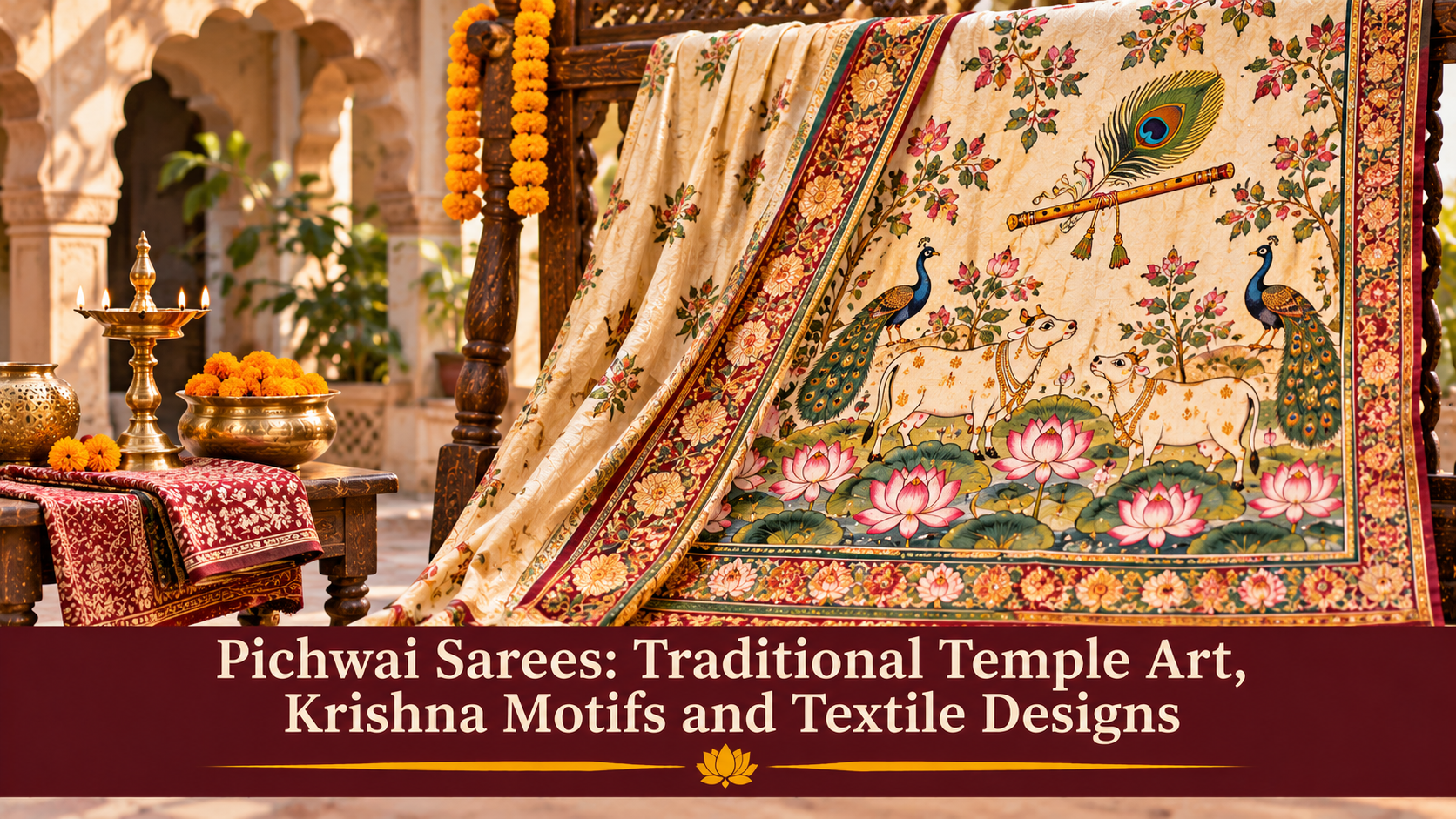
Search for pichwai sarees and you will find hand-painted silks, digital prints on georgette, woven jacquards and block-printed cottons, all sold under one name. The name comes from a specific temple art made in Nathdwara, Rajasthan, and the saree versions borrow from it in very different amounts. Some carry only a lotus or a row of cows. A few are painted by hand with real care. Many are prints of paintings that were made for a different purpose.
This guide explains what Pichwai art is, where it comes from and what its motifs mean in the tradition that produced them. It then shows how those motifs reach fabric, how hand-painted, printed and woven versions differ, and how to judge a Pichwai-inspired saree before you buy. It also separates the original painting tradition from contemporary textile adaptations, because the two are related but they are not the same thing. If you are still deciding on fabric, budget and occasion in general, our complete guide to buying sarees for women covers those basics, and you can return here for the Pichwai details.
What Pichwai art is
What the word means and what a pichwai does
Pichwai (also spelled pichhwai or picchwai) comes from words meaning “back” and “hanging”. A pichwai is a large painted or woven cloth hung behind the image of a deity. The tradition most closely tied to it is Pushtimarg, a Hindu devotional path that centres on Krishna as a child.
The Smithsonian’s National Museum of Asian Art describes pichwais as often monumental works, some as large as about 8 by 10 feet, hung behind sculptures or icons of Krishna. They are found mostly in temples, though some hang in homes. In Pushtimarg practice, devotees care for the child Krishna through rituals eight times a day, offering food, flowers, jewellery, music and song. The pichwai is part of that setting. Temples hang and remove pichwais according to the season or the festival being observed, so a single temple may use many different cloths over a year.
That function matters for anyone buying a saree. A pichwai was made to sit behind a deity as part of daily worship. It was never designed to be worn, folded into pleats or draped over a shoulder.
Pichwai and Nathdwara painting
Nathdwara is a town in the Rajsamand district of Rajasthan, built around the Shrinathji temple. Shrinathji is the form of Krishna worshipped there, shown as a young boy. The government’s craft resource for handicrafts, run under India’s Ministry of Textiles, lists Nathdwara Pichhwai painting as a Rajasthan folk painting and says the cloths are made as devotional backdrops for Shrinathji. Art writers place pichwai within the wider Nathdwara school of painting, which is linked to the Mewar tradition of miniature painting. Pichwai is the most widely known product of that school.
Nathdwara is the best-known centre, but not the only one. The Indian arts platform Sarmaya notes that families and workshops in Burhanpur in Madhya Pradesh and Machilipatnam in Andhra Pradesh have also produced pichwais. A Smithsonian pichwai made for the monsoon season, on indigo-dyed cotton, is attributed to Hyderabad. So “Pichwai” describes a type of devotional cloth with several places of production, though Nathdwara dominates the history and the name.
Historical background of Pichwai paintings
Pushtimarg and the move to Nathdwara
The Pushtimarg tradition was established by the teacher Vallabha, who lived from 1479 to 1531, according to the Smithsonian. Its early strength lay in Braj, the region around Mathura and Vrindavan associated with Krishna’s childhood. The government craft resource dates pichwai painting at Nathdwara to the 17th century, which fits the period when the Shrinathji image came to Mewar and a temple town grew around it. Accounts of the move differ in detail, so it is safest to say that Nathdwara became the main centre of the tradition from the 17th century onward.
From woven cloth to painted cloth
The Smithsonian’s curators explain that pichwais at first consisted mainly of floral or patterned cloths, usually hand-woven. Around the mid-18th century, artists began painting on cotton, working gold into the designs and using pigments that were popular in India and in parts of Europe. The shift likely followed the growing popularity of painting on paper in the same period. Pichwai painting therefore did not appear fully formed. Woven and patterned temple cloths came first, and the painted, narrative form developed later.
That history is worth holding onto when you see a “woven pichwai” saree. Woven pichwai-style cloth has a long precedent. The skill is not new, but a modern jacquard saree is still a different object from a temple cloth.
Artists and workshops
The craft resource names the Chitere community, including Adi Gaur, Joshi and Jangid artists, as the makers of Nathdwara pichwais. Sarmaya adds that painting families such as the Jangir Brahmins and Adi Gaur Brahmins link their work to the migration of the sect to Nathdwara, and that each group tells its own history. Skills have traditionally passed from master to student inside workshops.
Few pichwai painters signed their work until the late 19th or early 20th century, when Ghasiram Hardev Sharma became a master of the painting and photography workshops in Nathdwara. Because older pichwais are mostly unsigned, museums often label them “unknown artist” with a date range and a place.
Shrinathji, Nathdwara and the temple calendar
Pichwai designs follow the ritual year. The Museum of Art & Photography in Bengaluru, which holds a large Nathdwara collection, catalogues works titled after specific observances, such as Nandmahotsava (a late 19th-century cloth in mineral pigments, gold and silver on cotton, made in Nathdwara) and the Maha Daan Leela. The Smithsonian’s group includes pichwais for Sharad Purnima, the autumn full moon, for Kunj Ekadashi, the festival of the grove, and for the monsoon.
The government craft resource lists the episodes that recur in this art: the Rasleela, Govardhan Puja and Annakuta, along with scenes of Krishna’s adornment for Janmashtami and Gopashtami. A temple pichwai is therefore a calendar object. Its imagery tells the community which season or festival is being observed.
Krishna themes and symbolism
The Smithsonian notes that the pichwais in its collection show Krishna as a child, playing his flute, dancing, making mischief and protecting his community. The central figure is Shrinathji. In the Smithsonian’s entrance example, a blue-skinned boy in garlands and necklaces plays with a scarf while four cows look up at him. Each work is also understood as an offering. The Nathdwara tradition treats painting a pichwai as seva, devotional service, and the cloth is made for ritual use rather than for decoration.
Several kinds of subject appear again and again:
- Portraits of Shrinathji in seasonal dress and ornament.
- Narrative scenes from Krishna’s life, including dances with the gopis (the milkmaids) and the lifting of Govardhan hill.
- Festival offerings, such as the food mountains of Annakuta.
- Nature compositions, such as lotus ponds, groves and monsoon skies, which set the mood of a season.
Common Pichwai motifs and what they mean
Motif meanings in a living religious art are traditional readings, and they vary by workshop and by region. The table gives the most commonly cited associations, drawing on the government craft resource and museum descriptions.
| Motif | How it appears in Pichwai art | Commonly cited association | How it shows up on sarees |
| Cows | In rows, grouped around Shrinathji, or as a repeated border; central to Gopashtami imagery | Krishna the cowherd, devotion and care | Scattered across the body or arranged along the pallu |
| Lotus | Single large blooms, dense lotus ponds, or flowers offered at the feet of the deity | Purity (a reading given by the craft resource) | Repeating lotus fields, border bands, pallu medallions |
| Peacocks | Standing figures, feathers in Krishna’s crown, monsoon scenes | Monsoon and the season of rain | Pairs of peacocks on the pallu, feather motifs on borders |
| Flowers and garlands | Floral cloths (the oldest pichwai type), garlands and offerings | Offerings made to the deity during worship | Allover floral grids, trailing vines, floral borders |
| Sacred scenes | Rasleela, Govardhan Puja, Annakuta, festival adornment | Specific episodes of Krishna’s life and the temple calendar | Pallu panels, sometimes a small framed scene |
| Shrinathji and gopis | Central figure with attendants | The deity and his community | Usually avoided or kept small on worn textiles |
Seeing one of these motifs on a saree does not make it a Pichwai textile. A lotus appears across Indian art, and cows and peacocks appear in many folk traditions. The motif counts as Pichwai-derived only when the composition, colour treatment and subject draw clearly on Nathdwara painting.
Traditional colours, compositions and painting methods
Colours and composition
Traditional pichwai colour is strong and deliberate. A government-linked craft summary describes deep reds, blues, greens, gold and saffron, with black grounds used for night scenes. The Smithsonian’s monsoon pichwai uses an indigo-dyed cotton ground with gold, silver and opaque watercolour. Gold and silver add light to ornaments, crowns and borders.
Many pichwais are built around one of two layouts. One places a central figure, usually Shrinathji, on a framed ground with attendants and animals arranged around him. The other covers the whole cloth with a dense, repeating field such as a lotus pond, a grove of flowering trees or rows of cows, framed by a border. Both layouts transfer to sarees, but in different ways, which the section on adaptation covers below.
Materials and tools
The Ministry of Textiles’ craft resource lists the materials used in Nathdwara pichwai painting. The pigments come from minerals and plants such as indigo, saffron, coal and zinc, with gold leaf and red lac used for emphasis. The ground is hand-spun cotton treated with a flour paste. Squirrel-hair or goat-hair brushes handle fine detail, seashells hold the colours, gum arabic binds the pigment, and burnishing stones smooth and deepen the surface.
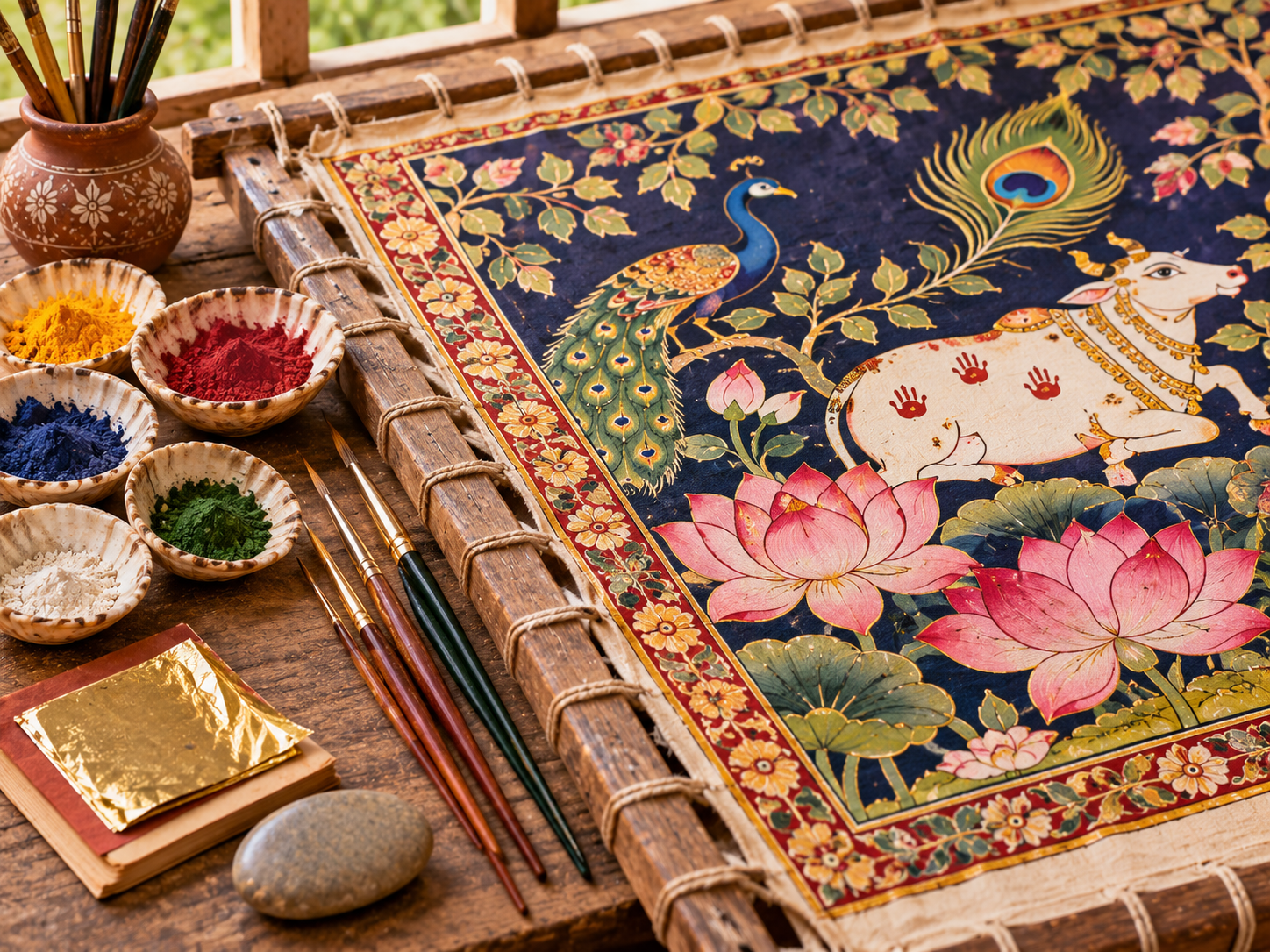
Museum research adds a caution. The Smithsonian’s conservation scientist found that pichwai painters readily adopted new materials as they became available, for example replacing a corrosive copper-based green with a gentler imported green pigment. Pigment use in pichwai has been documented but not fully verified. So “made only with traditional mineral colours” is a claim to treat carefully, even for old pieces.
The painting process
The craft resource describes the steps in this order:
- The cotton cloth is stretched and coated with a white paste called kharia, which gives a smooth base.
- The artist draws the composition in black pigment.
- Natural colours mixed with gum arabic are filled in.
- Gold detailing is added to ornaments, borders and other areas.
- The outlines are drawn again to sharpen the figures.
Time depends on size and detail. Sellers who work in this tradition commonly describe a temple-scale pichwai as taking from a few weeks to a few months. Painters traditionally learn in the workshop under a master, so training is slow by design.
How Pichwai art becomes a saree
What carries over to fabric
A saree is a long, narrow, pleated and draped piece, and a pichwai is a large rectangle viewed flat. Designers have to decide what to take and where to place it.
Most Pichwai-inspired sarees borrow motifs rather than whole scenes. The body of the saree often holds a repeated motif such as lotus blooms, cows or floral sprays, in a layout like the allover cloths of older pichwais. The pallu, the end piece seen on the shoulder, tends to carry the most detailed panel: a lotus pond, a pair of peacocks or a cow-and-grove scene. The border echoes the painted frames of temple cloths.
Large figural scenes are harder to place, because pleating and draping break them up. When a saree does carry a figure of Shrinathji, that image will fold and fall across the body, which some wearers prefer to avoid. We return to this in the FAQs.
Fabric bases
Traditional pichwais are painted on cotton. Contemporary sarees use a wider range. Sellers commonly offer Pichwai-inspired designs on silk, organza, cotton silk, chanderi, linen, tussar and georgette. The choice changes how the artwork reads. Silk takes colour deeply and holds metallic detail well. Organza keeps the design crisp but shows creases. Cotton and linen give a matte, handcrafted look. Cotton silk sits in between: if you want to understand how those blends feel, wear and age before choosing one, our guide to how cotton silk sarees compare on comfort, price factors and care goes through it.
Methods used on sarees
A saree can bring Pichwai imagery onto cloth in several ways. They produce visibly different results and carry different prices.
| Method | How the design is made | What you will see | Points to know |
| Hand-painted | An artist paints motifs directly on the finished fabric with textile colours | Slight variation between motifs, brush texture, softer edges | Slow work, so usually the most expensive; no two pieces match exactly |
| Block printed | Carved blocks stamp the design onto fabric, often one colour at a time | Repeating motifs with small alignment variations | Works best for repeated flowers and borders rather than detailed scenes |
| Screen printed | Colour is pushed through a patterned screen, one screen per colour | Crisp, uniform colour areas | Suits bold repeats; detail depends on the number of screens |
| Digitally printed | A printer applies the artwork from a digital file | Fine detail, many colours, identical repeats, flat surface | Reproduces paintings closely but involves no hand painting |
| Woven or jacquard | Motifs are built into the weave with extra threads | Pattern visible on both sides, with floats on the reverse | A textile craft in itself; does not copy the look of paint |
| Embroidered or appliqué | Thread or cut cloth is added on top of the base | Raised texture, visible stitching | Used alone or to add detail to painted and printed sarees |
Hand-painted sarees generally use fabric colours made for textiles. The mineral pigments and gold leaf of a temple pichwai do not usually appear on a wearable, washable fabric, though a seller may use gold-coloured paint or metallic details. If a listing claims traditional pigments or real gold on a saree, it should say exactly what is used.
Traditional Pichwai paintings versus Pichwai-style textiles
A saree sold as Pichwai-inspired and a temple pichwai share imagery but little else. The table sets out the differences.
| Feature | Traditional Pichwai painting | Pichwai-inspired saree |
| Purpose | Devotional backdrop behind Shrinathji, changed with the season and festival | A garment worn for festivals, celebrations or as wearable art |
| Makers | Nathdwara-trained painting families and workshops, with a few other centres | Textile designers, printers, weavers and painters across India |
| Base cloth | Cotton, often hand-spun and prepared with paste | Silk, cotton silk, chanderi, organza, linen, georgette and others |
| Colours | Natural and mineral pigments, with gold and silver, as documented by the craft resource | Textile paints, dyes or printing inks, sometimes with zari or metallic detail |
| Scale | Often large, up to about 8 by 10 feet | Roughly 5.5 metres of cloth, with the design cut up by the drape |
| Subject rules | Tied to a deity, a season or a festival | Free selection of motifs, often simplified |
| Variation | Each cloth made individually | Hand-painted: individual. Printed or woven: repeatable |
None of this makes saree adaptations lesser or illegitimate. Designers have worked from temple art for generations, and the government craft resource itself notes that Pichwai now appears on wall hangings, textiles and decor. What matters is honest naming. “Pichwai-inspired” is accurate for a saree that borrows the visual language. “Nathdwara pichwai” or “authentic Pichwai” should apply only to work made in that tradition, and a buyer is entitled to ask who made it, where and how.
A saree that carries a cow, a lotus or a Krishna figure is not automatically a Pichwai textile. Pichwai identifies a style of composition, colour and devotional subject. Plenty of sarees with similar motifs come from folk, Kalamkari or digital print backgrounds.
How to identify a quality Pichwai-inspired saree
Check how the design was made
- Look closely at a hand-painted saree. Brush texture, small differences between identical-looking motifs and colour that sits slightly raised on the cloth point to hand work.
- Compare repeated motifs on a printed saree. Exactly identical flowers or cows at regular intervals suggest block, screen or digital printing. Tiny misalignments in a block print are normal.
- Check the reverse of a woven saree. Extra threads running behind the motifs show that the pattern is woven.
- Look at the edges of motifs. Pixel-like softness or very smooth gradients suggest digital printing, which is fine as long as the listing says so.
Check the fabric and finish
- Read the fibre content. “Silk” and “silk look” mean different things, and a pichwai motif does not change what the cloth is made of.
- Hold the pallu to the light. Colour should be even, and painted or printed areas should not look patchy.
- Inspect the figures, if any. Faces, hands and animal outlines should be well proportioned, and gold or metallic detail should sit cleanly inside its outlines.
- Ask about colour fastness before washing at home, especially for painted sarees.
- Confirm blouse piece details, border finish and whether fall and pico are done.
If you are buying on screen, our online saree shopping guide on checking fabric, colour, quality and seller details explains how to read listings and which questions to put to a seller.
Questions to ask a seller
- Is this hand-painted, block printed, screen printed, digitally printed or woven?
- Who made the design, and where?
- What fabric is the base, and what colours or metallic materials are used?
- Is the claim about handwork or natural colour documented, and can you see close-up photos?
- How should it be washed, and what is the return policy?
Be wary of listings that call a printed saree “authentic Pichwai” without naming a maker, or that claim temple-grade materials with no detail. A clear, specific answer to the questions above is a better sign than a confident label.
Styling, occasions and care
Occasions
Pichwai-inspired sarees suit festivals and daytime celebrations. Janmashtami is a natural fit, as are pujas and family functions, and a lighter silk or cotton silk version works for an art-minded daywear look. Lotus and floral designs on soft silks or chanderi suit many settings. Wedding guests may prefer a painted or woven pallu on silk for evening events.
Gifting is another common use, particularly for hand-painted pieces, since each one is individual.
Styling
The pallu usually carries the most detailed panel, so keep the rest of the outfit quiet. A plain blouse in a colour taken from the saree, such as deep blue, green, maroon or ivory, lets the design stand out. Temple-style or oxidised silver jewellery suits the look, and heavy neckwear can compete with a detailed pallu. A well-pleated pallu displays the scene, while an open pallu shows more of it, and our saree draping styles for beginners guide shows how to arrange both so the motifs sit where you want them.
Care
Follow the care label first, and ask the seller if there is none.
| Type | Washing | Drying and ironing | Storage |
| Hand-painted | Dry clean unless the seller states otherwise; avoid scrubbing painted areas | Dry in shade; iron on the reverse at low heat with a cloth | Fold in muslin; refold along different lines from time to time |
| Printed (block, screen, digital) | Gentle hand wash or dry clean, depending on fabric; wash separately at first | Shade dry; iron on the reverse | Keep away from damp |
| Woven or jacquard | Follow fibre care; silk usually needs dry cleaning | Iron on the reverse at a setting that suits the most delicate fibre | Fold in cotton cloth, avoid long storage in plastic |
| Embroidered or with metallic detail | Dry clean | Press lightly on the reverse | Wrap separately to protect the metallic work |
Buying considerations
Price depends on how the design was made, the fabric, the amount of detail and any metallic work. A hand-painted saree takes much longer to make than a printed one, and that difference is the main reason for the price gap. A printed saree is a fair choice if you want the look at a lower cost, provided the listing describes it as printed. It becomes a problem only when a print is sold as handwork.
Set a budget range before you browse, compare sarees with the same fabric and making method, and consider cost per wear. Keep in mind how you will actually use the saree. A light cotton silk with a lotus border may suit repeated use, while a heavily painted silk may stay for special occasions.
Mahavir Cloth Center’s range changes over time, so check the product pages for what is currently available and read each listing for fabric and method.
Frequently asked questions
1. What is a Pichwai saree? A Pichwai saree is a saree whose design draws on Pichwai painting, the devotional cloth art of Nathdwara in Rajasthan. The design may be painted, printed, woven or embroidered, and commonly features lotuses, cows, peacocks and florals. The term is usually descriptive of style rather than a guarantee of origin.
2. Is every saree with Krishna, cow or lotus motifs a Pichwai saree? No. These motifs appear across Indian art, and a single lotus or cow does not make a textile Pichwai-derived. The saree should draw on the composition, colour and devotional subject of Nathdwara painting, and a seller should say how it relates to the tradition.
3. Are Pichwai sarees hand-painted? Some are, but many are block printed, screen printed, digitally printed or woven. A hand-painted saree is made by an artist directly on the fabric, usually with textile colours. Check the listing for the making method and ask if it is missing.
4. How can I tell a hand-painted Pichwai saree from a digital print? Look for brush texture, small variations between similar motifs and colour that sits on the cloth. Digital prints show identical repeats, very smooth gradients and a flat surface. Close-up photographs and a clear answer from the seller help most.
5. Which fabrics suit Pichwai-inspired designs? Silk, cotton silk, chanderi, organza, linen, tussar and georgette are commonly used. Silk and cotton silk give depth of colour, chanderi has a soft sheen, and cotton or linen looks matte and handcrafted. Choose by occasion, climate and the care you can give.
6. Can I wear a saree with a Shrinathji or Krishna figure? That is a personal choice, and views differ. Because a pichwai is a devotional object, some wearers prefer lotus, floral, cow or peacock motifs over a deity’s figure on a garment that will be pleated, sat on and washed. If the figure matters to you, ask to see how it falls once draped.
7. What is the difference between a Pichwai painting and a Pichwai saree? A pichwai painting is a large devotional cloth made for temple use, tied to a season or festival. A saree is a worn textile that adapts its imagery. The painting is made in a specific workshop tradition, while sarees are made by many designers, printers and weavers.
8. How should I care for a Pichwai-inspired saree? Follow the label. Hand-painted and silk pieces usually suit dry cleaning, while some printed cottons can be gently hand washed. Dry in shade, iron on the reverse at low heat, and store folded in muslin or cotton, refolding along different lines occasionally.
Conclusion
Pichwai is a temple art with a documented history in Nathdwara, a Pushtimarg ritual calendar and a defined set of materials, and its imagery now travels onto sarees in many forms. A hand-painted saree, a block print, a digital print and a woven jacquard can all carry its lotuses, cows and peacocks, but they are not equal as craft and should not be described as equal. When you shop, look at how the design was made, read the fabric details, and ask the seller who made it. A saree that is clearly described as Pichwai-inspired, with the making method stated, is easy to trust. One that claims authenticity without a maker, a place or a method is worth questioning.
