
Blog
Koorainadu Sarees: Tamil Nadu’s Traditional Wedding Weave of Checks, Silk and Cotton

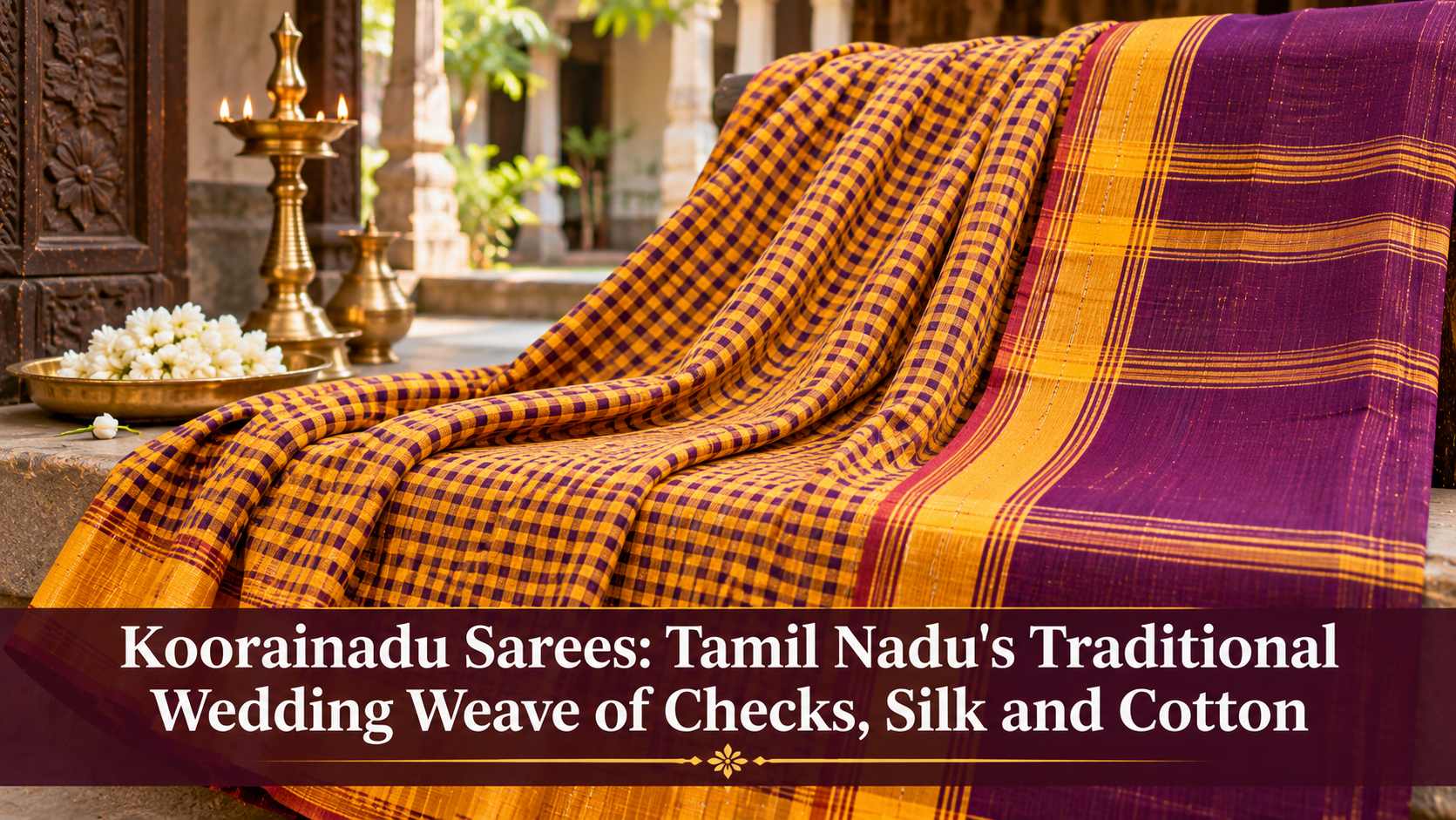
Few sarees are tied as closely to one moment as the Koorainadu saree. For generations in the Mayiladuthurai area of Tamil Nadu, a bride wore a nine-yard saree of small checks and a contrasting border at the muhurtham, the moment the mangalsutra is tied. The cloth is silk and cotton, woven on a plain handloom, and it is one of the least produced weaves in the state today.
This guide covers where Koorainadu weaving comes from, what its silk-cotton construction actually involves, how the checks and borders are made, how the saree is worn, how it compares with other South Indian silk-cotton traditions, and what to check before buying. If you are still working out which fabric suits which occasion, our saree for women buying guide sets out the basics first.
A note on sources. Koorainadu is thinly documented compared with Kanchipuram or Banarasi weaving. The best accounts come from a Deccan Herald feature on the Co-optex revival, the Gaatha craft documentation, a 2018 paper on the saree published in Trends in Textile Engineering and Fashion Technology, and a 2022 paper on the cooperative’s revitalisation. They agree on the broad picture and differ on details, and this article flags those differences instead of smoothing them over.
Where Koorainadu is and what the name means
Koorainadu (also written Koorai Nadu, Kooranadu or Koranad) is a neighbourhood of Mayiladuthurai, a town in Tamil Nadu that was long known as Mayavaram. Gaatha explains the name as a place name: Koorai refers to the area where the sarees are woven, pattu means silk and pudavai is the Tamil word for saree, so Koorai Pattu Pudavai is a silk saree from Koorainadu. You will see all of these names used for the same tradition.
Two clarifications help avoid confusion. First, Koorainadu is a Mayiladuthurai tradition, not a Chettinad one. A few commercial listings describe the Koorai saree as a modified form of the Kandangi of Chettinad, which is a different cotton weaving centre around Karaikudi. The two share a love of checks, but they come from different places. Second, Koorainadu is not Kanchipuram. Gaatha mentions that sarees in the Koorai style were also woven in Kanchipuram, Kumbakonam, Arani and Salem, with zari borders, but the home of the weave is Koorainadu.
A short history
The age of the weave is where care is needed. Popular summaries say it goes back nearly 5,000 years and was originally pure cotton. That figure appears widely but without firm documentary support, so it is better read as local tradition than as dated fact. What the Deccan Herald feature reports, citing recorded history, is that weavers in ancient times used only cotton, and that silk and cotton were later combined in the medieval era on demand. Some accounts add that the weave became prominent as a silk bridal saree by the early twentieth century. Tradition also links the area with Nesa Nayanar, a saint remembered for weaving garments for devotees, though this is a devotional association rather than a documented origin.
The same feature tells a story about the painter Raja Ravi Varma and his brother, who are said to have travelled by bullock cart to see the weavers at Koorainadu on a tour of the region. It is a charming anecdote, but it comes from one retelling and is best treated as local lore.
What is better documented is the saree’s place in bridal life. According to the Deccan Herald, the Koorainadu saree was part of every Tamil bride’s trousseau until the 1950s. Demand then fell, mainly after the 1970s, as powerlooms and synthetic sarees arrived and the weavers lacked patronage and marketing support.
The weaving community and the cooperative
Gaatha names the Saliyar and Devanga communities among the weavers of the region. The craft today is organised through a small weavers’ cooperative society in Koorainadu, and its sarees are sold through Co-optex, the Tamil Nadu handloom cooperative. Co-optex’s managing director T. N. Venkatesh led a revival effort from 2014, going back to the weavers with original designs. The Deccan Herald credits R. Manimegalai, president of the Kooraitex Weavers Society, as the first to start weaving the revived sarees, with about ten more women weavers joining her. A 2015 account by a Co-optex customer describes only around ten weavers in the society.
The numbers have not grown. A 2022 paper on the cooperative describes only five skilled weavers remaining, with younger family members preferring other work. The same paper reports that Co-optex typically receives about 30 Koorainadu sarees a month and sells roughly 250 to 300 a year, buying them at an average of Rs 6,000 each. Those are figures for one cooperative channel, not for every Koorainadu saree sold anywhere, but they show how small the output is.
Silk-cotton construction: what the sources actually say
This is the part of the story where generalisations are most tempting and least safe. The sources describe the yarns in different ways.
- Gaatha and a related craft profile say the saree is made with pure silk and fine-twisted mercerised cotton yarn in a 2:1 ratio, in both warp and weft.
- The Deccan Herald feature describes the revived sarees as silk-cotton in warp and silk-cotton in weft, of fine count, and says the silk was largely sourced from the Kollegal area of Karnataka while the cotton was procured locally.
- A 2015 customer account of a revival saree says it has silk in the warp and cotton in the weft.
- The same Gaatha material also says Koorainadu sarees come in two material categories: pure cotton in the ancient period, and a combination of cotton and silk in the medieval and present periods.
These descriptions cannot all describe the same cloth, and that is the point. The 2:1 ratio is the most frequently quoted figure, but it is a documented description of the traditional or standard construction, not a guarantee for every saree sold under the name. Weavers, cooperatives and brands have varied the yarns, and some sarees are made in cotton alone. So when you read “Koorainadu silk cotton saree” on a listing, treat the ratio as something to ask about, not something to assume.
The role of each yarn is easier to state in general terms. Silk adds sheen, a smooth hand and the silk-like finish that Gaatha says makes the saree look like silk rather than cotton. Mercerised cotton, which has been treated to add lustre and strength, adds body, breathability and the matte contrast needed to make checks stand out. The mix is what lets a nine-yard wedding saree stay light enough to wear for a long ceremony in a warm climate. For a general explanation of how cotton-silk blends behave in wear and care, see our cotton silk saree guide.
Yarn preparation, loom set-up and weaving
Detailed step-by-step documentation of Koorainadu weaving is limited, so this section separates what is documented from general handloom practice.
What is documented:
- Gaatha says that because the sarees consist only of checks and stripes, plain looms are used, with no dobby or jacquard attachment needed for complex motifs.
- The loom set-up is described as taking up to a week.
- A standard saree takes a weaver about 5 to 10 days to complete, depending on the design, according to both the Deccan Herald and the 2022 paper. Gaatha gives about ten days.
- The Deccan Herald adds that a weaver has to move hands and feet at least 13,000 times to complete one saree.
- The distinguishing feature, in the Deccan Herald’s words, is that the cotton checks are formed by the interlacement of warp and weft, a technique that takes considerable skill and that only a few experienced weavers can do.
What is general handloom practice rather than a Koorainadu specification: yarn is dyed in skeins, wound onto bobbins, arranged into a warp of the required width and length, sized so it can survive the friction of weaving, and then drawn through the heddles and reed. Colour changes in the warp and weft produce the checks. Because the pattern comes from the order of coloured threads rather than from added motifs, the set-up stage, where the warp colours are arranged, matters as much as the weaving itself. A mistake in the warp sequence shows up as an uneven check across the whole length.
Checks, stripes, borders and pallu
Koorainadu design is restrained. Gaatha states that the sarees consist only of checks and stripes, and that is the safest summary of the body.
Gaatha also lists check types that help in describing what you see:
- Simple checks crossing each other.
- Solid colour contrasting squares, sometimes called aatu muzhi, which translates as goat’s eye.
- Checks in contrasting colours, with the paalum pazhamum style described as the most prevalent.
For the border, accounts say nine-yard sarees traditionally carry a contrasting border, often yellow. A craft profile adds that sarees with wide borders are called temple sarees because they are offered to deities in temples. One Gaatha description mentions a seer pallu, a pallu with a silk look, woven alongside the small-checked body. Older descriptions say the borders carried zari while the checks stayed in the body, and one account mentions silk and zari sarees with motifs in the border.
Design has changed since the revival. The Deccan Herald reports collaboration with students of the National Institute of Design, Ahmedabad, introducing new motifs and colours, and a 2015 Co-optex report describes new pastels aimed at customers in other cities. So a modern Koorainadu saree in pastel tones with a modern border is a commercial variation, not a historic pattern. Both are real, but they are not the same thing.
Traditional colours, texture, drape and finishing
The documented traditional palette is warm and saturated. The Deccan Herald lists purple, orange, dark pink, turmeric and olive green. Gaatha’s bridal description centres on mustard or yellow with contrasting borders, and a popular reference page lists purple, dark pink and turmeric yellow. Turmeric yellow carries wedding associations in Tamil Nadu, which is one reason it appears so often. Some reports link the colours with prosperity and fertility, though those meanings are traditional beliefs rather than textile specifications.
On texture and drape, the craft profiles describe a lightweight fabric with a silk-like look and feel, and the 2:1 construction is credited for that. The cotton checks give the cloth some body, so it drapes with more structure than a pure silk saree of similar weight. No source consulted publishes a verified gram weight or thread count for Koorainadu sarees, so none is stated here. If a seller quotes one, ask how it was measured.
Traditional length is nine yards, about 8.2 metres by 1.22 metres in one reference, which is longer than the standard six-yard saree. The Deccan Herald notes that contemporary sarees are six yards, which suits modern draping. Check the length before you buy, as it changes how you can drape the saree.
Koorainadu in weddings and other occasions
In Tamil Hindu weddings the saree is traditionally associated with the muhurtham. The Deccan Herald says the bride wore it when the mangalsutra was tied, and that wearing it was believed to ensure a long-lasting marriage. Gaatha describes it as worn for wedding and religious purposes and as integral to the culture of Tamil Nadu. Wide-bordered temple sarees are connected to offerings in temples.
Today, practice varies. Families who value the tradition still choose the saree for the ceremony, and it has also found a place as a festive and puja saree for women who prefer handloom to heavy silk. The lightweight silk-cotton cloth makes it comfortable for daytime ceremonies, and the checked body pairs easily with a plain or contrasting blouse. Other wedding choices in the region, such as Kanchipuram silk, are far more common, so a Koorainadu saree is now a deliberate heritage choice, not a default. Families should check what their own community or priest expects, as customs differ.
For a comparison of the two fibres at the heart of this weave, our cotton saree vs silk saree comparison explains the trade-offs in comfort, formality and care.
Koorainadu compared with other South Indian silk-cotton traditions
South India has several weaves that combine silk and cotton. They do it in different ways, which is why a single label rarely tells you how a saree is built.
| Feature | Koorainadu (Mayiladuthurai, Tamil Nadu) | Gadwal (Telangana) | Narayanpet (Telangana) | Kandangi (Chettinad, Tamil Nadu) |
| Fibre approach | Silk and mercerised cotton, often described at 2:1 in warp and weft, with variations reported | Cotton body with silk border and pallu, plus pure silk and silk-body variants | Cotton, silk, or cotton weft locked into silk warp | Traditionally cotton, with checks and stripes |
| Body design | Checks and stripes only | Checks are a documented feature of the body | Checks across the body, small or large | Bold checks or stripes |
| Border and pallu | Contrasting border, often yellow; wide temple borders | Zari borders and pallu, temple borders on silk sarees | Bold zari ribbon border; temple border on silk sarees | Broad borders with temple or check designs |
| Joining technique | Checks formed by interlacing warp and weft | Interlocked weft joint called kupadam or kuttu | Interlocked weft method | Not a silk-cotton join technique |
| Traditional length | Nine yards, six yards in modern versions | About six metres | Pallu at least 60 cm | Standard saree lengths, with variations |
| Wedding link | Bridal muhurtham saree in Tamil Nadu | Used for festive and formal wear, pure silk versions for weddings | Festive and formal wear | Associated with Chettinad community wear |
| GI status | No registration found in sources consulted; check the GI Registry | Registered | Registered 2015 | Registered 2019 to 2020 |
The main contrast is structural. Gadwal’s silk-cotton character comes from joining a cotton body to a silk border and pallu with a three-shuttle interlocking method. Koorainadu’s silk-cotton character comes from the yarns themselves, with checks formed in the body by interlacing. Narayanpet falls between the two, depending on the variant. Kandangi shares the check tradition but is built mainly as cotton. If a listing says “Koorai style” but describes a cotton body with a separate silk border, it is describing something closer to Gadwal construction.
Practical buying guide
Fabric composition
Ask for the fibre content in writing. A genuine silk-cotton piece should name the silk and the cotton, and ideally describe whether the silk is in the warp, weft or both. Because documented constructions vary, a seller who gives one confident ratio for every saree deserves a follow-up question. Be wary of listings that say “silk look” or “silk touch”, which describe appearance and not fibre. Also watch for viscose or polyester, which are sometimes blended into sarees sold as silk-cotton.
Weave quality
Hold the saree up to the light. The checks should be even in size and colour along the whole length, and the lines should run straight. Handloom cloth will show small variations, but a check that drifts or a colour that shifts sharply between sections suggests a warp error. Look for even density across the body, and check that the border is parallel along both edges.
Finishing
Check the selvedge for a clean, even edge, and look at how the pallu end is finished, including whether tassels or fringes are knotted securely. Ask whether fall and pico are done and whether a blouse piece is included and matches. Because nine-yard sarees are rarely stocked off the shelf, confirm the length and width listed.
Authenticity and price
Handloom takes time. A Koorainadu saree takes about 5 to 10 days to weave after a set-up of up to a week, and the 2022 paper gives an average Co-optex purchase price of Rs 6,000. Cooperative and government emporium channels such as Co-optex are the most traceable sources. A very low price for a claimed handloom silk-cotton nine-yard saree needs an explanation. If you are buying online, our online saree shopping guide lists the description, photo and seller checks worth doing before you pay.
Care
Care instructions for Koorainadu specifically are not published in the sources consulted, so this is general guidance for silk-cotton handloom. Follow the label first. Dry clean for the first wash if the colours are deep, wash gently by hand in cold water with a mild detergent if the label allows, avoid wringing and long soaking, dry in shade, and iron on the reverse at a low to medium setting. Store folded in a cotton or muslin cloth, and refold along different lines now and then so permanent creases do not form.
Conclusion
The Koorainadu saree is a small but distinct piece of Tamil Nadu’s wedding heritage: a silk-cotton cloth of checks and stripes, woven on a plain loom in Mayiladuthurai, and worn for generations by brides at the muhurtham. Its construction is documented in several forms, with a 2:1 silk to mercerised cotton description the most often quoted, so no single ratio should be assumed. The craft survives through a very small group of weavers and the Co-optex revival that began in 2014. If you choose one, ask about the yarns, look closely at the checks, buy from a traceable source, and treat modern pastel versions as a contemporary take on the traditional palette.
Frequently asked questions
1. What is a Koorainadu saree? It is a traditional handloom saree from Koorainadu (Koranad) in Mayiladuthurai, Tamil Nadu. It is made from silk and cotton in checks and stripes and has long been worn by Tamil brides at weddings.
2. Is a Koorainadu saree pure silk? No. It is a silk-cotton weave. Ancient versions were cotton, and the silk-cotton form came later. Some modern sarees are sold in cotton alone, so always ask for the fibre content.
3. What is the silk to cotton ratio? A 2:1 ratio of pure silk to fine-twisted mercerised cotton is the most commonly quoted description, but other accounts describe silk and cotton in both warp and weft, or silk in the warp with cotton in the weft. The ratio is not the same for every saree.
4. Why is it called a wedding saree? Tradition links it with the muhurtham, when the mangalsutra is tied, and it was part of a Tamil bride’s trousseau until the 1950s. It was also believed to bring a long-lasting marriage.
5. What do the designs look like? The body has checks and stripes only, with a contrasting border, often yellow. Traditional colours include purple, orange, dark pink, turmeric and olive green. Modern versions use pastels and new motifs.
6. How long is a Koorainadu saree? Traditionally nine yards, which is about 8.2 metres. Contemporary pieces are often six yards. Check the listed length before buying.
7. Does Koorainadu have a GI tag? No registration was found in the sources consulted, though one reference page says an application is under review. Check the Geographical Indications Registry for the current status before making any claim.
8. How can I tell a genuine handloom Koorainadu saree? Ask for the weaver or cooperative source, check that the fibre content is stated, look for even checks with the small variations of handwork, and treat a very low price with caution. Co-optex is the main documented sales channel.
