
Blog
Sungudi Sarees: Madurai’s Traditional Tie-Dye Cotton Weaving and Dotted Patterns

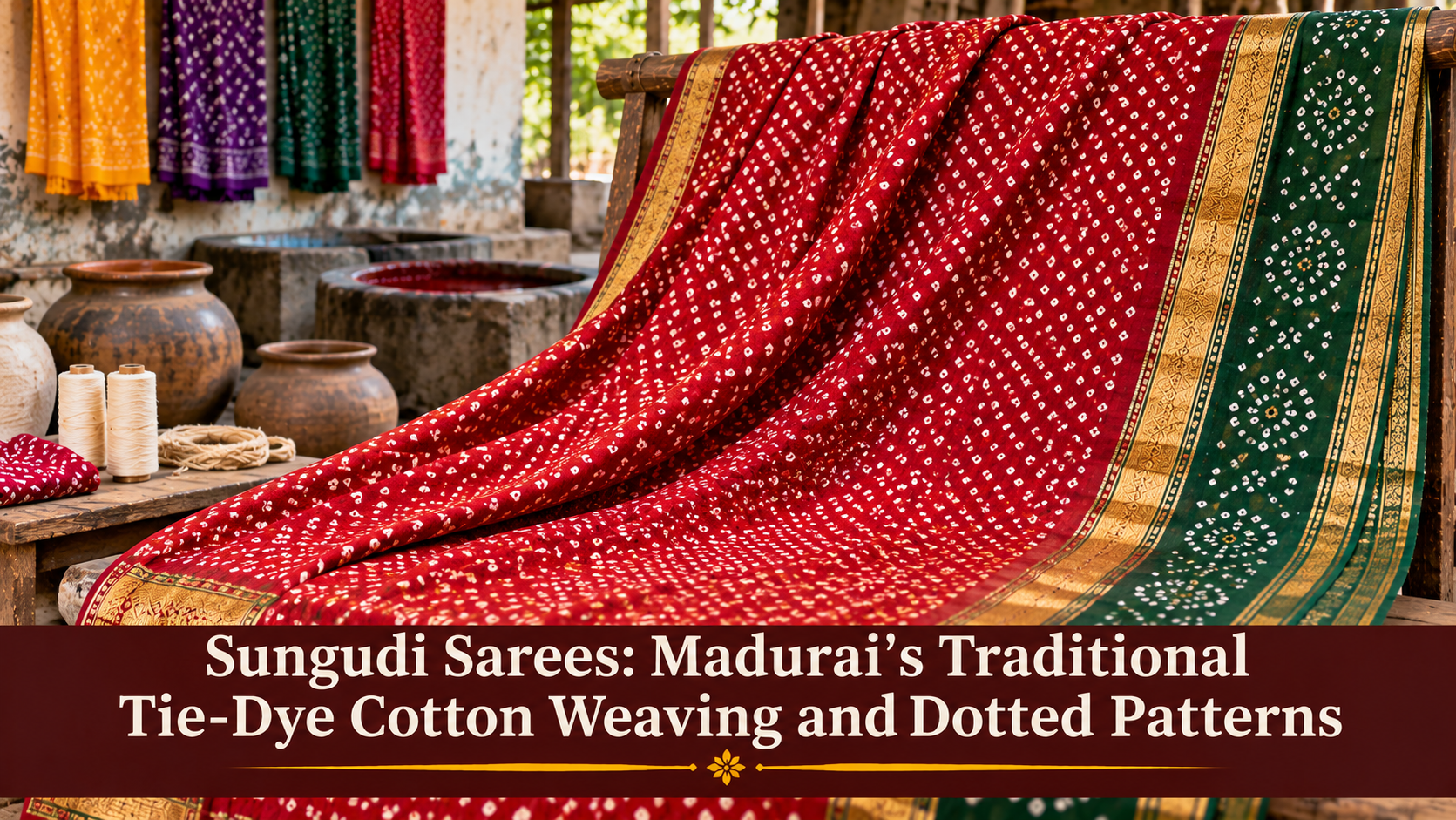
A Sungudi saree looks simple from a distance: a coloured cotton body covered with small white dots, a contrasting border and a pallu in a different shade. Up close, each dot is a tiny knot that an artisan tied by hand before the cloth ever touched dye. A single saree can carry well over ten thousand of them, and the whole pattern appears only when the knots are opened at the end.
Sungudi is a tie-dye tradition of Madurai in Tamil Nadu, and it holds Geographical Indication protection as Madurai Sungudi. It is also widely copied, because dotted cotton is easy to print. This guide covers the history and geography, the communities behind the craft, the tying and dyeing process, the dots, borders and colours, how Sungudi differs from Bandhani and other tie-dye traditions, and how to judge a saree when you buy. If you are still deciding which kind of saree suits you, our complete guide to buying sarees for women covers fabrics, occasions and price factors across all saree types.
What a Sungudi saree is
A Sungudi saree is a cotton saree decorated with tie-dye. The cloth is woven first and then tied and dyed, so the pattern is made in the resist stage and not at the loom. The Government of India handicrafts portal describes Madurai Sungadi (a common alternate spelling) as a tie-and-dye craft whose sarees carry tiny dots across the body, with contrasting woven borders that often include metallic zari.
The word itself has a documented explanation. The GI application says “sungudi” is a Saurashtra word linked to the Sanskrit “sunnam”, meaning round, and so it refers to the ringed dots spread across the cloth. The application also mentions another reading, which derives the name from “junnadi”. You may see the saree spelled Sungadi, Chungadi or Sungudi in different sources, and all of them refer to the same family of textiles.
History and geographical identity in Madurai
Madurai sits on the banks of the Vaigai River in southern Tamil Nadu, and the river features in the craft’s own story. The GI application says the water of the Vaigai is believed to bring out the brightness of the colours and help them hold. That is a claim made by the producers and cited in the GI documents, not a laboratory finding, but it explains why dyeing has long been tied to the city.
The craft is attributed to the Saurashtra community, whose members migrated from Gujarat to the south. The handicrafts portal says they brought a tie-and-dye technique with them, and that over time it developed into the dotted Sungadi style. Dates differ by source. The GI application places the arrival of the craft in Madurai in the period of the Nayak dynasty, from around the 16th century onwards, while other accounts link the migration to the patronage of Thirumalai Nayak in the 17th century. The honest summary is that the community’s migration to Madurai during the Nayak period is the established account, and the exact decade is not settled.
The same application says the Saurashtra community has long been known as weavers, and it records the Patnuli dialect (a form of Gujarati) among the languages spoken in the district. It also notes that in the later years many other communities of weavers joined the work, and that the tie-dye cotton won a bronze medal at the Colonial and Indian Exhibition in the 19th century. The portal adds that the sarees were originally made for royal patrons and temple offerings before becoming everyday cotton wear.
Madurai Sungudi was registered under the Geographical Indications of Goods (Registration and Protection) Act, 1999. The date usually cited is 12 December 2005, under GI application number 21, although a few sources give 2006. Check the GI Registry entry if you need the exact record.
The weaving and dyeing communities
The GI statement describes Sungudi as a cottage industry with a clear division of labour. Women carry out the knotting, which is the most time-consuming stage. Men do the dyeing. The cooperative societies of Madurai handle much of the marketing and quality inspection, and one of them, the Madurai Junnadi Javuli Vyaparigal Sangam, is recorded in the GI application as having been set up in 1943.
The application gives rough figures for the workforce at the time of filing: over a thousand people directly involved in making the sarees in Madurai, and several thousand more in related work such as weaving, dyeing and marketing. Those numbers date from the filing and will have changed. Later research papers describe the craft as the main livelihood of thousands of people in the Madurai region, but headcounts vary widely between sources.
Cotton fabric and why it suits the craft
Sungudi is made on cotton, and the choice shapes everything else. The GI statement says the base cloth is a woven, unbleached cotton saree made with fine combed or carded yarn, in counts of 80s and 100s. A saree of this kind is light, with a weight of around half a kilogram given in the application, and the fabric is said to suit tropical weather for both casual and formal wear.
Cotton takes tie-dye well because it absorbs dye evenly, holds a tight knot and softens with washing. Silk and synthetic fibres behave differently in resist dyeing, which is one reason Sungudi is usually described as a cotton craft. The Government portal notes that contemporary adaptations now use unconventional fabrics and blend techniques such as batik, but these are variations on the traditional cotton saree. For a comparison of the two main saree fibres, see our guide to cotton vs silk sarees.
The traditional tie-dye technique, step by step
Sungudi is a resist-dye method. Parts of the cloth are tied so dye cannot reach them, and when the ties come off, those parts stay the colour of the cloth. The sequence below follows the GI Statement of Case and the Government handicrafts portal.
- Preparing the cloth. The unbleached cotton saree is first cleaned and prepared. The GI application describes soaking the cloth in an emulsion of groundnut oil and an alkaline earth, treading it by foot, leaving it wet for two to three days, washing it in river water and sun drying it. This repeats over about a week. The handicrafts portal describes soaking and washing the fabric with soap and nut powder (soap nut) in cold water baths. Workshops differ, and many now use simpler washing methods.
- Marking the design. The cloth is marked with a grid of squares or lines, historically in red pigment, to guide where the knots will go. The portal says artisans mark the design on unbleached cotton before tying.
- Tying the knots. Women artisans pinch tiny points of cloth, often with the fingernails, and tie each one off. The GI statement says the knots are evenly spaced and that a single continuous thread can run through them. A saree can carry more than 20,000 knots, according to the application, while other published sources give ranges of about 10,000 to 21,000. The handicrafts portal says tying takes 8 to 10 days, and other accounts put the whole saree at around 15 days.
- Dyeing the body. The tied cloth is dipped in the dye bath, heated and cooled, and washed in stages. The knots resist the dye, so the tied points stay undyed.
- Dyeing the pallu separately. The pallu is clamped so the dye on the body does not touch it, and then it is dyed on its own in a contrasting colour.
- Opening the knots. After dyeing and drying, the artisan carefully undoes the knots. The GI statement notes that the single thread can be reused.
- Finishing. The cloth is washed, dried and finished. Descriptions of the final step mention starching and sun drying, and the finished cloth has a slightly puckered texture around each dot.
The application stresses that there is no second chance in this process. Knots are tied before dyeing, so an error in spacing or tension shows up in the finished cloth and cannot be corrected.
The characteristic dots, borders, pallu and colour combinations
Dots. The signature of the saree is a field of small, evenly spaced white dots. Each is a small ring with a pinpoint at the centre where the cloth was pinched. The GI statement describes a kaleidoscopic effect created by the uniform spacing. Because each knot is tied by hand, there is slight variation in size and spacing, and the application says no two sarees are identical.
Borders. The borders are woven into the base saree and are usually in a contrasting colour. The GI statement describes extra warp designs in the border using gold zari or half-fine zari, and the handicrafts portal also mentions metallic zari. Plain contrast borders without zari are common as well.
Pallu. The pallu is typically dyed in a different colour from the body, using the clamping method described above. This gives the traditional two-tone look of a body in one shade and a pallu in another.
Colours. The GI application says vegetable dyes were used in the earlier days, with deep reds obtained from sources such as safflower, stick lac, chay root and red sanders, yellow and orange from turmeric and similar plants, blue from indigo, green from indigo combined with turmeric, and black from iron sulphate. It also says that today chemical dyes are used, including vat alizarin red, naphthol and indigo. The handicrafts portal lists natural dyes such as indigo and madder alongside azo-free chemical dyes, so the practice today is mixed. Red, maroon, deep blue, green and mustard are the colours most commonly associated with Sungudi, though modern ranges include many more.
Sungudi and Madurai’s textile heritage
Madurai’s textile identity rests on more than one craft. The city is known for cotton weaving, and Sungudi adds a dyeing tradition to that history. The cooperative sector, which the GI statement says has supported marketing and quality inspection since the 20th century, links the craft to the city’s institutions. The statement also records state support such as sales tax exemption from 1959 and low-interest loans through cooperatives, though these details describe the position when the GI application was filed.
The craft also links Madurai to Gujarat. The Saurashtra community carried a tie-dye tradition south, and the result developed its own identity with local cotton, local colours and a dot pattern that differs from northern traditions.
Everyday wear and traditional occasions
Sungudi sarees are best known as everyday and daytime cotton wear. The GI statement says they are suited to the hot climate and can be worn for both casual and formal occasions, and it adds that working women and college students are among the wearers today. The light weight and the cotton fibre explain the appeal. If you are building a daily wardrobe, our guide to cotton sarees for daily wear compares several cotton weaves for office, home and travel.
The saree also has a ceremonial side. The GI statement says it is an essential part of marriage ceremonies in many South Indian communities, where it forms part of the gifts given to the bride and the bridegroom’s side, and that many traditional families prefer to wear a nine-yard version. Wedding customs vary by community and family, so treat that description as a general account and not a rule. A Sungudi saree in a rich red or deep colour with a zari border is the version most often chosen for festive use.
Documented differences: traditional Sungudi and modern printed imitations
The dotted look is easy to print, and many products sold as Sungudi are made by screen printing or digital printing on cotton or blends. The GI statement itself says that the colouring and knotting define the real product: the cloth is tied and dyed, and the dots are the untouched cloth revealed by removing the knots.
The distinction can be summed up as follows. In a traditional Sungudi, the white dots are undyed cloth. In a print, they are ink or a printed shape. The difference shows in how the dots look, how they feel and what happens on the reverse side.
Other modern adaptations are also real and legitimate, as long as they are described accurately. The Government portal notes contemporary versions that blend techniques such as batik and use fabrics beyond cotton, and the GI statement says chemical dyes are widely used today. A hand-tied Sungudi dyed with chemical dyes is still a genuine tie-dye saree, though it is not a naturally dyed one. A seller who says “natural dye” should be able to say what dye, from where and how it was fixed.
How to assess fabric, dye quality, patterns and finishing
Use several checks together, since no single sign is conclusive.
| What to check | Traditional hand-tied Sungudi | Printed or imitation Sungudi |
| Dots | Small rings with a tiny pinpoint at the centre. Slight differences in size and spacing | Identical dots with perfectly even edges, sometimes flat |
| Texture around dots | Slightly puckered or crinkled where the cloth was pinched | Smooth, with no change in the cloth surface |
| Reverse side | The dots look the same on the back, since the dye went through | The back is often paler, or the dots are missing or faint |
| Grid | Dots follow a marked grid, with minor shifts | Dots may repeat in a perfectly mechanical pattern |
| Pallu | Dyed in a separate colour, with a clean transition at the join | Printed pallu, or no colour contrast |
| Border | Woven into the saree, often with zari lines | Printed border, or a stitched-on border |
| Fabric | Fine cotton, light and soft. The GI statement describes a saree of about half a kilogram | Often a heavier or synthetic blend. Feels stiff or plasticky |
| Colour | Even colour with slight variation. Deep reds and blues that stay bright | Flat colour, or colour that bleeds heavily on first wash |
| Price and time | Reflects 8 to 15 days or more of tying and dyeing work | Much lower |
A few practical tests help. Hold the cloth to the light and look at the dots from both sides. Rub a damp white cloth on a dark area to check for colour release, and expect some release in the first wash of strongly dyed cotton. Look closely at the pallu join and the border for neat finishing. Ask the seller where the saree was tied and dyed, whether the dyes are natural or chemical, and whether it carries a GI tag. For a wider checklist on descriptions, photographs and seller details, see our guide to checking fabric, colour and seller details when you shop online.
Finishing matters too. Check that knots have been fully undone, that no residue or thread is left in the cloth, that the edges are straight and that the border is cleanly attached. A fine cotton saree with a soft hand and even dye is a better sign than a heavily starched piece that hides the fabric.
Sungudi compared with Bandhani and other tie-dye traditions
Sungudi is often described as the southern relative of Gujarati Bandhani, and the two share the principle of resist dyeing with tied cloth. The documented practices differ in several ways, so they should not be treated as one craft.
| Tradition | Region | Typical base | How the pattern is made | Typical look |
| Madurai Sungudi | Madurai, Tamil Nadu | Cotton | Evenly spaced knots tied on a marked grid, with a single thread, then dyed. Pallu dyed separately | Fine white dots on a coloured body, contrasting border and pallu |
| Bandhani | Gujarat (Jamnagar, Kutch and other towns) and Rajasthan | Silk, cotton, georgette and other fabrics | Small points tied by hand into clusters and motifs, then dyed, often in several colours | Dots grouped into flowers, waves and other shapes, often in several colours |
| Leheriya | Rajasthan | Cotton, silk and light fabrics | Cloth is rolled and tied to resist dye in diagonal bands | Wave-like diagonal stripes |
| Ikat | Odisha, Andhra Pradesh, Telangana, Gujarat | Cotton and silk | Yarn is tied and dyed before weaving | Blurred, feathered patterns formed during weaving |
| Shibori | Japan and other regions | Cotton, silk, linen | Folding, binding or stitching before dyeing | Varied geometric and organic patterns |
The main differences with Bandhani are the base fabric and the layout. Sungudi is cotton, with a regular field of single dots, while Bandhani is made on several fabrics and often forms motifs from groups of dots. Sungudi’s pallu is dyed separately in a contrasting colour. The GI statement also describes the knots being tied with one continuous thread, which is a detail of this craft’s documented method. Ikat is different again, because the resist is applied to yarn before weaving, while Sungudi is tied and dyed on woven cloth. The two Gujarati and Tamil traditions are related by migration and technique, but they should be described as separate crafts.
Care for a Sungudi saree
Follow the seller’s label first. A common approach for tie-dyed cotton is to wash the saree separately in cold water with a mild detergent for the first few washes, avoid long soaking, avoid wringing and dry it in the shade. Colours, especially deep reds and blues, can release a little in early washes. Iron on the reverse side at a cotton setting, and store the saree folded in a clean cotton cloth away from damp.
Frequently asked questions
1. What is a Sungudi saree?
A Sungudi saree is a cotton saree from Madurai in Tamil Nadu, decorated with small white dots made by tying knots in the cloth before dyeing. The dots are the undyed cloth revealed when the knots are opened.
2. Why is it called Sungudi?
The GI application says the word is a Saurashtra term linked to the Sanskrit word for round, referring to the ringed dots. Another reading links it to the word Junnadi. You may also see the spellings Sungadi and Chungadi.
3. Who makes Sungudi sarees?
The craft is traditionally attributed to the Saurashtra community, who migrated from Gujarat to Madurai. According to the GI statement, women tie the knots and men dye the cloth, and many other weaving communities have joined the work since.
4. Is Sungudi the same as Bandhani?
No. Both use tied resist dyeing, but Sungudi is a cotton craft of Madurai with a regular field of single dots and a separately dyed pallu. Bandhani is made across several fabrics in Gujarat and Rajasthan and often forms grouped motifs.
5. Are Sungudi sarees naturally dyed?
Not necessarily. The GI application says vegetable dyes were used in earlier times and that chemical dyes are common today. The handicrafts portal lists both natural dyes and azo-free chemical dyes. Ask the seller what was used.
6. How can I tell a real Sungudi from a print?
Look at the dots from both sides. Tied dots are small rings with slightly puckered cloth around them and look the same on the back. Printed dots are flat, identical and often paler on the reverse. Also check the pallu, border, weight and price.
7. Is Sungudi suitable for daily wear and weddings?
Yes for daily wear, because the fine cotton is light and comfortable in warm weather. The GI statement also says Sungudi forms part of wedding customs in many South Indian communities. Choose a rich colour with a zari border for festive use.
8. Does Sungudi have a GI tag?
Yes. Madurai Sungudi is registered as a Geographical Indication under the Geographical Indications of Goods (Registration and Protection) Act, 1999. The date usually cited is 12 December 2005, under application number 21. Check the GI Registry for the exact record.
Conclusion
Sungudi sarees combine fine cotton, a hand-tied field of dots and a separately dyed pallu in a form that Madurai’s Saurashtra community has carried for centuries. The craft is documented in the GI application and by the Government of India, and its defining feature is that the dots are cloth that never met the dye. Modern prints copy the look without the labour, and today’s tie-dyed sarees often use chemical dyes alongside the older natural ones. The sensible way to buy is to ask how a saree was made, what dyes were used and where it was tied and dyed, then check the dots, the reverse side and the finishing yourself. Choose the version that fits the occasion and your budget, and expect a hand-tied saree to cost more than a printed one.
