
Blog
Madhubani Sarees: Bihar’s Traditional Folk Art, Hand-Painted Motifs and Designs

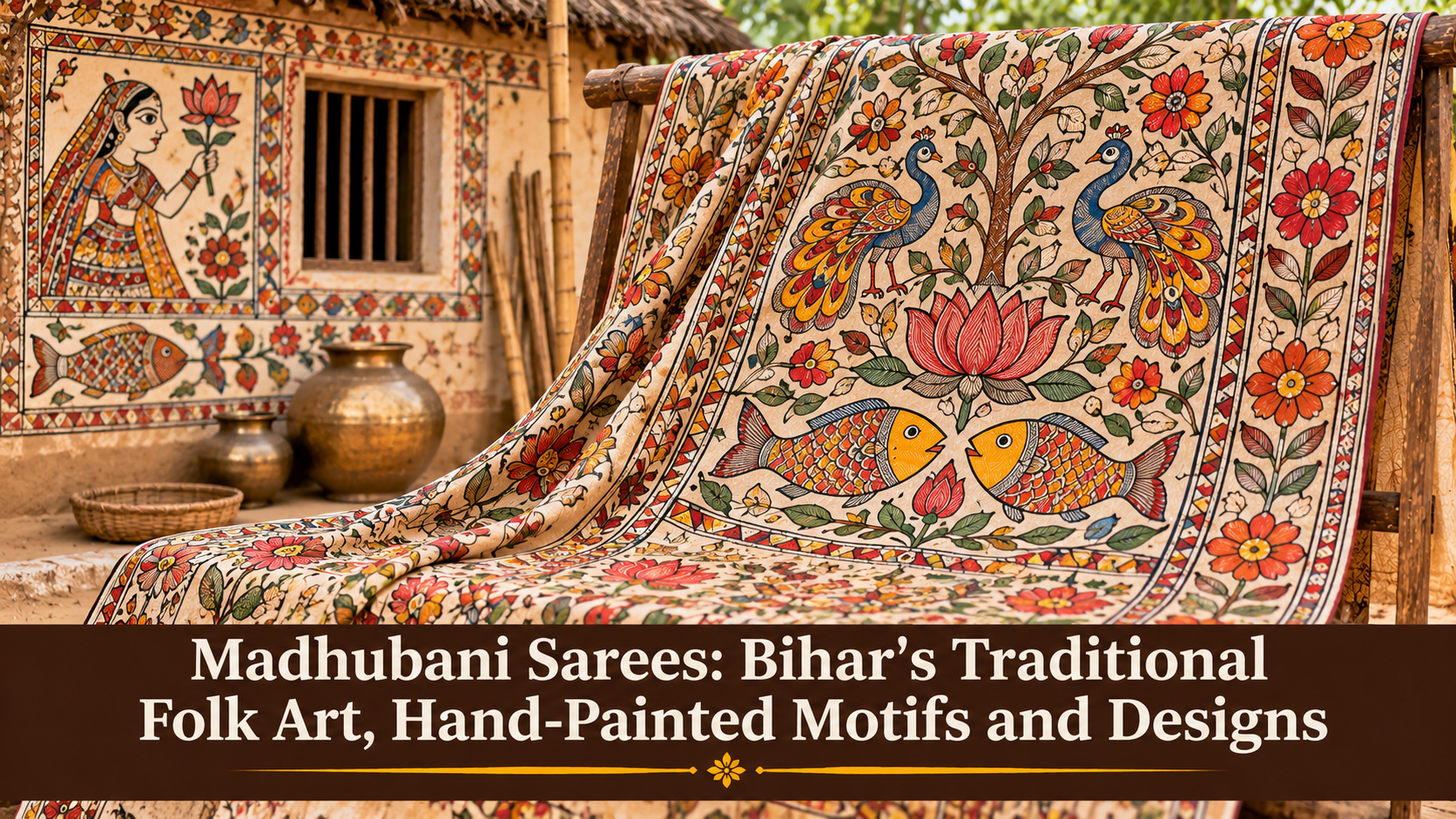
A Madhubani saree carries the look of a village wall painting from northern Bihar: double-outlined fish, peacocks with fanned tails, lotus flowers, trees heavy with birds, and borders where no patch of cloth is left empty. The designs come from Mithila painting, a folk art that women of the region practised on mud walls and floors for generations before it moved to paper, canvas and fabric.
The name now covers a wide range of products. Some Madhubani sarees are painted by hand, stroke by stroke. Others are block printed, screen printed or digitally printed with Mithila-style designs. They can look alike in a photograph and differ a great deal in price, effort and durability. This guide covers the history, the five recognised styles, the tools and colours, the motifs and the way the art is applied to saree fabrics. It finishes with a practical comparison of hand-painted, block-printed and digitally printed sarees. If you are still deciding what kind of saree suits you, our complete guide to buying sarees for women covers fabrics, occasions and price factors across all saree types.
History and geographical identity of Madhubani painting
Madhubani painting is also called Mithila painting, after the cultural region of Mithila in northern Bihar and the adjoining Terai of Nepal. The art is tied to the districts of Madhubani and Darbhanga, and villages such as Jitwarpur and Ranti are often named as centres. The name Madhubani, which is a town and district, became the common label in the wider market.
Popular accounts say the tradition is very old, with claims running to 2,500 years and a link to the epic story of Sita’s wedding in Mithila. These claims come from oral tradition and are hard to verify. The better documented history is more recent. The tradition was practised by women on the walls of homes, especially in the kohbar ghar, the room prepared for a newly married couple, and on the floors and walls of ritual spaces during festivals and weddings. These were temporary works, repainted for occasions.
Two moments are widely cited in the move from wall to paper and cloth. After the 1934 earthquake in Bihar, a British colonial officer, William Archer, saw and photographed wall paintings in damaged homes, which brought the art to outside attention. In the late 1960s, a severe drought pushed rural families to look for income, and the All India Handicrafts Board encouraged women artists to paint on paper for sale. From there the art reached galleries, exhibitions and eventually fashion and home textiles.
Madhubani painting is registered as a Geographical Indication of Goods under the Geographical Indications of Goods (Registration and Protection) Act, 1999. Most sources give 2007 as the registration year, though one reference lists 2005, so check the GI Registry journal before quoting a date.
Traditional Mithila art and contemporary saree design
On a saree, the relationship between tradition and contemporary design runs in three layers.
The first layer is original Mithila painting executed on cloth by artists trained in the tradition. These pieces use the same visual grammar as the wall paintings: bold outlines, filled forms, ritual or narrative subjects and borders that frame the composition.
The second layer is Madhubani-inspired design drawn by artists or designers and then reproduced in quantity. The motifs are recognisable, but the work may be simplified, rearranged for a saree layout, or scaled for repetition.
The third layer is pattern borrowing, where fish, peacocks and lotus shapes are used as decorative elements on machine-printed fabric. These are decorated sarees that reference the look.
All three have a place in the market. The accurate way to describe them is by method: hand-painted, block-printed, screen-printed or digitally printed. When a listing says only “Madhubani saree”, you cannot tell which layer you are buying.
Painting techniques and materials
Traditional Madhubani painting was done on walls and floors coated with a mixture of mud and cow dung. For paper and cloth, artists adapted the preparation. A rice-paste wash or a starch-based sizing is sometimes used to prepare the surface, and cloth is usually washed to remove finishing agents before painting.
The tools are simple. Artists use bamboo twigs sharpened at the tip, twigs wrapped with cotton rag to make a brush, matchsticks and sometimes fingers for filling larger areas. On fabric today, many artists also use fine synthetic brushes and pens, because a steady fine line matters on woven cloth.
The working method follows a pattern:
- The artist draws the main outline, often directly with a pen or brush without a pencil sketch, though some artists sketch first.
- Every form is outlined twice, with a thin gap or a second line, which is the most recognised feature of the style.
- The interior is filled with solid colour, hatching (parallel lines), cross-hatching or dots.
- Gaps in the background are filled with small motifs such as flowers, leaves, birds or geometric shapes.
- A border frames the composition, repeating bands of leaves, waves, flowers or geometric lines.
Many accounts describe a horror vacui: the instinct to leave no space empty. That is why a Madhubani composition feels dense even when each element is simple.
Natural colours and traditional pigment preparation
Traditional pigments were made from materials found locally. The recipes below are commonly documented, though they vary between villages and artists.
| Colour | Commonly documented source | Notes |
| Black | Lamp soot (kajal), burnt barley seeds, sometimes mixed with cow dung | Used for outlines and for deep fills |
| Yellow | Turmeric, pollen, or lime with banyan-leaf milk | Often a warm, slightly orange yellow |
| Red | Kusum flower juice, red sandalwood or kumkum | Tones range from brick to deep red |
| Blue | Indigo | Appears less often in older wall work |
| Green | Leaves such as bel | Gives soft, earthy greens |
| White | Rice paste | Often used as a base wash and for white detail |
| Orange | Palash (flame of the forest) flowers | Also reported in some sources |
Pigments are typically bound with natural gum, for example from the babool tree, or with goat’s milk, which helps them adhere to the surface. A plant-based colour on a wall behaves very differently from a colour on cotton cloth that will be washed, which is why the saree market has taken a different path.
This is where accuracy matters. Natural pigments are documented for traditional Mithila painting. A hand-painted Madhubani saree is not automatically made with natural colours. Many hand-painted sarees today use textile (fabric) colours or acrylic-based fabric paints, which are easier to apply on cloth and are designed to withstand washing once fixed. Sarees painted with natural pigments exist but are less common, and the claim should come with a clear explanation from the seller.
Line work, geometric patterns, borders and fills
Four visual features define the look of Madhubani painting, and they appear on sarees as well.
Line work. Clean, even lines are the structure of the art. Double outlines frame figures, and fine lines (sometimes drawn without lifting the pen) create flowing curves in fish, tails and vines.
Geometric patterns. Triangles, diamonds, zigzags, squares and rows of dots form borders and fill backgrounds. Many artists treat these as decoration, while others link particular patterns to ritual meaning.
Filling techniques. Interiors can be filled with flat colour (the Bharni approach), parallel hatching, cross-hatching or stippled dots (strongly associated with Kachni work).
Borders. A band of floral, wave or geometric pattern usually frames the whole composition. On sarees, borders often run along the edge and along the pallu end, with the main motifs placed in the body.
When you examine a Madhubani saree, these four elements are the quickest way to assess whether the design follows the tradition closely or borrows only its general look.
Documented motifs: fish, peacocks, lotus, trees and narrative scenes
Motifs come from daily life, nature and ritual. Their symbolic readings vary from source to source, so use them as a guide to what is commonly said rather than a fixed code.
Fish. One of the most recognised Mithila motifs, usually shown as a pair or in rows. Fish is commonly read as a sign of fertility, prosperity and good fortune, and appears in wedding-related imagery.
Peacocks. Shown with fanned tails filled with patterns, peacocks are frequent in both wall painting and saree designs. They are commonly associated with beauty and with romance in the region’s stories.
Lotus. Lotus flowers and buds appear in borders and as central motifs. In kohbar paintings the lotus is a common element, often alongside bamboo and birds.
Trees and bamboo. A tree, often with birds and sometimes with a deity, is a frequent composition. Bamboo is a recurring wedding symbol in kohbar work.
Birds. Parrots, doves and other birds fill branches and spaces. Parrots are often linked with the kohbar tradition.
Sun, moon and celestial forms. These show up as round faces or radiating forms.
Narrative scenes. Mythological stories, including scenes from the Ramayana and depictions of Radha and Krishna, Shiva, Durga and Kali, appear in more detailed paintings. On sarees, a narrative scene is usually reduced to a pallu panel or a repeated figure because the saree is long and the pattern must read at a distance.
Animals such as elephants, tortoises and fish are also common, filling the areas around central figures.
The five recognised styles of Madhubani painting
Most references list five styles: Bharni, Kachni, Tantrik, Godna and Kohbar. Some sources list Gobar instead of Kohbar, so you may see both spellings in different books. Historically the styles were linked to community and social context, and in the 1960s Bharni, Kachni and Tantrik were largely practised by Brahmin and Kayastha women, while Godna and Gobar were developed by artists from other communities. Artists today work across all of them.
| Style | Characteristics | Typical saree application |
| Bharni | Means “filling”. Bold double outlines filled with bright, flat colour. Often religious figures and deities | Large figurative panels and bold floral or fish motifs |
| Kachni | Fine line work, hatching and dots, with limited colour. A quieter, more graphic look | Delicate borders, monochrome or two-colour designs |
| Tantrik | Symbolic and ritual imagery linked to Tantric traditions, deities and diagrams | Less common on sarees, sometimes used in selected motifs |
| Godna | Inspired by tattoo patterns, with simple geometric and natural forms | Repeating geometric motifs and borders |
| Kohbar | Associated with the wedding chamber, with lotus, bamboo, birds and fish | Wedding-themed sarees and motif sets |
A saree labelled with a style name is not automatically a good example of it. Ask what the style label refers to: a design inspired by the style or work executed in the style by a trained artist.
Madhubani designs on cotton, silk and other fabrics
Madhubani designs are applied to many fabrics, and the choice shapes how the finished piece looks and behaves.
Cotton is the most common base for hand-painted work. Madhubani cotton sarees take colour well, hold a clean line when the cloth is smooth and suit daytime wear, which is also why the combination is popular for everyday and office use. Cotton is also the easiest fabric to wash once the paint is properly fixed.
Silk, including tussar and other silk types, gives a smoother surface and a sheen that makes colours look richer. Painting on silk needs a steady hand and suitable colours, because the surface can spread paint if it is not prepared correctly. Silk Madhubani sarees are usually dry cleaned. Blends such as cotton-silk sit in between, and our cotton silk sarees guide explains how these blends feel, price and wear. For a broader comparison of the two base fibres, see our cotton vs silk sarees article.
Other fabrics. Georgette, crepe and synthetic blends appear mostly in printed Madhubani-style sarees, where the design is applied by machine. These fabrics suit digital printing well, which is one reason they dominate lower-priced products.
Whatever the base, check the label for fibre content, and ask how the design was applied and how the colours were fixed. Hand-painted work needs gentle care. The colour used and the fixing method decide how it should be washed.
How to tell hand-painted, block-printed and digitally printed sarees apart
The market now includes at least four types of product: hand-painted, hand block-printed, screen-printed and digitally printed. The table compares the three most common ones. No single check is conclusive, so combine several.
| What to check | Hand-painted | Block-printed | Digitally printed |
| How the design is made | Painted by hand with a brush or pen | Stamped with carved blocks | Printed by machine from a digital file |
| Lines | Slight variation in thickness, small wobbles, no two figures identical | Even line within a block, small gaps or overlaps where blocks meet | Perfectly smooth, uniform and sharp |
| Repeats | Rarely repeats exactly. Motifs of the same type differ a little | Repeats with slight variation in ink and alignment | Identical repeats, sometimes with a visible tiling seam |
| Fills | Hatching and dots vary in spacing and pressure | Fills follow the block, often simplified | Fine detail, gradients and shading that are hard to paint by hand |
| Reverse side | Paint may show through on thin cotton, though intensity can differ | Colour usually shows on the back, often a little lighter | Often visibly paler or white at the back |
| Colour range | Limited palette of earthy shades, or bright fabric colours | Limited palette, depending on the number of blocks | Any colour, including photographic effects and gradients |
| Time and price | Highest, because each saree takes days of work | Moderate | Lowest |
| What the seller can tell you | Artist or workshop, colour type, fixing method | Block maker or printing unit, dyes used | Printing method and fabric |
A few habits help. Ask for close-up photographs of both the front and the back of the saree in natural light. Ask who made it and where. Ask whether the colours are natural, fabric colours or dyes, and how they were fixed. A seller who gives specific answers is generally more reliable than one who relies on words like “authentic” or “pure”. For a wider checklist, see our guide to checking fabric, colour and seller details when you shop online.
Printed Madhubani sarees can be a good buy when they are described honestly. They are lighter on the wallet and often easier to care for. The issue arises when a printed saree is sold as hand-painted, or when “natural dye” is stated without support.
Contemporary adaptations, stated accurately
Madhubani designs now appear on sarees, dupattas, stoles, kurtas, scarves and home textiles. Designers pair painted pallus with plain handloom bodies, shrink motifs for minimalist looks, and rework traditional compositions into modern layouts. These adaptations have helped the art reach a wider audience and, in many cases, provided income for artists.
At the same time, three realities should be kept in view. Hand painting is slow, so a fully hand-painted saree is a relatively expensive item. Many sarees sold at lower prices are printed. And natural pigments are less common on cloth than the history of the art might suggest. None of this reduces the value of honest printed designs. It means that a good listing names the method.
The role of artists and artisan communities
Mithila painting survives because families and communities kept practising it. Knowledge passed from mother to daughter, and from older women in the village to younger ones, through weddings and festivals long before there was a market for it.
Several artists became national figures after the art moved to paper, and their recognition helped draw attention to the whole tradition. Jagdamba Devi, Sita Devi and Ganga Devi received the Padma Shri in the 1970s and 1980s. Mahasundari Devi, Baua Devi and Dulari Devi were honoured later, with Dulari Devi receiving the Padma Shri in 2021. Artists from different communities developed different styles, and the Godna style in particular is linked to artists from communities that were historically excluded from the upper-caste painting tradition.
Cooperatives, craft institutions, training programmes and government schemes now support artists in Madhubani and Darbhanga. Estimates of how many artists work in the region vary widely between sources, so it is better not to rely on a single figure. For buyers, the practical point is that choosing artist-made work, or sellers who name the artists they work with, directly supports the tradition.
Caring for a Madhubani saree
Follow the seller’s care label first, since colour type and fixing method vary. As a general approach, hand-painted cotton is often washed gently by hand in cold water with a mild detergent, washed separately, kept away from prolonged soaking and dried in the shade. Ironing on the reverse side is usually safer for painted areas. Silk and heavily painted pieces are better dry cleaned. Printed sarees follow the care instructions for their base fabric. Store sarees folded in clean cotton or muslin, away from damp and direct sunlight.
Frequently asked questions
1. What is a Madhubani saree?
A Madhubani saree carries designs inspired by, or executed in, Madhubani (Mithila) painting from Bihar. The designs may be hand-painted, block-printed, screen-printed or digitally printed. The label alone does not tell you the method.
2. Is every Madhubani saree hand-painted?
No. Many Madhubani sarees are printed, either by block or by machine. Only some are painted by hand. Ask the seller how the design was made.
3. Are Madhubani sarees painted with natural dyes?
Traditional Mithila painting used natural pigments such as soot, turmeric and plant extracts. Many hand-painted sarees today use fabric colours instead. Treat a “natural dye” claim as a statement from the seller unless it is explained and documented.
4. What are the main styles of Madhubani painting?
The five styles are Bharni, Kachni, Tantrik, Godna and Kohbar. Bharni uses filled colour, Kachni relies on fine line work, Tantrik focuses on ritual imagery, Godna draws on tattoo patterns and Kohbar relates to wedding chamber art.
5. What do the common motifs mean?
Fish, peacocks, lotus, trees and birds are among the most common. They are often linked with prosperity, fertility, beauty and auspiciousness, though meanings vary between artists and sources.
6. Which fabric is best for a Madhubani saree?
Cotton is the most common base and suits daily and daytime wear. Silk and tussar give a richer surface for festive wear. Printed versions often use georgette or crepe. The best choice depends on climate, care and occasion.
7. How can I tell if a Madhubani saree is hand-painted?
Look for small variations in line thickness, motifs that do not repeat exactly and paint that varies slightly in density. Check the reverse side, ask for close-ups and ask about the artist and the colours. Combine several checks, as no single sign is conclusive.
8. Does Madhubani painting have a GI tag?
Yes. Madhubani painting is registered as a Geographical Indication under the Geographical Indications of Goods (Registration and Protection) Act, 1999. Most sources give 2007 as the year. Check the GI Registry for the exact registration details.
Conclusion
Madhubani sarees bring a village wall tradition from Mithila onto cloth, with double-outlined figures, dense fills and borders that frame every composition. The art has a documented history, five recognised styles and a vocabulary of fish, peacocks, lotus, trees and birds. The market also holds many printed interpretations, and the honest way to shop is to ask how a saree was made. A hand-painted saree is a labour-intensive piece with an artist behind it, a block-printed one sits in the middle and a digital print is a decorative fabric that borrows the look. Ask about the method, the colours and the maker, then choose the fabric and style that suit the occasion and your budget.
