
Blog
Kantha Stitch Sarees: Bengal’s Traditional Running-Stitch Embroidery and Textile Art

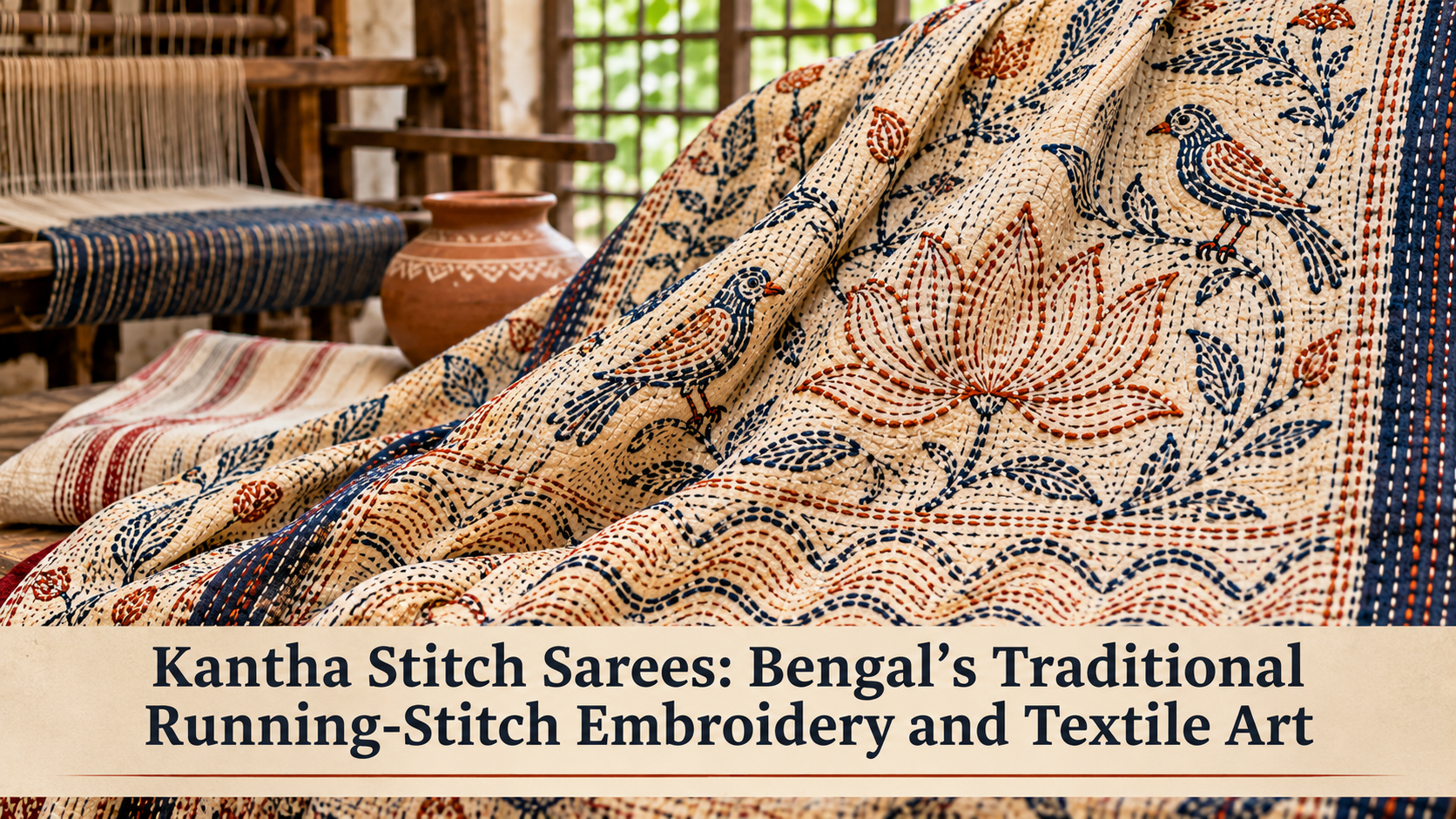
Pick up a genuine Kantha stitch saree and turn it over. The embroidery on the back looks almost the same as on the front, and the surface has a faint ripple, as if the cloth had been gently shirred. That ripple comes from thousands of small running stitches, each one passed through the fabric by hand. It is the quickest way to understand why Kantha is treated as a textile art and not just a decorative finish.
This guide covers where Kantha comes from, how it was made, what the stitches and motifs are called, how it is placed on a saree, and how to separate real handwork from machine and printed copies. It is written for readers who want to buy well and wear with understanding.
What is Kantha embroidery?
Kantha is a running-stitch embroidery tradition of the Bengal region. The basic materials are thread and old cloth, and the main stitch is the plain running stitch, often called the kantha stitch. The word is commonly linked to an old term for rags or patched cloth, which fits the craft’s origin in the household.
Traditionally, women layered worn sarees, dhotis and lungis, then stitched the layers together so they behaved as one piece of cloth. The stitching held the layers in place and, as a side effect, produced a soft, slightly rippled surface. Over time, the stitching became a place for design, and plain quilting grew into figured embroidery known as Nakshi Kantha.
A Kantha work saree applies this same stitching language to a wearable cloth. The saree may carry a few lines of running stitch along the border, scattered motifs across the body, or dense filling across the whole length.
Where Kantha comes from: history and geography
Kantha belongs to undivided Bengal, so today it is found on both sides of the India and Bangladesh border. In India the craft is associated with West Bengal, and strong working centres include Birbhum, Murshidabad, Nadia and the 24 Parganas districts. Related traditions also exist in Tripura and parts of Assam. In Bangladesh, Nakshi Kantha has been made in districts such as Jessore, Faridpur, Rajshahi, Mymensingh and Chittagong, and Jessore has given its name to a particular darning-based stitch.
The oldest surviving Nakshi Kantha pieces are usually dated to the 18th century, though most historians treat the practice as older, because everyday textiles in a household wear out and rarely survive. Craft writers describe the work as a pursuit of women from every social level. A landlord’s household might use finer cloth and more varied thread, while a farmer’s household used what was available, and the quality of the imagination was not tied to wealth.
The craft has also been recorded in literature. The poet Jasimuddin’s long poem “Nakshi Kanthar Math” tells of a woman who embroiders a Kantha as a record of her grief, and it is often cited to show how deeply the craft sits in Bengali cultural memory. Kantha went through periods of decline and revival, and its present visibility owes a good deal to craft organisations, designers and women’s cooperatives who brought it back into wider use.
Household textiles and the reuse of old cloth
Before Kantha was a saree, it was a family of household objects. The main working principle was reuse. Soft, worn cotton sarees and dhotis were washed, layered and stitched into new items, and threads were often drawn from the coloured borders of old sarees and used for the embroidery itself. Nothing was bought for the purpose that the household did not already have.
Textile studies commonly list several functional types of Kantha. The names differ slightly by source and region, but the usual set looks like this:
| Type | Typical use |
| Lep | A thicker quilt for winter, with wave-like stitching across layers of old sarees |
| Sujni | A rectangular spread, often used on festive or ceremonial occasions |
| Baytan | A wrapper for books or valuables |
| Oar | A pillow cover, often with simple birds, trees or foliage |
| Archilata | A cover for a mirror or toilet articles |
| Durjani | A small purse or wallet |
| Rumal | A handkerchief or small cloth |
Layering produced the thickness of a Kantha without any batting, which is one reason the craft is called an upcycling tradition today. Expectant mothers in many Bengali households also stitched small, soft Kanthas for newborns, using the gentlest of the old cloth.
The running stitch and its variations
The plain running stitch is the foundation. The needle goes up and down through the cloth in a straight line, leaving a broken dash of thread on the surface. Skilled Kantha stitchers keep the stitches small and even, and in good work they read almost like dots, giving the surface a pointillist effect.
Documented sources list several stitches that grow out of this base:
- Phor or kantha stitch: the predominant running stitch itself, used for outlines and filling.
- Chatai: pattern darning, in which running stitches are worked in rows to build a woven-looking texture.
- Jessore stitch: a variation of darning, linked to the Jessore region.
- Kaitya: a bending stitch, used for curved lines and borders.
- Threaded running stitch: a second thread is woven through a line of running stitches to thicken it.
- Lik phor, also called ghar hasia: a Holbein-type stitch that gives a continuous line.
Stitches used in more recent or commercial Kantha include the Kashmiri stitch and the arrowhead stitch, and satin stitch, herringbone, backstitch and cross-stitch appear occasionally. Because these are later additions in many cases, a saree carrying a lot of satin stitch or cross-stitch is a Kantha-inspired piece. It may still be handmade and beautiful, but it follows a different tradition from the simple running-stitch cloth.
Two broad families are often named in the literature. Par tola, or patterned Kantha, uses repeating stitched lines and bands. Nakshi, or figured Kantha, builds pictures, and is further divided into motif Kantha and scenic or narrative Kantha.
How a Kantha saree is made, step by step
Methods vary by workshop, so treat the sequence below as a general account of hand practice and not as a fixed rule.
- Fabric preparation. The base cloth, whether cotton or silk, is washed and pressed so it does not shrink or pucker after embroidery. In older practice, layers of cloth were spread and smoothed together before stitching. On modern sarees made from a single layer, the cloth is stretched so the stitches do not pull unevenly.
- Thread selection. Traditionally, threads were pulled from old saree borders, which is why early Kanthas show a soft, mixed colour range. Today workshops use cotton or silk embroidery thread, chosen to suit the base cloth.
- Tracing. Older work was often done from memory, with no drawn pattern. In Nakshi Kantha, the outline of the design was worked first in a darker thread and then filled in with brighter colours. Contemporary workshops often trace the design lightly with a washable marker or a printed outline so the pattern stays consistent along a long saree.
- Stitching. The embroiderer works with a fine needle and a running stitch, often turning the cloth to keep the lines even. Motifs are outlined, then filled with rows of close running stitches. Background areas may be stitched in parallel lines to create the characteristic ripple.
- Finishing. Loose thread ends are secured, the saree is washed or steamed to settle the stitches, and the fall, pico or edge finishing is completed. A well-made piece should look tidy on both faces of the cloth.
A fully embroidered saree can take a long time to finish, and some pieces are worked by more than one embroiderer. That is the main reason a genuine handmade Kantha is priced differently from a machine copy.
Motifs and designs
Kantha embroidery designs draw on the world around the maker. Common documented motifs include:
- Flowers and plants: lotus, creepers, leaves, trees and floral sprays.
- Birds and animals: parrots, peacocks, fish, elephants and horses are widely reported.
- Geometric forms: bands, grids, waves, spirals, squares and rippled borders.
- Everyday scenes: villages, farmers, boats, palanquins and animals.
- Narrative designs: episodes from epics such as the Ramayana and Mahabharata, folk tales and local legends.
A lotus at the centre of a Sujni, with borders of repeating patterns around it, is a classic structure. On sarees the same motifs are scaled down and spaced so that they sit well on a draped cloth. Ask the seller what a motif is meant to show. A maker who knows the craft can usually name the flower, bird or story.
Kantha on cotton, silk and other fabrics
Cotton is the historical base. Cotton takes the running stitch easily, holds thread well and becomes soft with washing, so a hand-embroidered cotton saree is the most traditional form of the craft. It also suits warm weather. If you are exploring cotton sarees more widely, the cotton saree for daily wear guide covers several Bengal and other handloom cottons you may wear alongside Kantha pieces.
Silk is a later and now very popular base. A Kantha silk saree is often made on tussar, mulberry or similar silks, and the stitching on silk tends to look finer and more lustrous. Because silk is slippery and delicate, stitches must be tension-controlled so the cloth does not pucker. Silk Kantha is closer to a contemporary adaptation than to the household craft, even when every stitch is made by hand.
Cotton-silk blends, muslin, georgette and other light fabrics are also used by designers. Read the fibre details in the listing, because fabric affects drape, weight and care. Our cotton silk saree guide explains how blended fabrics behave if you are considering one.
Placement of embroidery on the saree
Where the embroidery sits changes both the look and the price.
- Border: a narrow band of running stitch along one or both long edges is the simplest and most affordable placement. It frames the saree without covering it.
- Body: scattered motifs, rows of small butis or lines of wave stitching across the field give a light, even texture.
- Pallu: the end piece is the traditional place for the richest embroidery, with larger motifs or a narrative panel that shows when the saree is draped.
- Full-body work: dense stitching across the entire saree is the most labour-intensive form, and the cloth takes on a rippled, quilted feel.
Look at how the pallu and border relate to each other. In good work the motifs on the pallu echo the border in colour and scale, and the density of stitching changes gradually instead of stopping abruptly.
Hand-stitched Kantha versus machine embroidery and printed imitations
The word Kantha is used loosely in the market, and not everything sold under the name is handwork. Three categories are worth keeping apart.
| Feature | Traditional hand-stitched Kantha | Machine embroidery | Printed Kantha designs |
| How it is made | Running stitches worked by hand with a needle | Stitched by an embroidery machine, often at high speed | Design printed on the cloth surface |
| Surface texture | Slight ripple; thread sits in the cloth | Flat, uniform, often denser and stiffer | Completely flat; no raised thread |
| Reverse side | Stitches visible, similar to the front in good work | Often shows a backing layer or a tangle of locked threads | Shows only a faded print or plain cloth |
| Stitch spacing | Slightly varied; small natural differences | Perfectly regular | Not applicable |
| Motif outlines | Soft, hand-drawn character | Sharp, repeated exactly | Crisp or blurred depending on print quality |
| Time and labour | Long; skilled work | Fast once programmed | Fastest |
| Price expectation | Higher, reflecting labour | Mid-range | Lowest |
| Care | Gentle wash; check colour fastness | Gentle wash; embroidery may be stiffer | Follow label; print may fade |
| Honest labelling | “Hand-embroidered Kantha” | “Kantha-style machine embroidery” | “Kantha print” |
None of the three is wrong to buy, as long as the label tells you what you are getting. A printed Kantha design can be a pleasant, light saree for everyday use. The trouble starts when a printed or machine-made piece is described as traditional handwork.
Regional variations and contemporary adaptations
Different districts developed recognisable habits. Birbhum, near Santiniketan, is often associated with finer figurative work and has been a centre for craft revival. Murshidabad is known for silk and for Kantha on silk and cotton. Bangladeshi Nakshi Kantha has strong traditions of narrative and village scenes, and Jessore and Faridpur have given their names to particular stitches and styles. These are tendencies from craft literature and not strict boundaries, because makers and designs moved freely across the region.
Contemporary adaptations include Kantha on tussar and mulberry silk, light cotton muslin, georgette and blends, as well as abstract, geometric and modern motifs placed beside traditional lotus and bird forms. Designers have also used Kantha stitching in jackets, stoles and kurtas, and several fashion labels have shown Kantha-inspired collections. These adaptations are valid expressions of living craft, but they differ from household Kantha in purpose, fabric and often technique.
What to check before buying a Kantha saree
Use this list when you examine a saree in a shop or review a listing.
- Turn the saree over. Hand embroidery shows stitches on the back. Machine work often shows a stabiliser or locked threads.
- Look at the stitch. Running stitches should be small, close and reasonably even, with the natural variation of a human hand.
- Feel the surface. A gentle ripple around dense stitching is expected. Hard, stiff patches may point to heavy machine filling or a backing.
- Check for printed outlines. If the stitches follow a visible printed or marker line that has not washed out, ask how the design was transferred.
- Read the fabric description. Confirm whether the base is cotton, silk or a blend, and whether the thread is cotton or silk. Our guide to buying sarees for women explains how to read fibre terms and judge finish across sarees in general.
- Ask who made it. A seller should be able to say whether the saree is hand-embroidered, machine-embroidered or printed, and where it was made.
- Compare weight and drape. Dense Kantha can feel heavier, and the pallu may sit differently from the body.
- Test the colours. Ask about colour fastness, and wash separately the first time.
- Check the finishing. Thread ends, fall and pico should be neat, and the embroidery should not pull the cloth.
- Match price to claim. Fully hand-embroidered work takes long hours, and a very low price for a claim of full handwork deserves a question.
If you are buying remotely, photographs of the reverse side and close-ups in daylight are worth requesting. The online saree shopping guide lists questions to ask a seller and checks to make on delivery.
Caring for Kantha embroidery
Care depends on the base cloth and thread, so follow the care label first. As a general approach, wash gently by hand in cold water with a mild detergent, avoid wringing, dry in shade and iron on the reverse side at a temperature suited to the most delicate fibre in the piece. Wash dark or richly dyed pieces separately at first. Store folded in a cotton or muslin cloth, and refold along different lines now and then so the stitched areas do not crease permanently.
Frequently asked questions
1. What is a Kantha stitch saree? A Kantha stitch saree carries embroidery worked mainly in running stitch, a technique from Bengal. The stitching may be on the border, the body, the pallu or the whole cloth, and on genuine pieces it is done by hand.
2. How is a Kantha saree different from other embroidered sarees? Kantha relies mostly on the simple running stitch and on soft, rippled texture, while many other embroideries use raised satin stitch, zari thread or applied materials. Kantha work often looks quieter and more textural.
3. Is every saree sold as Kantha handmade? No. The name is used for hand-embroidered, machine-embroidered and printed sarees. Check the reverse side, ask the seller how the saree was made and look for honest labels.
4. Can Kantha be done on silk? Yes. Kantha on tussar, mulberry and other silks is common in contemporary work. It is a later adaptation of a craft that began on layered cotton, and the finish is generally finer and more lustrous.
5. Is a hand-embroidered cotton saree suitable for summer? Cotton is breathable, so many people find it comfortable in warm weather. Dense embroidery adds some weight, so lighter stitching on a soft cotton base is easier in heat.
6. How should I wash a Kantha saree? Follow the care label. In general, hand wash gently in cold water with mild detergent, wash separately the first time, avoid wringing and dry in shade.
7. Why do hand-stitched Kantha sarees cost more than printed ones? Hand embroidery takes skilled labour and many hours, while printing is a quick surface process. Price also reflects fabric, density of stitching and how much of the saree is embroidered.
8. Are Kantha designs only traditional? No. Traditional motifs such as lotus, birds and village scenes remain popular, and contemporary makers add geometric, abstract and modern patterns. Check whether a listing describes the piece as traditional or as a contemporary adaptation.
Conclusion
Kantha began as a way of giving old cloth a second life and became one of Bengal’s most recognisable embroidery traditions. A genuine Kantha stitch saree carries that history in its small, uneven running stitches, its soft ripple and its motifs drawn from village life and story. When you shop, look at the reverse side, ask how the piece was made and choose a label that matches the work. Handmade, machine-embroidered and printed Kantha all have a place, provided you know which one you are holding.
