Blog
Narayanpet Sarees: Telangana’s Traditional Checks, Borders and Handloom Heritage

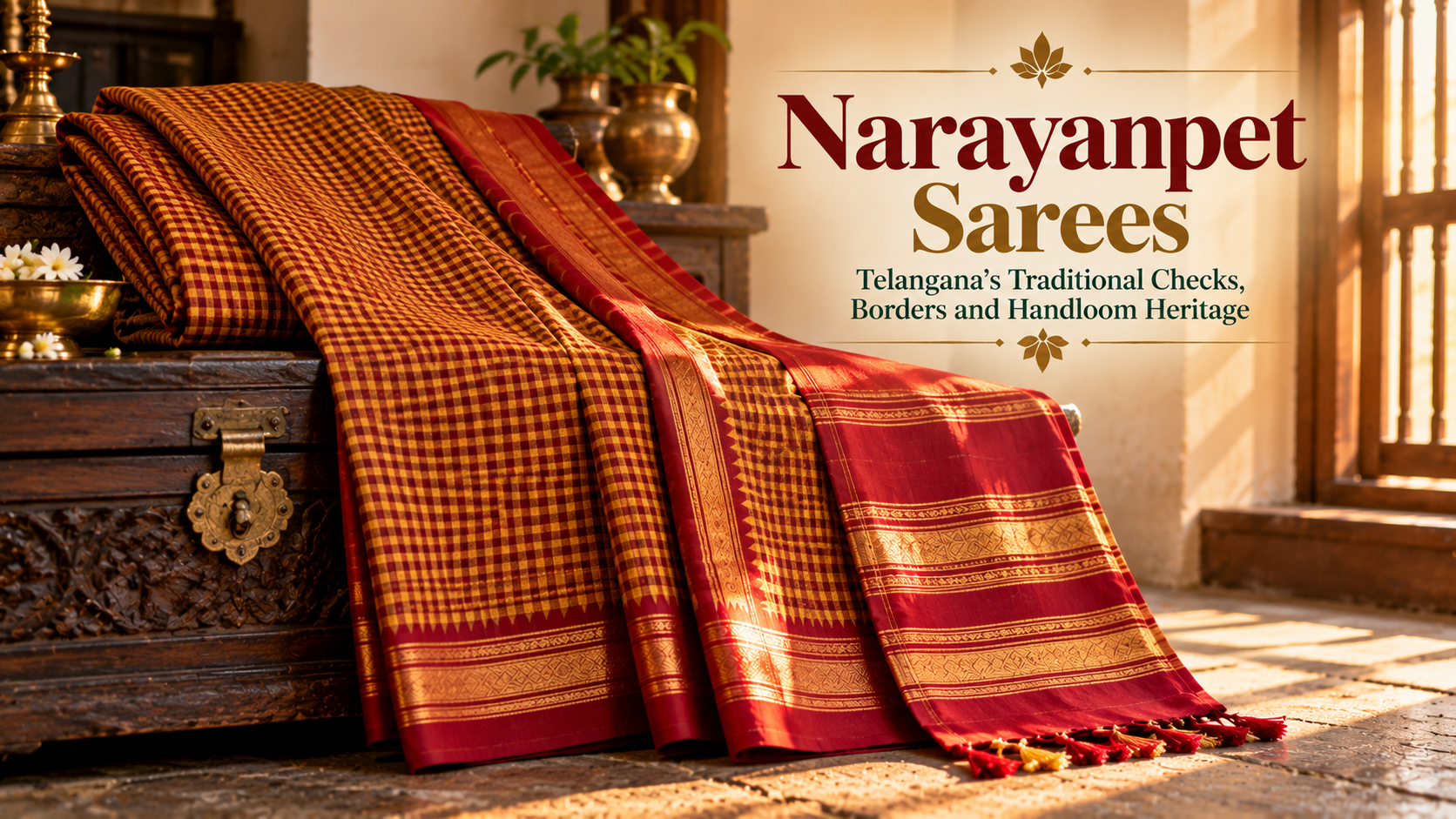
A traditional Narayanpet cotton saree follows a clear set of rules. The body is covered in checks, small or large, and carries no other motif. A border of equal width runs along both edges. The pallu has no border of its own but carries bands of zari. These rules are not just custom; they are written into the saree’s Geographical Indication documentation, which makes Narayanpet one of the most precisely defined handloom traditions in Telangana.
This guide explains where the Narayanpet saree comes from, how its checks, borders and pallu are designed, how silk, cotton and silk-cotton versions differ, and how it compares with other Telangana weaving traditions.
Narayanpet and Telangana’s weaving heritage
Narayanpet is a town in south-western Telangana, close to the Karnataka border. It was part of Mahabubnagar district until 2019, when Narayanpet district was formed. The town and surrounding villages are home to many weaving families who depend on handloom work for their livelihood.
The Maratha connection
The best-known account of Narayanpet’s weaving history links it to Chhatrapati Shivaji. According to this account, recorded in the GI application and repeated by government handloom sources, Shivaji camped in the Narayanpet region during his travels, and some weavers from his entourage stayed behind when he moved on. Their work developed into the Narayanpet saree. Many sources date this to around 1630.
The account is widely repeated, but its details rest largely on tradition. What is clear is that Narayanpet sarees show a strong Maharashtrian influence in colour and design, which government sources attribute to these weavers’ origins.
Geographical Indication
“Narayanpet Handloom Sarees” is a registered Geographical Indication from Telangana. Intellectual Property India’s records list it as GI application 214, with the registration certificate issued in 2013. The application was filed by local handloom weavers’ cooperative societies, and its statement of case sets out the specific design features described below.
The three types of Narayanpet saree
The GI documentation recognises three types of Narayanpet handloom saree:
- Cotton: cotton yarn in both warp and weft
- Silk: silk yarn in both warp and weft
- Silk-cotton: pure silk warp with pure cotton weft
Related GI documentation for Telangana handlooms notes that, in cotton and silk sarees, warp and weft are of the same fibre and not mixed, and that where a mix is used, the warp is silk and the weft is cotton. The cotton is described as 80s count, which is fine yarn. Government handloom sources describe Narayanpet cotton sarees as normally woven with 60s to 80s count yarn in warp and weft.
For a broader explanation of how silk and blended fibres differ in feel, durability and value, see our article on silk saree vs silk blend saree.
Narayanpet cotton saree
The cotton saree is the form most closely tied to the checked body. It is light, breathable and suited to daily wear, and its checks and borders give it a crisp, structured look.
Narayanpet silk saree
Silk Narayanpet sarees use silk in both warp and weft. They are more lustrous and are often chosen for festivals and functions. Silk Narayanpet sarees are widely known for being more affordable than many other South Indian silk traditions.
Narayanpet silk-cotton saree
The silk-cotton saree combines a silk warp with a cotton weft, balancing sheen with comfort.
Traditional checks
Checks as a compulsory feature
The GI documentation is explicit: checks are woven throughout the body of the saree, and the presence of checks is a compulsory feature in all Narayanpet cotton sarees. The checks may be small or large, but no other design, whether flora, fauna or any other motif, is woven in the body of the cotton saree. The documentation describes the presence of checks, together with the absence of any other body design, as a unique feature.
How the checks are woven
Checks are produced by arranging bands of different coloured yarn in both the warp and the weft. Where coloured warp bands cross coloured weft bands, squares form. The size of the checks depends on how many threads are in each colour band.
Because the pattern comes from coloured yarn rather than printing, the checks show equally on both sides of the fabric. They form a grid that frames the body and contrasts with the solid, decorated border.
Silk and silk-cotton bodies
Checks are compulsory in the cotton saree. Silk and silk-cotton Narayanpet sarees may also have checked bodies, and many do, but plain or lightly patterned bodies are also seen in these types.
Borders
The GI documentation describes the Narayanpet border in precise terms:
- On both sides: a border runs along both edges of the saree for the full length of the body.
- Uniform width: both borders are the same size.
- Width: between 3 and 5.5 inches, measured from the outer edge to the inner edge of the border.
- Compulsory: the double border is a requirement in all three types of Narayanpet saree.
- Not in the pallu: there is no border in the pallu area.
Border designs
Border designs are woven in thread or zari. The GI application lists characteristic border designs such as swans, mangoes and leaves, and it mentions a temple design. Government handloom sources describe small extra-warp geometric designs in the border, woven in zari or art silk. Related documentation describes the zari border as a bold, ribbon-like band.
How the border is woven
Telangana Tourism describes Narayanpet sarees as traditionally woven using the interlocked-weft technique. In this method, separate shuttles carry the body weft and the border weft, and the two are interlocked where they meet, allowing the border to be a solid contrasting colour. The small border motifs are then added with extra-warp threads, as government sources describe.
The pallu
The pallu is where much of the saree’s decoration is concentrated. According to the GI documentation:
- the pallu has zari work, as does the border, and
- there is no border running through the pallu.
The pallu is typically a solid colour, often matching the border, crossed by bands of zari or contrasting thread. Many traditional pallus feature horizontal stripes of varying width, sometimes with small geometric motifs. The contrast between the checked body and the solid, banded pallu is one of the saree’s most recognisable visual features.
The GI documentation gives a standard length for silk and silk-cotton sarees of 6 metres, made up of about 5.4 metres of body and 0.6 metres of pallu.
Characteristic colour combinations
Narayanpet sarees are known for bold, contrasting colours, which many sources link to the Maratha influence on the craft. Traditional combinations include:
- deep red, maroon or pomegranate borders with green, mustard or black checked bodies
- dark green borders with red or orange checks
- mustard and maroon pairings
- black and red contrasts
The GI application states that the region’s water quality contributes to the quality of colour. This is the applicants’ own claim about the craft, and it reflects how strongly the region associates colour with Narayanpet weaving. Telangana Tourism also notes the sarees are well known for the durability of their colours.
The Narayanpet weaving process
General saree-making stages, from yarn preparation to finishing, are covered in our guide to the saree making process. The steps below focus on what is specific to Narayanpet.
- Dyeing. Telangana Tourism notes that each saree begins with dyeing the silk or cotton yarn. For checked sarees, yarns are dyed in all the colours needed for the check bands, border and pallu.
- Warping. The warp is prepared with coloured bands in the sequence needed for the checks, plus border warps along both edges. Telangana Tourism reports that weavers can make around 30 sarees from one warp beam.
- Setting the loom. The warp is set on the handloom, with extra-warp threads arranged for border motifs.
- Weaving the body and borders. The weaver passes coloured weft bands to form the checks, interlocking the body and border wefts where they meet.
- Adding border motifs. Extra-warp threads in zari or art silk create small geometric, temple, swan or mango designs along the borders.
- Weaving the pallu. At the end of the body, the weaver changes to the pallu colour and adds bands of zari, with no border continuing through it.
- Finishing. The saree is cut from the loom and checked.
Traditional and contemporary designs
Traditional design
The traditional Narayanpet saree, as described in the GI documentation, has:
- a checked cotton body with no other motifs
- matching borders of 3 to 5.5 inches on both sides
- border designs such as swans, mangoes, leaves, temple forms and geometric patterns in thread or zari
- a zari pallu with no border
- bold, contrasting colours
Contemporary design
Narayanpet weaving has adapted to changing demand in several ways:
- New colour palettes: pastels and softer tones alongside traditional bold colours
- Larger or bolder checks: for a more graphic look
- Lighter silk and silk-cotton pieces: for office and occasion wear
- Designer reinterpretations: some contemporary designers use Narayanpet checks and borders in modern colour stories
Not every saree sold as Narayanpet follows the GI rules. Powerloom versions and imitations may copy the checks and border but differ in fibre, construction or design details.
How Narayanpet differs from other Telangana weaving traditions
Telangana has several GI-protected handloom traditions, each with a distinct identity. The table below compares Narayanpet with three of them.
| Feature | Narayanpet | Pochampally Ikat | Gadwal | Siddipet Gollabama |
| Region | Narayanpet district, south-western Telangana | Bhoodan Pochampally and nearby villages, Yadadri Bhuvanagiri district | Jogulamba Gadwal district, southern Telangana | Siddipet, northern Telangana |
| How the pattern is made | Coloured warp and weft bands form checks; extra-warp motifs in the border | Yarn is tie-dyed before weaving (Ikat) | Interlocked joints between a cotton body and silk border and pallu | Woven figure of a milkmaid (gollabama) as a signature motif |
| Body design | Checks, compulsory in cotton sarees; no other body motifs | Geometric Ikat patterns across the body | Often plain or with small buttas | Typically plain or simple, with the motif in the border |
| Border | Matching borders of 3 to 5.5 inches on both sides, with zari or thread motifs | Contrast bands or Ikat patterns | Silk border interlocked with cotton body | Gollabama motifs woven along the bottom border |
| Pallu | Zari bands, no border in the pallu | Larger Ikat motifs | Silk pallu joined at a horizontal joint | Often decorated with the gollabama motif |
| Typical fibres | Cotton, silk, silk-cotton | Cotton, silk, silk-cotton | Cotton body with silk border and pallu; pure silk | Cotton |
In short, Narayanpet’s identity comes from its checks and its matching double border, Pochampally’s from resist-dyed yarn, Gadwal’s from the joining of cotton and silk, and Gollabama’s from its milkmaid motif.
Reading a Narayanpet product description
For general advice on budget, occasion and fabric choice, see our complete saree buying guide. For a Narayanpet specifically, the GI features give you a useful checklist:
- Type: cotton, silk or silk-cotton, and for silk-cotton, whether the warp is silk and the weft cotton
- Body: checks in a cotton saree, with no other body motifs
- Borders: matching borders on both sides, 3 to 5.5 inches wide
- Pallu: zari work and no border through the pallu
- Weaving method: handloom or powerloom
- Labels: the Handloom Mark and GI-linked labels support handloom and origin claims, though not every small producer uses them
A saree may be attractive without meeting every GI feature, but these details help you understand how closely it follows the traditional design.
Caring for a Narayanpet saree
- Dry clean silk and silk-cotton Narayanpet sarees, especially those with heavy zari.
- Hand wash cotton Narayanpet sarees gently in cold water if the label allows, separately for the first few washes in case strong colours bleed.
- Dry in shade to protect the colours.
- Iron cotton on medium heat and silk on low, with a cloth over the zari.
- Store folded in cotton cloth and refold periodically so zari does not crack along creases.
Conclusion
The Narayanpet saree from south-western Telangana is defined by a distinctive set of features: a checked body that carries no other motif in the cotton saree, matching borders of equal width on both edges, border designs in thread or zari, and a zari pallu with no border running through it. Linked by tradition to weavers who stayed behind from Shivaji’s camp and protected today by a Geographical Indication, it stands apart from Telangana’s Ikat, Gadwal and Gollabama traditions. Whether cotton, silk or silk-cotton, understanding those features makes it easier to recognise a traditional Narayanpet saree and appreciate how it is made.
Frequently asked questions
Where are Narayanpet sarees made?
Narayanpet sarees are woven in and around Narayanpet in south-western Telangana, near the Karnataka border. The town was part of Mahabubnagar district until Narayanpet district was formed in 2019.
What are the main features of a Narayanpet saree?
A checked body, matching borders on both sides, border designs in thread or zari and a zari pallu with no border through it. In cotton sarees, checks are compulsory and no other body motifs are woven.
What are the types of Narayanpet sarees?
There are three types: cotton, silk and silk-cotton. In silk-cotton sarees, the warp is silk and the weft is cotton.
Does the Narayanpet saree have a GI tag?
Yes. “Narayanpet Handloom Sarees” is a registered Geographical Indication from Telangana, with the registration certificate issued in 2013.
How wide is the border on a Narayanpet saree?
According to the GI documentation, the border is between 3 and 5.5 inches wide, with matching borders on both sides of the saree.
What motifs appear on Narayanpet sarees?
Border designs include swans, mangoes, leaves, temple forms and small geometric patterns, woven in thread or zari. The body of a cotton saree carries only checks.
What is the history behind Narayanpet sarees?
Tradition holds that weavers from Chhatrapati Shivaji’s entourage stayed behind when he camped in the Narayanpet region, around 1630, and developed the saree style. Its Maharashtrian influence is often attributed to them.
How is a Narayanpet saree different from a Gadwal saree?
Narayanpet sarees are known for checked bodies and matching double borders. Gadwal sarees are known for joining a cotton body to silk borders and pallu through interlocked joints.
