
Blog
Ilkal Sarees: Traditional Karnataka Weaving, Tope Teni Pallu and Distinctive Borders

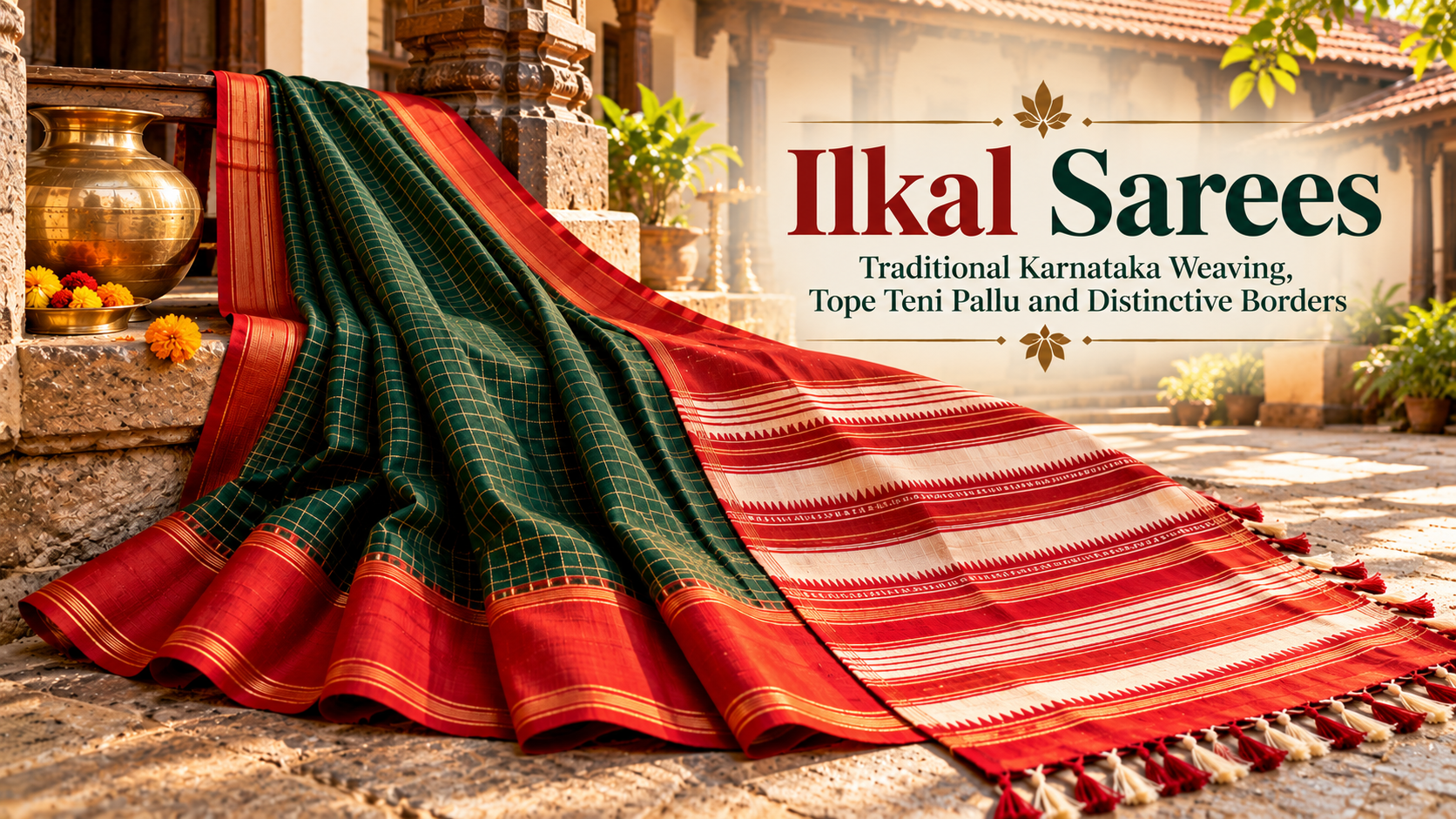
On most sarees, the pallu is simply the last stretch of the same length of cloth. On a traditional Ilkal saree, it is not. The pallu is prepared on its own warp and then joined to the body warp through a series of hand-made loops before weaving. Turn an Ilkal saree over at the point where the body meets the pallu and you can often see that looped joint.
This guide explains where the Ilkal saree comes from, how the tope teni joint and the traditional pallu design work, what makes Ilkal borders distinctive, how fabrics vary and how traditional handloom pieces differ from contemporary adaptations.
Ilkal and Karnataka’s weaving heritage
Ilkal is a town in the Bagalkot district of northern Karnataka, about 60 km from Bagalkot town. It lies in a cotton-growing region, and weaving has long been a major occupation there.
Government handloom sources describe Ilkal as an ancient weaving centre and suggest weaving may have begun there as early as the 8th century AD. That early date is best understood as a broad tradition rather than a precise record. What is well documented is that Ilkal developed its own saree style, now recognised as one of Karnataka’s best-known handloom traditions.
Geographical Indication
Ilkal sarees received Geographical Indication (GI) registration in 2007, with support from NABARD. The GI protects the name for handloom sarees woven in the defined region using the traditional techniques described below.
Reach beyond Karnataka
Ilkal sarees are also widely worn in neighbouring Maharashtra, where the style has become closely associated with traditional dress. Ilkal weavers traditionally produce warps for 6-yard, 8-yard and 9-yard sarees, the longer lengths suiting the nine-yard drapes worn in parts of Karnataka and Maharashtra. Our saree length and width guide explains how saree dimensions affect different draping styles.
The anatomy of an Ilkal saree
A traditional Ilkal saree has three distinct parts, each with its own role in the design.
- Body: often cotton, plain or patterned with coloured stripes and checks
- Border: broad, usually about 4 to 6 inches, in a solid colour contrasting with the body
- Pallu (seragu in Kannada): traditionally silk or art silk, with bold horizontal bands and without the body’s stripes and checks
Government handloom documentation notes an important colour relationship: the border and pallu warp are the same colour, while the body warp is a contrasting colour. This is why a typical Ilkal saree reads as a contrasting body framed by a matching border and pallu.
Tope teni: the looped joint between body and pallu
The term tope teni is used in two related ways, and it helps to separate them.
Tope teni as a joining technique
Government handloom sources describe the defining feature of the Ilkal saree as the joining of the body warp with the pallu warp using a series of loops, a technique locally called tope teni. They describe this technique as exclusive to Ilkal and note that the loops can be seen on the back of the saree.
In practice, this means:
- The warp threads for the body and the warp threads for the pallu are prepared separately, often in different colours and fibres.
- Before weaving, the end of each body warp thread is looped together with a matching pallu warp thread, one by one across the full width.
- Once joined, the combined warp is set on the loom and woven as one continuous saree, changing from body to pallu at the joint.
Because the joint is made in the warp, the change from body to pallu is built into the structure of the saree. It is not stitched on afterwards. Accounts also describe the weaver relying on skilled assistants for this preparatory work, since joining thousands of warp threads by hand is time-consuming.
One practical consequence noted in GI-related documentation is that weavers set up their warps in standard lengths of 6, 8 or 9 yards, because the pallu joint fixes where the saree ends.
Tope teni as a pallu design
The name also refers to the traditional pallu pattern, called tope teni seragu. In its classic form, the pallu has three solid red bands separated by two white bands. This red and white pallu is the most recognisable Ilkal design and is held in high regard, especially for festive occasions.
The middle of the tope teni seragu is sometimes decorated with an additional woven pattern known as kyadgi. Some sources describe the tope teni pattern as resembling a field of jowar (sorghum), reflecting the region’s farming life, though explanations of the name vary.
How it differs from ordinary pallu designs
On most sarees, including many with a contrast pallu, the body and pallu share the same warp. The pallu’s colour and design come from changing the weft or adding extra-weft patterns. On a traditional Ilkal, the pallu has its own warp, joined to the body warp with loops. That joint is what allows the pallu to change in both colour and fibre from the body, for example from a cotton body to a red silk pallu.
Other South Indian traditions solve the problem of a contrasting pallu in different ways. Some join a new warp by twisting or weaving it into the old one, and some rely on extra-weft patterning across a shared warp. For a different approach, the Uppada Jamdani saree builds its pallu decoration through discontinuous extra-weft motifs rather than a change of warp.
Kondi: the three-shuttle border
The broad solid border is the other defining feature of an Ilkal saree. Government sources state that the kondi technique is used to produce solid-coloured borders using three shuttles:
- one shuttle carries weft across the body, and
- two shuttles carry weft for the borders on either side.
At the meeting point between body and border, the wefts interlock, so the border can be a completely different solid colour from the body. This is a three-shuttle interlocked-weft technique, similar in principle to methods used in other South Indian weaving centres, but in Ilkal it is combined with the separate tope teni warp joint at the pallu.
The result is a saree with two kinds of joint: interlocked wefts along the length at the borders, and looped warps across the width at the pallu.
Borders, colours and motifs
Borders
Ilkal borders are broad, generally about 4 to 6 inches, and usually in a single strong colour that contrasts with the body. Borders may carry small woven patterns along their edges, with motifs often described as triangles, dots and lines.
Traditional colours
Classic Ilkal colour schemes include:
- red borders and pallus with dark green, maroon, black, deep blue or mustard bodies
- bright pomegranate red, parrot green and peacock blue
- the red and white tope teni pallu
The strong contrast between body and border is part of the traditional look.
Body patterns
The body is often patterned with coloured stripes and checks, woven by arranging different coloured threads in the warp and weft. Government sources specify that these stripes and checks appear in the body but not in the pallu.
Kasuti embroidery
Some Ilkal sarees are decorated with kasuti, a traditional embroidery of Karnataka. Kasuti motifs include palanquins, elephants, lotuses and temple forms, worked by hand with a needle after weaving. Kasuti has its own GI protection, held by the Karnataka Handicrafts Development Corporation.
Kasuti is embroidery, not weaving. An Ilkal saree may or may not carry it, and the presence or absence of kasuti does not change whether the saree itself is a traditional handloom Ilkal.
Ilkal saree fabrics
Ilkal sarees are woven in several fibre combinations. The traditional pattern combines a cotton body with a silk or art silk pallu, but other forms are common.
Cotton body with silk or art silk pallu
The most traditional combination. The cotton body is breathable and practical; the silk or art silk pallu gives sheen and makes the red tope teni bands stand out. Historically, accounts describe silk as being expensive and used mainly in the pallu.
Ilkal cotton saree
All-cotton Ilkal sarees are widely made for daily wear. They keep the broad border and banded pallu but use cotton throughout.
Ilkal silk saree
Pure silk Ilkal sarees use silk in both body and pallu. They are heavier and more lustrous and are often chosen for festivals and weddings.
Cotton-silk and art silk variations
Many contemporary Ilkal sarees use cotton-silk blends in the body, or art silk (a synthetic or viscose silk-like yarn) in the border and pallu. Art silk is a valid choice, but it is not the same as mulberry silk, and descriptions should say which is used. For more on how blends change feel and value, see our article on silk saree vs silk blend saree.
The Ilkal weaving process
General stages of saree making, from yarn preparation to finishing, are covered in our guide to the saree making process. The steps specific to Ilkal are:
- Preparing three warps. The body, border and pallu warps are prepared separately, with the border and pallu warps in the same colour and the body in a contrasting colour.
- Joining with tope teni. Body warp threads are looped to pallu warp threads by hand across the full width.
- Setting the loom. The joined warp, with border warps along each edge, is set on a traditional pit loom or frame loom, often fitted with a dobby or jacquard for patterns.
- Weaving the body and borders. The weaver uses three shuttles in the kondi technique, interlocking body and border wefts on each pass.
- Weaving the pallu. At the joint, the warp changes to the pallu warp, and the weaver creates the banded tope teni design.
- Finishing. The saree is removed, checked and, if required, embellished with kasuti.
Traditional handloom vs contemporary adaptations
Ilkal sarees today range from traditional handloom pieces to modern adaptations and imitations.
Traditional handloom characteristics
- Looped tope teni joint between body and pallu warps, visible on the reverse
- Broad solid border made with the three-shuttle kondi technique
- Border and pallu warp in the same colour, contrasting with the body
- Stripes or checks in the body but not in the pallu
- Pallu with bold bands, often the red and white tope teni seragu
- Woven on pit or frame looms
Contemporary adaptations
- New colour combinations, including pastels and muted tones
- Lighter fabrics and blends for office wear
- Simplified pallus or pallus with added motifs
- Designer reinterpretations that keep some Ilkal features but not others
Powerloom imitations
Powerloom sarees sold as “Ilkal style” may copy the broad border and banded pallu but usually do not use the looped tope teni joint or the three-shuttle kondi border. Such sarees are cheaper and easier to find but are a different product from a handloom Ilkal.
Comparing Ilkal construction and design features
| Feature | Traditional Ilkal handloom | Contemporary handloom adaptation | Powerloom “Ilkal-style” saree |
| Body-pallu join | Separate warps joined by hand-made loops (tope teni) | Usually tope teni; sometimes simplified | Typically one continuous warp, no looped joint |
| Border construction | Broad solid border with three-shuttle kondi interlocking | Kondi borders, sometimes narrower | Border colour usually from warp change, without interlocked weft |
| Colour relationship | Border and pallu warp same colour; body contrasting | Often follows the same rule, with new palettes | May copy the look without the warp structure |
| Body pattern | Stripes and checks in the body only | Stripes, checks or plain | Varies |
| Pallu design | Bold bands, often red and white tope teni seragu, sometimes with kyadgi | Traditional or modified bands, sometimes with added motifs | Printed or woven imitation bands |
| Typical fibres | Cotton body with silk or art silk pallu; all-cotton; pure silk | Cotton-silk blends, art silk | Often synthetic or viscose |
| Embellishment | Optional hand kasuti embroidery | Optional kasuti or machine embroidery | Often machine embroidery or print |
| Reverse side | Looped joint visible at the pallu | Usually visible | No looped joint |
What to look for in an Ilkal product description
Our complete saree buying guide covers general budget, occasion and fabric choices. For an Ilkal specifically, check:
- Fibre by part: body, border and pallu, and whether the silk is mulberry silk or art silk.
- Weaving method: handloom or powerloom.
- Tope teni joint: whether the pallu is joined with the looped technique.
- Border: whether it is woven with interlocked weft (kondi).
- Length: 6, 8 or 9 yards, depending on your draping style.
- Embellishment: whether any kasuti is hand embroidered or machine made.
- Labels: the Handloom Mark or GI-linked labels support handloom and origin claims. Their absence, especially from small weavers, is a reason to ask rather than proof of imitation.
Caring for an Ilkal saree
- Dry clean silk and art silk pallus, especially on festive pieces.
- Hand wash all-cotton Ilkal sarees gently in cold water if the label allows, and wash separately the first few times in case the strong colours bleed.
- Dry in shade to protect the reds and greens.
- Iron cotton on medium heat and silk on low.
- Do not pull at the pallu joint; store folded in cotton cloth and refold periodically.
Conclusion
The Ilkal saree from Bagalkot district in Karnataka is defined by its construction. Separate body and pallu warps are joined by hand with a series of loops in the tope teni technique, and broad solid borders are woven with three shuttles in the kondi technique. Together with the classic red and white tope teni pallu, these features give the saree its strong, recognisable look and its standing as a GI-protected tradition. Today the name covers cotton, silk and blended pieces, handloom and powerloom, so checking the fibre, the joint and the border is the clearest way to understand any particular Ilkal saree.
Frequently asked questions
Where are Ilkal sarees made?
Ilkal sarees are woven in and around Ilkal, a town in the Bagalkot district of northern Karnataka.
What is the tope teni technique?
Tope teni is the technique of joining the body warp to the pallu warp with a series of loops before weaving. Government handloom sources describe it as exclusive to Ilkal.
What is a tope teni pallu?
The tope teni seragu is the traditional Ilkal pallu design, classically three solid red bands separated by two white bands, sometimes with a kyadgi pattern in the middle.
What is kondi weaving in Ilkal sarees?
Kondi is the three-shuttle technique used to weave the broad, solid-coloured border. One shuttle weaves the body and two weave the borders, with the wefts interlocked where they meet.
Are Ilkal sarees made of cotton or silk?
Both. The traditional form has a cotton body with a silk or art silk pallu, and all-cotton and pure silk versions are also woven.
Does Ilkal saree have a GI tag?
Yes. Ilkal sarees received Geographical Indication registration in 2007.
Is kasuti embroidery part of every Ilkal saree?
No. Kasuti is a separate hand embroidery tradition from Karnataka that is sometimes added to Ilkal sarees. Many Ilkal sarees have no kasuti.
What lengths do Ilkal sarees come in?
Ilkal sarees are traditionally woven in 6-yard, 8-yard and 9-yard lengths, the longer ones suiting nine-yard drapes.
