
Blog
Maheshwari Sarees: Traditional Weaves, Reversible Borders and Signature Designs

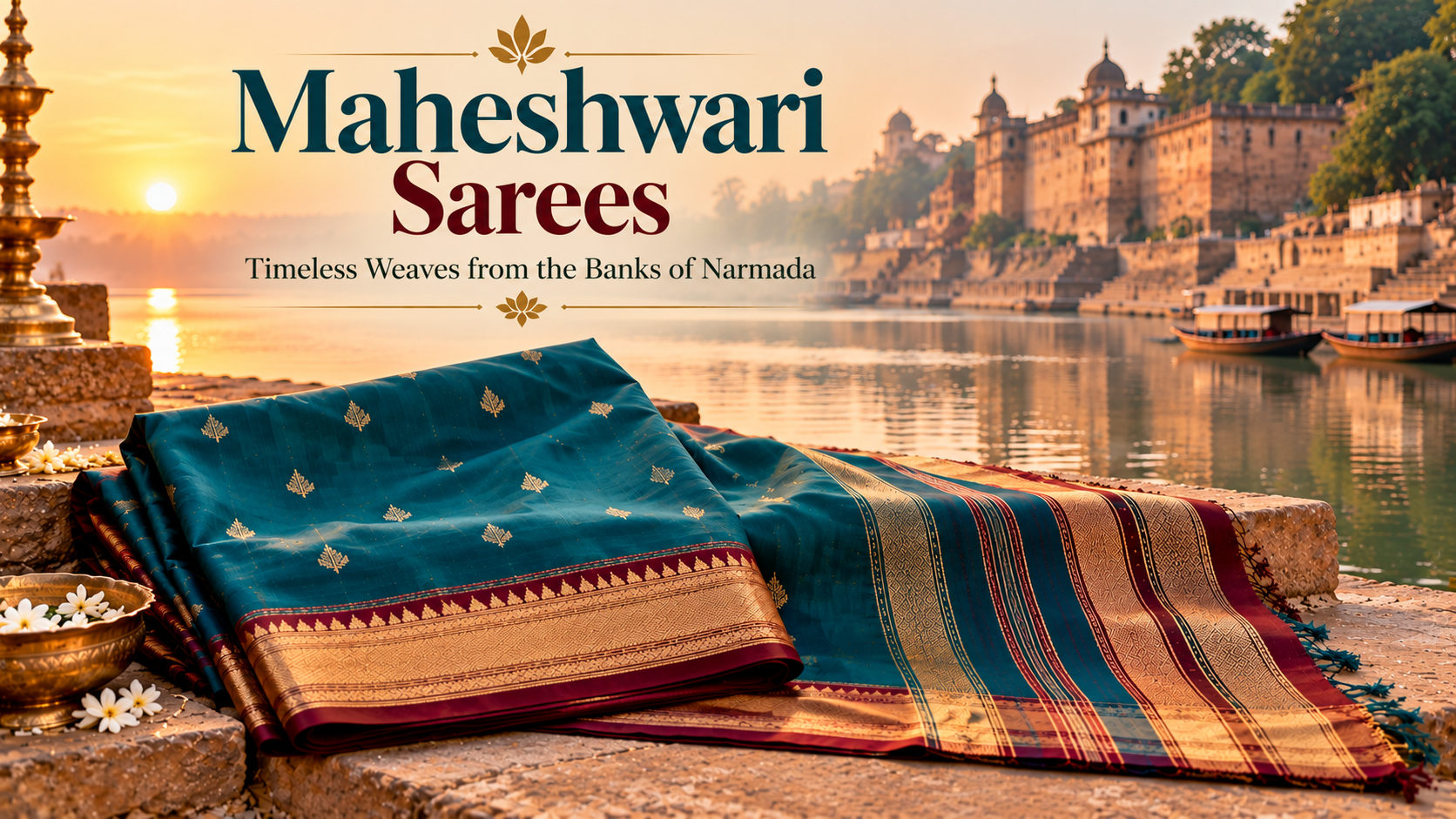
Fold a Maheshwari saree over your arm and look at both faces of the border. On a traditional piece, the pattern looks almost the same from either side. That reversible border, known locally as bugdi, is the feature most people associate with the Maheshwari saree, but it sits within a larger design language of fine stripes, small checks and a pallu marked by bands of colour.
This guide explains where the Maheshwar saree tradition comes from, how the reversible border and other signature designs are woven, how silk, cotton and silk-cotton versions differ, and how to tell handloom Maheshwari weaving from powerloom imitations.
Where Maheshwari weaving comes from
Maheshwar is a town on the north bank of the Narmada river in the Khargone district of Madhya Pradesh. Its riverside ghats and the fort above them are among the best-known sights in the Malwa region.
The town’s weaving tradition is closely linked to Ahilyabai Holkar, the 18th-century ruler of the Holkar state, who made Maheshwar her capital in the 1760s. Accounts commonly credit her with encouraging weavers to settle in the town, with some naming Surat and other weaving centres as their places of origin. The details of these accounts vary between sources and rest partly on tradition, but the link between Maheshwar’s weaving and Holkar patronage is widely documented.
Many traditional Maheshwari designs are said to draw on the architecture of the Maheshwar fort, including its carved walls, niches and patterned surfaces. Motif names such as chatai (mat) and eent (brick) reflect that architectural vocabulary.
Decline and revival
Like many Indian handloom traditions, Maheshwari weaving declined in the 20th century. In the late 1970s, the Rehwa Society was set up in Maheshwar by members of the Holkar family to support local weavers. It works from the Ahilya Fort complex, trains weavers and markets their work, and is widely credited with reviving demand for the Maheshwari handloom saree.
Geographical Indication
“Maheshwar Sarees & Fabrics” is a registered Geographical Indication, listed in Intellectual Property India’s GI register as a handicraft of Madhya Pradesh. India’s official tourism portal also describes the fabrics as GI registered. The GI protects the name for products woven in the defined region using traditional methods.
What makes a Maheshwari saree distinctive
A traditional Maheshwari saree is light, smooth and slightly lustrous, with a clean, geometric look. Four design elements define it.
The reversible border (bugdi)
The bugdi is a border woven so that it looks nearly the same on both sides of the fabric. This lets the saree be draped either way out without the border appearing as the “wrong side”.
On an ordinary woven border, the patterning threads float on the back, so the reverse looks different from the front. In a bugdi border, the weaver controls how the border warp and weft interlace so that the pattern shows on both faces. The result takes more skill and time than a one-sided border, and it is the single feature most often used to describe Maheshwari weaving.
Not every Maheshwari saree has a fully reversible border. Contemporary pieces, especially those with heavy zari borders or extra-weft motifs, may show a clear front and back.
Narrow borders with geometric motifs
Traditional borders are relatively narrow and carry small, repeating geometric or floral designs. Names used by weavers include chatai (mat), eent (brick), heera (diamond), rui phool (cotton flower) and chameli (jasmine). Borders are often woven in contrasting colours, sometimes with silver or gold-toned zari.
Stripes and checks in the body
The body of a Maheshwari saree is often plain, finely striped or checked. Stripes can run lengthwise or across, and checks range from tiny squares to larger blocks. These patterns are woven by arranging different coloured threads in the warp and weft rather than by adding extra threads, which keeps the fabric light.
The striped pallu
Traditional Maheshwari pallus are known for bands of colour, often described as five stripes, usually alternating coloured and white or contrasting bands. The stripes may be plain or carry small zari lines. Some contemporary pallus add buttis or zari patterns, but the striped pallu remains one of the most recognisable Maheshwari saree designs.
Maheshwari saree fabric types
“Maheshwari” describes the weaving tradition and design style. It does not fix the fibre, and Maheshwari sarees are woven in several compositions.
Silk-cotton Maheshwari
The most traditional and widely made form uses a silk warp (lengthwise threads) with a cotton weft (crosswise threads). The silk gives the surface a soft sheen; the cotton keeps it light, breathable and comfortable. Many sarees described simply as “Maheshwari” are this mix.
Maheshwari cotton saree
Pure cotton Maheshwari sarees use cotton in both warp and weft. They are matte or only faintly lustrous and are well suited to daily wear and hot weather.
Maheshwari silk saree
A pure Maheshwari silk saree uses silk in both warp and weft. It has a fuller sheen and drape and is usually more expensive. It suits festive occasions and functions.
Tissue and zari variations
Some Maheshwari sarees use zari in the weft or across the body to create a shimmering tissue effect. Others add zari to the border, pallu or as small buttis. The zari may be tested zari (copper-based with a metallic coating) or imitation metallic thread, and the description should say which.
Because these variations look similar at a glance, the fibre line in a product description matters. Our article on silk saree vs silk blend saree explains how blended fibres affect feel, durability and price.
How Maheshwari weaving is done
The general stages of saree making, from yarn preparation to finishing, are covered in our guide to the saree making process. This section focuses on what is specific to Maheshwari handloom work.
1. Yarn preparation
Silk and cotton yarns are cleaned, dyed and wound onto bobbins and pirns. Some traditional sources describe the silk warp as undegummed or lightly degummed mulberry silk, which helps give the fabric its crispness.
2. Warping
The warp is prepared with the body colour in the centre and border colours along the edges. For striped bodies, coloured warp threads are arranged in the stripe sequence at this stage, because the stripes are built into the warp.
3. Setting up the loom
Maheshwari sarees are woven on handlooms, typically frame looms with a fly shuttle. Dobby attachments are commonly used to lift selected warp threads for border and body patterns, allowing small geometric designs to repeat accurately.
4. Weaving the body and border
The weaver passes the weft across the warp, beating each pick into place. Checks are formed by changing weft colour at intervals to cross the coloured warp stripes. Along the edges, the border is woven at the same time. For a bugdi border, the interlacing in the border area is controlled so that the pattern shows on both faces.
5. Weaving the pallu
At the pallu, the weaver changes weft colours to create the characteristic bands. Zari lines or motifs, where used, are added at this stage.
6. Finishing
The saree is cut from the loom, checked for faults and lightly finished.
A plain Maheshwari saree takes less time than one with dense borders, zari work or reversible patterning. The exact time varies with design and weaver.
Handloom vs powerloom Maheshwari
Maheshwari-style sarees are also woven on powerlooms, often outside Maheshwar, and sometimes in polyester or viscose blends. These are cheaper and can look very similar in photographs.
No single check proves a saree is handloom, but several signs together give a reasonable picture:
- Border reverse: a true bugdi border looks nearly the same on both sides. Many powerloom borders show clear floats on the back. Remember that some genuine handloom pieces have one-sided borders too.
- Edges and selvedge: handloom selvedges often show slight irregularities; powerloom edges tend to be very even.
- Small variations: handwoven stripes and checks may vary slightly in spacing. Perfect uniformity suggests machine weaving, though skilled weavers can be very consistent.
- Description wording: “handloom”, “handwoven” and a named source such as Maheshwar make a specific claim. “Maheshwari style” or “Maheshwari print” usually do not.
- Labels: the Handloom Mark, GI-linked labels or a cooperative such as the Rehwa Society add confidence. Their absence is a reason to ask questions, not proof of imitation.
- Price: handloom silk-cotton work has a cost floor. A very low price for a “handloom silk Maheshwari” deserves a closer look.
Our complete saree buying guide covers budget, occasion and fabric choices across all saree types, which is useful context when comparing Maheshwari pieces with other options.
Maheshwari compared with related lightweight weaves
Maheshwari is most often confused with Chanderi, which also comes from Madhya Pradesh and also uses silk and cotton. Kota Doria is another light weave that buyers sometimes compare with both.
| Feature | Maheshwari | Chanderi | Kota Doria |
| Origin | Maheshwar, Khargone district, Madhya Pradesh | Chanderi, Ashoknagar district, Madhya Pradesh | Kota region, Rajasthan |
| Common fibres | Silk-cotton, cotton, silk | Silk-cotton, cotton, silk | Cotton, silk, cotton-silk |
| Texture | Light, smooth, slightly firm | Very fine and sheer | Very airy, open weave |
| Signature border | Narrow geometric border, often reversible (bugdi) | Zari border, usually one-sided | Plain or zari border |
| Body pattern | Plain, stripes, checks | Plain with scattered buttis | Woven square check (khat) |
| Pallu | Bands of colour, often five stripes | Zari motifs and bands | Zari bands or plain |
| Overall look | Clean, geometric, structured | Delicate, translucent, ornamental | Grid-patterned, very light |
In short, a Maheshwari tends to look more structured and geometric, a Chanderi more sheer and ornamental, and a Kota Doria is recognisable by its woven square grid. For other breathable options for hot weather, see our article on summer fabric trends.
Reading a Maheshwari saree description
Before buying, check four details in the listing:
- Fibre: pure silk, pure cotton or silk-cotton (silk warp, cotton weft). A listing that says only “Maheshwari” may be any of these.
- Weaving method: handloom or powerloom.
- Border: whether it is reversible, and whether it carries zari.
- Zari type: tested or imitation, if zari is used.
Also check whether a blouse piece is included.
Caring for a Maheshwari saree
- Dry clean silk and silk-cotton pieces, especially those with zari.
- Hand wash pure cotton Maheshwari gently in cold water with mild detergent if the label allows.
- Dry in shade and avoid wringing.
- Iron on low to medium heat, with a cloth over zari.
- Store folded in cotton cloth and refold every few months.
Conclusion
The Maheshwari saree comes from a specific place and a specific design language: a riverside town in Madhya Pradesh, a weaving tradition tied to Holkar patronage, and a look built from fine stripes, small geometric borders, a reversible bugdi edge and a banded pallu. Within that tradition, the fibre can be silk-cotton, cotton or silk, and the weaving can be handloom or powerloom, so the best way to understand any individual saree is to read its fibre, weaving and border details carefully. Chosen with that in mind, a Maheshwari offers a light, versatile drape that suits both daily wear and celebrations.
Frequently asked questions
Where do Maheshwari sarees come from?
Maheshwari sarees come from Maheshwar, a town on the Narmada river in the Khargone district of Madhya Pradesh. “Maheshwar Sarees & Fabrics” is a registered Geographical Indication.
What is the bugdi border in a Maheshwari saree?
Bugdi is the local name for the reversible border, woven so that the pattern looks nearly the same on both sides. This lets the saree be draped either way out.
Do all Maheshwari sarees have reversible borders?
No. The reversible border is traditional, but some contemporary pieces, especially those with heavy zari or extra-weft motifs, have borders with a distinct front and back.
What fabric is a Maheshwari saree made of?
Maheshwari sarees are woven in silk-cotton (silk warp, cotton weft), pure cotton and pure silk. Some also use zari for tissue effects or borders.
What are common Maheshwari saree designs?
Common designs include plain, striped and checked bodies, narrow borders with motifs such as chatai, eent, heera and rui phool, and a pallu with bands of colour, often five stripes.
How is a Maheshwari saree different from a Chanderi saree?
Both come from Madhya Pradesh and use silk and cotton. Maheshwari sarees are usually more structured, with stripes, checks and a reversible border. Chanderi sarees are more sheer, with scattered buttis and zari borders.
How can I tell if a Maheshwari saree is handloom?
Look at the border reverse, selvedge and small variations in the weave, read the description for “handloom” and origin, and check for the Handloom Mark or cooperative labels. No single sign is conclusive.
Is a Maheshwari saree good for summer?
Yes. Cotton and silk-cotton Maheshwari sarees are light and breathable, which makes them comfortable in warm weather.
