
Blog
Gadwal Sarees: The Art of Combining Cotton Bodies with Silk Borders

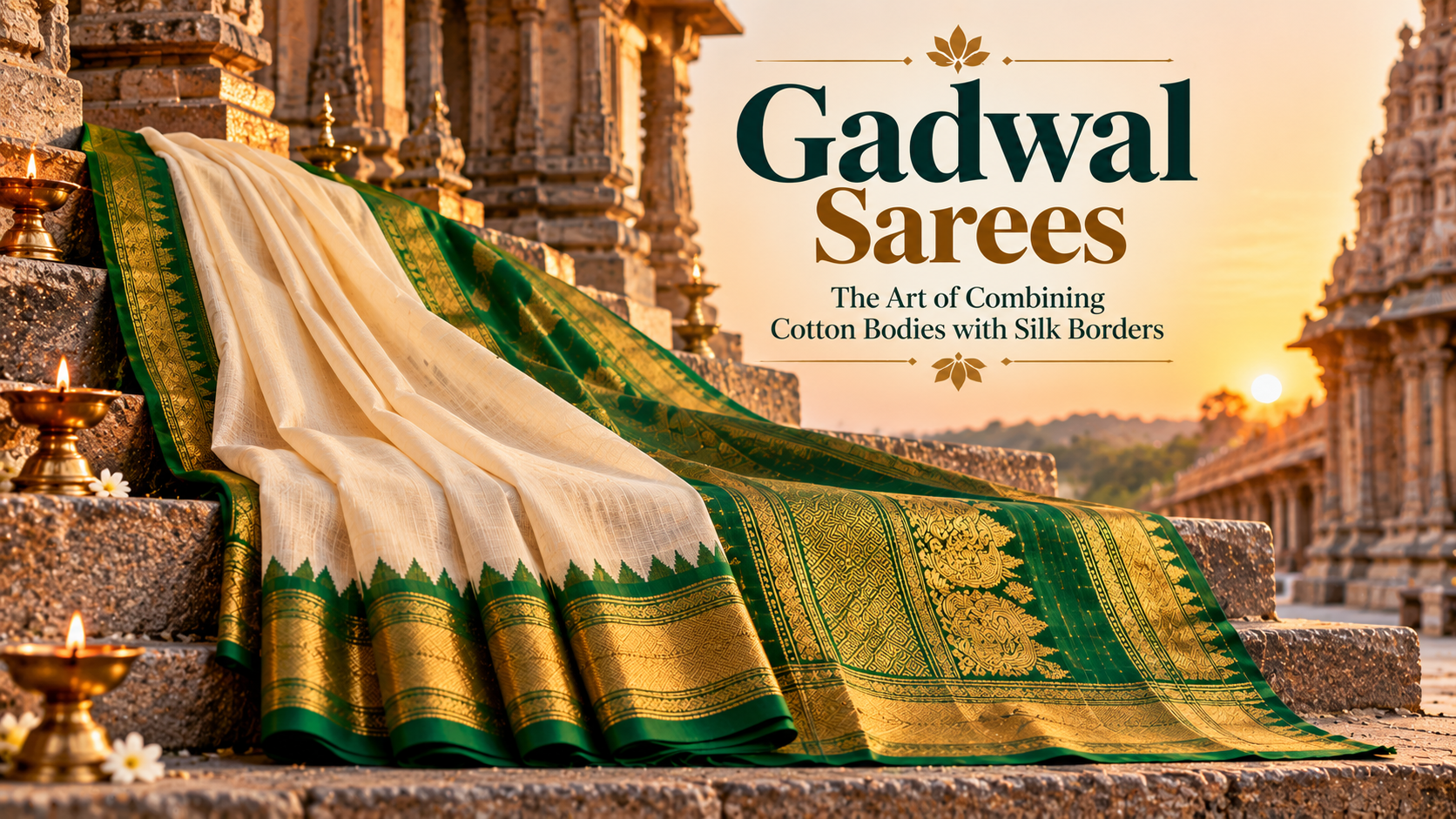
Most sarees are woven from one fibre from end to end. A traditional Gadwal saree is not. Its body is fine cotton, light and breathable, while its borders and pallu are silk, often with zari. The two are not stitched together afterwards. They are joined on the loom, thread by thread, so the saree comes off as one continuous piece with two different fibres meeting along its edges.
This guide explains where the Gadwal saree comes from, how its body, border and pallu are built and joined, how contemporary versions vary, and how to separate weaving method from fibre and appearance when reading a product description.
Gadwal and Telangana’s weaving heritage
Gadwal is a town in the Jogulamba Gadwal district of southern Telangana, near the Krishna river. It was historically the seat of the Gadwal Samsthanam, a princely estate under the Nizam of Hyderabad, and its fort dates to the 17th century.
Weaving in Gadwal is closely tied to temple use. Accounts describe Gadwal sarees being woven as offerings for deities, and a long-reported tradition holds that a Gadwal saree is offered at the start of the Brahmotsavam festival at Tirumala. These accounts reflect regional tradition and are widely repeated, though the details vary between sources.
Geographical Indication
“Gadwal Sarees” is a registered Geographical Indication from Telangana, widely reported as registered in 2010. GI documentation for the region identifies two interlocked joints, explained below, as the feature that makes the Gadwal saree distinct.
The traditional Gadwal construction
Government handloom documentation describes the traditional Gadwal saree like this:
- Body: cotton yarn in both warp and weft
- Border and pallu: silk yarn in both warp and weft
- Zari: used in borders, pallu and motifs
Because the saree combines silk and cotton, this traditional form is often called a sico (silk-cotton) Gadwal. That name describes the combination of zones, not a blended yarn. The cotton and silk sit in separate parts of the saree rather than being mixed within one thread.
Why combine cotton and silk?
The combination gives the saree two different qualities in one piece. The cotton body is light and comfortable for long wear. The silk border and pallu add structure, sheen and a surface for zari decoration. The firmer silk border also helps pleats hold their shape while the cotton body drapes softly.
The fineness of the cotton body is behind a well-known saying that a Gadwal saree is so light it could be folded into a matchbox. This is a traditional expression of how fine the weave can be, not a measurable standard for every saree.
How the body, border and pallu are joined
Joining two fibres in one saree requires two kinds of joint. GI documentation for the region names them as the vertical joint and the horizontal joint.
The vertical joint: body to border
The vertical joint runs along the length of the saree, where the cotton body meets the silk border on each side.
To make it, the loom carries cotton warp in the body area and silk warp in the border areas. The weaver then uses three shuttles: one carrying cotton weft across the body, and two carrying silk weft for the two borders. At each pass, the body weft and border weft are interlocked where they meet, so the cotton and silk zones are joined into one cloth. Government sources note that this three-shuttle weaving requires high skill.
This interlocked-weft border construction is widely called kuttu. Some sources also use the term kupadam or kuppadam, either for the interlocked technique or for the body itself; usage varies between weavers and writers.
If you have read about Kanjivaram weaving, this will sound similar to the korvai method used there for contrast-colour borders. The principle of interlocking separate border and body wefts is related. The difference in a Gadwal is that the two zones are traditionally different fibres (cotton and silk), not only different colours of silk.
The horizontal joint: body to pallu
The horizontal joint runs across the width of the saree, where the cotton body ends and the silk pallu begins.
At this point, both the warp and weft change from cotton to silk. GI documentation for Telangana’s handlooms describes the horizontal joint as what makes the Gadwal saree most distinctive, because this type of joining, from a cotton body to a silk pallu, is not found in the same form in other weaving traditions.
The result is a visible line across the saree where the matte cotton gives way to the lustrous silk pallu, with the joint woven rather than stitched.
Looms and patterning
Simple Gadwal designs are woven using a dobby to lift selected warp threads. More complex border and pallu patterns use jacquards; government sources mention jacquards of up to 480 hooks for this work. Weaving is done on handlooms, and the community’s women are widely credited with much of the weaving work.
General saree-making stages, from yarn preparation to finishing, are covered in our guide to the saree making process. The joints above are what make the Gadwal process distinct.
Contrasting colours, motifs and visual effect
Colour contrast
Traditional Gadwal sarees often pair a light or mid-toned cotton body with a strongly contrasting silk border and pallu: for example, an off-white or pale body with a deep red, maroon, green or yellow border. Some traditional pieces use bright, unexpected pairings such as lime green or canary yellow. The contrast emphasises the construction itself, since the change of colour marks the change of fibre.
Motifs
Gadwal borders and pallus carry zari and silk motifs, many drawn from temple imagery and nature. Commonly described motifs include:
- Temple or gopuram borders: stepped, tower-like shapes along the border
- Kumbham: a pot-shaped motif, often linked to temple ritual
- Annam or hamsa: a swan or bird motif
- Mango or paisley forms
- Small buttas scattered across the body, sometimes in zari
Motif names and forms vary between weavers. Border widths range from narrow to very wide, and the pallu usually carries the most elaborate zari work.
Visual effect of the construction
The construction creates a clear visual hierarchy: a soft, matte body framed by a crisper, shinier border and finished with a rich pallu. Because the border is silk with zari and the body is cotton, the saree catches light differently in each zone. This contrast in texture is a large part of the Gadwal’s look, even before colour or motifs are considered.
Gadwal saree variations today
The traditional cotton-body, silk-border saree is only one of several forms sold as Gadwal today.
Sico Gadwal (cotton body, silk border and pallu)
The traditional form described above. It is often the lightest and most comfortable for long wear.
Pure silk Gadwal (Gadwal pattu saree)
Both body and border are silk, usually mulberry. Pattu is the Telugu word for silk, so “Gadwal pattu” usually refers to these silk versions. Interlocked borders may still be used, especially when the border is a contrasting colour. Pure silk Gadwals are heavier and more lustrous and are often chosen for weddings.
Tussar and other silks
Some Gadwal sarees use tussar silk in the border or body, giving a more textured surface.
Contemporary designs
Designers and weavers now produce Gadwals with minimalist bodies, modern colour pairings and simplified borders. Some accounts note that market demand for silk led many weavers away from the traditional cotton body and three-shuttle method, and some revival projects are now working to restore it.
Because all of these may be sold as “Gadwal”, the description needs to say which construction and fibres are used.
Weaving method vs fibre vs appearance
When reading about a Gadwal saree, it helps to separate three kinds of claim.
- Weaving method: how the saree was built, such as handloom, interlocked (kuttu) border, woven horizontal joint, dobby or jacquard patterning.
- Fibre composition: what it is made of, such as cotton body with silk border, pure silk or tussar.
- Decorative appearance: how it looks, such as contrast border, temple motifs, zari pallu.
These do not prove one another. A contrast-coloured border can be produced without interlocking, for example on a powerloom with a different warp colour along the edge, so a contrast border alone does not prove the kuttu technique. Likewise, an interlocked border does not tell you whether the body is cotton or silk, or what kind of zari is used.
To understand a Gadwal saree, check each claim separately in the description or with the seller. For a broader explanation of how fibre composition affects feel and value, see our article on silk saree vs silk blend saree.
What to look for in a Gadwal product description
Our complete saree buying guide covers general budget, occasion and fabric choice. For a Gadwal specifically, look for:
- Fibre by zone: whether the body is cotton or silk, and what the border and pallu are made of.
- Weaving method: handloom or powerloom, and whether the border is interlocked.
- Pallu joint: whether the pallu is woven with a fibre change at the horizontal joint.
- Zari type: real, tested or imitation.
- Labels: Silk Mark for silk content, the Handloom Mark and GI-linked labels for handloom and origin claims. Not every genuine small-producer piece carries them, so their absence is a reason to ask rather than proof of imitation.
Close inspection can help. On an interlocked border, the meeting point of body and border weft often shows a slight toothed or stepped line, visible on both sides. On a traditional sico Gadwal, you can usually see and feel the change from matte cotton to lustrous silk at the border and pallu. These signs suggest the construction but are not conclusive on their own.
Gadwal compared with related South Indian weaves
| Feature | Gadwal | Kanjivaram | Narayanpet | Dharmavaram |
| Region | Gadwal, Jogulamba Gadwal district, Telangana | Kanchipuram, Tamil Nadu | Narayanpet, Telangana | Dharmavaram, Andhra Pradesh |
| Traditional fibres | Cotton body with silk border and pallu; also pure silk | Mulberry silk, heavy weft | Cotton or silk; sometimes silk warp with cotton weft | Mulberry silk |
| Body-border join | Interlocked weft (kuttu) joining cotton body and silk border | Interlocked contrast border (korvai) in silk | Typically woven without a fibre change between zones | Interlocked border (kuttu) common; sarees can also be made without it |
| Pallu join | Horizontal joint, from cotton body to silk pallu | Contrast pallu joined by petni (warp change) | Pallu woven in the same warp | Kuttu not usual in the pallu |
| Weight and feel | Light body, firmer border | Heavy and structured | Light to medium | Medium to heavy, with dense zari |
| Typical look | Matte body framed by a contrasting silk and zari border | Rich silk, wide zari borders and pallu | Bold borders, often with checks or a plain body | Wide zari borders and elaborate pallus |
The comparison draws on GI documentation for Telangana and Andhra Pradesh handlooms. These are general traditional features; contemporary pieces in all four traditions vary.
Caring for a Gadwal saree
The two fibres need slightly different care, so it is safest to treat the saree as silk.
- Dry clean silk and zari pieces, including sico Gadwals with zari borders.
- If the label permits washing a cotton-body Gadwal, wash gently by hand in cold water, keeping the silk border from rubbing.
- Dry in shade.
- Iron cotton on medium heat and silk on low, with a cloth over zari.
- Store folded in cotton cloth and refold periodically so zari does not crack along creases.
Conclusion
The Gadwal saree’s character comes from its construction. A cotton body and silk borders and pallu are joined on the loom by two interlocked joints: a vertical one along each border and a horizontal one at the pallu. That combination gives the saree a light, comfortable body with a structured, decorative frame, and it is what the Gadwal GI recognises. Today the name covers both the traditional sico construction and pure silk and contemporary versions, so the fibre in each zone, the weaving method and the decoration are best understood as separate details when choosing a Gadwal.
Frequently asked questions
Where are Gadwal sarees made?
Gadwal sarees are woven in and around Gadwal in the Jogulamba Gadwal district of Telangana.
What is a Gadwal saree made of?
A traditional Gadwal saree has a cotton body and a silk border and pallu, often with zari. Pure silk and tussar versions are also woven.
What is a sico Gadwal saree?
Sico (silk-cotton) refers to the traditional Gadwal construction, with a cotton body and silk borders and pallu joined on the loom.
What is the kuttu technique in Gadwal weaving?
Kuttu is the interlocked-weft technique used to join the border to the body. Separate shuttles carry body and border wefts, which are interlocked at each pass. Some sources use the term kupadam for related parts of the process.
What makes the Gadwal pallu different?
At the pallu, the saree changes from a cotton body to a silk pallu through a woven horizontal joint. GI documentation describes this joint as the most distinctive feature of Gadwal weaving.
What is a Gadwal pattu saree?
Pattu means silk in Telugu. A Gadwal pattu saree is usually a pure silk Gadwal, often chosen for weddings and festivals.
How is a Gadwal saree different from a Kanjivaram?
Both may use interlocked borders. A traditional Gadwal joins a cotton body to silk borders and pallu, while a Kanjivaram is woven in heavy silk throughout, with contrast borders and pallus in silk.
Does a contrast border prove a saree is a handwoven Gadwal?
No. Contrast borders can be produced in other ways, including on powerlooms. Check the description for fibre, weaving method and interlocking, and look for labels such as the Handloom Mark.
