
Blog
Bhagalpuri Tussar Silk Sarees: From Silk Production to Traditional Textile Designs

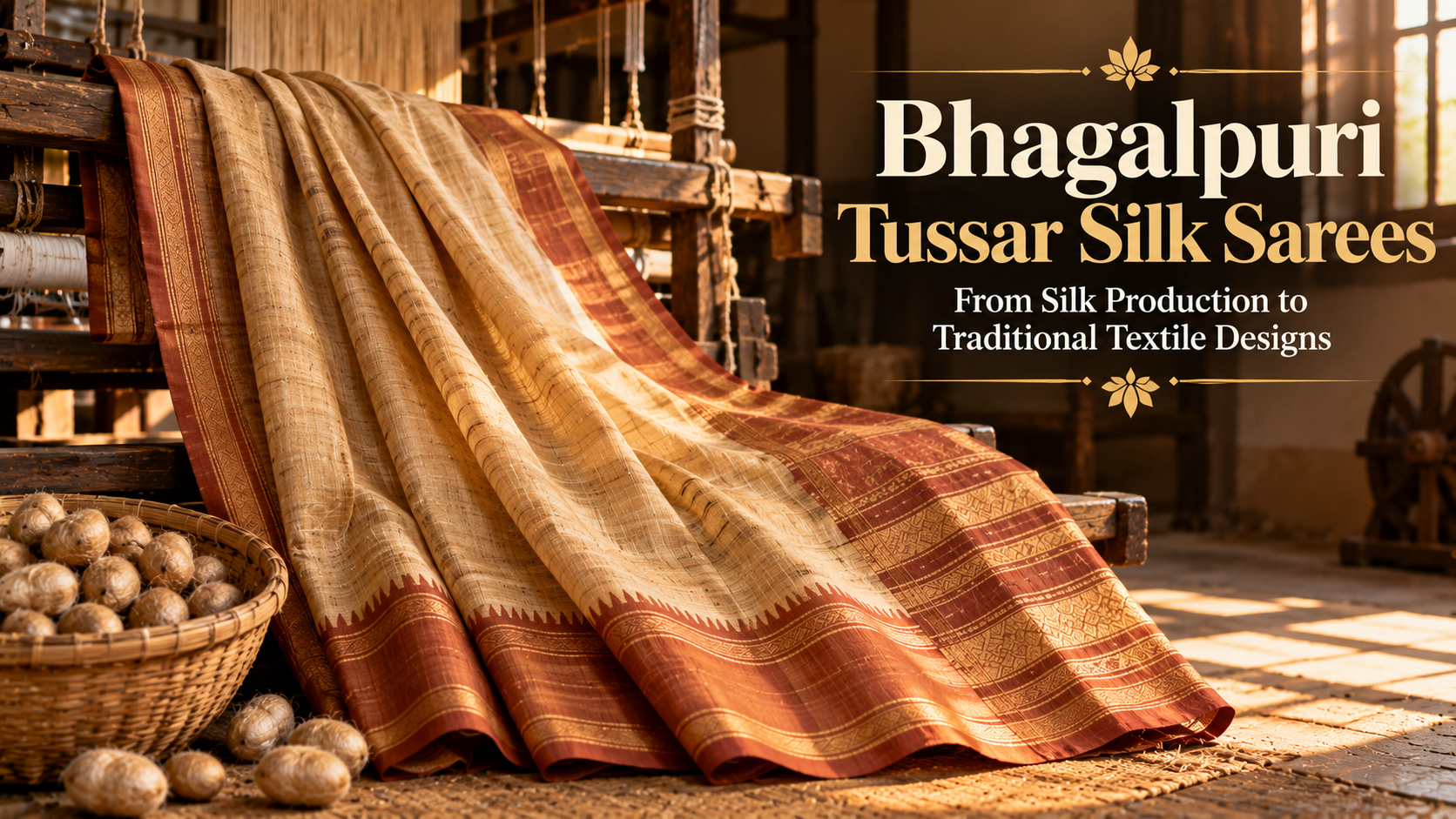
Run your hand over a Bhagalpuri Tussar saree and you notice the texture before the colour. The surface has a subtle grain, sometimes with small slubs where the yarn thickens and thins. The sheen is softer and more muted than that of most mulberry silks. Both qualities come from the Tussar silkworm, a wild silk moth native to India’s forests, and from the way the silk is processed and woven in and around Bhagalpur in Bihar.
This guide follows a Bhagalpuri silk saree from forest to loom: how Tussar silk is produced, what gives it its character, how Bhagalpur weavers use it, what traditional designs look like, and how to read the fibre and origin claims you will see in product descriptions.
Bhagalpur and Bihar’s silk heritage
Bhagalpur is a city on the banks of the Ganga in eastern Bihar. It is so closely associated with Tussar silk that it is often called the Silk City of India, and “Bhagalpuri silk” has become a common name for Tussar silk fabrics woven there.
A parliamentary answer from the Ministry of Textiles describes Bhagalpur as famous worldwide for its distinct type of Tussar silk and notes that the Central Silk Board has set up units in Bhagalpur specifically to develop the Tussar silk industry, including a silk testing unit for exports. Map Academy, a textile research resource, describes Bhagalpur as a significant Tussar weaving centre, home to tens of thousands of dyers, spinners and weavers. Weaving is concentrated in areas of the city such as Nathnagar and Champanagar and in nearby villages.
Where the silk itself comes from
Bhagalpur is above all a centre of processing and weaving. Tussar silkworm rearing takes place across the forested tribal regions of central and eastern India, and Jharkhand is the country’s leading producer of Tussar silk. Bhagalpur’s weavers work with cocoons and yarn from Bihar and neighbouring states. So “Bhagalpuri” describes where the fabric is woven and finished, not necessarily where every cocoon was grown.
Geographical Indication status
Weavers’ organisations in Bhagalpur have applied to the GI Registry for protection of Bhagalpur silk fabrics and sarees. Before stating a GI registration year in any product description, check the current status of the application in the Intellectual Property India register.
What is Tussar silk?
India produces four main types of natural silk: mulberry, Tussar (also spelled Tasar or Tussah), Eri and Muga. Tussar, Eri and Muga are called Vanya or non-mulberry silks, because their silkworms are wild or semi-domesticated rather than fully domesticated.
There are two broad kinds of Tussar in India:
- Tropical Tussar comes from the silkworm Antheraea mylitta, native to India, which feeds mainly on the leaves of Asan (Terminalia tomentosa) and Arjun (Terminalia arjuna) trees, and also on Sal. This is the Tussar used in Bhagalpur.
- Oak Tussar comes from a different species, reared on oak in the sub-Himalayan belt, and produces a finer yarn.
The Central Silk Board describes Tussar as a copperish, coarse silk that is less lustrous than mulberry silk but has its own feel and appeal. Tussar sericulture is an important livelihood for tribal communities across several states.
How Tussar silk is produced
The journey from silkworm to saree has four distinct stages, usually carried out by different people in different places.
Stage 1: Silkworm rearing
Tussar silkworms are reared outdoors on host trees in forests or plantations. Rearers place young larvae on Asan, Arjun or Sal trees and protect them from birds, insects and disease as they feed and grow. Research published through the Central Silk Board notes that rearers raise the larvae two or three times a year, and that host plants and weather strongly affect the crop. When fully grown, the larvae spin large, hard cocoons attached to twigs by a stalk.
Stage 2: Cocoon processing
The cocoons are collected and sorted. For reeled silk, cocoons are usually treated to stop the moth from emerging and then cooked or softened so that the filament can be unwound. Tussar cocoons are tougher than mulberry cocoons, so softening takes more effort.
Some cocoons are used after the moth has emerged, or are damaged, or are left over from the reeling process. These cannot be reeled as a continuous filament and are used for spun yarns instead.
Stage 3: Yarn preparation
Several kinds of Tussar yarn are made, and they produce very different fabrics.
- Reeled Tussar: filaments unwound from several cocoons together into a continuous thread. It gives a smoother fabric with a gentle sheen.
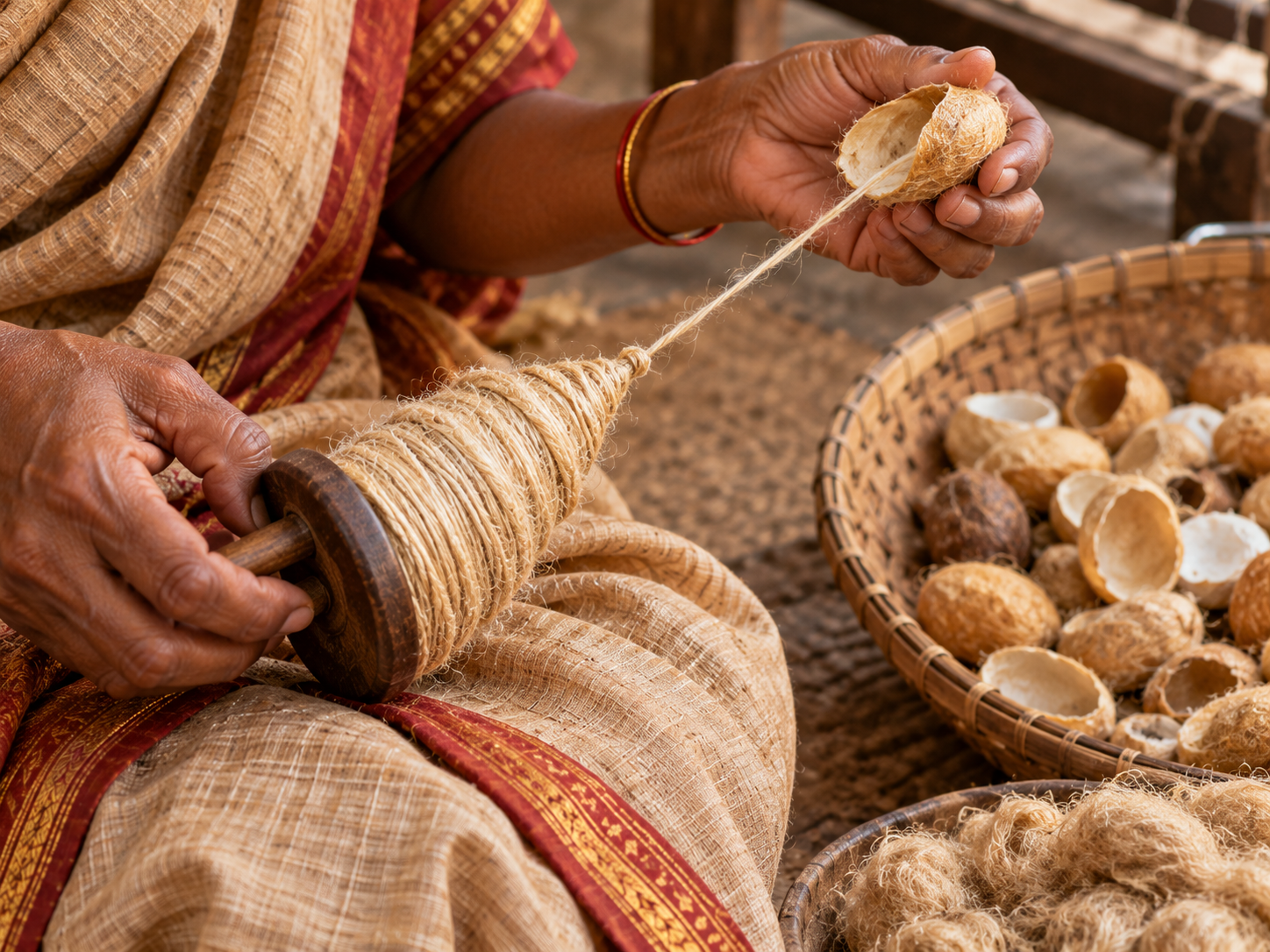
- Ghicha: a hand-spun yarn commonly described as made from the outer layers of cocoons or from pierced cocoons. It is thicker and uneven, with a slubby, textured look.
- Katia: a yarn commonly described as spun from cocoon waste left over after reeling. It is also textured and matte.
Many traditional Bhagalpuri fabrics combine these yarns, for example a reeled Tussar warp with a ghicha weft, giving a textured surface with a slight sheen.
Stage 4: Weaving
The yarn is dyed or left in its natural shade, then woven on handlooms in Bhagalpur and surrounding areas. General saree-making stages, from yarn preparation to finishing, are covered in our guide to the saree making process.
Map Academy notes that Bhagalpuri silk is commonly dyed in bright colours such as red, blue, pink and orange, and woven with stripes and checks of varying density. Plain, undyed Tussar is also widely woven.
Texture, appearance and characteristics
Tussar silk’s character comes from the fibre and from how it is processed.
- Texture: Tussar is coarser than mulberry silk, with a slightly dry, grainy hand. Fabrics woven with ghicha or katia yarns have visible slubs and irregularities.
- Sheen: Tussar has a soft, muted sheen rather than the bright gloss of mulberry silk.
- Colour: undyed Tussar is often described as copperish, honey or beige. The exact shade varies with the silkworm, host plants, season and processing, so it is not uniform from one batch to another.
- Weight and drape: Tussar fabrics often feel crisp and have body, holding pleats well. Weight depends on yarn and weave: reeled Tussar can be fairly light, while ghicha fabrics are heavier.
- Dyeing: Tussar takes dye, and Bhagalpur has a long tradition of dyeing silk in strong colours as well as weaving natural-shade fabrics.
These are general characteristics. Individual sarees vary depending on the yarns used, the weave density and finishing.
Traditional Bhagalpuri designs and variations
Woven stripes and checks
The classic Bhagalpuri fabric is woven with stripes and checks of varying density, created by arranging different coloured threads in the warp and weft. These patterns are part of the fabric’s structure.
Natural-shade Tussar with contrast borders
Many traditional sarees keep the body in the natural Tussar shade and add a contrasting border or pallu in a dyed colour such as rust, maroon or black.
Ghicha and textured weaves
Sarees woven with ghicha or katia yarns have a rustic, textured surface that many buyers value for its handmade look.
Printed Bhagalpuri sarees
Bhagalpuri silk is also widely block printed or screen printed after weaving, with floral, geometric and folk-inspired designs. Printing adds pattern to the finished cloth; it does not change the fabric itself.
Painted and embroidered designs
Tussar’s slightly textured surface takes paint well, and sarees painted with folk styles such as Madhubani, a painting tradition from Bihar’s Mithila region, are popular. Embroidered Tussar sarees, including those decorated with kantha stitch, are also common. These are surface decorations added after weaving.
Blends
Bhagalpur weavers also produce blended fabrics, combining Tussar with cotton, linen or other fibres. These blends are often sold as “Bhagalpuri silk”, which is one reason it is important to read fibre descriptions carefully.
Tussar compared with Muga, Eri and mulberry silk
India’s four main silks differ in silkworm, rearing, yarn type and appearance. The table below summarises the key differences.
| Feature | Tussar (tropical) | Muga | Eri | Mulberry |
| Silkworm | Antheraea mylitta | Antheraea assamensis | Samia ricini | Bombyx mori |
| Main food plants | Asan, Arjun, Sal | Som, Soalu | Castor and others | Mulberry |
| Rearing | Outdoors on forest trees | Outdoors on trees | Indoors | Indoors |
| Main producing regions | Central and eastern India; Jharkhand leads | Assam (about 90 percent of world production) | Assam and the North-East | Karnataka and other southern states lead |
| Yarn types | Reeled, plus spun ghicha and katia | Usually reeled | Spun (moth usually emerges first) | Reeled |
| Natural appearance | Copperish to honey or beige, muted sheen | Golden yellow, lustrous | Off-white to cream, matte | White to off-white, bright sheen |
| Texture | Coarser, grainy, often slubbed | Firm and smooth | Soft, woolly | Smooth and fine |
| Common uses | Sarees, dress fabric, furnishings | Mekhela chador, sarees | Shawls, stoles | Sarees and a wide range of fabrics |
Muga and Eri are covered in more detail in the context of Assam’s silk traditions; the comparison here is limited to what helps place Tussar.
Reading fibre and origin descriptions
Because “Bhagalpuri silk” is used for a range of fabrics, product descriptions can mean different things. For general budgeting and selection advice across all sarees, see our complete saree buying guide. For Bhagalpuri sarees specifically:
Fibre composition
- “Pure Tussar silk” claims Tussar in both warp and weft.
- “Tussar ghicha” or “ghicha silk” indicates spun ghicha yarn, often in the weft, sometimes with a reeled Tussar warp.
- “Tussar blend”, “Bhagalpuri cotton silk” or “Bhagalpuri linen” indicate mixed fibres.
- “Art silk” or “Bhagalpuri art silk” indicate a synthetic or viscose yarn, not natural silk.
For a general explanation of how blends compare with pure silk, see our article on silk saree vs silk blend saree.
Origin
“Bhagalpuri” usually indicates where the fabric was woven or traded, not necessarily where the cocoons were reared. If origin matters to you, ask where the saree was woven and whether it was handloom or powerloom.
Design method
- Woven stripes and checks are part of the fabric structure.
- Printed designs are applied after weaving.
- Painted or embroidered designs are added by hand or machine after weaving.
Labels
The Silk Mark, issued by the Silk Mark Organisation of India under the Central Silk Board, certifies natural silk content. The Handloom Mark supports a handloom claim. Not every genuine small-producer piece carries these labels, so their absence is a reason to ask questions rather than proof that a fabric is not silk.
Caring for a Bhagalpuri Tussar saree
A few points are specific to Tussar’s texture:
- Dry clean dyed, printed and painted Tussar sarees.
- Avoid rubbing ghicha and katia surfaces, which can pill or fuzz.
- Iron on low to medium heat on the reverse.
- Keep away from prolonged direct sunlight, which can change natural Tussar shades over time.
- Store folded in cotton cloth.
Conclusion
A Bhagalpuri silk saree begins in the forests of central and eastern India, where Tussar silkworms are reared on Asan, Arjun and Sal trees. Their cocoons are reeled into smooth yarn or spun into textured ghicha and katia, and the yarn is dyed and woven on the handlooms of Bhagalpur in Bihar into fabrics known for their muted sheen, natural grain and bold stripes, checks, prints and painted designs. Because the name now covers pure Tussar, blends and printed fabrics, reading the fibre, yarn type and design method is the clearest way to understand what any individual Bhagalpuri saree is.
Frequently asked questions
What is a Bhagalpuri silk saree?
A Bhagalpuri silk saree is usually a Tussar silk saree woven in or around Bhagalpur in Bihar. The name is also used for blended and printed fabrics from the region.
Where does Bhagalpuri Tussar silk come from?
Tussar silkworms are reared outdoors in the forested regions of central and eastern India, with Jharkhand the leading producer. Bhagalpur is a major centre for processing, dyeing and weaving the silk.
Which silkworm produces Tussar silk?
Tropical Tussar silk comes from Antheraea mylitta, a wild silkworm native to India that feeds mainly on Asan and Arjun trees.
What is ghicha silk?
Ghicha is a hand-spun Tussar yarn commonly made from the outer layers of cocoons or from pierced cocoons. It is thick and uneven, giving fabric a slubby texture.
How is Tussar different from mulberry silk?
Tussar comes from wild silkworms reared outdoors and is coarser, with a muted sheen and a natural copperish to beige shade. Mulberry silk comes from domesticated silkworms and is smoother, brighter and white to off-white.
Is Bhagalpuri silk always pure Tussar?
No. The name is also used for Tussar blends with cotton or linen, and sometimes for art silk. Check the fibre description.
What designs are typical of Bhagalpuri sarees?
Traditional designs include woven stripes and checks, natural Tussar bodies with contrast borders, and textured ghicha weaves. Printed, painted and embroidered designs are also common.
Does Bhagalpuri silk have a GI tag?
Weavers’ organisations in Bhagalpur have applied for GI protection for Bhagalpur silk fabrics and sarees. Check the Intellectual Property India register for the current status.
