
Blog
Mysore Silk Sarees: History, Silk Production, Zari and Traditional Designs

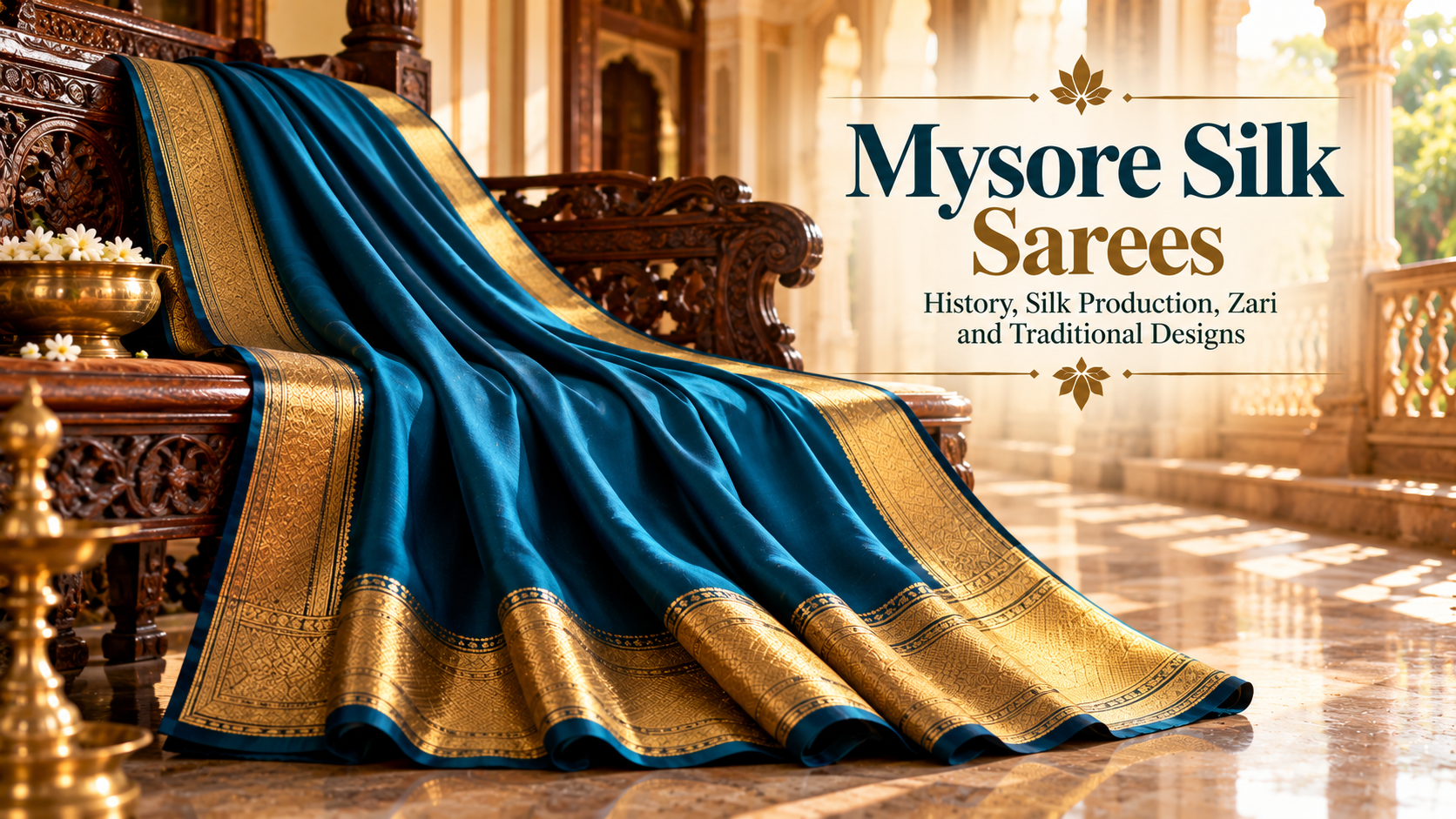
A traditional Mysore silk saree is easy to recognise by its restraint. The body is usually plain: one smooth, lustrous colour. The border is a band of gold zari, and the pallu carries a little more gold. There are no dense motifs to distract the eye. The appeal lies in the silk itself, soft and fluid with a fine crepe texture, and in the quality of the zari.
This guide explains where Mysore silk comes from, how it is produced from cocoon to cloth, what gives the fabric and its zari their character, how traditional pieces differ from contemporary variations, and how to read the product descriptions you will see.
The history of Mysore silk in Karnataka
Tipu Sultan and early sericulture
Silk production in the old Kingdom of Mysore is commonly traced to the reign of Tipu Sultan in the late 18th century, around 1780 to 1790. Accounts describe him sending envoys to source silkworms and setting up units to rear them, with the aim of making silk a significant industry in his kingdom. The details vary between sources, but the link between Tipu Sultan and the start of organised sericulture in Mysore is widely recorded.
The industry later suffered from global depression and competition from imported silk and rayon, before reviving in the 20th century.
The Mysore Silk Weaving Factory, 1912
The modern Mysore silk saree traces directly to 1912, when Maharaja Krishnaraja Wadiyar IV, also known as Nalvadi Krishnaraja Wadiyar, founded the Mysore Silk Weaving Factory. The factory initially made silk fabrics for the royal family and ornamental fabrics for the state’s armed forces. Accounts describe the Maharaja importing weaving machinery from Switzerland to set it up.
After independence, the factory came under the Mysore State Sericulture Department, and in 1980 it was handed over to the Karnataka Silk Industries Corporation Limited (KSIC), a Government of Karnataka public sector undertaking.
Karnataka as a silk state
Karnataka is today India’s leading silk-producing state, mostly producing mulberry silk. That broad base of sericulture, combined with KSIC’s factory in Mysuru, underpins the Mysore silk tradition.
Mysore silk and the Geographical Indication
“Mysore Silk” is a registered Geographical Indication, listed as GI number 11. KSIC holds the GI and owns the Mysore Silk brand. A GI-registered logo for Mysore Silk is also listed among India’s registered handloom product logos.
This is an important point for buyers. In the strict, legally protected sense, “Mysore Silk” refers to silk produced under the GI, which KSIC controls. Many other sarees are sold as “Mysore silk” or “Mysore silk style” to describe a look, a fabric type or a crepe texture. They may be attractive and genuine silk, but they are not the same product as GI-protected Mysore Silk.
How Mysore silk is produced
Mysore silk is a mulberry silk, made from the cocoons of the domesticated silkworm Bombyx mori, which feeds only on mulberry leaves. Production has several distinct stages.
1. Mulberry cultivation and silkworm rearing
Farmers across Karnataka grow mulberry and rear silkworms indoors on trays, feeding them fresh leaves until they spin their cocoons. This is the farming side of sericulture, carried out by thousands of rearing households.
2. Cocoon selection
Cocoons are traded in cocoon markets. For Mysore silk, KSIC officials select cocoons at market through a government bidding process and send them to KSIC’s raw silk production unit at T. Narasipura.
3. Reeling raw silk
At the reeling unit, cocoons are soaked and cooked to soften the natural gum (sericin), and filaments from several cocoons are reeled together into raw silk yarn. A single cocoon yields a long continuous filament, and combining filaments gives a yarn of usable thickness and strength.
4. Twisting for crepe
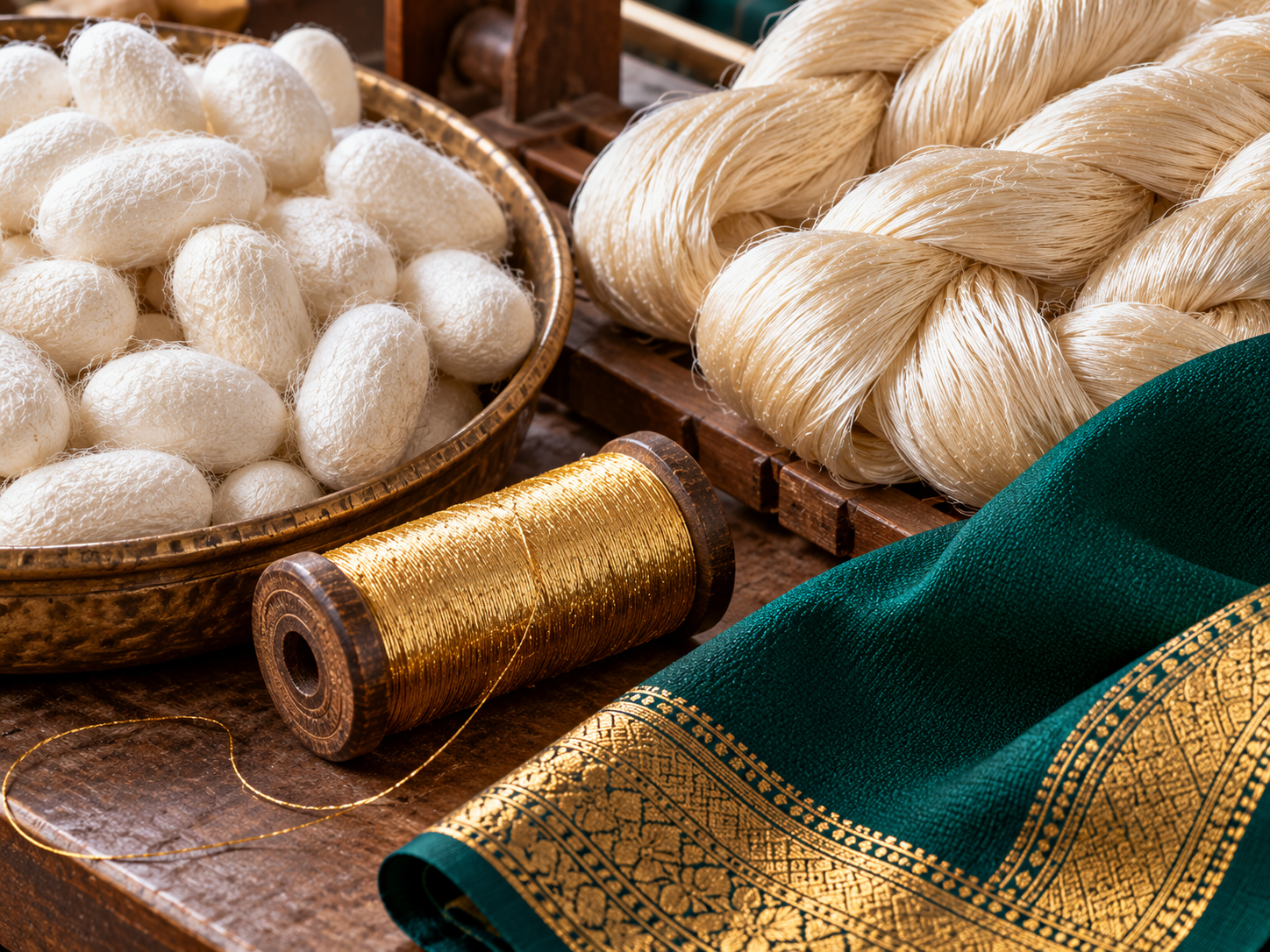
This step is central to Mysore silk’s character. The yarn used for Mysore silk sarees is given a very high twist, widely reported as about 2,200 twists per metre. High-twist yarn makes the woven fabric spring back slightly after finishing, which creates the fine, pebbly crepe texture and the soft, fluid drape that Mysore silk is known for.
5. Degumming and dyeing
The silk is degummed to remove remaining sericin, which brings out its lustre and softness, and is then dyed. KSIC is known for producing sarees in a very wide range of colours.
6. Weaving
The dyed yarn is woven, with zari added for the border and pallu. Unlike many traditional Indian silk sarees, Mysore silk from the KSIC factory has historically been woven on mechanised looms, a practice that goes back to the factory’s founding.
General saree-making stages are covered in our guide to the saree making process. For Mysore silk, the distinctive steps are the cocoon selection, the high-twist yarn and the zari.
7. Finishing and identification
After weaving, each saree is finished, cut and checked. KSIC marks its sarees with identifiers such as a unique code, hologram and woven barcode to help customers recognise its products.
Characteristics of Mysore silk fabric
Mysore silk’s look and feel come from its yarn and finishing.
- Crepe texture: The high-twist yarn gives a subtle, fine crepe surface rather than the smooth or stiff surface of many other silks.
- Soft, fluid drape: The fabric is relatively light and falls in soft folds, which makes it comfortable for long wear and easy to drape. If you are new to draping, our guide to saree draping styles for beginners can help.
- Lustre: Degummed mulberry silk has a natural sheen that shows the dye colour richly.
- Plain body: Traditional pieces rely on the silk itself rather than dense patterning.
These are typical traits of traditional Mysore silk. Individual sarees vary with the weave, weight and finish.
Mysore silk zari
Composition
The zari used on traditional Mysore silk sarees is widely reported to contain about 65 percent pure silver and 0.65 percent gold. This means the gold is a thin layer over silver, not solid gold, as is the case with most fine zari. The zari is commonly described as sourced from Surat, a major zari-making centre.
These figures describe KSIC’s traditional zari specification. Other sarees sold as “Mysore silk” may use tested zari (copper-based) or imitation metallic thread, which look similar but are made very differently.
Zari borders
The classic Mysore silk border is a solid band of gold zari, ranging from narrow to broad. Some borders are plain gold; others carry small woven patterns. The pallu usually has wider zari bands or a simple zari design.
Colour and zari together
Body colours are chosen to set off the gold. Deep jewel tones such as royal blue, peacock blue, emerald, ruby red, purple and maroon are classic, along with softer pinks, creams and pastels. The plain body and gold border create a strong, clean contrast.
Silk quality, yarn preparation and weaving
The quality of a Mysore silk saree depends on decisions made long before weaving.
- Cocoon quality: Better cocoons give longer, more even filaments, which produce smoother, stronger yarn.
- Reeling: Careful reeling keeps the yarn consistent in thickness, which affects how evenly the fabric looks and drapes.
- Twist: The high twist creates the crepe texture. Without it, the fabric would look and feel like an ordinary smooth silk.
- Degumming and dyeing: These determine the final softness, lustre and colour depth.
- Weaving and zari: The density of the weave and the quality of the zari determine the saree’s weight, finish and how the border ages.
This is why Mysore silk is often discussed in terms of its yarn and zari as much as its design.
Traditional Mysore silk and contemporary variations
Traditional Mysore silk
- Plain, solid-colour body
- Solid gold zari border
- Zari bands or simple design in the pallu
- High-twist crepe silk
- Pure mulberry silk with fine silver-and-gold zari
Contemporary variations
KSIC and other producers now offer a wider range, including:
- Printed Mysore silk: floral, paisley or geometric prints on the silk
- Zari checks and stripes: woven gold patterns across the body
- Butta designs: small woven motifs on the body
- Georgette and crepe varieties: lighter or more textured fabrics
- Tissue sarees: woven with metallic thread for an all-over shimmer
- Contrast pallu and half-and-half designs: two colours in one saree
These are legitimate variations, but they move away from the classic plain-body, gold-border look.
Mysore silk compared with Kanjivaram and other silks
| Feature | Mysore silk | Kanjivaram | Banarasi silk | Bhagalpuri Tussar |
| Region | Mysuru, Karnataka | Kanchipuram, Tamil Nadu | Varanasi, Uttar Pradesh | Bhagalpur, Bihar |
| Silk type | Mulberry | Mulberry | Mostly mulberry | Tussar (wild, non-mulberry) |
| Yarn | High-twist yarn for crepe texture | Plied yarn, often 3-ply weft | Fine mulberry yarn | Reeled Tussar and spun ghicha or katia |
| Texture and weight | Soft, light, crepe, fluid drape | Heavy, firm, structured | Varies; often rich and textured with brocade | Grainy, muted sheen, slightly coarse |
| Typical design | Plain body, gold zari border, simple pallu | Contrast borders and pallu, dense zari motifs | Dense brocade patterns in zari and silk | Woven stripes and checks, prints, painting |
| Typical weaving | Mechanised looms at the KSIC factory | Handloom, often with jacquard | Handloom and powerloom | Mostly handloom |
| GI holder or base | KSIC (GI number 11) | Kancheepuram Silk Sarees GI | Banaras Brocades and Sarees GI | Application filed by Bhagalpur weavers |
In short, Mysore silk is the lightest and plainest of the major mulberry silks, defined by its crepe texture and gold border. Kanjivaram is heavier and more ornamented, Banarasi is known for brocade, and Bhagalpuri uses a different silk entirely.
Reading Mysore silk product descriptions
For general budget, occasion and fabric choices, see our complete saree buying guide. For Mysore silk specifically, the key distinctions are:
“Mysore Silk” vs “Mysore silk style”
“Mysore Silk” in the GI sense refers to KSIC’s product. Listings that say “Mysore silk style”, “Mysore crepe” or simply “Mysore silk” from other sellers may describe the look or fabric type rather than GI-protected Mysore Silk. Ask the seller who produced the saree.
Fibre
Check whether the saree is pure mulberry silk, a silk blend or art silk (a synthetic or viscose yarn). For how blends compare with pure silk, see our article on silk saree vs silk blend saree.
Zari
Check whether the zari is described as silver-based with gold plating, tested (copper-based) or imitation.
Design
Check whether the design is woven (borders, checks, buttas) or printed.
Identification
KSIC sarees carry KSIC identifiers such as a unique code, hologram and woven barcode. The Silk Mark from the Silk Mark Organisation of India certifies natural silk content. These marks help, but always ask questions if a description is unclear.
Caring for a Mysore silk saree
- Dry clean, especially for zari-bordered pieces.
- Avoid wringing or crushing, which can flatten the crepe texture.
- Iron on low heat on the reverse, with a cloth over the zari.
- Store folded in cotton or muslin, away from damp, and refold every few months so zari does not crack along creases.
- Keep perfume away from zari, which can tarnish.
Conclusion
Mysore silk grew from organised sericulture in the Kingdom of Mysore under Tipu Sultan and took its modern form in 1912, when Maharaja Krishnaraja Wadiyar IV founded the Mysore Silk Weaving Factory, now run by KSIC. Its character comes from mulberry silk given a very high twist for a soft crepe texture and a fluid drape, from zari made of silver with a thin layer of gold, and from a restrained design of plain bodies and gold borders. Because many sarees use the Mysore name for a look or fabric type, knowing the difference between GI-protected Mysore Silk and Mysore-style silks is the clearest way to understand what any particular saree is.
Frequently asked questions
What is Mysore silk?
Mysore silk is a mulberry silk associated with Mysuru in Karnataka, known for its soft crepe texture, plain lustrous body and gold zari border. “Mysore Silk” is a registered GI held by KSIC.
Who makes Mysore silk sarees?
GI-protected Mysore Silk is produced by the Karnataka Silk Industries Corporation Limited (KSIC), which took over the Mysore Silk Weaving Factory founded in 1912.
What gives Mysore silk its crepe texture?
The yarn is given a very high twist, widely reported as about 2,200 twists per metre, which creates a fine crepe surface and soft drape.
What is Mysore silk zari made of?
Traditional Mysore silk zari is widely reported to contain about 65 percent silver and 0.65 percent gold, with a thin layer of gold over silver.
How is Mysore silk different from Kanjivaram?
Mysore silk is lighter and softer with a crepe texture, a plain body and a gold border. Kanjivaram is heavier and firmer, with contrast borders and pallu and dense zari motifs.
Is Mysore silk handloom?
Mysore silk from the KSIC factory has historically been woven on mechanised looms, a practice dating back to the factory’s founding. Its distinctiveness comes mainly from its yarn, crepe texture and zari.
Are all sarees sold as Mysore silk made by KSIC?
No. Many sarees use the name to describe a look or fabric type. GI-protected Mysore Silk is KSIC’s product and carries KSIC identifiers.
What colours are traditional for Mysore silk sarees?
Deep jewel tones such as royal blue, peacock blue, emerald, ruby red, purple and maroon are classic, along with softer pinks and pastels, all paired with gold zari.
