
Blog
Kosa Silk Sarees: Chhattisgarh’s Traditional Silk, Texture and Weaving Heritage

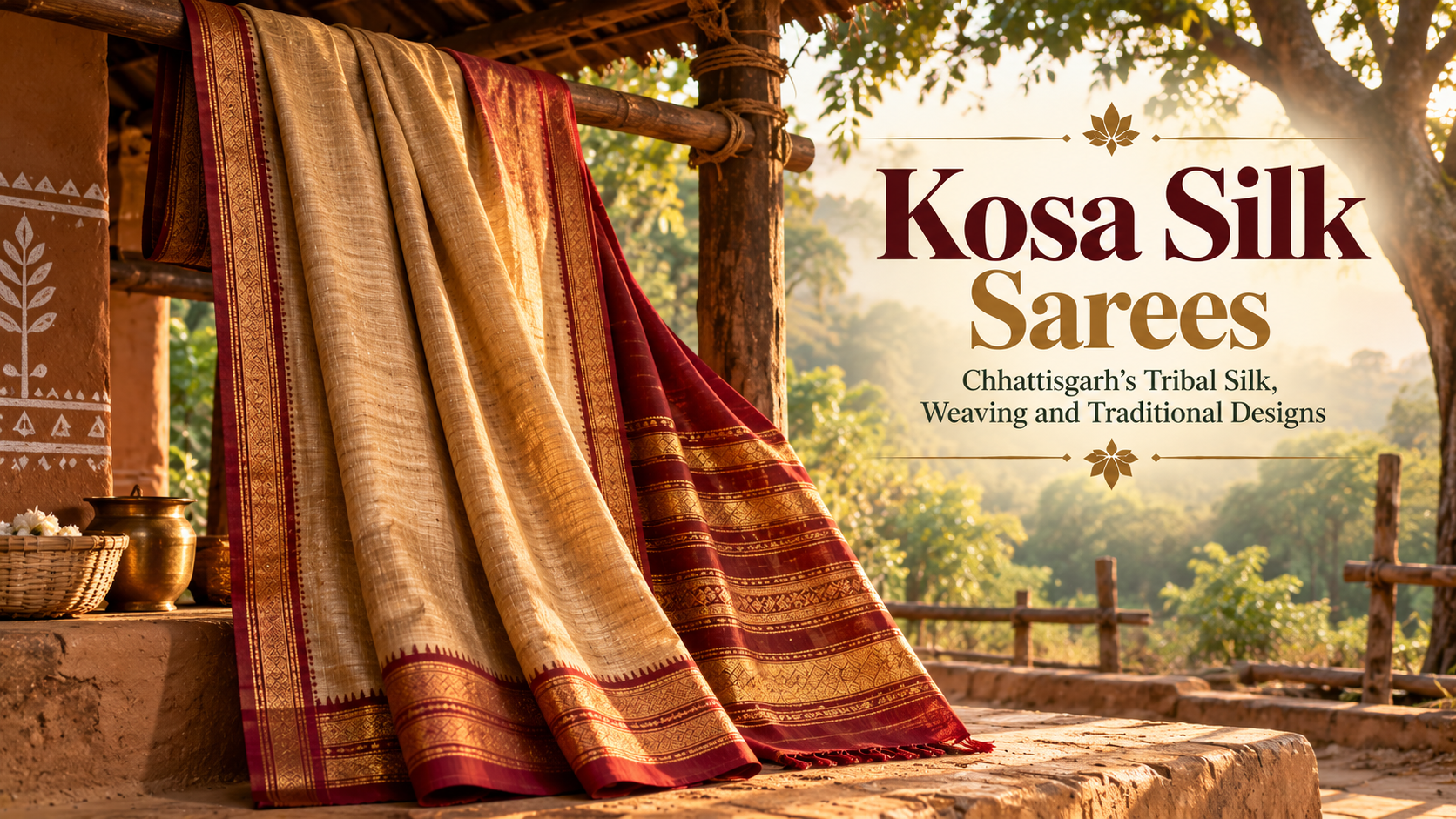
In Chhattisgarh, the word for the Tussar silk cocoon is kosa, and the silk spun from it carries the same name. Kosa silk sarees from the weaving towns of Janjgir-Champa and Raigarh have a warm, natural look: shades of dull gold, cream and soft brown, a gentle sheen and a slightly textured surface. Behind each saree is a chain of work that begins in the state’s forests and ends on handlooms in weavers’ homes.
This guide explains what Kosa silk is, how it is produced, what gives the fabric its character, how it is woven and designed, how it compares with other Indian silks and how to read the fibre and origin claims in product descriptions.
What Kosa silk is
Fibre, origin and tradition: three different things
It helps to separate three ideas that often get blurred:
- Fibre type: Kosa silk is a form of Tussar silk, produced by the Indian wild silkworm Antheraea mylitta. The same species produces the Tussar used in Jharkhand, Bihar, Odisha and other states.
- Geographical origin: “Kosa” refers specifically to Tussar silk associated with Chhattisgarh, and especially the weaving belt of Janjgir-Champa and Raigarh.
- Weaving tradition: Kosa sarees are tied to the weaving communities of this region, particularly the Dewangan (also spelled Devangan) community, and to a long tradition of home-based reeling and weaving.
So every Kosa silk saree is Tussar, but not every Tussar saree is Kosa. Bhagalpuri silk from Bihar, for example, uses the same fibre but belongs to a different regional tradition.
Champa: Chhattisgarh’s silk town
Champa, in Janjgir-Champa district, is often called the silk city of Chhattisgarh and is the best-known centre for Kosa weaving. Raigarh is another major centre, and Korba and Bilaspur are also associated with Kosa production. Map Academy notes that the Tussar silk of Raigarh, Bilaspur and Janjgir-Champa is also known as Champa silk.
Geographical Indication
The GI application for Kosa silk was filed by the Champa Raigarh Hathkargha Kosa Samiti, a weavers’ society, for “Kosa silk saree and fabric of Janjgir-Champa and Raigarh region”. It is registered under the name “Champa Silk Saree and Fabrics”, and the registration is widely reported as 2011. The application describes the belt between Raigarh and Janjgir-Champa, with Champa at its centre, as placing particular emphasis on Kosa silk production.
The Kosa silkworm and its cocoon
The silkworm
Antheraea mylitta is a wild silkworm native to India. In Chhattisgarh, it feeds on the leaves of forest trees, especially Arjun (Terminalia arjuna), Saja (also known as Asan, Terminalia tomentosa) and Sal (Shorea robusta). The silkworm is not domesticated like the mulberry silkworm, and rearing takes place outdoors on the host trees.
Where rearing happens
The GI application records Tussar rearing in Chhattisgarh’s Raigarh, Surguja and Bilaspur districts and in the Bhopalpatnam area of Bastar district. Rearing is carried out largely by tribal and rural forest communities, for whom it is an important source of income.
The cocoon
When fully grown, the silkworm spins a large, hard cocoon, usually attached to a twig by a stalk. This cocoon, the kosa, is the raw material for the silk. Cocoons vary in size, colour and filament quality depending on the host trees, the season and the region.
How Kosa silk is produced
Kosa silk production follows the general Tussar process: rearing, cocoon processing, yarn making and weaving. Rather than repeat every stage, this section focuses on what is distinctive in Chhattisgarh.
Home-based reeling alongside weaving
The GI application highlights an important feature of the Chhattisgarh tradition: in Janjgir-Champa and Raigarh, reeling of the yarn is closely tied to weaving within the home-based industry. In other words, many weaving households also prepare their own yarn, rather than buying it ready-made, while cocoon production remains with the rearers in the forest areas.
This means the character of a Kosa saree often reflects choices made in the same household, from how the yarn is reeled or spun to how it is woven.
Reeled and spun yarns
Kosa weavers use both:
- Reeled yarn, drawn as a continuous filament from softened cocoons, which gives a smoother surface with a gentle sheen; and
- Spun yarns, including gichha (ghicha), made from cocoons that cannot be reeled continuously, which give a thicker, uneven, textured surface.
Government sources note that Tussar gichha weaving has been practised in Bilaspur, Champa and Raigarh for more than 100 years, producing saris, dress material, stoles and scarves.
Weaving
The yarn is woven on handlooms, mostly in weavers’ homes and through cooperative societies in the Champa and Raigarh belt. General saree-making stages are covered in our guide to the saree making process.
Texture, appearance and natural shades
Kosa silk’s look comes from the fibre and how it is processed.
Natural shades
Undyed Kosa silk occurs in shades often described as brown, cream and dull gold. The exact shade varies with the silkworm, the host trees, the season and how the yarn is processed, so two Kosa sarees in “natural” colour may not match exactly. Kosa can also be dyed, and many sarees combine a natural-shade body with a dyed border or pallu.
Texture
- Fabrics woven from reeled Kosa yarn have a fairly smooth surface with a gentle sheen.
- Fabrics woven with gichha or other spun yarns have a coarser, slubby texture with visible irregularities.
- Many Kosa sarees combine the two, for a fabric that is textured but still lustrous.
Sheen and feel
Like other Tussar silks, Kosa has a softer, more muted sheen than mulberry silk and a slightly dry, crisp hand. It tends to hold pleats well and feels comfortable in warm weather.
Weight
Weight varies with the yarns and weave. Reeled Kosa fabrics can be relatively light, while gichha-rich fabrics are heavier.
These are general traits. Individual sarees vary considerably.
Traditional weaving practices, motifs and designs
Natural body with contrast border
A classic Kosa saree keeps the body in a natural shade and adds a border and pallu in a contrasting dyed colour, such as maroon, rust, deep green or black. This highlights the silk’s natural tone.
Woven patterns
Kosa weavers produce stripes, checks and small woven motifs (buttis) on the body, along with patterned borders. Pallus often carry bands of colour or larger woven designs. Accounts of Raigarh weaving describe sarees decorated with tribal-inspired and zari motifs.
Plain and textured weaves
Plain Kosa sarees with little decoration are popular because they let the natural shade and texture of the silk stand out. Gichha-based sarees have a rustic, handwoven look that many buyers specifically seek.
Printing, painting and embroidery
Kosa silk is also used as a base for block printing, hand painting and embroidery. These decorations are added after weaving and change the surface but not the fabric itself.
Blends
Kosa yarn is also woven with cotton or other fibres. These blends are lighter and less expensive but differ from pure Kosa silk.
Kosa compared with other Indian silks
| Feature | Kosa (Chhattisgarh Tussar) | Bhagalpuri Tussar | Muga | Eri | Mulberry |
| Silkworm | Antheraea mylitta | Antheraea mylitta | Antheraea assamensis | Samia ricini | Bombyx mori |
| Fibre type | Tussar (wild, non-mulberry) | Tussar (wild, non-mulberry) | Muga (semi-domesticated, non-mulberry) | Eri (non-mulberry) | Mulberry (domesticated) |
| Main region | Chhattisgarh: Janjgir-Champa, Raigarh, Korba, Bilaspur | Bhagalpur, Bihar (weaving hub) | Assam | Assam and the North-East | Karnataka and other southern states lead |
| Host plants | Arjun, Saja (Asan), Sal | Asan, Arjun, Sal | Som, Soalu | Castor and others | Mulberry |
| Natural appearance | Brown, cream, dull gold; muted sheen | Copperish to beige; muted sheen | Golden yellow; lustrous | Off-white to cream; matte | White to off-white; bright sheen |
| Texture | Slightly coarse; textured with gichha | Slightly coarse; textured with ghicha | Firm and smooth | Soft, woolly | Smooth and fine |
| Distinctive tradition | Home-based reeling with weaving; Dewangan weavers; Champa GI | Major processing, dyeing and weaving centre | Assamese mekhela chador tradition | Shawls and warm fabrics | Many regional saree traditions |
Kosa and Bhagalpuri share the same fibre, so the differences between them come from region, community, weaving practice and design, not from the silk itself.
Reading Kosa silk descriptions
For general budget, occasion and fabric decisions, see our complete saree buying guide. For Kosa sarees specifically, keep fibre, origin and weaving method separate.
Fibre
- “Pure Kosa silk” or “pure Tussar silk” claims Tussar silk in both warp and weft.
- “Kosa gichha” or “gichha silk” indicates spun gichha yarn, often in the weft.
- “Kosa cotton”, “Kosa blend” or “Kosa silk-cotton” indicate mixed fibres.
- “Art silk” indicates a synthetic or viscose yarn, not natural silk.
For a general explanation of how blends compare with pure silk, see our article on silk saree vs silk blend saree.
Origin
“Kosa” implies an association with Chhattisgarh. A description that names Champa, Janjgir-Champa or Raigarh makes a more specific origin claim. “Tussar” alone describes the fibre, not where the saree was made.
Weaving method
Check whether the saree is handloom or powerloom, and whether designs are woven, printed, painted or embroidered.
Labels
The Silk Mark from the Silk Mark Organisation of India certifies natural silk content. The Handloom Mark and GI-linked labels support handloom and origin claims. Not every genuine small-producer piece carries these labels, so their absence is a reason to ask questions rather than proof that a saree is not Kosa.
Caring for a Kosa silk saree
- Dry clean dyed, printed and painted Kosa sarees.
- Avoid rubbing gichha surfaces, which can pill.
- Iron on low to medium heat on the reverse.
- Keep away from prolonged direct sunlight, which can alter natural shades.
- Store folded in cotton cloth and refold periodically.
Conclusion
Kosa silk is Chhattisgarh’s own Tussar silk, spun from the cocoons of the wild Antheraea mylitta silkworm reared on Arjun, Saja and Sal trees in the state’s forests. Its identity comes as much from place and people as from fibre: the weaving belt of Janjgir-Champa and Raigarh, the Dewangan weaving community, home-based reeling alongside weaving and a GI-protected regional name. Its natural shades, muted sheen and textured surface make it distinctive, and because the name is used for pure silk, blends and decorated fabrics alike, separating fibre, origin and weaving method is the best way to understand any individual Kosa saree.
Frequently asked questions
What is Kosa silk?
Kosa silk is Tussar silk from Chhattisgarh, produced by the wild silkworm Antheraea mylitta. “Kosa” is the local word for the cocoon.
Is Kosa silk the same as Tussar silk?
Kosa is a type of Tussar silk. The fibre is the same, but “Kosa” refers specifically to Tussar associated with Chhattisgarh and its weaving tradition.
Where are Kosa silk sarees made?
The best-known centres are Champa in Janjgir-Champa district and Raigarh, with Korba and Bilaspur also associated with Kosa production.
Which trees do Kosa silkworms feed on?
In Chhattisgarh, Kosa silkworms feed mainly on Arjun, Saja (also called Asan) and Sal trees.
Does Kosa silk have a GI tag?
Yes. It is registered as “Champa Silk Saree and Fabrics”, covering Kosa silk sarees and fabric of the Janjgir-Champa and Raigarh region. The registration is widely reported as 2011.
What colour is natural Kosa silk?
Undyed Kosa silk is often described as brown, cream or dull gold. The exact shade varies with the host trees, season and processing.
How is Kosa silk different from Bhagalpuri silk?
Both are Tussar silk from the same silkworm. Kosa is associated with Chhattisgarh’s Champa and Raigarh weavers, while Bhagalpuri is associated with weaving and processing in Bhagalpur, Bihar.
Who weaves Kosa silk sarees?
The Dewangan community is closely associated with Kosa weaving in Chhattisgarh, and many weavers work through home-based units and cooperative societies.
