
Blog
Kuthampully Sarees: Kerala’s Traditional Cotton Handloom and Kasavu Craft

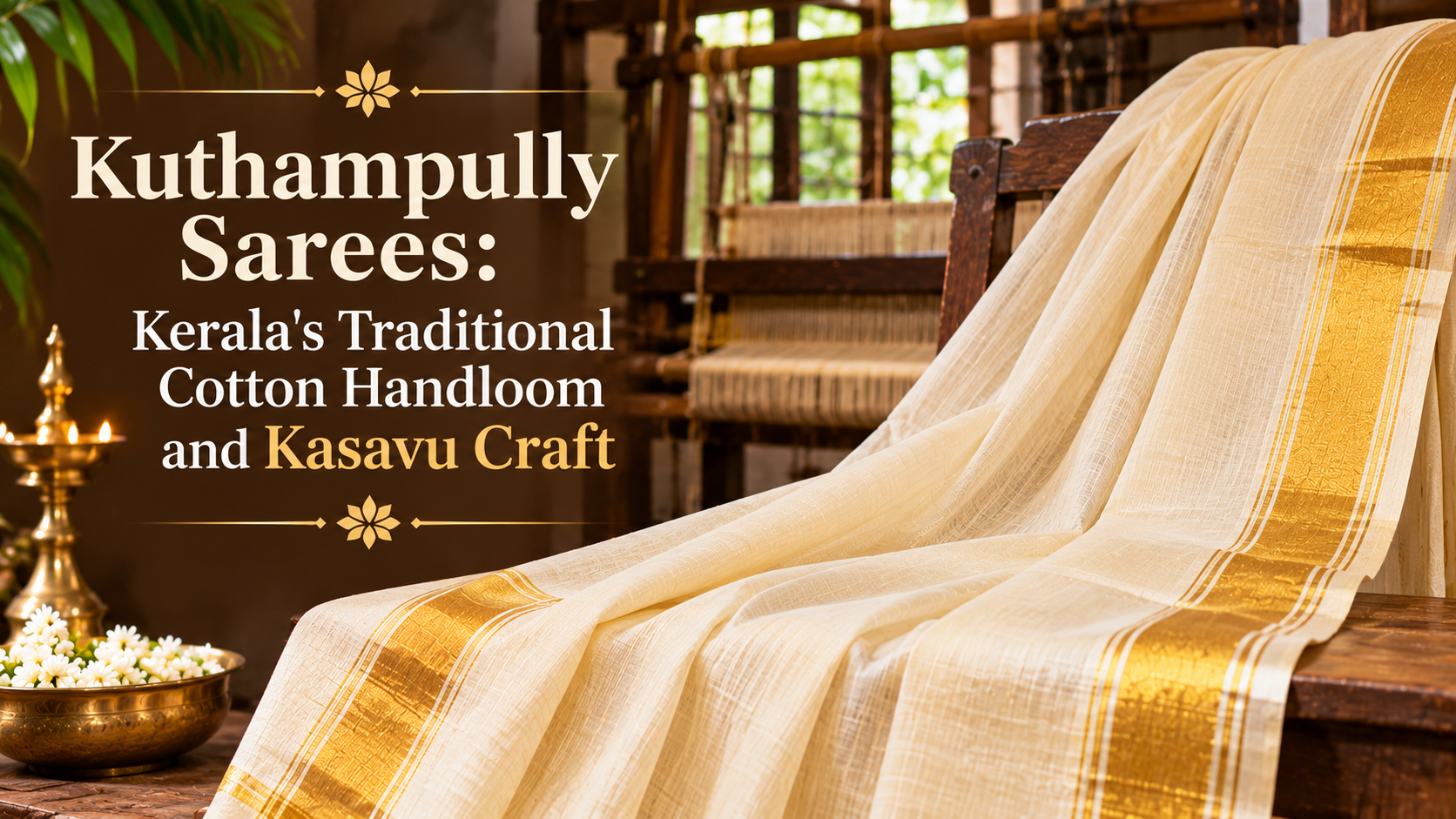
A Kuthampully saree usually starts as soft cotton in an ivory or off-white shade, finished with a gold border and a woven pallu. It comes from one village in Thrissur district, where families have worked handlooms for roughly five centuries. The village sits at the centre of how many people picture the Kerala Kasavu saree, yet the name also gets used loosely. Not every ivory-and-gold saree sold in Kerala is from Kuthampully, and not every gold-looking border is made from the same zari.
This guide covers where Kuthampully is, who the weavers are, how a saree moves from yarn to finished cloth, what Kasavu actually means, and how Kuthampully differs from Balaramapuram and other Kerala handloom centres. It also covers festival use, modern designs and practical buying checks.
Where Kuthampully is and why it matters
Kuthampully is a village in the Thiruvilwamala grama panchayat of Thrissur district, Kerala. Kerala Tourism places it about 50 km northeast of Thrissur town, with Shoranur railway station roughly 29 km away. Reporting by the People’s Archive of Rural India (PARI) describes the settlement as lying between two rivers, the Bharathapuzha to the north and the Gayathripuzha to the west.
The village is small. PARI cites a 2011 Census population of about 2,400, and the weaving economy extends into nearby areas. One handloom-heritage source lists Thiruvilwamala, Eravathody and Kondozhi among the places where these sarees are made, so “Kuthampully” often refers to a cluster as much as a single settlement.
Kuthampully is one of three Kerala handloom clusters whose products hold a Geographical Indication (GI) tag. The other two are Balaramapuram and Chendamangalam. A GI protects the link between a product and its place of origin. Scroll reports that the Kuthampully saree received GI status in September 2011, and PARI notes that Kuthampully sarees, veshtis and settu mundu are covered.
The weaving community and its history
The weavers are mostly Devanga Chettiars. Accounts of how they reached Kerala differ in the details. Several sources say the community came about 500 years ago at the invitation of the Kochi royal family, to weave cloth for the court. Some place the ancestors in Mysore or elsewhere in Karnataka, while others say they came from Tamil Nadu. One account in Scroll adds that rulers of Kollengode and Cochin both invited the weavers and gave them homes on the river bank. Because the oral histories do not agree, it is safer to say “around 500 years ago, from the Karnataka and Tamil Nadu region” than to name a single origin.
The Devanga community traces its craft to the goddess Chamundeshwari, and Scroll reports that the village keeps temples for her and holds a day of worship each February. In Kuthampully the craft was a family project for generations. PARI’s interviews describe grandparents, parents and children each handling a different stage: separating and straightening threads, rolling the warp, and twisting gold thread onto smaller spools with a charkha.
The craft today is under pressure. PARI describes an ageing workforce, modest earnings and young people moving to other jobs. The Kuthampully Handloom Industrial Co-operative Society, registered in 1972 with 102 members, supplies raw material and pays wages to its member weavers. Other weavers work for master weavers who take orders from shops around the state.
How a Kuthampully saree is made
Cotton and yarn
Kuthampully weavers buy their cotton yarn rather than spinning it in the village. PARI reports that the thread arrives from spinning mills in Malappuram and Coimbatore. The yarn is normally left natural or lightly bleached, which gives the base cloth its ivory or off-white tone. If a customer asks for a coloured saree, the yarn has to be dyed first, and that adds a step that needs extra hands.
Warp preparation and sizing
The warp threads (called paavu in the village) arrive as starched bundles roughly 44 metres long, according to PARI’s account. They must be separated, straightened and rolled onto a beam so they run in even parallel lines. Doing this takes several people working along a road or open space because of the length. One handloom-heritage source describes the sizing method used here as “street sizing”, where the warp is stretched out and starched in the open before it goes onto the loom.
Loom setup and weaving
The loom is a traditional handloom, often a pit loom, worked with a throw shuttle. Scroll notes that Kuthampully weavers have stayed with this method while many other centres moved to powerlooms. PARI photographed a roller carrying between 4,000 and 4,500 threads. Joining the new warp to the old, or fixing a broken thread partway through, can take a full day and needs more than one person.
For plain sarees, the weaver passes the weft through the shed and beats it into place. For patterned sarees the loom is fitted with a jacquard mechanism that reads punched cards. PARI saw stacks of these cards in a weaver’s house and was told that someone has to design the card for each pattern, and a technician has to repair the jacquard when it fails.
Border weaving and kasavu insertion
The border is where the saree gets its identity. Zari thread is generally woven in as an extra weft, so the gold sits on the surface of the border while the cotton base is formed. PARI describes rolls of kasavu soaked in liquid starch, which keeps the metallic thread stiff and easier to handle. The pallu is also woven with zari, and a heritage source states that jacquard is used for the pallu and for buti motifs on the body.
Speed depends on design. According to PARI, a plain mundu takes around a day, while a saree with heavy patterning has taken one weaver eight days and a younger weaver two. These figures are illustrations from one report, not fixed production times.
Finishing
Once the cloth is cut from the loom, it goes through light finishing. Some handloom writing describes a starchy finish that softens with washing. A new Kuthampully saree can therefore feel crisp at first and relax after a few washes, which is a normal trait of starched cotton and not a defect.
Kasavu, zari borders and traditional colour combinations
What kasavu means
Several sources are precise on this point: kasavu is the word for the zari thread, and it is also used for the technique of weaving it into the border. A “Kasavu saree” is therefore a saree with a kasavu border. Calling the whole saree “Kasavu” is common shorthand, and it is acceptable in shopping, but the border is the item that the word describes.
Why zari is not one single thing
Traditionally, kasavu was made with real gold or silver. Gold and silver prices pushed most weavers toward cheaper options, and that is the part buyers need to understand. Kerala weaving reports describe at least three grades in use:
- Fine or “real” zari, made by plating a silver thread with gold. Weavers in the Balaramapuram area told a news report that this grade is bought from Surat and that a reel can cost between ₹16,000 and ₹20,000, depending on metal prices.
- Half-fine or imitation zari, made in a similar way but without gold or silver, as one Gulf News piece explains.
- Copper-plated “second quality” zari, which Balaramapuram weavers say many now use to control cost.
Because sources describe the layers differently (for example, one article gives a gold content of 0.1 percent for real kasavu on a silk filament), it would be wrong to say that every gold border has the same composition. The right claim is that composition varies, and the seller should state it.
Traditional colours
The classic palette is ivory or off-white for the body with a gold border. Variations that appear in Kerala shops include a thin gold line, a broad gold band, a coloured border next to the gold, and a coloured body such as black, maroon or green with a gold edge. Scroll quotes one seller mentioning a black-and-gold handloom Kasavu saree. PARI reports that after the 2018 floods the Kuthampully society chose to start weaving coloured sarees as well, to keep demand going outside the festival season.
Fabric, weave, motifs and pallu
The base cloth is a plain weave in cotton. It is light, breathable and, according to one Kuthampully seller quoted in PARI, noticeably softer and more durable than machine-woven versions. A seller in Scroll adds that handwoven cloth is usually lighter in weight than a powerloom piece, which is a useful hand test but not proof.
One report from Wikipedia’s Kerala sari entry says that Kuthampully sarees include more patterns, borders and motifs than the other two GI clusters. Motifs mentioned by PARI include elephants and peacocks. One heritage source also mentions buti motifs woven in zari on the body. Because designs vary by weaver and shop, treat any list as typical examples and not a rulebook.
The pallu is the other place where a Kuthampully saree can look distinct. A simple saree may end with a plain gold stripe. A more detailed one may carry a woven zari panel, and some use jacquard to build larger figures.
Traditional uses: festivals, ceremonies and weddings
The ivory-and-gold saree is Kerala’s festive garment. Onam is the clearest example. PARI says Onam is when the sale of traditional clothing is at its peak, and the 2018 floods left the society with unsold stock from that season, which it later discounted. Women often wear the saree, or a two-piece set mundu, on Onam morning for the family feast and the pookalam ceremonies.
Vishu and temple visits call for the same garment. Weddings use it too, and for many Kerala families a Kasavu saree or settu mundu is part of the ceremonial wardrobe. The set mundu comes as two pieces, a lower mundu and a neriyathu, and PARI lists it among the products with GI recognition. Wedding choices usually lean towards a wider gold border and a richer pallu, while day-to-day temple wear is plainer.
Contemporary Kuthampully saree designs and styling
New designs have widened the range beyond festival white. Weavers and wholesalers quoted by Scroll mention Krishna murals, hand-painted or screen-painted, as a popular recent addition. Others add coloured borders, checks and floral buttas, and some versions come in solid colours with a gold edge.
Styling follows the fabric. Ivory with a plain gold border works with a contrast blouse in maroon, bottle green, mustard or black. A coloured saree with a narrow gold border suits a matching or ivory blouse. Jewellery tends to stay simple, with temple designs or a plain gold chain, so the border remains the focal point.
The cotton base also suits regular use. If you are building a week of wearable sarees, our notes on cotton sarees suited to daily wear cover fabrics, drape and care for everyday rotation, and a Kuthampully piece with a narrow border sits comfortably in that group.
Kuthampully compared with Balaramapuram and other Kasavu traditions
Kuthampully and Balaramapuram are different places with different habits. Balaramapuram is in the Thiruvananthapuram district, in the south of Kerala. Kuthampully is in Thrissur district, in central Kerala. Chendamangalam, the third GI cluster, is in Ernakulam district.
Style notes in the trade press give the following contrasts. Deccan Herald describes Balaramapuram saris and mundus with fine thread counts (120s is cited) and pure zari, which is silver thread plated in gold. A caleidoscope feature says traditional Balaramapuram textiles carry a gold border and usually a simple zari stripe at the end. Chendamangalam, in the same report, uses half-fine zari with counts from 80s to 100s and simpler colours and motifs. Wikipedia’s entry on the Kerala sari says Kuthampully pieces show more patterns, borders and motifs than the other two.
| Feature | Kuthampully | Balaramapuram | Chendamangalam |
| District | Thrissur | Thiruvananthapuram | Ernakulam |
| Weaving community mentioned in sources | Devanga Chettiar families; origin accounts vary | Traditional Balaramapuram weavers (varies by society) | Local weaver societies |
| Typical character | More borders, motifs and pattern variety | Fine, smooth cloth with restrained gold edge | Subtle, simple colours and motifs |
| Thread count noted in reports | Not given in the sources used here | Around 120s cited | 80s to 100s cited |
| Zari | Varies by product; ask the seller | Associated with fine zari, though copper-plated grades are also used by weavers | Half-fine zari cited |
| GI tag | Yes | Yes | Yes |
Two points keep the comparison honest. First, these are tendencies, not fixed rules, and individual weavers differ. Second, price and fineness depend on yarn count, zari and the weaver’s time, not only on the village.
Fibre is another source of confusion. Many Kerala sarees are pure cotton, but shops also sell blends. If a listing says cotton silk, read what the fabric actually contains. Our explainer on cotton silk sarees shows how those blends differ from pure cotton and how their care changes.
How to buy a Kuthampully saree with confidence
Do not treat the label “Kerala saree” as proof of origin. A PARI report quotes Kuthampully society staff saying that around 80 percent of the sarees on display in the village’s shops were powerloom pieces made in Tamil Nadu, and that figure dates from 2019. Powerloom sarees are not bad products, but they are not the same as a Kuthampully handloom saree, and a good seller will say which is which.
For a general framework on fabric, weave, price factors and care, start with our complete guide to buying sarees for women. Then apply these checks to a Kuthampully piece:
- Ask whether the saree is handloom or powerloom, and whether it was woven in Kuthampully or only sold there.
- Look for a Handloom Mark or the GI details on the tag. These are tools, not guarantees, so check the seller’s documents.
- Ask what the border is made of: fine zari, half-fine zari or copper-based. Prices should reflect the answer.
- Examine the border from the back. A woven border has zari that runs into the cloth, while a stitched-on border usually shows a seam.
- Treat home tests with caution. Some articles suggest rubbing the thread to expose a red silk core, or rubbing the border with a coin, but these tests can damage the saree and are not laboratory proof.
- Check the blouse piece, length and care instructions in the listing.
If you are shopping remotely, run through our online saree shopping checklist before paying, because photographs hide weave and zari quality.
For care, follow the label. As a general rule, handloom cotton with zari does better with gentle hand washing, shade drying and ironing on the reverse side. Avoid bleach and harsh scrubbing across the border, and store the saree folded in a cotton cloth.
Frequently asked questions
1. What is a Kuthampully saree? It is a handloom saree woven by families in Kuthampully, in the Thiruvilwamala panchayat of Thrissur district. It is best known for ivory cotton bodies with gold borders, and the product carries a GI tag.
2. Is a Kuthampully saree the same as a Kerala Kasavu saree? Not exactly. A Kerala Kasavu saree is any saree with a kasavu zari border. A Kuthampully saree is one made in Kuthampully. Balaramapuram and Chendamangalam also produce Kasavu sarees.
3. Are all ivory sarees with gold borders made in Kuthampully? No. Many are made in other Kerala clusters, and many are powerloom pieces from elsewhere. Ask about the weaving place and the loom type.
4. Is the gold border real gold? It depends on the product. Weavers and reports describe fine zari (silver plated with gold), half-fine zari and copper-based zari. Each costs differently, so ask the seller what is used.
5. How is Kuthampully different from Balaramapuram? They are in different districts. Balaramapuram is linked in reports with fine thread counts and a restrained gold edge, while Kuthampully is noted for more borders and motifs. Both are GI-tagged.
6. Can I wear a Kuthampully cotton saree every day? Yes, especially versions with narrow borders and simple pallus. Heavier zari pieces suit festivals and weddings better.
7. How should I wash a Kuthampully saree with a zari border? Follow the label. In general, hand wash gently in cold water with a mild detergent, dry in shade and iron on the reverse. Dry cleaning may be safer for heavy zari.
8. Why are handloom Kuthampully sarees priced higher than machine versions? They take more labour and time. PARI reports that a handloom saree priced at ₹2,000 could cost around ₹400 as a powerloom piece, and that one person can supervise several powerlooms at once.
Conclusion
A Kuthampully saree is best understood as a product of a place, a community and a loom. The cotton comes from mills, the weaving happens in homes and sheds in Thrissur district, and the gold border is a separate craft inside the larger one. Knowing that kasavu is the zari, that zari grades vary, and that Kuthampully differs from Balaramapuram makes it easier to judge what you are being offered.
Whether you want a plain ivory piece for Onam, a coloured saree with a narrow gold edge, or a wedding-day set mundu, ask where it was woven, what the border contains and whether it came off a handloom. Those three answers tell you most of what you need to know.
