
Blog
Gota Patti Sarees: Rajasthan’s Traditional Gold Ribbon Embroidery and Decorative Craft

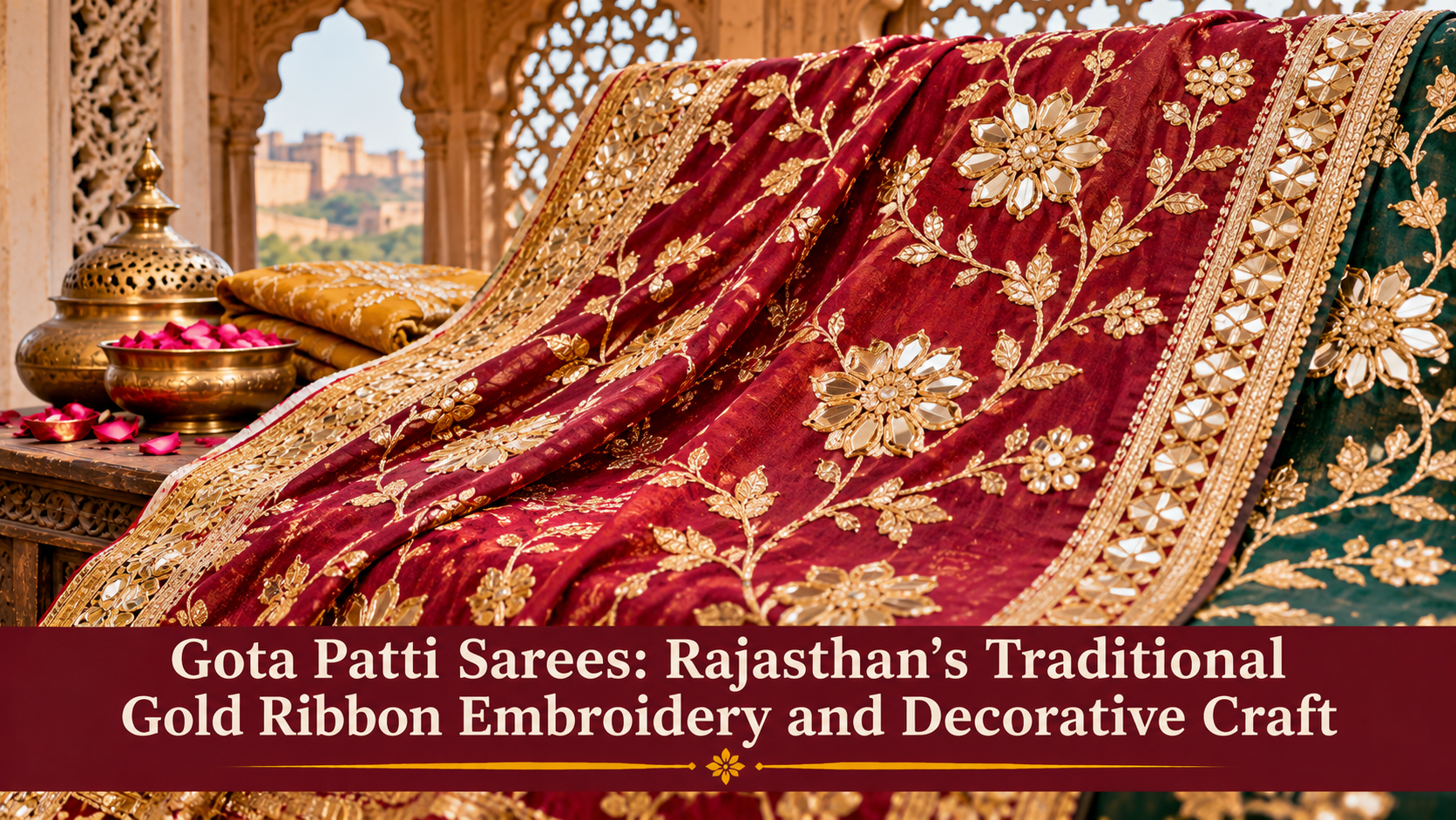
A gota patti saree catches light differently from a sequinned or beaded one. The shine is softer and flatter, the motifs are cut from ribbon and laid onto the fabric, and the overall effect reads as festive and traditional at once. It is a favourite for weddings, pujas, Karwa Chauth, Teej and family functions, mostly because it adds richness without needing a heavy silk base.
This guide explains what gota patti work actually is, where it comes from, how it is made, which motifs and materials are common, and how traditional hand-applied work differs from machine-made and printed imitations. It also covers fabrics, borders and pallus, wedding and festive use, blouse and styling ideas, care, and how to judge quality before you buy a gota patti saree. Where sources disagree, the article says so.
What is gota patti work?
Gota patti, also called gota work, gota-kinari or lappe ka kaam, is a form of metallic ribbon appliqué embroidery associated with Rajasthan. The Government of India’s handicrafts portal describes it as a traditional metal lace embroidery known for its luxurious appearance.
The two words describe the materials. Gota refers to the woven metallic ribbon, usually in gold or silver tones, and patti means strip or piece. In practice, artisans cut or fold the ribbon into shapes and stitch them onto a base fabric, often adding thread embroidery around the edges.
The key point is that gota patti is surface appliqué. The ribbon is applied on top of the fabric and secured with stitches, which gives the work its slightly raised, flat-metal look. It is not woven into the saree, and it is not the same as zari weaving, though the two are often discussed together. Our comparison of mirror work, gota patti and zari explains how these embellishments differ in look, weight and care.
Origins and history of gota patti embroidery
The craft is generally described as originating in Rajasthan, and many accounts link its growth to the courts of the Mughal and Rajput periods, when metallic ornament was used on royal clothing and furnishings. Jaipur is widely named as a centre of the tradition.
Beyond that broad picture, the details are less certain, and it is worth being honest about this. Some sources describe the craft as moving through other regions, including Gujarat, before settling in Rajasthan. Others note a link with Lucknow’s metallic lace tradition. Claims about exact dates, such as “500 years” or specific royal patrons, appear mostly in retail and popular writing and are rarely backed by primary documentation. A safe summary is that gota is an old, court-associated craft with Rajasthan as its best-known home, and that its precise early history is not firmly documented.
Traditionally, gota work was used on garments such as ghagras, odhnis, saree borders and turbans, and on household textiles. It has long been linked with auspicious occasions, weddings and festivals.
Rajasthan’s textile and embroidery landscape
Rajasthan is rich in textile traditions, from block printing and bandhani (tie-dye) to mirror work and many kinds of regional embroidery. Gota patti belongs to this wider landscape of decorative craft rather than standing alone.
Production is concentrated in particular places. Sources commonly name Jaipur, Ajmer and the villages of Naila (also spelled Nyla) and Khandela in the Jaipur and Sikar areas as important clusters for gota ribbon production and gota work, with other towns such as Bikaner, Udaipur and Kota also mentioned. Figures about the number of artisans vary widely between sources, so this article does not quote any.
One caution applies throughout. Sources describe artisans from many backgrounds working in gota, and it is not accurate to attribute the craft to a single community unless a specific piece or workshop documents that. When a seller makes such a claim, ask for details.
Traditional materials and decorative elements
Gota ribbon
Gota is a woven ribbon or lace, usually in a satin or twill weave, made in a range of widths. Traditionally it used real gold and silver metallic thread. Today, ribbons vary: some use metal-coated thread, and others use synthetic metallic yarn that is lighter and less costly. Because composition affects shine, weight, durability and price, ask the seller what the gota is made of and do not assume it is precious metal.
Base fabric and thread
The ribbon is stitched onto the base fabric with cotton or silk thread. A hook (ari), needles, scissors and a wooden frame are among the tools described for the craft, along with the loom used to weave the ribbon itself.
Supporting embellishments
Gota patti is often combined with other decoration. Thread embroidery commonly outlines the edges of appliquéd motifs, and some pieces add sequins, beads, zardozi or other metalwork. Those additions change the weight and care needs of the garment, so check what is actually on the saree.
How gota patti motifs are created and attached
Descriptions of the technique vary a little by workshop, but the core steps are consistent.
- Designing and tracing. The artisan traces the motif outline onto the base fabric.
- Cutting or folding the ribbon. Pieces of gota are cut or folded into shapes such as leaves, petals and geometric forms.
- Appliquéing the ribbon. The pieces are stitched down using hemming, running stitch, back stitch or couching, in which a thin cord or thread holds the ribbon in place.
- Adding thread work. Embroidery along the edges of motifs adds definition and holds the appliqué firmly.
- Finishing. The piece is checked, trimmed and finished, and a lining or backing may be added on garments such as blouses.
One well-documented variation is gota tukdi, where the ribbon is cut into small pieces, such as flowers and mango shapes, and attached as individual motifs. Gota is also applied as continuous strips along borders.
Common gota patti motifs
Motifs are usually drawn from nature and traditional ornament. Commonly described examples include:
- Floral motifs: flowers and petals, including champak-style blooms
- Leaf motifs: leaves and vines, from which the “patti” (leaf) in the name is sometimes explained
- Mango or paisley forms: the kairi shape appears in many Indian textile traditions
- Pot or urn shapes: sometimes called gamla in craft descriptions
- Geometric patterns: diamonds, lines, scallops and borders
- Figurative motifs: birds, animals and other forms appear in some traditional pieces
Names and vocabulary vary between regions and workshops, so treat these as common examples, not an official list.
Gota patti borders, pallu and saree-body designs
Borders
Gota patti borders are among the most popular uses on a saree. A border can be a simple strip of ribbon, a scalloped edge or a band of repeated motifs. Border work is a practical choice because it adds a festive frame without covering the whole saree.
Pallu
The pallu often carries the densest gota work, with larger motifs, clustered flowers or a broad band that stands out when the saree is draped.
Saree body
On the body of the saree, gota may appear as scattered motifs, rows of small shapes or, on richer pieces, dense all-over work. Heavier coverage adds weight and stiffness, which affects how the saree drapes and how comfortable it is for long wear.
Blouse
A gota patti blouse is a popular way to add metallic detail to a plain saree. It lets you keep the saree light and put the decoration where it shows.
Fabrics commonly used with gota patti
The base fabric changes how the work looks and wears.
| Fabric | How it works with gota patti | Things to consider |
| Georgette | Light and flowing; suits scattered motifs and borders | Dense work can pull or pucker the fabric; needs lining or backing |
| Chiffon | Very light and fluid | Delicate; heavy appliqué may be too much |
| Crepe | Soft, matte base that shows metallic work well | Generally stable under moderate decoration |
| Silk and silk blends | Holds heavier work well and complements metallic shine | Heavier overall; usually dry clean |
| Cotton and cotton silk | Gives a lighter, daytime look | Check that the base can support the ribbon; see care notes |
| Kota Doria | A lightweight, checked weave often paired with gota | Fragile when worn with heavy work; handle gently |
| Net | Often used for dupattas and lehengas | Needs good support for appliqué |
Different regions and sellers pair fabrics differently, so use the table as a guide, not a rule. As a general principle, the heavier the work, the sturdier the base should be. Our complete saree for women buying guide explains how fabric choice affects drape, weight and care across saree types.
Traditional hand-applied work versus machine-made and imitation gota patti
This is the area where buyers most often feel uncertain. Not every gota patti saree is handmade, and not every machine-made piece is poor. What matters is that the saree is described honestly and priced accordingly.
| Feature | Traditional hand-applied gota patti | Machine-made or imitation versions |
| How it is made | Ribbon cut, shaped and stitched onto the fabric by hand, often with thread work | Appliqué or embroidery done by machine; sometimes printed or stuck-on designs that imitate the look |
| Surface | Slight natural variation in spacing and shape | Highly uniform, with identical repeats |
| Stitching | Visible, individual hand stitches or couching | Machine stitching in even lines, or glue with no stitching |
| Reverse side | Shows hand-finished thread ends and anchoring stitches | Often a tidy, uniform back, or a stiff backing |
| Ribbon | Varies; may be metal-coated or synthetic | Often synthetic or printed foil |
| Time and cost | Slower and usually more expensive | Faster and usually less expensive |
| Documentation | Seller may describe the maker, workshop or region | May give only general marketing claims |
Some pieces combine methods, such as machine-embroidered outlines with hand-applied ribbon, so a sharp split between “handmade” and “machine-made” is not always accurate. If the seller says the work is hand-done, ask for close-up photos of the front and back and for a specific description of the process.
Wedding, festive and occasion-wear applications
Weddings
Gota patti is a common choice for pre-wedding functions, guest wear and, in some communities, for bridal and family outfits. Light gota borders on a georgette or silk saree suit daytime ceremonies. If you are choosing for a bride or for a major ceremony, our bridal saree buying checklist walks through fabric, weight, budget and wedding-day comfort.
Festivals and pujas
Gota is closely linked with auspicious occasions. Festive favourites include Teej, Karwa Chauth, Diwali pujas and family gatherings, where a gota border adds richness without too much weight.
Everyday festive and office events
A saree with a narrow gota border or a gota blouse on a plain saree can work for smaller functions and festive office days.
Blouse combinations and styling suggestions
- Matching base-fabric blouse: a cohesive look that lets the gota border stand out.
- Gota patti blouse on a plain saree: puts the metallic detail where you want it and keeps the saree light.
- Raw silk or brocade blouse: adds richness for weddings.
- Contrast colour blouse: a gold-toned or deep contrast shade makes the border pop.
Colour pairings
Gold gota tends to look striking on jewel tones such as maroon, emerald, royal blue and deep pink, and on warm shades like mustard and orange. Silver-toned gota suits pastels, ivory, grey and cooler colours.
Jewellery
Kundan, polki-style and gold-tone jewellery suit gold gota, and silver or oxidised pieces suit silver-toned work. If the saree is heavily embellished, simpler jewellery keeps the look balanced.
Care, storage and maintenance
Always follow the care label. General guidance for ribbon appliqué includes:
- Washing: most gota patti pieces are safer with dry cleaning, because water and agitation can loosen stitching and tarnish metallic ribbon. Avoid home washing unless the label clearly allows it.
- Ironing: use a low heat on the reverse side and place a thin cloth between the iron and the work. Never press directly on the gota.
- Storage: fold loosely in a cotton or muslin cloth, keep the saree dry, and refold along different lines occasionally. Avoid tight folds across embellished areas.
- Moisture and sunlight: keep away from damp spaces and long direct sunlight, which can dull metallic ribbon.
- Wearing: avoid rough surfaces and sharp jewellery that can snag the ribbon, and check for lifting edges before each wear.
How to evaluate gota patti quality when buying
Visual checks give useful clues, but no single check proves how a piece was made. Labels and seller transparency matter as much as appearance.
- Check the stitching. Look for secure, even stitches along the edges of each motif. Lifted corners and loose ends are a warning sign.
- Turn the saree over. The back shows how the work was anchored. Messy knots, long loose threads or a stiff glued backing are worth questioning.
- Look at motif consistency. Slight variation is normal in handwork, but distorted shapes or uneven spacing along a border suggest careless finishing.
- Feel the weight and stiffness. Dense work adds weight. Make sure the saree drapes comfortably and the fabric is not pulled out of shape by the appliqué.
- Inspect the ribbon. It should be even, without tarnished patches, fraying or kinks.
- Ask what the gota is made of. Metal-coated and synthetic ribbons differ in shine, weight and price.
- Ask about the process. A clear answer about whether the work is hand-applied, machine-made or mixed is more useful than a general claim.
- View it in natural light. Metallic work can look different under shop lighting.
For a fuller checklist covering fabric, borders, zari and finishing, see our guide on how to identify a good-quality saree.
Common buying mistakes
- Assuming “gota patti” means handmade. Ask how the work was done.
- Ignoring weight. Dense appliqué can make a saree heavy and stiff.
- Overlooking the base fabric. A delicate fabric under heavy gota may pucker or tear.
- Skipping the care label. Many pieces need dry cleaning, which adds to the cost of ownership.
- Choosing only from photographs. Colour and sheen look different in person.
- Forgetting lining and blouse comfort. Metallic edges can rub the skin.
- Ignoring the return policy. This matters most when buying online or on sale.
Frequently asked questions
1. What is a gota patti saree?
A gota patti saree is a saree decorated with gota patti work, in which metallic ribbon is cut into shapes and stitched onto the fabric as borders, pallus or motifs. The craft is associated with Rajasthan.
2. Is gota patti always handmade?
No. Traditional gota patti is hand-applied, but machine-made and printed imitations also exist, and some pieces combine methods. Ask the seller to explain how the work was done and to show close-ups of the front and back.
3. Where does gota patti come from?
It is widely described as originating in Rajasthan, with Jaipur and nearby centres such as Naila and Khandela often named. Early dates and exact origins are not firmly documented, so sources differ.
4. Is gota patti real gold or silver?
Traditionally, gota used real gold and silver thread. Today, many ribbons use metal-coated or synthetic metallic yarn. Ask the seller what the ribbon is made of.
5. Which fabrics suit a gota patti saree?
Georgette, crepe, chiffon, silk, silk blends, cotton silk and Kota Doria are commonly paired with gota. Heavier work needs a sturdier base fabric.
6. Can I wash a gota patti saree at home?
Most are safer with dry cleaning, because water and rubbing can loosen stitches and tarnish metallic ribbon. Always check the care label first.
7. Is a gota patti saree suitable for weddings?
Yes, it is a common choice for pre-wedding functions, guest wear and some bridal outfits. Choose the weight and base fabric to suit the ceremony and the weather.
8. How do I tell good gota patti work from poor work?
Check for secure stitching, even motifs, a neat reverse side, an undamaged ribbon and a comfortable weight. Ask for details about materials and process.
Conclusion
A gota patti saree is about the quality of the ribbon work as much as the colour of the fabric. Understand how the craft is made, check the stitching and the back, ask what the ribbon is and whether the work was done by hand or machine, and choose a base fabric that can carry the decoration. With those checks, you can enjoy a piece that suits your occasion and treat it well for years.
