Blog
Mirror Work vs Gota Patti vs Zari: Which Embellishment Suits Your Festive Outfit?

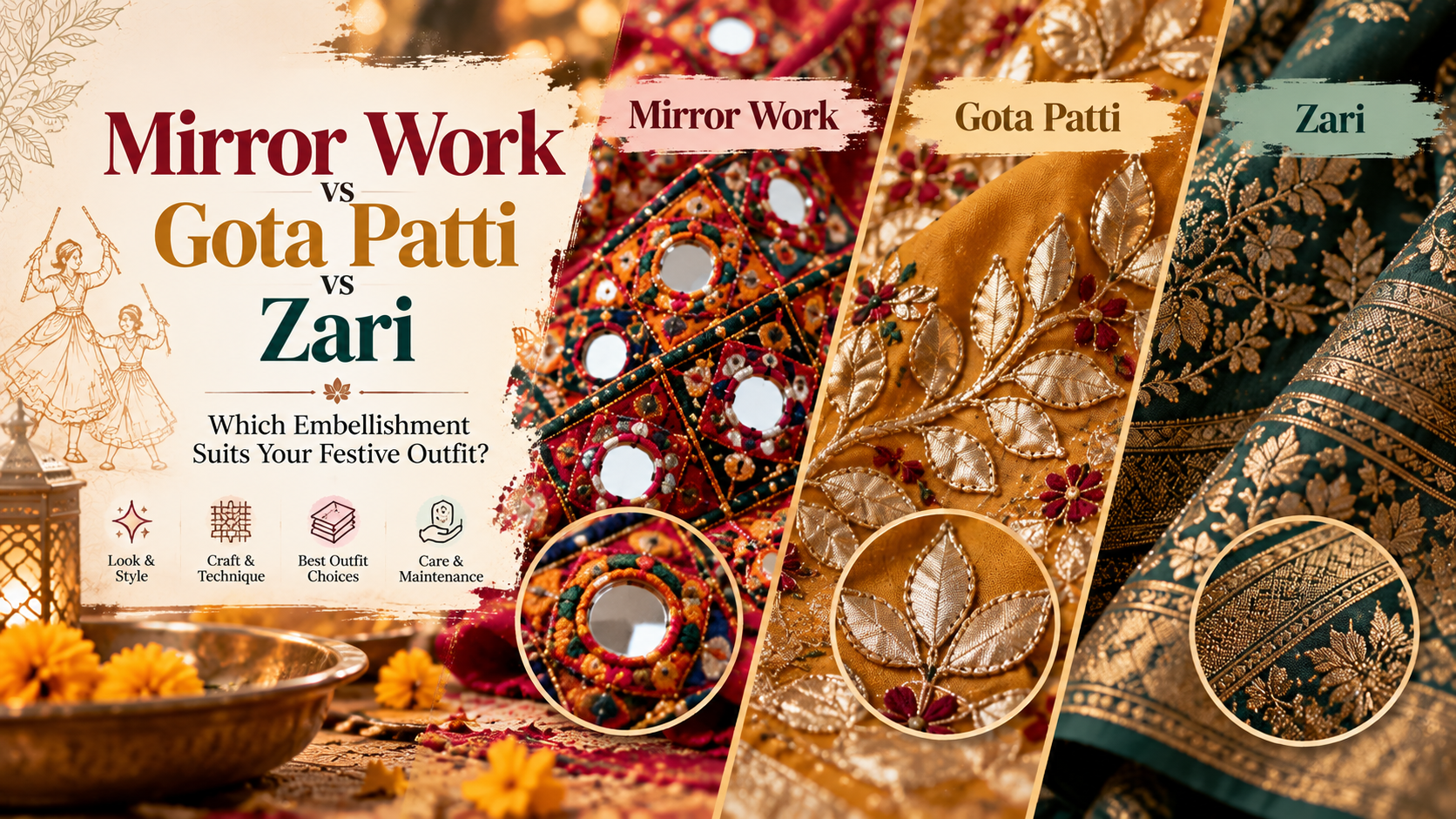
Embellishment changes more than how an outfit looks in a photograph. It decides how the fabric catches light, how stiff or soft the garment feels, how heavy it is to wear for a long evening and how carefully you need to wash and store it. Two lehengas in the same colour and cut can feel completely different on the body if one is covered in mirrors and the other has a light zari border.
Mirror work, gota patti and zari are three of the most common embellishments on Indian festive clothing, and shoppers often see them side by side on the same rack. This guide explains what each one is, how they compare, which garments and occasions suit each, and what to ask a seller before you buy. If you are planning several outfits for the festive season, our Navratri Outfit Ideas 2026 guide is a good starting point.
A note on terms: each of these names covers a broad family of techniques. The same word can describe hand-stitched work by a craft community, machine-made work in a factory and printed or stuck-on imitations. Regional traditions also differ in motifs, materials and methods. The descriptions below are general, and individual pieces vary by region and maker.
What is mirror work?
Mirror work, often called shisha work, attaches small pieces of reflective material to fabric. In traditional hand embroidery, each mirror is held in place by a frame of thread stitched around its edge, because the mirror itself has no holes. The surrounding embroidery then builds patterns around the mirrors. Mirror embroidery is closely associated with Gujarat and Rajasthan, including the Kutch region, though similar work is made in other parts of India and neighbouring countries, and each community has its own stitches and motifs.
Visual characteristics
Mirrors reflect light in small flashes as you move, which gives mirror work a lively, sparkling quality. The mirrors are usually round, but square, triangular and other shapes are also used. The surrounding thread is often brightly coloured, so mirror work tends to look bold and folk-inspired, although it can also be done in tonal or metallic threads for a more subtle finish.
Common applications
You will most often see mirror work fabric on chaniya cholis, lehenga skirts, blouses, dupattas and jackets. A mirror work lehenga is a familiar sight at Garba because the reflections suit night-time dancing under lights.
Practical considerations
- Real glass mirrors add weight and stiffness. Many modern pieces use lighter plastic or acrylic mirrors instead.
- Mirrors that are glued rather than stitched can come loose over time.
- The edges and the backs of the stitching can feel rough against skin, so lining matters.
- Mirrors can scratch or break if the garment is folded tightly or washed roughly.
What is gota patti work?
Gota is a woven ribbon or tape, traditionally made with metallic threads, in gold or silver tones. In gota patti work, pieces of this ribbon are cut or folded into shapes such as leaves, petals and geometric forms, then stitched onto the base fabric, often with surrounding embroidery. The technique is strongly associated with Rajasthan, though it is now made in many places.
Visual characteristics
Gota patti has a soft metallic shine rather than the sharp sparkle of mirrors. Because the ribbon is flat, it creates broad areas of gold or silver, which reads as festive and slightly traditional. Motifs are frequently floral or leaf-like, which is where the word “patti” (leaf) comes from.
Common applications
It appears on lehengas, sarees, suits, dupattas and blouses. A gota patti blouse is a popular way to add metallic detail to a plain saree or lehenga skirt. Borders of gota are also common on dupattas and saree edges.
Care considerations
- Metallic ribbons can tarnish or lose shine over time, especially with moisture.
- The cut edges of the ribbon can fray or lift if the stitching is loose.
- Gota pieces are generally lighter than mirrors, but dense work still adds stiffness.
- Most gota garments are safer with dry cleaning or very gentle handling; follow the label.
What is zari work?
Zari is metallic thread used in weaving and embroidery. It appears woven into fabrics, as in many traditional silk sarees, and embroidered onto fabric in techniques such as zardozi, which often combines zari threads with beads, sequins and other materials.
Varieties of zari
Zari is generally described in three broad types, though names and composition vary between sellers:
- Real or pure zari: traditionally made with silver, often coated or electroplated with gold, wrapped around a silk core.
- Imitation or tested zari: usually copper-based thread electroplated to look like silver or gold.
- Metallic or plastic zari: synthetic metallic yarn, lighter and generally lower in cost.
Because composition affects weight, shine, durability and price, it is worth asking the seller which type is used rather than assuming.
Visual characteristics
Woven zari creates borders, pallus and motifs that sit flat within the fabric and give it a rich, formal look. Embroidered zari is raised and textured, especially in zardozi, which looks ornate and heavy.
Typical applications
A zari work saree is the most familiar example, with metallic borders and pallus. Zari also appears on lehengas, blouses, sherwanis, dupattas and suits, from fine piping to dense embroidery.
Practical considerations
- Woven zari is usually smooth and comfortable; heavy embroidered zari can be stiff and scratchy.
- Metallic threads can tarnish, so storage matters.
- Dense zardozi is heavy and usually needs professional cleaning.
Mirror work vs gota patti vs zari: how they compare
Visual effect
Mirror work sparkles in points of light and looks playful and colourful. Gota patti gives broad, soft metallic shine with a traditional floral feel. Zari ranges from subtle woven borders to ornate raised embroidery and reads as the most formal of the three.
Texture
Mirror work has hard, raised elements with thread around them. Gota patti is flat with slightly raised edges. Woven zari is smooth and part of the fabric itself; embroidered zari is raised and textured.
Typical use
Mirror work leans towards folk and festive styles, especially chaniya cholis and Garba outfits. Gota patti suits celebratory traditional outfits such as lehengas, suits and dupattas. Zari is common in sarees and formal or bridal wear.
Styling versatility
Woven zari is the most versatile, since a zari border can look restrained or rich depending on how it is styled. Gota patti works well for traditional events and can be paired simply. Mirror work has a strong personality that suits festive and casual-festive occasions but can feel too informal for some formal events.
Care requirements
All three need careful handling. Mirror work risks loose or broken mirrors, gota patti risks tarnishing and lifting edges, and zari risks tarnishing and snagging. Heavier versions of each usually call for professional cleaning.
Which embellishment works best for each garment?
Sarees: woven zari borders and pallus are the classic choice and suit silk sarees for formal events. Gota patti borders suit lighter georgette or chiffon sarees for festivities. Mirror work sarees exist but are less common and usually lean festive and casual. For festival-ready options, see our list of the Best Sarees to Wear for Navratri 2026.
Lehenga skirts: all three work. A mirror work lehenga suits Garba nights, gota patti suits traditional functions, and zari or zardozi suits weddings and formal events.
Chaniya cholis: mirror work is the most traditional pairing, often combined with bright thread embroidery. Our Chaniya Choli Styling Guide covers how to style these with dupattas and jewellery.
Blouses: a mirror work or gota patti blouse adds detail to a plain saree or skirt, and zari piping or embroidery works for formal looks. Our Navratri Blouse Design Ideas guide covers necklines and sleeves for each.
Ethnic suits: gota patti and light zari detailing on the neckline, sleeves or dupatta are common. Mirror work suits casual festive kurtas.
Choosing embellishments by occasion
Garba and Dandiya: mirror work suits the setting best, both visually and traditionally. Choose lighter versions with acrylic mirrors or scattered placement so the outfit is not too heavy for hours of dancing. Light gota patti also works.
Puja: gota patti and light zari borders look traditional without being too heavy. Avoid very dense work if you will be sitting on the floor for long.
Weddings: zari and zardozi are the usual choice for formal and bridal wear, with gota patti common for pre-wedding functions.
Family gatherings: light gota patti, small zari borders or scattered mirror work give a festive touch without feeling overdressed.
How fabric choice changes the result
The base fabric affects how embellishment looks and feels.
- Cotton: gives a matte, folk look that suits mirror work. It is breathable and supports moderate embellishment well.
- Silk and silk blends: the natural sheen complements zari and gota. Silk holds heavier work without sagging.
- Georgette and chiffon: light and flowing, they suit scattered or light embellishment. Heavy work can pull and pucker these fabrics.
- Net: often used for lehengas and dupattas with gota or zari; it needs good support and lining for heavy work.
- Velvet: rich and heavy, often paired with zari or zardozi for winter weddings.
As a general rule, heavier embellishment needs a sturdier base fabric or a supporting layer.
Colour pairings and jewellery combinations
Mirror work: suits bright multicolour palettes such as red, green, yellow, pink and orange, often on black or indigo bases. Oxidised silver jewellery, mirror jewellery and beaded pieces match its folk character.
Gota patti: works well on pastels, pinks, reds, greens and mustard, where the gold or silver stands out. Kundan, polki-style and gold-tone jewellery pair naturally.
Zari: gold zari suits jewel tones such as maroon, emerald, royal blue and purple, while silver zari suits pastels and cool colours. Match jewellery metal to the zari tone: gold jewellery with gold zari, silver or oxidised with silver zari.
Practical considerations
Weight: dense mirror work with glass mirrors and heavy zardozi are usually the heaviest. Gota patti and woven zari are usually lighter, but density matters more than the type.
Lining: a soft lining protects your skin from stitching backs, mirror edges and metallic threads. Check that blouses and cholis are lined, especially at the underarms and neckline.
Loose pieces: check for lifting mirrors, fraying gota edges and pulled zari threads before buying and before each wear.
Skin comfort: metallic threads and mirror edges can scratch, especially for sensitive skin. Place heavy work away from areas that rub, or choose lighter work for long events.
Maintenance: follow the care label. Many embellished garments need dry cleaning. Spot-clean carefully and avoid scrubbing embellished areas.
Storage: store garments flat or loosely folded, wrapped in soft cotton or muslin. Keep them dry to reduce tarnishing. Avoid tight folds across mirrors or zari, and refold occasionally along different lines.
How to read craft descriptions and ask sellers useful questions
Product descriptions often use these terms loosely. A few questions help you understand what you are actually buying:
- Is the work done by hand or machine? Both are valid, but they differ in look, price and finish.
- Are the mirrors glass, acrylic or plastic, and are they stitched or glued?
- What is the gota made of? Ask whether it is metallic or synthetic.
- Which type of zari is used? Ask whether it is pure, tested or metallic zari.
- Is the garment lined?
- What are the care instructions?
- Can I see close-up photos of the work and the reverse side? The reverse often shows how carefully the work is secured.
- Where and by whom is the work made? If a seller describes a piece as a specific regional craft, it is reasonable to ask for details.
Be cautious about broad claims of authenticity without details. A clear, specific answer is more useful than a label.
Decision-making guide
If you want sparkle for dancing: choose mirror work in a lighter version on cotton or georgette.
If you want a traditional, festive glow: choose gota patti on a lehenga, suit or dupatta.
If you want a formal, rich look: choose zari, either woven into a silk saree or embroidered on a lehenga.
If comfort is your priority: choose woven zari or light gota patti, and make sure the garment is lined.
If low maintenance matters most: choose lighter, sparser work of any type, and favour woven zari over heavy embroidery.
If you want one outfit for many occasions: a woven zari border or light gota detailing is usually the most adaptable.
Detailed comparison table
| Feature | Mirror work | Gota patti | Zari |
| What it is | Small reflective pieces stitched or attached to fabric | Metallic or synthetic ribbon cut into shapes and stitched on | Metallic thread, woven or embroidered |
| Commonly associated regions | Gujarat, Rajasthan (incl. Kutch), among others | Rajasthan, among others | Many weaving and embroidery centres across India |
| Visual effect | Sparkling, colourful, folk | Soft metallic shine, traditional | Subtle to ornate, formal |
| Texture | Hard, raised | Flat with raised edges | Smooth (woven) or raised (embroidered) |
| Typical weight | Medium to heavy | Light to medium | Light (woven) to heavy (zardozi) |
| Best garments | Chaniya choli, lehenga, blouse, dupatta | Lehenga, suit, dupatta, blouse, saree borders | Saree, lehenga, blouse, bridal wear |
| Best occasions | Garba, Dandiya, festive casual | Puja, family functions, pre-wedding | Weddings, formal events, puja |
| Skin comfort | Needs lining; edges can rub | Usually comfortable; edges can feel stiff | Woven is smooth; embroidered can scratch |
| Common care issues | Loose or broken mirrors | Tarnishing, lifting edges | Tarnishing, snagging |
| Cleaning | Gentle; often dry clean | Often dry clean | Often dry clean, especially heavy work |
Frequently asked questions
1. What is the main difference between mirror work and gota patti? Mirror work uses small reflective pieces that sparkle in points of light, while gota patti uses flat metallic ribbon shapes that give a broader, softer shine.
2. Which embellishment is lightest to wear? Woven zari and light gota patti are usually the lightest. Heavy mirror work and dense zardozi tend to be the heaviest, though density matters more than the type.
3. Is mirror work good for Garba? Yes. Its reflections suit night-time dancing, and it is traditionally associated with Garba outfits. Choose lighter mirrors and scattered placement for comfort.
4. How do I know if zari is real? Ask the seller which type is used and request details. Composition can be hard to judge by eye, so a clear answer from the seller is more reliable than appearance.
5. Can I wash gota patti or mirror work at home? It depends on the garment, so check the care label. Many embellished pieces are safer with dry cleaning or very gentle hand washing.
6. How do I stop zari and gota from tarnishing? Store them dry, wrapped in soft cotton or muslin, away from moisture and direct sunlight.
7. Which embellishment is best for a wedding? Zari and zardozi are the most common for formal and bridal wear, with gota patti popular for pre-wedding functions.
8. Is hand-done work always better than machine work? Not necessarily. Hand work has its own character and value, while machine work can be neat and more affordable. Choose based on the look, budget and finish you want.
Conclusion
The right embellishment depends on how you want to look and how you plan to wear the outfit. Mirror work brings sparkle and colour that suits Garba, Dandiya and festive gatherings. Gota patti gives a soft metallic glow that works for puja, family functions and traditional events. Zari ranges from understated woven borders to rich embroidery, which makes it the usual choice for weddings and formal occasions.
