
Blog
How to Identify a Good-Quality Saree: Fabric, Weaving, Borders and Finishing

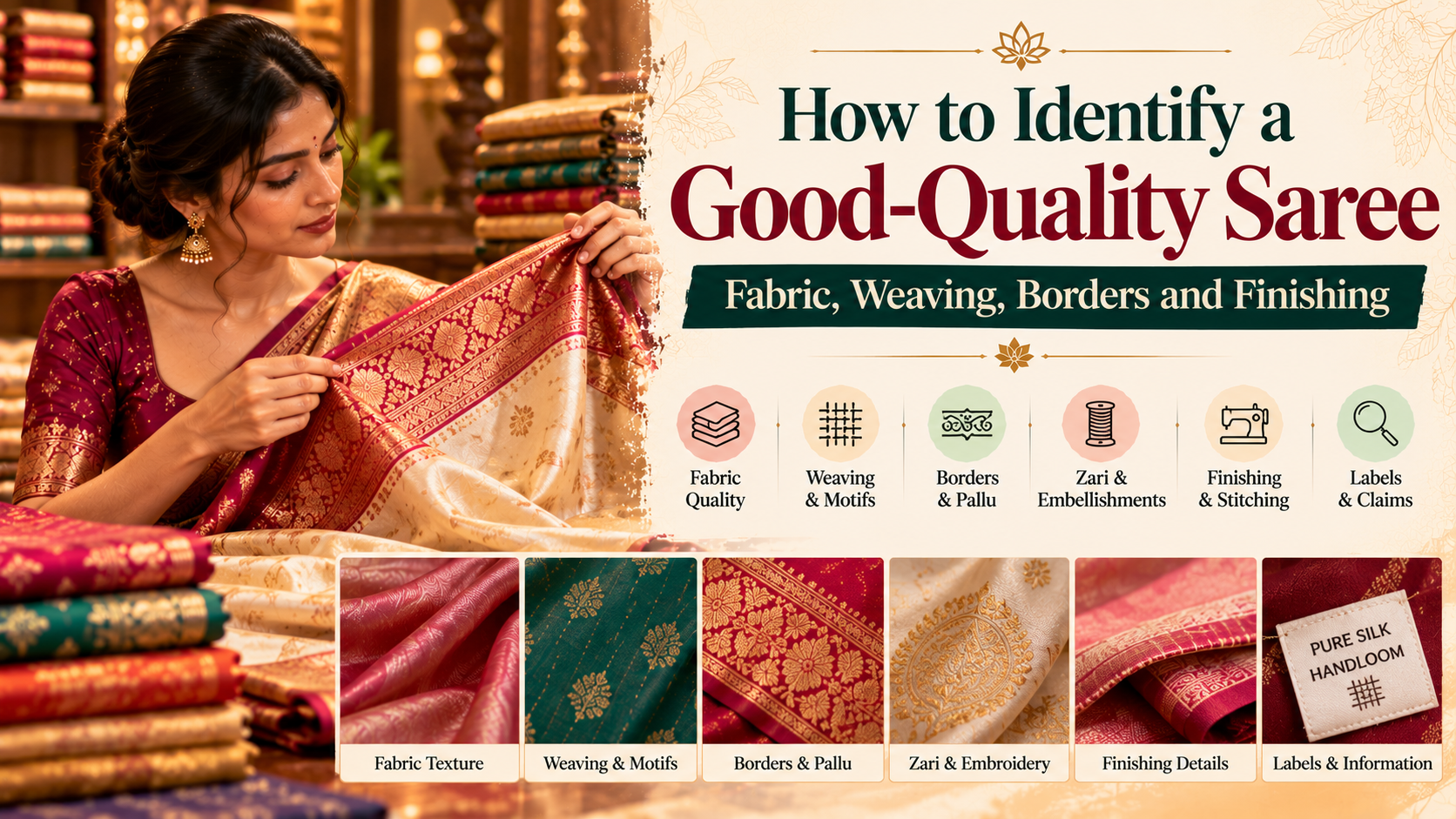
A saree can look stunning on a hanger or in a photograph and still disappoint once you wear it. Thin patches show up in daylight, the border puckers after the first wear, or the zari starts to dull sooner than expected. Most of these problems are visible before you buy, if you know where to look.
Learning how to identify a good quality saree is less about expert knowledge and more about a systematic look at a few key areas: fabric, weaving, borders, embellishment, finishing and the information the seller provides. This guide walks you through each one, explains what is normal and what is a warning sign, and ends with a checklist you can use at the counter or while shopping online.
One important note before you begin: no single home test can conclusively prove a saree’s fibre or zari content. Visual and touch checks give you useful clues, but labels, documentation, seller transparency and, where needed, professional testing are more reliable for uncertain claims.
How to inspect fabric texture, consistency and construction
Feel the full length
Run the saree through your hands along its length, not just the pallu. The texture should feel consistent. Sudden thin, rough or stiff patches can indicate weaving or finishing issues.
Hold it up to the light
Hold a section up to natural light. Look for:
- Even density across the fabric.
- No thin areas, gaps or holes.
- Consistent colour without streaks or blotches.
Some fabrics, such as chiffon, organza and fine cotton, are naturally sheer. You are looking for consistency, not opacity.
Check the weight
Lift the saree and note whether it feels as you would expect for its fabric. Silk weaves, brocades and embellished sarees are heavier; chiffon and mulmul are light. A saree that feels unexpectedly light or heavy for its described fabric is worth asking about.
Look at the drape
Let a section fall over your arm. Notice whether it drapes smoothly or bunches stiffly. Starch or finishing treatments can change drape, especially in cotton.
Normal variation
Handloom and hand-dyed sarees may show small, natural variations in texture or colour. These are part of the craft, not defects.
How to examine weaving, motifs and design alignment
Weave consistency
Look closely at the surface. Threads should be evenly spaced, with no obvious skipped areas, broken threads or loose loops.
Motifs
- Check that woven motifs are complete and clearly defined.
- Look along the length for consistent spacing and size. Slight variation is common in handwork; large inconsistencies or distorted motifs are worth noting.
- Check printed motifs for blurring, smudging or misregistration, where colours do not line up.
Reverse side
Turn the saree over. In woven designs, the reverse shows how motifs were made. Floating threads on the back are normal in some weaves, but they should not be snagged, broken or loosely hanging.
Pattern alignment
Where the saree has stripes, checks or repeating designs, check that they run straight and do not drift diagonally across the fabric.
How to check borders, pallu and selvedges
Borders
- The border should run evenly along the full length without puckering, waving or pulling the body fabric.
- Woven borders should be firmly integrated with the body.
- Stitched-on borders should be attached with neat, secure stitching.
- Colours should be consistent along the border.
Pallu
The pallu is the most visible part of the saree when draped.
- Check that the pallu design is complete and matches what was shown or described.
- Look for consistent density and finishing.
- Check the end of the pallu for neat tassels, fringes or finishing.
Selvedges
The selvedges are the finished long edges of the fabric.
- They should be straight and secure, without fraying.
- Slight irregularity can occur in handloom sarees; heavy fraying or loose threads are a concern.
How to inspect zari, embroidery, sequins and embellishments
Zari
- Look for even zari throughout the border, pallu and motifs.
- Check for broken, pulled or fraying zari threads.
- Look for tarnishing or dull patches.
- Ask the seller what type of zari is used. Zari may be real, tested or metallic, and these differ in material and price. Appearance alone cannot reliably confirm zari type; documentation from the seller or professional testing is more dependable.
Embroidery
- Check that stitches are even and secure.
- Look at the reverse for loose threads or unfinished ends.
- Hand embroidery may show small natural variations.
Sequins, beads, stones and mirrors
- Run your hand gently over embellished areas; pieces should feel secure.
- Look for gaps where pieces are missing.
- Check whether embellishments are stitched individually or attached in a continuous thread, which may unravel if one breaks.
- Note whether any pieces are glued rather than stitched, and ask the seller if unsure.
How to assess stitching, finishing and loose threads
Even an unstitched saree has finishing elements.
- Fall and pico: if included, the fall should be stitched evenly along the lower border, and the pico (edge finishing) should be neat and secure.
- Attached borders and pallus: check that any stitched joins are straight and strong.
- Loose threads: a few trimmed thread ends are common. Long loose threads hanging from the weave, border or embroidery suggest careless finishing.
- Blouse piece: check whether it is included, how long it is, whether it matches and whether it is finished at the cut edges.
How to evaluate product labels and fibre-composition claims
Labels and descriptions are often your most reliable information, provided they are specific.
What useful labels include
- Fibre content, such as pure silk, silk blend, art silk, cotton or viscose.
- Weaving method, such as handloom or powerloom.
- Zari type, where relevant.
- Care instructions.
- Origin or regional weave, where claimed.
Vague or unclear claims
Phrases such as “silk look”, “silk feel”, “premium fabric” or “traditional weave” describe appearance or marketing, not fibre content. Ask for specifics.
When fibre or zari claims are uncertain
- Ask the seller for written fibre and zari details.
- Look for recognised labels where applicable, and check their details.
- Keep invoices and product information.
- For high-value purchases, consider professional verification if there is doubt.
Avoid burn tests and other destructive checks. They can damage the saree, they are not conclusive for blends and you should never test a saree you have not bought.
For guidance on how pure silk and art silk differ, read our pure silk vs art silk guide.
What to inspect online versus in a physical store
| Check | In a store | Online |
| Fabric texture | Feel the full length | Read fibre content; zoom into close-ups |
| Colour | View in natural light | Compare photos on different screens; read reviews |
| Weave and motifs | Inspect front and reverse | Look for close-up and reverse photos |
| Border and pallu | Unfold fully and inspect | Check dedicated border and pallu photos |
| Zari and embellishment | Touch and inspect closely | Ask for close-ups; read the description |
| Finishing | Check edges, fall and pico | Read whether fall and pico are included |
| Labels | Read the tag and ask questions | Read the full description and ask the seller |
| After purchase | Check before leaving | Inspect on arrival before removing tags |
For more on evaluating listings, photos, seller details and policies, see our online saree shopping guide.
Common defects and warning signs
Defects that may affect wear
- Holes, tears or thin patches.
- Broken or pulled threads in the weave.
- Puckered or uneven borders.
- Fraying selvedges or edges.
- Broken or tarnished zari.
- Loose or missing embellishments.
- Colour streaks, stains or fading.
Warning signs in product information
- Fibre content not stated.
- Title and description contradicting each other.
- Only marketing phrases with no specifics.
- Photos that look generic or heavily edited.
- No care instructions.
Usually acceptable variations
- Small irregularities in handloom weaving.
- Minor colour variation in hand-dyed fabric.
- Slight differences in hand-embroidered motifs.
Step-by-step saree quality check
- Read the label or description for fibre, weave, zari and care details.
- Feel the full length for consistent texture.
- Hold sections up to natural light to check density and colour.
- Inspect the weave and motifs on the front and reverse.
- Check pattern alignment.
- Inspect the border along its full length.
- Examine the pallu and its finishing.
- Check the selvedges for fraying.
- Inspect zari, embroidery and embellishments.
- Check fall, pico and any stitched joins.
- Check the blouse piece.
- Ask the seller about anything unclear.
- Confirm return and exchange terms.
Frequently asked questions
1. How can I tell whether a saree is good quality? Check fabric consistency, weave, motifs, borders, selvedges, embellishments and finishing, and read the fibre and zari details carefully.
2. Is there a home test to confirm pure silk? No single home test is conclusive. Labels, seller documentation and professional testing are more reliable.
3. Are irregularities in a handloom saree a defect? Small irregularities are often a natural part of handloom weaving. Holes, broken threads and weak patches are defects.
4. How do I check zari quality? Look for even, unbroken zari without tarnishing, and ask the seller what type of zari is used.
5. What should I check when buying a saree online? Fibre content, close-up photos, border and pallu images, finishing details and the seller’s return policy.
6. Should I do a burn test? No. Burn tests damage the fabric, are not conclusive for blends and should never be done on a saree you have not bought.
Conclusion
Knowing how to identify a good quality saree comes down to a careful, step-by-step look: consistent fabric, well-formed weaving and motifs, even borders, secure embellishment, neat finishing and clear, specific product information. A thorough saree quality check takes only a few minutes and can save you from disappointment later. When fibre or zari claims are uncertain, rely on labels, documentation and seller transparency rather than guesswork.
For a broader view of saree fabric quality, styles and price factors, read our complete guide to buying sarees for women. When you are ready, explore sarees at Mahavir Cloth Center and use this checklist to choose with confidence.
