
Blog
Mirror Work Sarees: Traditional Shisha Embroidery, Regional Craft and Styling Guide

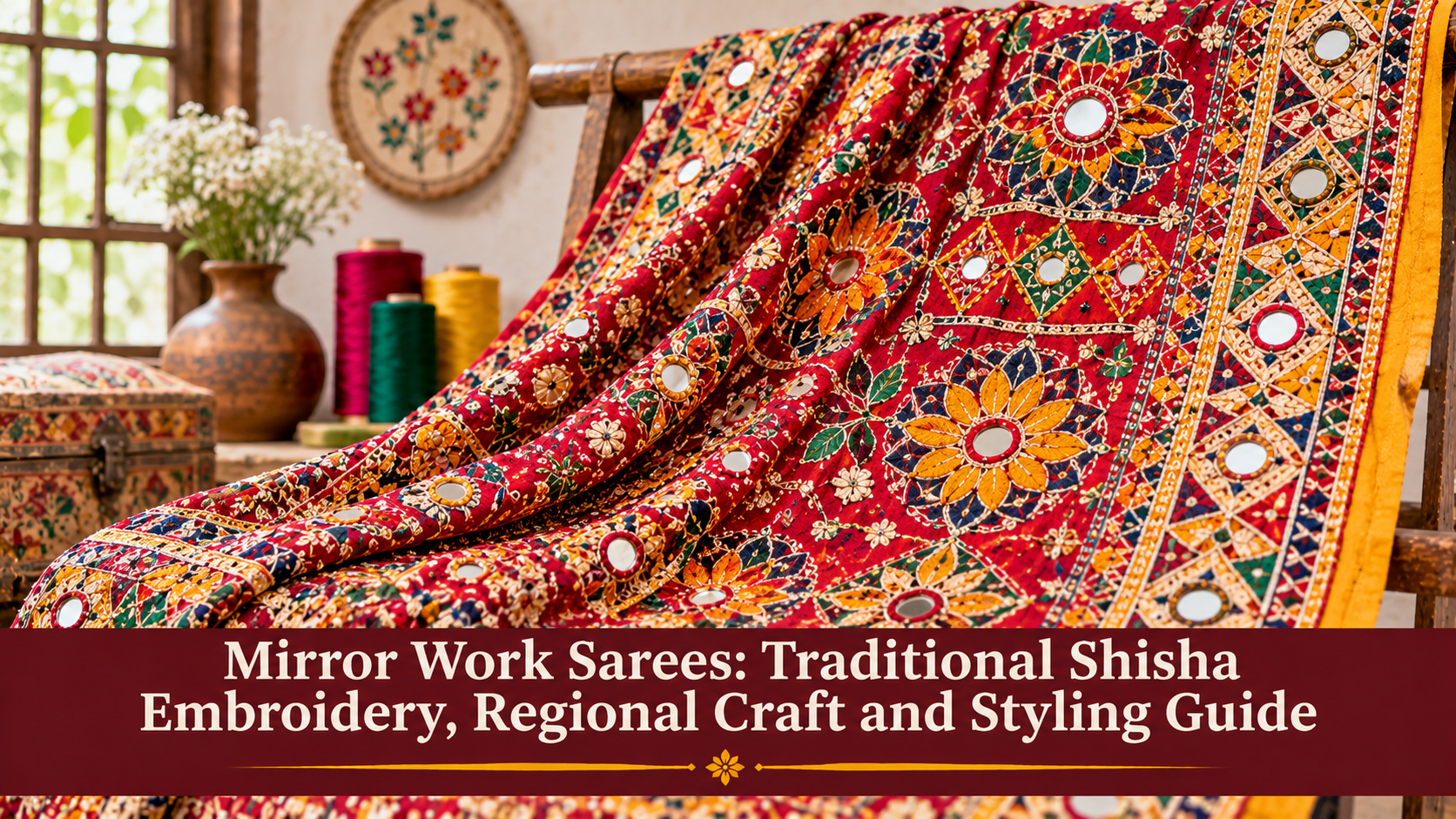
A mirror work saree does something most sarees do not: it moves with the light. Each small mirror catches a flash as you walk, turn or dance, and the embroidery around it keeps the effect colourful instead of plain shine. That is why mirror work is so closely tied to festivals such as Navratri, and why it also shows up on wedding blouses, pallus and borders.
This guide explains what mirror work, also called shisha embroidery, actually is. It covers the history as far as it can be documented, the regional traditions in Gujarat, Rajasthan and elsewhere, the mirrors and stitches used, common motifs, and how mirror work appears on saree borders, pallus and bodies. It also compares handcrafted and machine-made work, separates mirror work from sequins and other reflective embellishments, and finishes with styling, care and a practical checklist for assessing quality. Where sources disagree, the article says so.
What is mirror work or shisha embroidery?
Mirror work is an embroidery technique in which small reflective pieces are attached to fabric and held in place by a framework of stitches. In traditional hand embroidery, there is no adhesive. The thread itself locks each mirror down, then decorative stitching spreads outward to form a motif.
In India the technique is widely called shisha, from a Persian and Hindi word meaning glass or mirror. In Kutch, in Gujarat, a local term for it is abhla or abhla bharat. A Royal School of Needlework collection record of a Kutch embroidered envelope notes that round mirrors, known as shisha, were attached using shisha stitch, alongside stitches such as herringbone, back stitch, cross stitch and couching.
The reflective material has changed over time. Earlier pieces used mica, a naturally shiny mineral, and later glass mirrors became widely available. Today, many commercial pieces use machine-cut glass with a silvered backing, and some use acrylic or plastic discs. The same word, mirror work, can therefore describe very different things, which is why the quality section of this guide matters.
History and regional associations
Origins
The origins of shisha embroidery are not precisely documented, and different sources tell slightly different stories. Several accounts place its development around the 17th century and link it with Persian influence and the Mughal period, noting that mica came first and glass later. One popular account holds that people of modest means imitated the jewelled clothing of wealthier groups by decorating cloth with shiny materials. These explanations are repeated widely, but they are broad summaries and not detailed historical records, so it is best to treat them as likely rather than certain.
A different, cultural note also appears in museum description: mirrors were not merely decorative, and their reflective quality is credited in some traditions with deflecting evil spirits.
Gujarat
Gujarat, and in particular Kutch and Kathiawar, is the region most strongly associated with mirror embroidery. Several Kutch communities have distinct mirror work styles, and community names such as Rabari and Ahir often appear in craft descriptions. The Ahir style is described as using animal and bird designs in chain stitch and herringbone with small mirrors. Kutch embroidery as a whole is known for its dense, curved or circular designs.
Rajasthan
Rajasthan is the other region most often named. Mirror work there appears widely on ghagras, cholis, odhnis and household textiles. One academic source describes Gujarat’s mirror work as drawing on animal patterns and Rajasthan’s as leaning towards geometric designs and strong colours, though regional styles overlap and any such summary is a generalisation.
Elsewhere
Mirror embroidery is also documented in other parts of South Asia, including Haryana, Punjab and Sindh, though the quality of sources for some of these regions is uneven. It is not accurate to say that mirror work belongs to one region or one community, and a buyer should be cautious about any seller who claims a single origin without detail.
Mirror shapes, sizes and materials
Mirrors used in embroidery come in several forms.
| Type | Description | Typical look | Notes |
| Hand-cut mica or glass pieces | Small, slightly irregular pieces | Soft, uneven shine | Associated with older and traditional pieces |
| Round glass mirrors | Small circular glass discs with a silver backing | Bright, crisp flashes | Common in both traditional and modern work |
| Machine-cut glass | Uniform pieces, often with silvered backing | Even, regular shine | Widely used in contemporary work |
| Acrylic or plastic discs | Lightweight, uniform | Brighter but flatter shine | Lighter and cheaper; can scratch more easily |
| Shaped mirrors (square, triangular, petal, teardrop) | Cut in different forms | Varied patterns and borders | Used for design variety |
Round mirrors are the classic form. Larger mirrors suit bold motifs, while tiny mirrors are used for fine outlines and dense all-over work.
How mirrors are secured with embroidery stitches
The method below is the traditional hand-stitching approach. Descriptions vary by community, so treat this as a general outline.
- Positioning. The mirror is placed face down against the fabric or held in place on the front, and the motif position is chosen.
- Creating the framework. Long threads are laid across the mirror in a grid, forming a cross or a square, so that the mirror cannot slip out.
- Securing with a decorative stitch. The embroiderer works a stitch around the edge, often buttonhole stitch or a similar looped stitch, which pins the framework threads and locks the mirror in place.
- Building the surrounding motif. Chain stitch, herringbone stitch, satin stitch and cross stitch fill the area around the mirror.
- Finishing. Loose ends are secured and the piece is checked to ensure every mirror is firmly held.
The visible result is a ring of thread around each mirror, which is a useful clue when you are checking quality.
Traditional stitches and threadwork
The stitches most often named in connection with mirror embroidery include:
- Shisha or abhla stitch: the stitch sequence used to hold a mirror in place
- Herringbone stitch: a criss-cross stitch often used around mirrors and for borders
- Chain stitch: a looped stitch used for outlines and curved motifs; it is especially associated with Kutchi work
- Buttonhole stitch: often used to secure mirror edges
- Satin stitch: smooth stitching to fill shapes
- Cross stitch and back stitch: for detail and outlines
- Couching: laying a thread on the surface and securing it with small stitches
Thread colour and density differ between regions and makers. Bright contrasting colours are typical of many traditional pieces, while contemporary work often uses tonal or metallic thread for a quieter effect.
Motifs: floral, geometric, animal and folk-inspired
Mirror work motifs are drawn from everyday and symbolic imagery.
- Floral: flowers, buds and creeping vines, often arranged in circles or rows
- Geometric: triangles, diamonds, zigzags, squares and concentric circles
- Animal and bird: peacocks, parrots, elephants and other creatures, which appear in folk-style pieces
- Folk and village imagery: trees, pots, temples and stylised human forms in some traditional work
- Border patterns: repeated mirror-and-stitch units that form frames along edges
Motif styles vary by community, region and maker, and the lists above are examples rather than an official catalogue.
Mirror work on saree borders, pallus and body designs
Borders
Mirror work borders are a practical way to wear the technique. A row of small mirrors with stitched framing along the edge gives a lively finish without weighing down the whole saree.
Pallu
The pallu is a natural place for denser mirror work, with larger motifs and clustered mirrors that stand out when the saree is draped.
Saree body
On the body, mirror work may appear as scattered mirrors, small repeating motifs or, on festive pieces, closely worked all-over designs. Dense coverage makes a saree heavier and stiffer, which affects how it drapes.
Blouse
A mirror work blouse is one of the most popular ways to use the craft. It adds sparkle to a plain saree and keeps the weight where you want it. If you are choosing a blouse, look at the neckline, sleeves and lining, since mirror edges can feel rough against the skin.
Fabrics suitable for mirror embroidery
The base fabric must be strong enough to hold the mirrors and framework threads.
| Fabric | Suitability | Notes |
| Cotton | Very suitable | Sturdy, matte, a traditional match for mirror work; comfortable in warm weather |
| Cotton silk | Suitable | Gives a bit of sheen and structure |
| Silk and silk blends | Suitable | Holds heavier work well; usually dry clean |
| Georgette | Suitable for lighter work | Dense mirror work can pull and pucker the fabric; needs lining |
| Chiffon | Best for very light work | Delicate; heavy mirrors may strain it |
| Crepe | Suitable | Soft drape with moderate embellishment |
| Net | Needs backing | Often used for dupattas and lehengas; needs lining |
As a general rule, the heavier the mirror work, the sturdier the base fabric should be. Our complete saree for women buying guide explains how fabric choice affects weight, drape and care across all saree types.
Handcrafted versus machine-produced mirror work
The phrase “mirror work” covers a wide range of production methods, and not every piece is handmade.
| Feature | Traditional hand-stitched mirror work | Machine-made or glued imitation |
| How mirrors are attached | Held by a visible thread framework and stitching | Machine-stitched, or attached with adhesive |
| Mirrors | May be hand-cut mica or glass, with slightly irregular shapes | Often uniform, machine-cut glass or acrylic |
| Surrounding embroidery | Worked by hand, with small natural variation | Uniform machine stitching or none |
| Reverse side | Shows thread framework and hand-finished ends | Often neat and uniform, or covered with backing |
| Time and cost | Slower and usually more expensive | Faster and usually less expensive |
| Durability | Mirrors are usually secure if well stitched | Glued mirrors may loosen over time |
Machine production is not automatically poor quality, and handwork is not automatically perfect. Some pieces mix methods. What matters is an honest description, and a price that reflects what you are buying.
Mirror work versus sequin work and other reflective embellishments
Several decorations create sparkle, but they work differently.
| Embellishment | What it is | How it looks | Comfort and care |
| Mirror work | Small mirrors secured by embroidery stitches | Bright flashes with colourful threadwork | Can be heavy; mirrors may loosen or break |
| Sequin work | Small flat discs stitched or strung on thread | Soft glitter, lighter than mirrors | Lighter, but sequins can snag or fall off |
| Gota patti | Metallic ribbon cut into shapes and appliquéd | Flat, soft metallic shine | Usually lighter; may tarnish |
| Zari | Metallic thread, woven or embroidered | Subtle to rich gold or silver shine | Woven zari is smooth; embroidered can be stiff |
| Beads and stones | Individual beads or stones stitched on | Raised, textured sparkle | Can be heavy; may loosen |
Mirror work stands out because the reflective piece is held by embroidery rather than simply sewn flat or glued on. Our guide comparing mirror work, gota patti and zari explains how these three common embellishments differ in look, weight and care.
Styling a mirror work saree
Weddings
Mirror work suits some wedding functions, particularly daytime and pre-wedding events, and some communities use it for bridal garments. For a formal wedding, choose a rich base fabric and balance the sparkle with the rest of the outfit. Heavy mirror work already carries a lot of visual interest, so keep other embellishment restrained.
Festivals
Mirror work is strongly linked with Navratri, Garba and Dandiya, since the reflections show well in lights and movement. For long nights of dancing, choose lighter mirrors, scattered placement and a fabric that moves easily.
Parties
For evening events, a mirror work blouse on a plain georgette or silk saree gives a focused sparkle without overwhelming the outfit.
Everyday festive wear
A cotton or cotton silk saree with a narrow mirror work border suits family gatherings and daytime pujas.
Blouse designs, accessories and jewellery
Blouse ideas
- Mirror work blouse on a plain saree: the simplest way to wear the craft.
- Matching blouse: gives a cohesive look when the saree itself carries mirror work.
- Contrast blouse: a bold colour against a neutral saree makes the mirrors stand out.
- Backless or tie-back designs: can feature mirror work along the back panel, though comfort and lining matter.
Jewellery
Oxidised silver jewellery is a classic pairing, because its darker tone suits the folk character of the work. Gold-toned pieces suit mirror work on richer silk sarees. Let one area carry the weight: if the saree is heavily worked, keep jewellery light, and if the saree is plain, you can wear bolder pieces. Our Navratri accessories guide covers jewellery, dupattas, potli bags and footwear for festive evenings, including how to keep accessories secure during dancing.
Other accessories
A simple potli bag, comfortable footwear and a lightweight dupatta (if worn) complete the look. Avoid piling on embellished accessories, since mirror work already draws the eye.
Cleaning, storage and care
Always follow the care label first. General guidance for mirror work includes:
- Washing: many mirror work pieces are safer with dry cleaning, particularly silk, georgette and heavily worked sarees. If the label allows hand washing, use cold water and a mild detergent, and avoid scrubbing near the mirrors.
- Drying: dry in shade, flat or hung carefully, away from strong sunlight.
- Ironing: use a low heat on the reverse side, and keep the iron away from the mirrors. Place a cloth between the iron and the embroidery.
- Storage: fold loosely in soft cotton or muslin, with the embroidered side protected. Avoid tight folds across mirrors, which can break them, and refold along different lines occasionally.
- Handling: avoid rough surfaces and sharp jewellery, which can catch on threads and lift mirrors.
- Mirror care: wipe gently with a soft, dry cloth if needed, and avoid chemical cleaners that can damage the silvered backing.
How to assess mirror attachment and embroidery finishing
Visual checks give useful clues, but no single check proves how a piece was made.
- Look at the framework. On hand-stitched work, you should see a ring of embroidery around each mirror. A mirror with no stitching around it may be glued.
- Gently test each mirror. Run a finger lightly over several mirrors. They should feel firmly held, with no rattling or lifting.
- Check the edges. Mirror edges should be covered by the stitching. Sharp, exposed edges can rub or cut thread.
- Turn the saree over. The back shows how the work was anchored. Neat thread ends are good. Loose, tangled threads or a stiff glued backing are worth questioning.
- Inspect the thread work. Stitches should be even and tight, without puckering the fabric.
- Look for missing or cracked mirrors. Check the pallu and border carefully, where wear is greatest.
- Feel the weight. Dense work adds weight, so make sure the saree is comfortable to wear for several hours.
- Ask about materials and process. A clear answer about the type of mirror and whether the work is hand-stitched, machine-made or mixed is more useful than a general claim.
For a fuller checklist covering fabric, borders, zari and finishing, see our guide on how to identify a good-quality saree.
Common buying mistakes
- Assuming mirror work means handmade. Ask how the mirrors are attached.
- Ignoring weight. Dense work can make a saree heavy and stiff.
- Overlooking the base fabric. A delicate fabric under heavy mirrors may pucker.
- Skipping the care label. Many pieces need dry cleaning.
- Forgetting lining and skin comfort. Mirror edges and stitching can rub, especially on blouses.
- Choosing only from photographs. Mirror work looks different in different lighting.
- Attributing the craft to one origin. Mirror work is a wider tradition, so be careful with broad claims.
Frequently asked questions
1. What is a mirror work saree?
A mirror work saree is decorated with small reflective mirrors held in place by embroidery stitches, usually combined with colourful threadwork. The mirrors may appear on the border, pallu, body or blouse.
2. What is shisha embroidery?
Shisha embroidery is another name for mirror work. The word shisha comes from Persian and Hindi and means glass or mirror. In traditional work, the mirror is secured by a framework of thread, not adhesive.
3. Where does mirror work come from?
Gujarat, especially Kutch and Kathiawar, and Rajasthan are the regions most strongly associated with it, and it is also documented elsewhere in South Asia. Exact origins and dates are not firmly documented, so sources differ.
4. How can I tell whether the mirrors are stitched or glued?
Look for a visible ring of thread around each mirror and check the reverse side. Mirrors with no stitching around them are likely glued, and glued mirrors can loosen over time.
5. Are mirror work sarees heavy?
It depends on the density and the type of mirror. Light, scattered work is easy to wear, while dense all-over work on a heavy fabric can be tiring over long hours.
6. Can I wash a mirror work saree at home?
Some can be hand washed gently, but many are safer with dry cleaning. Always follow the care label and avoid scrubbing near the mirrors.
7. What is the difference between mirror work and sequin work?
Mirror work uses small mirrors held by embroidery stitches, while sequins are flat discs stitched or strung on thread. Mirrors give brighter flashes and are usually heavier.
8. Is a mirror work saree suitable for weddings?
It can be, especially for daytime and pre-wedding functions, depending on the community, the base fabric and the weight of the work. Choose the weight and fabric to suit the ceremony and weather.
Conclusion
A mirror work saree rewards attention to detail. Understand how the mirrors are attached, check for a visible stitched framework, think about weight and base fabric, and ask whether the work is hand-stitched, machine-made or a mix. Match the amount of mirror work to the occasion, keep accessories balanced, and follow the care instructions. Done well, mirror work is a lively link to a long, regionally varied embroidery tradition.
