
Blog
Chanderi Sarees: Madhya Pradesh’s Lightweight Handloom Tradition, Silk and Cotton Weaves

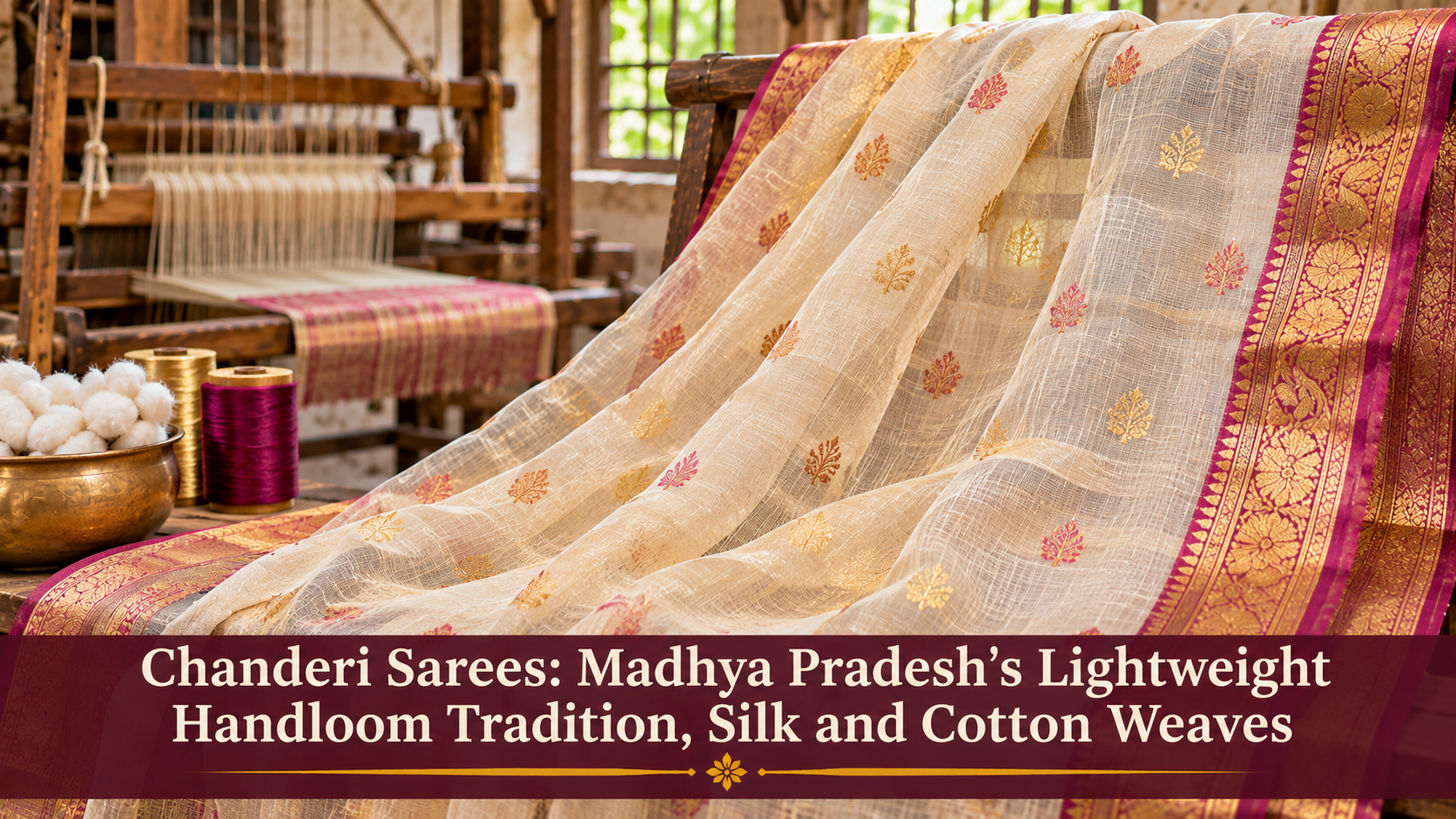
Some sarees announce themselves. A chanderi saree does the opposite. It is light enough to feel almost weightless, slightly sheer, with a soft sheen that shows up when it catches the light and fades when it does not. People reach for it on warm days, at daytime pujas, at small weddings and at offices where a handloom saree is part of the dress code.
This guide explains what a chanderi saree is, where the weave comes from, how it is made, how silk, cotton and silk-cotton versions differ, which motifs and borders to look for, and how handloom production compares with powerloom and other commercial versions. It also covers styling, care, price factors and common buying mistakes. Where facts are uncertain or sources disagree, the article says so instead of picking the most dramatic version.
What is a chanderi saree?
A chanderi saree is a handloom saree associated with the town of Chanderi in the Ashoknagar district of Madhya Pradesh. The town sits in the hills of the Vindhya region, and its weaving tradition is one of the best-known in central India. Government tourism and craft resources describe Chanderi as a living handloom town, and the textile carries a Geographical Indication (GI) tag.
The fabric is known for three qualities. It is light, it is slightly translucent, and it has a gentle lustre that comes from the mix of fibres. The classic construction uses fine silk in the warp and cotton in the weft, though other combinations exist, which the sections below explain.
Chanderi is also sold as dress material, dupattas and stoles, but the saree remains its most recognised form.
History and heritage of Chanderi weaving
Chanderi’s weaving history is old, but exact dates are disputed, and this is worth stating plainly. Published accounts place the beginnings of the tradition anywhere from the 2nd to the 7th century, while others speak of a recorded history of at least several hundred years. These claims are repeated widely in retail and craft writing, and few come with primary documentation. A careful writer treats “very old, with uncertain dating” as the safe summary.
What sources broadly agree on is the setting. Chanderi was an established town on trade routes in central India and developed a reputation for fine textiles. Accounts also describe the weaving community as historically linked to the Koshti and other weaving families, and describe royal and courtly patronage over the centuries, though the specific stories vary from source to source.
Several shifts in materials are commonly noted in the craft literature:
- A move from handspun cotton yarn to mill-made yarn, reported around the late 19th century.
- The introduction of gold-coloured zari motifs to fine cotton fabric.
- The adoption of imported silk yarn, reported around the 1930s, which expanded the range of fabrics.
A government handloom training centre in Chanderi is reported to have been set up in 1920 and to remain active, which indicates an institutional role in skills and quality control. The GI tag, reported to have been granted in 2005, now ties the name “Chanderi” to production in the designated area using traditional methods. Verify GI details through the GI Registry before quoting them in a product description.
Chanderi, Madhya Pradesh, and the textile landscape
Madhya Pradesh has more than one handloom tradition. Maheshwari, from the town of Maheshwar on the Narmada, is another well-known lightweight weave from the state, and the two are often mentioned together. They are different traditions, with different structures, motifs and border styles. Our broader guide to cotton silk sarees explains how blended weaves like these sit between cotton and silk.
How a traditional chanderi saree is woven
Descriptions of the process vary slightly by weaver and cluster, but the broad sequence is consistent.
- Preparing the yarn. Fine silk and cotton yarns are cleaned, dyed and prepared for the warp and weft. Yarn quality strongly affects how sheer and how soft the final fabric feels.
- Setting up the warp. The warp threads are laid out and stretched on the loom. For a saree, this means many fine threads arranged to the width and length of the finished piece.
- Weaving the ground. The weaver passes the weft through the warp on a handloom. The open, airy structure of the cloth is what gives chanderi its light, slightly transparent quality.
- Adding motifs and zari. Motifs are woven in during weaving, not printed on afterwards. Extra weft threads, often metallic or coloured, form the buti, border and pallu patterns.
- Finishing. The fabric is removed from the loom and finished. Some finishing gives the fabric a crisp drape that softens with wear and washing.
The process takes time, and the more elaborate the border, pallu and motifs, the longer the piece takes to weave. That time is one reason handloom pieces tend to cost more than quick-production versions.
Silk, cotton and silk-cotton chanderi: the main variations
Not every chanderi saree is made from the same fibres. Understanding the main types makes buying much easier.
| Type | Typical fibre structure | Feel and look | Best suited to |
| Chanderi silk cotton | Silk warp, cotton weft (the classic structure) | Light, sheer, soft sheen, crisp drape that softens | Daytime pujas, festive daywear, formal events |
| Chanderi cotton (sometimes called pure cotton) | Cotton warp and weft | Soft, matte, more breathable, less lustre | Warm weather, everyday and office wear |
| Chanderi silk (pure silk) | Silk warp and weft | Richer sheen, slightly more body | Weddings and festive occasions |
| Blended or synthetic versions | Mixed fibres, sometimes with viscose or polyester | Varies; often shinier or stiffer | Budget purchases; check the label |
Terms differ between sellers. “Chanderi” in a product title does not always mean the fibre is what you expect, so read the composition line, ask for written details, and do not rely on the title alone.
Fabric characteristics: lightweight, sheer and softly lustrous
Weight and sheerness. Chanderi is among the lightest handloom sarees. The fabric is often slightly sheer, which is part of its character and not a flaw. You may want to choose your petticoat colour carefully so that it complements the saree.
Sheen. The silk content gives the cloth a delicate shine, which reads differently from the glossier finish of heavier silks.
Drape. The drape is light and flowing, though a new piece can feel a little crisp from finishing and then softens after washing and wear.
Comfort. The light weight and the natural fibre content make chanderi a common choice for warm weather, though comfort also depends on the exact blend.
Traditional motifs, butis, borders and pallu designs
Motifs are a major part of how people recognise a chanderi saree.
Butis
A buti is a small woven motif scattered across the body of the saree. Traditional chanderi motifs are often described as inspired by architecture, nature and everyday objects. Widely mentioned examples include coins (often called ashrafi), peacocks, flowers and geometric shapes. A buti woven into the fabric looks slightly raised or textured against the sheer ground, and it should not look printed on.
Borders
Borders range from narrow, understated lines to broad zari bands. Many are woven in metallic thread, and some use a contrast colour. A border may be simple and geometric or more elaborate. If you want to inspect a border for evenness and finish, our guide on how to identify a good-quality saree explains the checks in detail.
Pallu
The pallu often carries the heaviest design, with denser motifs or a broader zari band than the body. On a plainer saree, it may simply repeat the border pattern.
Design vocabulary differs between weavers and regions, so treat the names above as common examples, not a complete or official list.
Handloom chanderi versus powerloom and commercial alternatives
The popularity of chanderi has led to many lookalikes. This is not a reason to avoid the weave, but it does mean buyers should understand the difference.
| Feature | Traditional handloom chanderi | Powerloom or commercial versions |
| How it is made | Woven on hand-operated looms, with motifs woven in | Woven or produced on mechanised looms, or printed to imitate woven designs |
| Surface | Small natural variation in motif spacing and texture is normal | Highly uniform and repetitive |
| Motifs | Woven into the fabric | May be woven by machine or simply printed |
| Fibre | Often a documented silk-cotton or other stated blend | Varies widely; sometimes synthetic content is not obvious |
| Price | Often higher because of time and skill | Often lower |
| Documentation | May come with GI and handloom documentation, where the seller provides it | May have none, or only general claims |
For a fuller look at how the two production methods differ in weaving, quality and price, read our guide to handloom vs powerloom sarees.
A powerloom saree is not automatically poor quality, and a handloom saree is not automatically flawless. The practical point is honesty: the saree should be described accurately, and the price should reflect what it is.
How to recognise handloom characteristics without overclaiming
No home test can prove authenticity, and the article does not suggest otherwise. The following checks give useful clues, and labels, documentation and seller transparency are more reliable than any visual test.
- Look at the motifs. Woven motifs should feel part of the fabric. Printed motifs sit on the surface.
- Expect small variation. Handwork often shows slight differences in spacing and size.
- Check the reverse. Woven designs show their structure on the back, with floating threads that should be neat and not snagged.
- Hold it to the light. Chanderi is naturally sheer, so you are checking for even density, not opacity.
- Ask for documentation. Where a seller claims GI status or handloom origin, ask for certificates, tags or invoices and check them.
- Read the fibre label. Look for a specific composition and not vague phrases like “silk look”.
- Avoid burn tests. They damage the saree and are not conclusive for blends.
Occasions, styling and blouse combinations
Occasions
- Daytime pujas and family functions: a silk-cotton chanderi with a zari border feels festive without being heavy.
- Offices and formal events: plain or lightly patterned pieces in solid colours look polished.
- Weddings (as a guest): a chanderi silk with a broad border works for daytime ceremonies and warm venues.
- Everyday wear: simpler cotton versions are practical if the care requirements suit you.
Blouse combinations
- Matching chanderi or silk: a classic, cohesive look.
- Raw silk or brocade: adds richness for festive wear.
- Cotton: comfortable for daily wear and warm weather.
- Contrast colour: a bolder, more modern effect, especially with plain sarees.
Accessories
Light jewellery tends to suit a light saree. Temple jewellery, oxidised silver and small jhumkas are common pairings, and a structured potli or simple clutch completes the look.
Caring for a chanderi saree
Always follow the care label first, because blends, dyes and zari differ. General guidance for delicate handloom fabrics includes:
- Washing: many owners prefer dry cleaning for the first wash and for sarees with heavy zari. If the label allows hand washing, use cold water and a mild detergent, and avoid soaking and wringing.
- Drying: dry in shade, away from strong direct sunlight.
- Ironing: use a low to medium heat on the reverse side, and use a pressing cloth over zari.
- Storage: fold in a clean cotton or muslin cloth, keep the saree dry and refold it along different lines now and then to avoid permanent creases.
- Handling: the fabric is fine, so avoid rough surfaces, sharp jewellery and tight clasps that can snag it.
Buying considerations, price factors and common mistakes
What affects the price of a chanderi saree
- Fibre content: silk-rich pieces usually cost more than cotton or blended ones.
- Weaving method: handloom production usually takes longer than powerloom production.
- Design complexity: dense motifs, broad borders and detailed pallus take more time.
- Zari type: real, tested and metallic zari differ in material and cost.
- Documentation and origin: GI-linked or handloom-marked pieces may be priced differently from undocumented ones.
- Seller and retail costs: these vary and affect the final price.
Compare sarees with similar fibre content, weave and design, and avoid comparing only the number on the tag.
Common mistakes to avoid
- Trusting the title. “Chanderi style” or “chanderi look” is not the same as chanderi.
- Ignoring the label. Check fibre content and care instructions.
- Assuming sheer means poor quality. Some transparency is part of the fabric.
- Choosing by photograph alone. Colour, sheen and texture look different in person.
- Forgetting the petticoat and blouse. A sheer fabric changes how the underlayers show.
- Skipping care checks. Some pieces need dry cleaning, which adds to the cost of ownership.
- Overlooking the return policy. This matters most when buying online or during a sale.
If you are comparing chanderi with other sarees across fabrics, styles and budgets, our complete saree for women buying guide covers the wider decision.
Frequently asked questions
1. What is a chanderi saree?
A chanderi saree is a lightweight handloom saree associated with the town of Chanderi in Madhya Pradesh. It is known for its slight sheerness, soft sheen and woven motifs, and the classic version combines silk and cotton yarns.
2. Is a chanderi saree made of silk or cotton?
It can be either, or a blend. The traditional silk-cotton version uses silk in the warp and cotton in the weft, while cotton and pure silk versions also exist. Always check the fibre label.
3. Is a chanderi saree good for summer?
Many people find it comfortable in warm weather because it is light and made partly or wholly of natural fibres. Comfort still depends on the exact blend and weave.
4. What does the GI tag mean for chanderi?
A Geographical Indication ties the name “Chanderi” to production in a defined area using traditional methods. Ask sellers for documentation when a GI claim is made, and verify details with the GI Registry.
5. How can I tell handloom chanderi from powerloom or printed versions?
Look for woven (not printed) motifs, small natural variations, neat weaving on the reverse and clear fibre and origin details. No single test is conclusive, so rely on labels and documentation where possible.
6. Why do chanderi saree prices vary?
Price depends on fibre content, weaving method, design complexity, zari type, documentation and seller costs. Two sarees that look similar can differ a lot in how they are made.
7. Can I wash a chanderi saree at home?
Some can be hand washed gently, while others need dry cleaning, especially if they have heavy zari. Follow the care label and ask the seller if you are unsure.
8. Is chanderi suitable for weddings?
It can be, particularly for daytime ceremonies and warm venues, when chosen with a rich border or festive colour. For very formal or heavy bridal looks, many people prefer heavier silks.
Conclusion
A chanderi saree rewards careful buyers. Its appeal lies in how little it weighs, how gently it shines and how clearly its woven motifs show the work behind them. Check the fibre content, look for woven and not printed motifs, ask for documentation where claims are made, and follow the care instructions. Handloom, powerloom and blended versions all have a place, as long as they are described honestly and priced accordingly.
