
Blog
Bawan Buti Sarees: Bihar’s 52-Motif Handloom Tradition and Buddhist Heritage

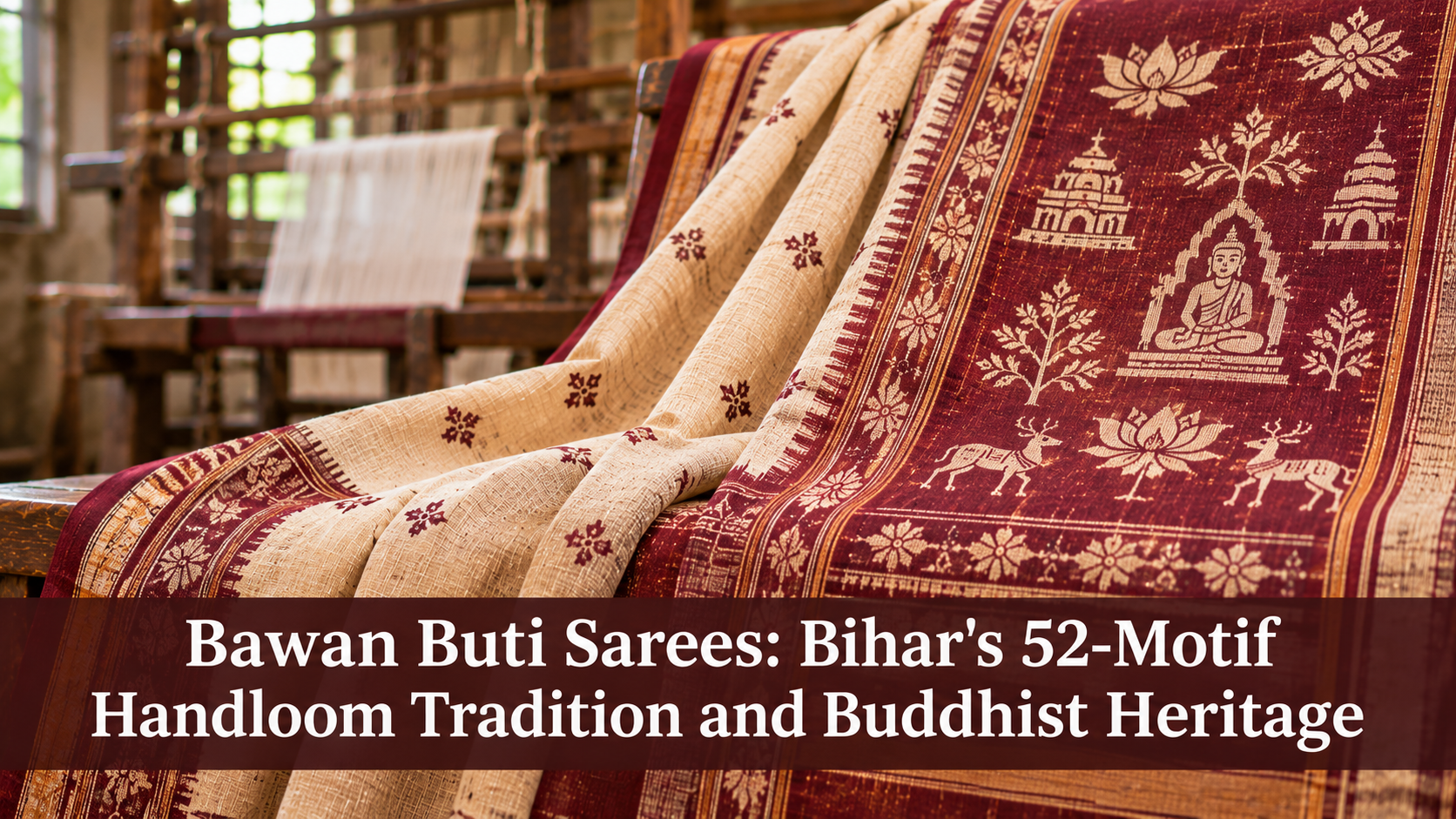
A Bawan Buti saree looks plain from across a room. Step closer and the cloth fills with small motifs, each one woven into the fabric thread by thread instead of being printed or stitched on afterwards. The weave comes from Nalanda district in Bihar, a place best known for its ancient Buddhist university, and in June 2026 it received a Geographical Indication (GI) tag.
This guide explains what the name means, where and how the saree is woven, which motifs are documented and why the number 52 needs a careful reading. It also covers how to tell a handwoven piece from a lookalike. If you are still deciding between handloom, powerloom and printed sarees in general, our complete guide to buying sarees for women covers the basics, and this article goes deeper into one weave.
What is a Bawan Buti saree?
Bawan Buti is a handloom weave from south-central Bihar. The name joins bawan, which means 52, with buti, a small motif. In print you will also see Bavaan Buti, Bawan Booti and 52 Booti, all referring to the same craft.
The motifs are made with an extra weft: a supplementary thread that the weaver inserts by hand over the ordinary weft that builds the cloth. The Indian Culture portal, run by the Ministry of Culture, describes the weave as a cotton-on-cotton brocade, and silk versions are also woven.
The technique is not limited to sarees. Weavers in Baswan Bigha make bedsheets, pillow covers, durries and curtains, and Srijani Foundation, a Patna organisation that works with weavers in four Bihar districts, has added stoles and yardage.
Where Bawan Buti is woven: Nalanda, Baswan Bigha and Nepura
Veena Upadhyay, founder of Srijani Foundation, told Selvedge magazine that Bawan Buti has traditionally been woven in the Nalanda and Gaya districts of south-central Bihar. The GI announcement is more specific. A NABARD Bihar statement, reported in June 2026, says the craft developed mainly in and around Baswan Bigha, where weaving families have kept it going for generations. News reports sometimes spell the village Basawan Bigha. It lies about three kilometres from Bihar Sharif, the Nalanda district headquarters.
Two production centres come up again and again. Baswan Bigha is known for cotton, and Nepura is known for tussar silk. The craft is small today: ETV Bharat reported in June 2026 that only a few families in Basawan Bigha are still engaged in it.
Nalanda has been a major Buddhist centre since the fifth century, and the Bihar Museum describes the Bawan Buti tradition as rooted in that spiritual heritage. That geography explains why the weave is so often called Nalanda weaving, and why its motif vocabulary carries Buddhist symbols.
History: what is documented and what is not
Ask how old a Bawan Buti saree tradition is and the answers differ. Weavers whom Upadhyay interviewed said the saree goes back about three to four centuries. A retail listing says over four centuries, and a Free Press Journal report on the GI award says 600 years. None of these figures comes with a documented source. The honest summary is that the weave is old, that elder weavers place it in the range of several hundred years, and that no archive pins down a start date.
The earliest dated detail comes from Srijani’s account of motifs. It says Bawan Buti sarees woven around the late eighteenth century carried motifs such as the pointed gourd, cowrie shell, flower, peacock and betel leaf.
The weave had patrons. Royal and zamindar families ordered the sarees, and an elderly weaver recalled crowds outside master weavers’ homes, people carrying samples or asking for a motif in a particular colour. Demand fell around the middle of the twentieth century as power mills made lighter cotton saris and polyester saris arrived at lower prices. Support from the Bihar State Handloom Corporation helped weavers for a time, but the corporation closed in 2001, and Upadhyay lists the loss of patronage and government attention after the 1980s among the reasons the craft nearly disappeared.
What the number 52 means
The “52 motifs saree” label is the most repeated claim about this weave, and sources do not agree on what it counts. Three readings appear in the material I reviewed.
The first reading is 52 different motifs. The NABARD statement on the GI tag, the Bihar Museum and the Indian Culture portal all describe the weave as carrying 52 motifs, and the NABARD statement calls them 52 types of traditional motifs and cultural symbols.
The second reading is one motif repeated 52 times. Upadhyay says the number 52 refers to the repeats of a motif, and that the motif’s size stays the same throughout a given textile. In her description, one motif recurs 52 times on the saree, with a cluster in the pallu and more along the upper and lower borders.
The third reading is that the number is a name without documented symbolism. Upadhyay says the older weavers she spoke with know of no meaning behind 52, and no documentation exists. Some people link it to beliefs about Vishnu. Another idea she mentions is that sarees were once about 5.10 metres long, and a weaver may have happened to fit 52 motifs onto one, liked the result, and the design took its name from that.
For a buyer, the practical point is simple. A Bawan Buti saree may have 52 distinct motifs, 52 repeats of one motif, or a different count altogether, depending on the design. Modern designs sometimes scatter motifs sparingly along borders. Counting motifs is not a test of authenticity, and any listing that promises exactly 52 on every piece is claiming more than the sources support.
Buddhist heritage and the motifs
Motifs linked to Buddhism and Nalanda
Selvedge notes that Nalanda and Gaya are the cradle of Buddhism and that this has influenced some of the motifs on these sarees. Oak Lores, drawing on a National Institute of Fashion Technology (NIFT) documentation project on the craft, lists Buddhist symbols that appear in the weave: the peepal leaf, bull, stupa, deer, elephant, Bodhi tree, trident, golden fish, wheel of dharma, treasure, flower vase, parasol and conch. A Map Academy source also names the lotus. The Bihar Museum adds that the craft frequently shows the Mahabodhi Temple, Nalanda University and stupas.
A general observation, not a claim from these sources: several items on that list, including the parasol, golden fish, vase, conch and wheel, also belong to the set of eight auspicious symbols in Buddhist art. The sources I reviewed do not say the weavers chose them for that reason.
Everyday motifs from the weavers’ surroundings
Not every motif is religious. Srijani says weavers traditionally drew on the plants and animals around them and on the customs of their time. The betel leaf motif, for instance, comes from the custom of offering a guest a betel leaf on leaving, after welcoming them with water and jaggery.
Motifs added in the twentieth and twenty-first centuries
Upendra Maharathi, an Odisha-born artist and follower of Rabindranath Tagore, came to Bihar around the time demand was falling. Selvedge reports that he brought about 200 new motifs, among them a boy, an ox, the lotus, ducks and the tree of life, and that he guided weavers to weave neater motifs. Many of his motifs are no longer remembered, and no samples survive.
More recently, Srijani’s brand Bun.Kar Bihar worked with the designers Richard Pandav and Amit Vijaya of the label Amrich, who toured the weaving belt and designed about 300 motifs. These are geometric and floral, drawn from local Buddhist and Jain architecture, and many are free-floating and multi-directional so they can sit anywhere on the cloth.
The extra-weft technique and how motifs are created
In ordinary plain weaving, a weft thread crosses the warp from edge to edge and forms the cloth. In extra-weft weaving, the weaver adds a second weft only where a motif is wanted. In brocade weaving generally, the ground would stay intact if the extra threads were removed, because the supplementary weft is independent of it.
Bawan Buti follows this logic. According to Srijani, each motif is made by inserting an extra weft by hand into the standard weft that binds the warp. The weaver follows the motif drawn on graph paper, and the work depends on close coordination between eye and hand. The Bihar Museum describes the method as using an extra shuttle for the weft.
Observers often compare it to embroidery, and the comparison helps. Oak Lores likens it to satin-stitch embroidery, with the shuttle taking the place of the needle and the extra weft taking the place of embroidery thread. Upadhyay says a woven Bawan Buti motif looks like cross-stitch up close and resembles Bihar’s sujani embroidery, which already has a GI tag.
She also separates it from neighbouring techniques. It differs, she says, from Bengal’s Jamdani, and from the extra-weft work done in Chhattisgarh and Madhya Pradesh using the jala technique.
From yarn to finished cloth
Published sources describe the Bawan Buti process in broad strokes, not step by step. The sections below separate what is documented from what is general handloom practice.
Yarn
Upadhyay describes a shift in materials. Older Bawan Butis used coarse cotton yarns. Weavers in Nepura were accustomed to kela-resham, a yarn with a significant polyester content, and Bun.Kar Bihar guided them towards mulberry silk in the warp with thigh-spun or reeled tussar in the weft. Some skilled weavers now use reeled tussar in both warp and weft for pure tussar sarees. For cotton, the group works with fine mill yarn (2/100 count) and, in small quantities, hand-spun cotton made on a kisan charkha, a portable wooden spinning wheel. Hand-spun yarn is hard to use as warp, and only two weavers were willing to take it on. Cotton-silk combinations are common across Indian handloom, and our cotton silk saree guide explains how such blends behave and how to read their labels.
Loom setup
Bawan Buti is woven on frame looms and pit looms. Before weaving begins, the weaver must settle the motif’s size and its place across the length and width of the saree, which Upadhyay calls a challenge. Srijani designs a piece of seven metres by 46 inches, made up of six metres for the saree and one metre for a matching blouse piece, and the blouse piece may carry smaller motifs, stripes or no pattern. The sources do not describe warping, sizing or heddle preparation for this weave. In handloom generally, those steps come first: the warp is measured, set up on the loom and tied to the heddles so that the plain ground can be woven.
Weaving
The weaver builds the ground cloth with the ordinary weft and adds the motifs with the extra weft as the pattern requires, reading from the graph-paper design. Bun.Kar Bihar’s weavers are now careful about neat motifs and correct placement, and Upadhyay says they even keep the loom clean. Sampling happens on the loom, and colours are checked when a new motif is introduced.
Finishing
I did not find a published description of finishing for Bawan Buti. In handloom generally, the cloth is cut from the loom, loose thread ends are trimmed and the piece is pressed and folded. If you are buying directly from a weaver cluster, ask what finishing the saree has had, especially if it uses natural-dyed yarn.
Fabric, texture, borders and pallu
Bawan Buti sarees are woven in cotton and in silk, and the feel changes with the yarn. Upadhyay says sarees woven from hand-spun cotton weigh about a kilo and become softer and lighter as they are worn. Finer mill-spun cotton gives a smoother cloth. Tussar silk adds the slightly coarse, matte sheen associated with that fibre. If you want a refresher on how cotton and silk differ in comfort and care, our cotton vs silk saree comparison sets out the trade-offs plainly.
Motif placement follows a fairly consistent logic. A cluster of motifs usually sits in the pallu, and motifs run along the upper and lower borders. Some designs place all the motifs densely on the end panel, making the saree a statement piece. Others keep placement minimal, with a sprinkling along the borders and stripes through the body. A contrast border is common in retail examples, such as a grey cotton saree sold with a contrasting edge.
Traditional colours and colour combinations
This is the part of the craft that is least documented. I found no source that records a fixed traditional palette. What the sources do show is that colour was often customised: Upadhyay mentions patrons arriving with a sample and asking for a motif in a specific colour. Bun.Kar Bihar’s current work leans towards soft, subtle colours, with festive pieces such as a golden yellow and olive saree with garland motifs running 2.5 metres. Retail listings show ground colours such as grey and lavender with white or contrast motifs. The group also uses natural dyes on hand-spun cotton and azo-free dyes where synthetic dyes are used.
Bawan Buti compared with other extra-weft traditions
Several Indian handloom traditions use supplementary or extra weft to place motifs on a ground cloth. They differ in region, fibre and method.
| Tradition | Region | Typical base | How the pattern is made | Motif character |
| Bawan Buti | Nalanda and Gaya, Bihar | Cotton, tussar or mulberry silk | Extra weft inserted by hand with a separate shuttle, following a graph-paper design, on frame or pit looms | Small motifs, often symmetrical; Buddhist symbols, plants, animals, and newer geometric and floral designs |
| Jamdani | West Bengal; Dhaka region in Bangladesh | Fine cotton muslin | Discontinuous supplementary weft built up on the loom, thicker than the ground yarn | Floral and geometric forms, creepers, paisleys, leaves |
| Chanderi | Chanderi, Madhya Pradesh | Silk-cotton, silk or cotton, often sheer | Extra-weft butis on a light ground (trade sources) | Coins, florals, peacocks |
| Banarasi brocade | Varanasi, Uttar Pradesh | Silk with zari | Supplementary weft brocade | Dense floral and zari patterns |
| Paithani | Paithan and Yeola, Maharashtra | Silk with zari | Interlocking tapestry-style weaving rather than plain extra weft | Peacock, lotus, parrot and other nature motifs |
Two cautions apply. Paithani is often grouped with extra-weft weaves, but its tapestry-style interlocking technique is different. And Upadhyay stresses that Bawan Buti’s method is distinct from both Jamdani and the jala technique, so similar-looking motifs do not mean the same construction.
Cultural importance, artisan communities and revival
Why the saree mattered
According to Upadhyay, giving a Bawan Buti saree was once seen as necessary at festivals and weddings. People would say that whatever else you bring, bring a Bawan Buti. She adds that nobody knows why the saree was considered auspicious, and that no documentation explains it. Her guess is that its beauty, its motifs and the skill needed to weave it made it special, and that being given at happy occasions tied it to them.
Kapil Dev Prasad, the best-known modern weaver of the craft, said that India’s first president, Dr Rajendra Prasad, had Bawan Buti curtains and bedsheets installed at Rashtrapati Bhavan. ETV Bharat repeats the claim in its GI coverage.
Decline and the people who kept it going
Prasad, born in 1954 in Baswan Bigha, came from a handloom family and received the Padma Shri in 2023. In an interview with India Tribune, he described a government weavers’ school in Bihar Sharif that closed in 1990 and noted that many weavers were leaving because regular work was hard to find. Patna Press, in May 2026, calls him the late Kapil Dev Prasad Singh and credits him with training thousands of weavers. ETV Bharat reports that his son Suraj Deo and daughter-in-law Neelu Kumari are carrying the work forward.
A timeline of revival efforts
- Mid-twentieth century: Upendra Maharathi introduces new motifs and extends the technique to home furnishings, according to Selvedge.
- 2009: Oak Lores reports a second revival by the Asian Heritage Foundation, funded by the World Bank. Treat this date as reported by a single secondary source.
- 2016: Srijani Foundation begins intensive work with Bawan Buti weavers, supported by a Tata Trust grant, and sets up the Bun.Kar Bihar brand.
- 2018: Bun.Kar Bihar receives a first order for 300 sarees from Taneira, the ethnic-wear brand of Titan Company.
- 2023: Prasad receives the Padma Shri. A Bawan Buti wall panel from Bun.Kar Bihar is shown in the Sutr Santati exhibition in India and at Melbourne Museum.
- June 2026: NABARD Bihar announces that Nalanda’s Bawan Buti sarees and fabrics have received a GI tag.
What the GI tag does
On 13 June 2026, NABARD’s Bihar office said Nalanda’s Bawan Buti sarees and fabrics, along with Gayaji’s Patharkatti stone craft and Bhojpur’s Pidiya painting, had been awarded GI tags. The statement explains that a GI tag means only registered authorised users may use the product name, and it expects new employment and income for artisans, weavers and women’s self-help groups. NABARD’s chief general manager for Bihar, Gautam Kumar Singh, added that the real work starts after registration: market linkage, product development, branding, quality, skill training and registering producers as authorised users.
For a shopper, that means the name “Bawan Buti” should in time become easier to verify, but only once producers are registered as authorised users. A GI tag by itself does not guarantee that any single saree in a shop is genuine.
How to identify a genuine handwoven Bawan Buti
No single test settles it, but several checks together give a reliable picture.
- Check that the motif is woven in. Run a fingertip over it and look at the reverse. A woven motif is part of the cloth, with thread interlacing the warp. A printed motif sits on the surface as colour, and an embroidered one is stitched through the fabric.
- Look at the cloth up close. Upadhyay says a woven Bawan Buti motif resembles cross-stitch. Expect small hand-made variations in spacing and edges, though motif size is generally consistent across one textile.
- Ask about the fibre. The label should say cotton, tussar, mulberry silk or a named blend. A phrase like “silk feel” describes appearance and not fibre.
- Ask about the loom and the weaver cluster. A seller who knows the piece should be able to say whether it was woven on a frame or pit loom and where, for example Baswan Bigha or Nepura.
- Ask about GI authorised-user status and whether the piece carries a Handloom Mark or similar documentation. Because the GI tag is recent, some genuine sellers may still be in the process of registering.
- Treat very low prices for densely patterned pieces with caution. As with other GI textiles, powerloom, jacquard and printed lookalikes exist.
- Do not count motifs. As explained above, the number varies by design.
If you are buying online, our online saree shopping guide lists what a listing should state, including fibre, weave method, length and blouse piece, and the questions worth putting to a seller before you pay.
Frequently asked questions
1. What does Bawan Buti mean? Bawan means 52 and buti means a small motif. The name refers to the motifs woven into the cloth with an extra weft.
2. Does every Bawan Buti saree have exactly 52 motifs? No. Sources describe the number differently: 52 distinct motifs in some accounts, 52 repeats of a single motif in the account of Srijani Foundation, and a name with no documented symbolism in the weavers’ own recollection. The count depends on the design.
3. Where is Bawan Buti woven? Traditionally in the Nalanda and Gaya districts of south-central Bihar. The GI announcement places the craft mainly in and around Baswan Bigha in Nalanda district. Nepura is known for tussar silk versions.
4. Does the Bawan Buti saree have a GI tag? Yes. NABARD’s Bihar office announced on 13 June 2026 that Nalanda’s Bawan Buti sarees and fabrics had received a GI tag. Only registered authorised users may use the name.
5. Is Bawan Buti a cotton or a silk saree? Both exist. Baswan Bigha is associated with cotton and Nepura with tussar silk, and mulberry silk is also used. Always check the fibre stated by the seller.
6. How is Bawan Buti different from Jamdani? Both place motifs with an extra weft, but they are different traditions. Jamdani is associated with Bengal and fine muslin and uses a discontinuous supplementary weft. Srijani Foundation says Bawan Buti’s technique is distinct from Jamdani and from the jala technique used in Chhattisgarh and Madhya Pradesh.
7. How can I tell if a Bawan Buti saree is handwoven? Look at the reverse to confirm the motif is woven into the cloth, expect small hand-made irregularities and ask about the loom, the fibre and the weaving cluster. A printed or machine-made piece usually cannot answer those questions.
8. How should I care for a Bawan Buti saree? Follow the seller’s care label first. As a general precaution, wash natural-dyed cotton separately in cold water, avoid long soaking, dry in the shade and press on the reverse side at a temperature suited to the fibre. Silk pieces are often better dry cleaned.
Conclusion
The Bawan Buti saree is a small, labour-heavy craft from Nalanda district, built on extra-weft motifs, some of them drawn from Buddhist symbols and some from the plants, animals and customs of Bihar. Its age is uncertain, its meaning of 52 is read in more than one way and its traditional colours are thinly documented. What is clear is the technique, the geography around Baswan Bigha and Nepura, and a revival that has moved from individual weavers and Srijani Foundation to a GI tag in June 2026.
If you are looking at a Bawan Buti saree, check the fibre, look at the reverse of the motif and ask where it was woven. Those three questions say more about a piece than the number of motifs it carries.
