
Blog
Siddipet Gollabhama Sarees: Telangana’s Iconic Milkmaid Motifs and Handloom Craft

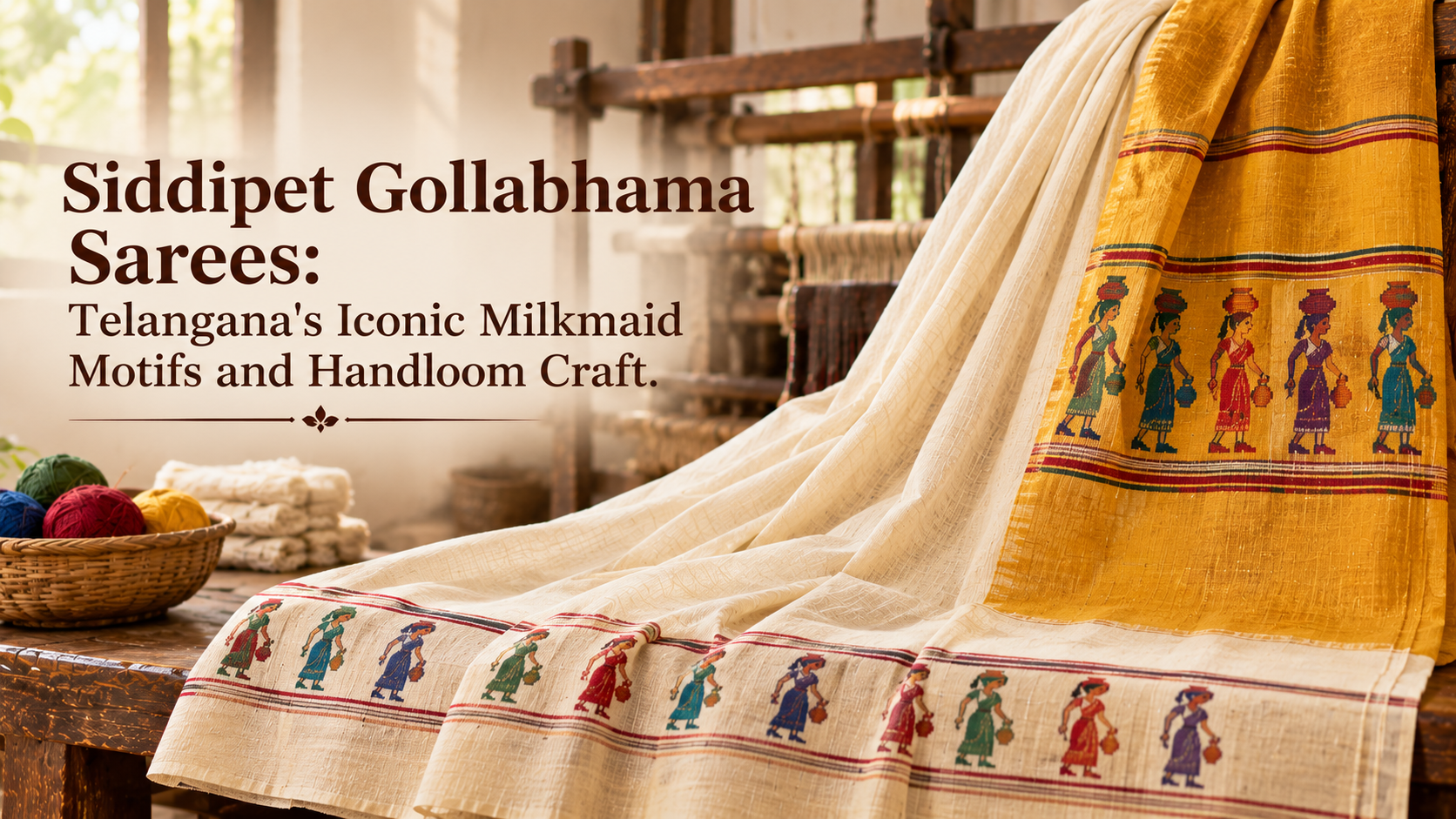
Most saree motifs repeat across the whole cloth. The Gollabhama motif does not. On a Gollabhama saree, a row of small woven milkmaid figures, each carrying pots, sits in the pallu in a straight line, placed there by hand after the rest of the cloth has been woven on the loom. That single feature separates this Telangana handloom saree from Siddipet from nearly every other saree in the country, and it is the reason the weave holds its own Geographical Indication (GI) registration.
This guide covers where Gollabhama weaving is centred, what the official record says about its history and weavers, how the milkmaid motif is built into the saree, how the extra-weft process works, what the cotton and colours are like, and what the GI status does and does not mean. It also places the saree next to other Telangana and Andhra handlooms. Where a point rests on legend or on a single source, the text says so, and it does not assign meanings to the motif that the documents do not give. If you are comparing weaves from several regions before you buy, our complete guide to buying sarees for women covers fabrics, occasions and price factors across the whole range.
Gollabhama saree at a glance
| Aspect | What the official sources record |
| Name | Registered as “Siddipet Gollabama”; commonly written Gollabhama |
| Place | Siddipet, Telangana, with nearby Kondapaka and Dubbaka mandals in the production area |
| Defining feature | A hand-woven milkmaid figure carrying a pot overhead and another in one hand, always present in the pallu |
| Technique | Extra-weft (inlay) motifs woven with cotton thread using the traditional jala technique, on pit and frame looms |
| Fibre | Mostly cotton or mercerised cotton; some silk sarees; motifs always in cotton thread |
| Motif size | About 9 to 10 cm high and 5 cm wide, according to the GI application |
| Body | Plain, or with small buttas |
| GI details | Application 188, certificate dated 19 March 2012, registration valid to 4 November 2029 |
What is a Gollabhama saree?
A Gollabhama saree is a handloom cotton saree from Siddipet in which small figurative motifs of a milkmaid are woven into the pallu and sometimes along the lower border. The name is commonly glossed as milkmaid, and the GI application describes the figure as a milkmaid carrying a milk pot on her head and another in her hand. Spelling varies, and you will see Gollabama, Gollabhama and Gollabhaama. They all refer to the same weave.
The word Gollabhama describes the motif first and the saree second. The registered product also includes other cloth that carries the same figure. The GI application lists towels, lungis, shirt material and bed sheets alongside sarees, and it says weavers began to carry the motif onto those products over time. For this article, Gollabhama weaving means the technique and the regional craft, and a Gollabhama saree is the best-known product of it.
Geographical identity: Siddipet and its weaving villages
Siddipet is a town in Telangana that is the headquarters of Siddipet district, according to the government-run Vikaspedia portal. When the GI application was filed in 2009 it sat in the old Medak district, and the application defines the production area as the Siddipet, Kondapaka and Dubbaka mandals, with villages such as Irkode and Dudeda named as weaving locations near the town. The application was filed by four weavers’ cooperative societies in Siddipet: the Handloom Weavers Cooperative Society, the Project Handloom Weavers Cooperative Society, the Adarsha Handloom Weavers Cooperative Society and the Irkode Handloom Weavers Cooperative Society.
This geography matters for two practical reasons. First, the GI protects the name for goods made in this defined area. Second, Siddipet is a cluster that weaves other cloth too, and the Gollabhama handloom is only one of its products. A 2022 feature in The Hans India reports that the town’s weavers also work in ikat and other weaves, and that the GI covers only the Gollabhama weave. A saree from Siddipet is therefore not automatically a Gollabhama saree.
History and what the record supports
Reliable dating for Gollabhama weaving is thin, and it helps to separate what is documented from what is told as a story.
The GI application offers a legend as its proof of origin. In that account, Gollabama was the name of a queen in tales of King Vikramaditya who was separated from the king and was reduced to selling milk, and the couple recognised each other when the king took a milk pot from her. The application then says that in the mid to late 1940s a film called Gollabama was released and that, based on it, a few weavers in and around Siddipet began weaving Gollabama sarees. Vikaspedia repeats the same account. Both present it as legend and film, with no independent record behind it, so this article treats it as the story the registered applicants gave and does not present it as proven history of the motif.
Other statements are easier to date. The Hans India feature says the Siddipet weavers’ society was established in 1948 and that the weave itself goes back further, and it adds that the milkmaid figure technique was revived roughly fifty years before the article was written. Since the sources differ on how old the figure weaving is, it is safest to say that Siddipet has a long handloom tradition and that the Gollabhama figure weaving is documented in its current form from about the mid twentieth century.
The decline of the craft is also on record. The 2009 GI application itself says the number of families weaving Gollabama sarees had dropped sharply with falling demand, and that artisans were shifting to buta sarees, which are easier to make. The application put output at about 200 sarees a month. The Hans India feature counted around 50 weavers in Siddipet in 2022, with about 20 working on the Gollabhama weave and an average age near 60 for the older group. It also mentions training for women in Siddipet under the SAMARTH scheme. Telangana Today reported that the UNESCO report “Handmade for the 21st Century: Safeguarding Traditional Indian Textile” included Siddipet Gollabhama sarees among nearly 50 textile crafts it listed.
The artisans and traditional weaving practice
The sources identify the weaving community by its institutions more than by a named caste or group, and this article follows that. The four cooperative societies that filed the GI application are the visible organisational base. The application also says that about 90 percent of sales at the time went to APCO, the state handloom cooperative, with the rest sold outside the state, and that Kolkata was the main outside market.
The application describes a division of skill. The master artisan conceives the motif and the layout. The Gollabama figures are then woven only by senior weavers who are highly skilled and experienced, and the application calls the work painstaking and demanding of patience. Designs for the line patterns around the motif are sometimes drawn on graph paper before weaving. Quality control is done by the master artisans and weavers themselves, as the application puts it. Yarn, according to the application, was procured through the state handloom cooperative and the National Handloom Development Corporation, and dyes were supplied by the same bodies.
The craft today depends on a small number of experienced weavers, and that is a reason to be careful with sweeping claims. Production figures in the sources come from different years and do not agree, so any current output or weaver count in a product listing should be treated as the seller’s estimate.
The Gollabhama motif and how it sits in the saree
The GI application defines the motif closely, which makes it unusually easy to describe without guessing. It is a figure of a milkmaid carrying a milk pot over her head and another in her hand. The figures are woven in a straight line, and each is a fixed size of about 9 to 10 cm in height and about 5 cm in width. The application treats that size as standard. Shoppers often search for a milkmaid motif saree, but the registered product is narrower than that phrase suggests, because the figure has a fixed size, a fixed row and a fixed place on the saree.
Placement follows rules in the same document:
| Part of the saree | What the GI application says |
| Pallu | The Gollabama motif is compulsory. A pallu carries roughly 8 to 13 motifs, depending on whether it has a border on one or both sides of the figure row |
| Lower border | Optional. Where present, about 13 to 15 motifs are woven along it |
| Upper border | No motifs are ever woven here |
| Border position | The border is on one side only, the lower side, and never on both |
| Body | Plain, or with butta designs, which may or may not be present |
| Line designs | Optional lines run across the pallu above and below the motif row, in contrasting colours chosen by the weaver |
What the motif means is a separate question, and the sources are silent on it. They describe how it looks, how big it is, where it goes and how it is woven. They do not attach religious, social or symbolic meaning to the figure, and the milkmaid account in the GI application is framed as a legend about a name. Treat any detailed meaning offered for the motif as someone’s interpretation.
Later additions to the Siddipet design vocabulary are documented too. Telangana government handloom documentation, as summarised on a Telangana tourism and culture site, lists Bathukamma and Kolatam among designs associated with Siddipet sarees. The Hans India feature says the weavers took up Bathukamma and Kolatam motifs to stay relevant. Both are named in the sources as design themes, so it is fair to say they appear, and equally fair to say the Gollabhama figure remains the registered, defining one.
Extra-weft weaving: how the motif is made
A saree has a ground weave in which warp and weft threads interlace to make the cloth. Extra-weft, also called supplementary weft, adds further weft threads beyond the ground weft. They are inserted only where a design is needed, so the motif sits in the cloth as an inlaid figure and not as printing or embroidery. Government handloom documentation on Vikaspedia (from the India Handloom Brand) describes Siddipet Gollabama sarees as woven on pit looms and frame looms with extra-weft Gollabama motifs and geometrical designs in the border, body and pallu, using the traditional jala technique. It notes that the motifs are woven with extra-weft cotton yarns and that no zari is used.
Two further details from the GI application explain why the process is slow. First, the body, border, pallu and line designs are woven by ordinary handloom weaving, while the Gollabama itself is woven separately and by hand in cotton thread. Second, the application says the Gollabama motifs are not woven on the loom but “purely by hand”, which is how the figures can be placed precisely in a line. The Hans India feature adds that Siddipet weavers still use the jala technique for the borders and pallu even though a jacquard loom is available, and describes this as the cluster sticking to its roots and not as extra work taken on needlessly.
Why this is not ikat
Some web pages describe Siddipet weaving as tie-and-dye ikat. The government documents describe the Gollabhama figures as extra-weft inlay. In ikat, yarn is resist-dyed before weaving so the pattern forms in the yarn. In Gollabhama weaving, the dyed yarn is woven as it is, and the figure is added during weaving with extra cotton thread. Siddipet does have ikat weavers, per the Hans India feature, but that is a different product from the registered Gollabhama saree.
The process from yarn to finished saree
The GI application and the Vikaspedia documentation together describe the stages.
Yarn preparation
The application describes boiling the cotton yarn for four to five hours in a liquor of caustic soda and soap ash in soft water, then bleaching it by the hypochlorite or hydrogen peroxide method. The bleaching removes the natural colour so the yarn takes dye evenly. Vikaspedia adds that single cotton yarn is sized by the hank sizing method.
Dyeing
Three dye types are named in the application: direct, naphthol and vat dyes. Direct dyes are used to keep the sarees soft, and two dyes are used where fast colours are needed. The dyed yarn is dried for a day. The application says the dyes were supplied by the state handloom cooperative and the National Handloom Development Corporation, so this is a record of past practice and not a statement of current sourcing.
Winding, warping and loom setup
Dried yarn is wound on a charkha, then warped. The application says warped yarn then goes onto the loom for drafting and denting, where each warp end is drawn through the heald and reed. Vikaspedia notes that long-length warps are prepared on a sectional warping machine. The looms are pit looms and frame looms, and the application records that pedals are used on the loom to make designs.
Pattern creation
The master artisan first conceives the Gollabama motif and its layout. The number, placement and colour of the motifs and line designs are then fixed. Sometimes the line pattern is drawn on graph paper first. The application says the placement, colour and number of motifs and lines add to the uniqueness of each saree, and that on some sarees the motif is on the pallu only and on others on the border as well, at the weaver’s discretion.
Weaving the cloth and the motif
The body, border and pallu lines are woven in the usual handloom way. The Gollabama figures are then woven in by hand with cotton thread in a straight line across the pallu. According to the application, a saree takes roughly two to five days to complete at about eight hours of weaving a day, depending on the design and buttas.
Finishing
The sources are brief on finishing. The GI application describes the finished cloth as having a smooth finish and glaze, and states that quality is checked by master artisans before products go to market. It does not list specific finishing treatments, so none are claimed here.
Fabric, cotton quality and texture
Most Gollabhama sarees are cotton, so the weave counts as a Telangana cotton saree first and a silk one only occasionally. The GI application says they are mostly woven in cotton or mercerised cotton yarn, with the cotton yarn of 80s count, and that some are woven in silk. Vikaspedia says the sarees were originally woven with 60s to 80s cotton in warp and weft, and that cotton and silk sarees today use 2/120s mercerised cotton and 20/22 denier silk respectively. The Hans India feature gives the cotton sarees as 100 or 120 fine counts and says they suit tropical weather. These figures differ because they come from different periods and sources, so the safest reading is that Gollabhama cotton ranges from fine to very fine counts and that the count should be asked about.
On texture the application is candid. It calls the cotton sarees rough to feel but comfortable to wear, with a glazed look and a nice finish. That description fits an honest handloom cotton. Expect a crisper hand than a soft mulmul, and expect it to relax with wear. The standard length is about 5.5 metres and the width about 47 inches, according to the application.
Because the fabric is cotton, it overlaps with the everyday sarees many people already own. Our guide to the cotton saree for daily wear compares handloom cottons by weight, drape and upkeep, which helps if you are deciding where a Gollabhama saree fits among them.
Borders and pallu designs
The border and pallu carry the identity of the saree, since the body is often plain. The border sits on the lower side only. It is documented as plain, with the optional Gollabhama row of 13 to 15 motifs. Vikaspedia says Gollabama butis are woven in a straight line across the width and that geometrical designs also appear in the border, body and pallu.
The pallu is where the compulsory milkmaid row lives. Above and below it, line designs run across the width. The application says there is no set pattern for these lines: the thickness, layout and colour of the yarn are left to the weaver’s design sense. The Hans India feature describes the overall look as a plain body with intricately woven pallu and borders, and says no zari is used.
Colours and traditional design combinations
The GI application lists all colours as used in the body. It names cream and white as the most popular body colours. For the pallu, it names yellow, maroon, green and other bright colours as the most widely used. The motifs themselves are most often woven in blue, green, black, red and violet in various shades, and the choice depends on the weaver. The motif specification adds that bright colours such as green, violet, red and orange predominate in the figures.
Two combinations are given in the application as examples. One is a cream body with a turmeric yellow pallu. The other is a same-colour pairing such as violet with violet, or grey with purple. The lines in the pallu are woven in colours that contrast with the pallu: a dark line on a light pallu, and a light line on a dark one. The application says body and pallu are generally contrasting but may be the same colour at times, based on the weaver’s design sense.
The Hans India feature adds that these sarees do not use zari. So if a listing describes a gold zari Gollabhama border as the traditional form, ask what it is based on.
Silk and other fabric variations
The registered description includes silk. The GI application says some Siddipet Gollabama sarees are woven in silk, and that in every case, whether cotton, mercerised cotton or silk, the Gollabama motifs are woven only with cotton thread. It also puts the minimum price of a silk saree well above that of a cotton one, though the figures are from 2009 and are not reliable today. The Hans India feature says demand has always been for cotton and mercerised cotton and that demand for silk in the cluster is very low.
Beyond sarees, the same motif appears on towels, lungis, shirt materials and bed sheets, per the GI application. If you come across a listing described as a silk, cotton silk or blended Gollabhama saree, it helps to understand what such blends are. Our cotton silk saree guide explains how blended cloth feels, what affects its price and how to look after it, so you can read a fibre description with more confidence.
GI recognition and what it means
A Geographical Indication identifies goods whose qualities or reputation are linked to a specific place. In India GIs are registered under the Geographical Indications of Goods (Registration and Protection) Act, 1999, and a registration is valid for ten years and can be renewed. The Ministry of Textiles has said in a reply tabled in Parliament that it supports handloom GI registration, with help desks at its Weavers Service Centres.
For this weave, the official GI Registry entry shows the following:
| GI Registry field | Entry |
| Geographical indication | Siddipet Gollabama |
| Application number | 188 |
| Date of filing | 5 November 2009 |
| Applicant | Handloom Weavers Cooperative Society Limited, Siddipet |
| Classes | 24 and 25 |
| Certificate number and date | 170, dated 19 March 2012 |
| Registration valid up to | 4 November 2029 |
| Geographical area | Telangana |
Renewal documents dated 2019 and 2022 are also listed on the registry page, which shows the registration being kept up.
In practical terms, the GI protects the name Siddipet Gollabama for goods that meet the registered description and are made in the defined area. It gives the registered applicants and authorised users a legal basis to object to unauthorised use of the name. It is not a statement about the quality of an individual saree, and it does not by itself tell a buyer whether a particular piece was woven by hand. The GI application’s own specification is the useful yardstick: the milkmaid motif in the pallu, woven by hand in cotton thread, in a straight line, at the fixed size, and only on the lower border if on the border at all.
The Hans India feature notes the GI has helped the weave gain attention. A Telangana tourism and culture site (Telangana360) cautions that the tag has not by itself led to a boost in sales for the weavers, which is a reminder that registration protects a name and does not create demand.
How Gollabhama differs from other Telangana and Andhra handlooms
Telangana and Andhra Pradesh have several well-known cotton and silk handlooms. They differ in technique and in where the design sits on the saree.
Pochampally Ikat comes from Bhoodan Pochampally and nearby villages and is an ikat weave, in which yarn is resist-dyed before weaving. Gadwal, from Jogulamba Gadwal district, is known for a cotton body joined to a silk border and pallu by the interlocked weft method called kuttu. Narayanpet sarees have a GI description that features checks in the body and a temple border, with the temple border compulsory in silk sarees. Mangalagiri, in Andhra Pradesh, is a fine cotton saree whose identity is a zari Nizam border woven with extra warp, and it carries no woven designs on the body. Venkatagiri, also in Andhra Pradesh, is a fine cotton saree with zari in the pallu and border and extra-weft designs made on a jacquard.
| Feature | Gollabhama (Siddipet) | Pochampally Ikat | Gadwal | Narayanpet | Mangalagiri | Venkatagiri |
| State | Telangana | Telangana | Telangana | Telangana | Andhra Pradesh | Andhra Pradesh |
| Typical fibre | Cotton, mercerised cotton, some silk | Cotton, silk | Cotton body with silk border and pallu | Cotton or silk | Cotton | Cotton |
| Defining technique | Hand-woven extra-weft milkmaid figures (jala) | Resist-dyed yarn (ikat) | Interlocked weft joining body to border and pallu (kuttu) | Handloom weaving with checks and temple border | Extra-warp Nizam border | Extra-weft designs with zari |
| Where the design sits | Row of figures in the pallu, optional lower border | Across the cloth, built into the yarn | Contrast silk border and pallu | Body checks, temple border | Border only, plain body | Pallu and border |
| Zari | Not used | Not a defining feature | Zari borders are common | Zari border noted for cotton sarees | Zari border | Zari in border and pallu |
| Body | Plain or small buttas | Patterned by ikat | Plain or simple | Checks | Plain | Plain or small motifs |
The shortest way to separate Gollabhama from the rest is to look at the pallu. A row of small milkmaid figures at a fixed size, woven in cotton thread, is the registered mark of this weave. None of the other five sarees above uses that figure.
What to check before buying a Gollabhama saree
No guide can authenticate a particular saree, so the aim is to help you ask useful questions. Look for the milkmaid figure in the pallu and check that it is woven into the cloth and not printed or embroidered. Check that the figures sit in a straight line at a consistent size. If there is a border motif row, it should be on the lower border only. Ask about the cotton count and whether the yarn is mercerised, since the sources give a range. Ask where it was woven, and ask how the seller’s description relates to the registered Siddipet Gollabama GI, because a name alone is not proof. Do not assume a zari border is traditional.
For reading product descriptions, judging photographs and checking seller policies before you pay, our online saree shopping guide walks through the process.
Frequently asked questions
1. What is a Gollabhama saree? It is a handloom cotton saree from Siddipet in Telangana with woven milkmaid figures in the pallu. The GI application describes the figure as a milkmaid carrying a pot overhead and another in her hand.
2. Where is Gollabhama weaving centred? In Siddipet, with Kondapaka and Dubbaka mandals and villages such as Irkode and Dudeda in the registered production area. Siddipet is the headquarters of Siddipet district, which in 2009 was part of Medak district.
3. How is the milkmaid motif made? It is woven by hand in cotton thread as an extra-weft inlay, using the traditional jala technique on pit and frame looms. The rest of the saree is woven in the usual handloom way.
4. Is a Gollabhama saree ikat? No. Government documents describe extra-weft inlay figures. In ikat the yarn is resist-dyed before weaving. Siddipet does have ikat weavers, but that is a separate product from the registered Gollabhama saree.
5. What does the GI tag mean for this saree? It means “Siddipet Gollabama” is a registered Geographical Indication (application 188, certificate dated 19 March 2012, valid to 4 November 2029). It protects the name for goods that meet the registered description and are made in the defined area. It is not a quality rating for an individual saree.
6. What colours are traditional? The GI application names cream and white as the most popular body colours, and yellow, maroon, green and other bright colours for the pallu. The motifs are most often woven in blue, green, black, red and violet.
7. Is the Gollabhama saree always cotton? Mostly, but not always. The application says the sarees are mostly cotton or mercerised cotton, with some silk sarees. The motifs are woven in cotton thread in every case.
8. What does the milkmaid motif symbolise? The sources do not say. The GI application records a legend about a queen named Gollabama who was reduced to selling milk and a 1940s film, and describes the figure’s appearance. It gives no symbolic meaning for the motif, so any detailed meaning should be treated as interpretation.
Conclusion
The Gollabhama saree is a rare case of a motif being defined in writing down to its height, width, count and position. A milkmaid figure carrying pots, woven by hand in cotton thread, appears in a straight row in the pallu, and the border sits on the lower edge only. The rest of the saree is plain, fine cotton, usually in cream or white with a bright pallu, and the character of the weave comes from the contrast between a simple body and an exacting hand-woven pallu.
Careful reading also shows the limits of the record. The legend about the motif is a story the applicants recorded, the meaning of the figure is not documented, and the number of working weavers is small and changes from source to source. Knowing this makes it easier to value the saree for what the documents do establish: a registered handloom of Telangana, woven in cotton on pit and frame looms, with a motif that no other saree carries in the same way. When you see one, look at the pallu first and ask who wove it and in what yarn.
