Blog
Khandua Sarees: Odisha’s Sacred Ikat Weaving and Jagannath Motifs

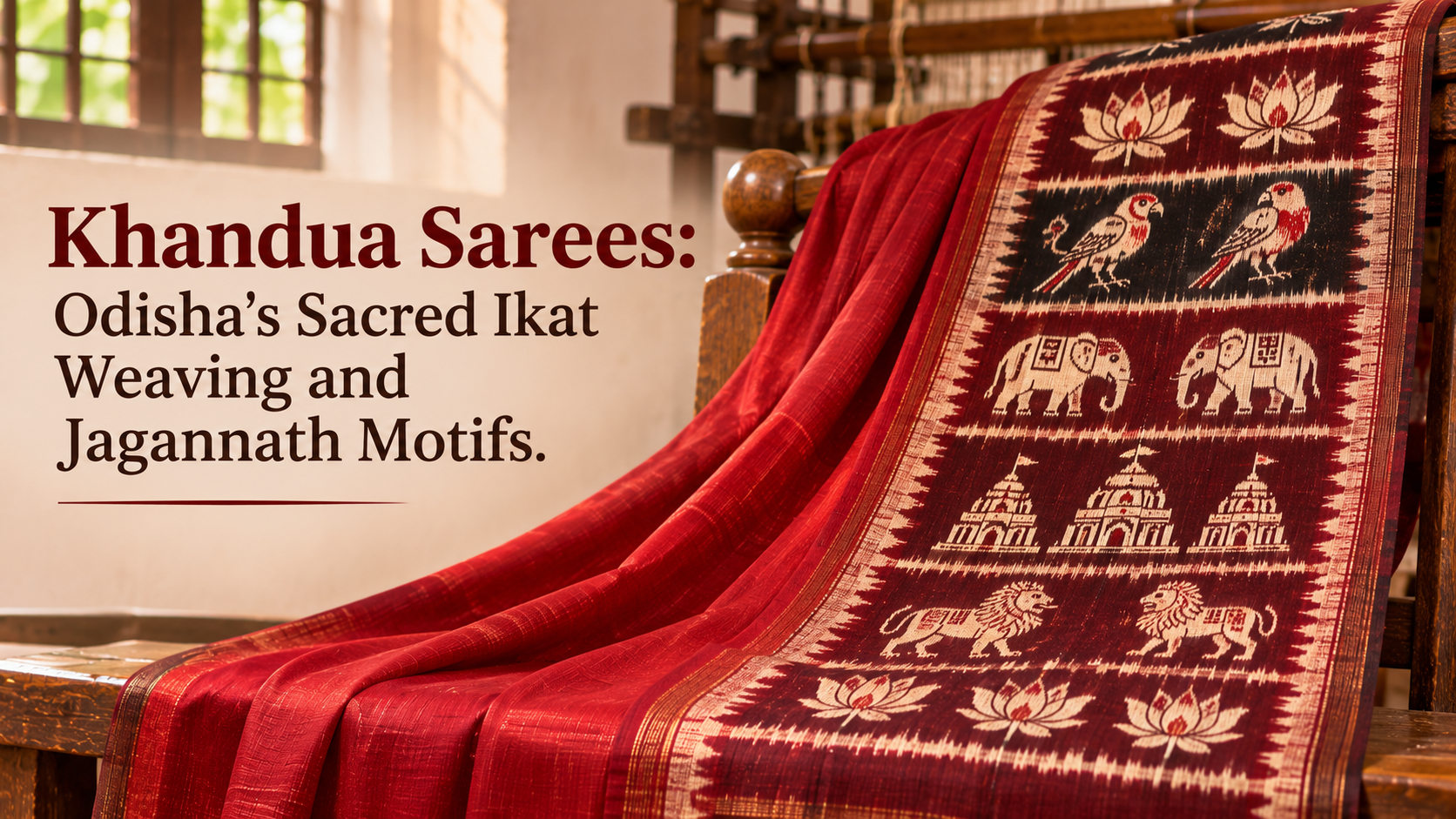
A Khandua saree starts as plain yarn that a weaver ties by hand, dips in dye, and ties again, long before any cloth exists. By the time the yarn reaches the loom, the pattern is already stored in it as bands of colour, and the weaver’s job is to line those bands up thread by thread. This is Khandua weaving, the tie-dyed weft ikat of Nuapatna and the surrounding villages of Cuttack district in Odisha. Its history is bound up with the Jagannath temple at Puri, where weavers have supplied cloth for the deities for centuries.
This guide explains where the Khandua saree comes from, what the documents say about its link with Jagannath culture, how the yarn is tied, dyed, warped and woven, which motifs and colours are on record, and how Khandua differs from Sambalpuri ikat and Patan Patola. Where sources disagree, or where something rests on tradition and not on a dated record, the text says so. If you are comparing Khandua with weaves from other regions, our complete guide to buying sarees for women covers fabrics, occasions and price factors across the whole range.
Khandua saree at a glance
| Aspect | What the sources record |
| Textile | Khandua Saree and Fabrics, a handwoven ikat (bandha) textile of Odisha, also written Khandua pata |
| Main weaving centre | Nuapatna, Tigiria block, Cuttack district, with Maniabandha nearby |
| Ikat type | Mainly weft ikat, according to the Geographical Indication (GI) application |
| Fibres | Silk, cotton and tussar |
| Colours listed in the GI application | Red, black, yellow, green, blue, maroon and white |
| Motifs listed in the GI application | Temple, conch, rudraksha, fish, chakra, lotus, swan, peacock, parrot, deer, elephant, horse, lion, dancers and natural scenery |
| Link with Puri | Ritual cloth for Jagannath, Balabhadra and Subhadra is woven at Nuapatna |
| Recognition | Registered as a Geographical Indication under the name Khandua Saree and Fabrics |
What is a Khandua saree?
A Khandua saree is a handwoven ikat saree from Odisha in which the yarn is resist-dyed before weaving. Odia weavers call the tie-dye craft bandha, which simply means tying, and pata (or patta) is the Odia word for silk cloth. That explains why the same textile appears in shops and search results as Khandua saree, Khandua silk saree and Khandua Patta saree. The word Khandua itself is commonly explained as a lower cloth, a reference to the garment offered to the deities.
The registered name, Khandua Saree and Fabrics, covers more than sarees. The GI application lists stoles, dupattas, dress material, bed and pillow covers, curtains, wall hangings and table linen as products of the same tie-dye process. So when someone talks about Khandua weaving, they mean a technique and a regional tradition first, and a garment second.
History and regional identity of Khandua weaving
The centre of Khandua weaving is Nuapatna, a village in the Tigiria block of Cuttack district, roughly 70 km from Bhubaneswar according to the government-run Vikaspedia portal. The GI application names four blocks in the production area (Baramba, Tigiria, Banki and Athagarh) and treats Nuapatna as the main centre. It adds that weavers in nearby villages took up Khandua weaving as demand for it grew. Textile expert Surendra Kumar Patra, who was born into a Nuapatna ikat-weaving family and retired as a Deputy Director at the Weavers Service Centre, Bhubaneswar, estimates about 10,000 weavers within a five-kilometre radius of Nuapatna.
Maniabandha, also in Cuttack district, has its own identity. Patra describes it as home to traditional Buddhist weaving families who mostly weave cotton because they avoid the silkworm killing that silk reeling involves. He puts the number of handloom weavers there at roughly 1,800 to 2,000. This is one reason the fabric content of Khandua varies from village to village.
How old is the tradition?
Two kinds of evidence sit side by side, and it helps to keep them apart. The GI application traces the origin to the 12th century, but it frames that date with “it is believed”, linking it to the poet Jayadeva and his Gitagovinda. The firmer, dated references are from the early 1700s. The application cites the Madala Panji, the Jagannath temple chronicle, as recording that King Ramachandra of Puri ordered Nuapatna weavers to weave special dresses for the three deities from 1710 onward. The Museum of Art & Photography’s MAP Academy refers to a document from 1719 that mentions a bandha Gitagovinda being woven at Nuapatna.
Patra states that records mention weaving at Nuapatna in the 12th century, though the records themselves are not reproduced in the sources used here. The safest summary is that Khandua weaving is widely held to be several centuries old, that tradition places its start in the 12th century, and that the earliest dated temple records cited in this article come from the early 18th century.
Weavers as temple servants
Vikaspedia records that a section of Nuapatna’s weaving community (the bunakar) was assigned temple work as sevakas, servants of the deity, weaving decorative cloth for Jagannath, Balabhadra and Subhadra. The GI application adds that weavers were compensated by the king with cultivable land. In other words, the craft grew up with a patron and a fixed set of obligations, not only with a market.
Where Khandua fits within Odisha ikat
Odisha is known for ikat, and Patra says over 70 percent of its woven textiles are ikat, predominantly weft ikat. The state’s GI registrations for textiles include Orissa Ikat (covering ikat from several clusters), Khandua Saree and Fabrics (a single weft ikat from Nuapatna) and Sambalpuri Bandha Saree and Fabrics (from the west of the state). Khandua is therefore one branch of Odisha ikat, tied to the eastern, coastal side of the state and to the Puri temple.
Khandua textiles and Jagannath culture
The link between Khandua and Jagannath culture is the best documented part of the story, and it can be described without stretching the evidence.
The GI application states that the ritual dresses of the three deities of the Puri temple, Jagannath, Balabhadra and Subhadra, are woven in the Nuapatna production centre. It also records that two families, named in the application, still wove silk fabric for the Lord of Puri at the time of filing. Patra adds that Nuapatna weavers make textiles for Jagannath, Balabhadra, Subhadra, the Sudarshan emblem and other deities of the temple, with specific cloths for each day of the week, for the night rest, for seasons, for festivals and for the ritual bath. He describes weavers supplying the temple for over seven centuries.
The best-known category is the Gitagobinda Khandua. According to Patra and the GI application, the poet Jayadeva wanted to offer his Gitagovinda to Lord Jagannath and had its verses woven by ikat weavers so the cloth could be offered to the deities. Patra says these textiles have been woven at Nuapatna since the 12th century and are still offered by devotees. The application notes that some weavers observe fasting and avoid non-vegetarian food while weaving such cloth. It also says the chariots of the Rath Yatra are covered with coloured plain silk cloth woven mainly in and around Nuapatna.
What the sources do not say
Several claims circulate online that the documents do not support, so this article leaves them out:
- The sources list motifs and colours but do not assign a fixed religious meaning to any single motif.
- They do not say that every Khandua saree sold today carries temple status. The ritual cloths are one part of the tradition, and a saree bought for personal wear is a commercial product of the same craft.
- “Jagannath saree” is a popular search phrase and not a recognised textile category. The accurate description is a Khandua textile from a weaving tradition that supplies Jagannath temple cloth.
How ikat works, and why Khandua is a weft ikat
Ikat is a method of tie-dyeing yarn before it is woven. In single ikat only one set of threads (the warp or the weft) carries the tied pattern. In double ikat both are tied and dyed, and they must meet exactly at the loom.
The GI application describes Khandua as basically a weft ikat. In Nuapatna, it says, the weavers tie-dye the weft, called bharani locally, while the warp is usually a single plain colour dyed in each household. The application also records that the border is warp tie-dyed and the pallu is weft tie-dyed, and that a brush is sometimes used to dye a small portion of the warp for the pallu, so the whole warp does not have to be tied there. Read together, the main pattern work lives in the weft, with warp tie-dye appearing in specific parts of the saree.
| Term | Meaning in this craft |
| Ikat | Resist-dyeing yarn before weaving, so the pattern forms in the yarn itself |
| Bandha | The Odia word for tying, used for the tie-dye craft |
| Warp | The lengthwise threads set up on the loom |
| Weft (bharani) | The crosswise threads that carry most of the Khandua pattern |
| Resist | Tied sections that stay undyed, giving white outlines and shapes |
| Dobby | A loom attachment used here mainly for selvedge and border designs |
The Khandua weaving process, step by step
The GI application and Patra’s interview give a detailed picture of the work. The stages below follow their descriptions.
Preparing the yarn
Mulberry silk yarn is soaked, degummed (the natural gum is boiled out), rinsed in hot and then cold water, and wound onto bobbins and stick cages. The warp yarn is sized with boiled rice. The weft is plied, meaning several single threads are twisted into one, and the application says weavers do their own plying instead of buying ready-plied yarn so the quality stays in their hands. The same document counts several days of winding, sizing and drying for the warp alone, which gives a sense of how much of the work happens before a single design is tied.
Setting the design
Designers in the cluster draw patterns on graph paper, either from their own ideas or from what buyers prefer. The weavers then use that drawing to set up the dobby for the borders. The tying plan for the weft follows the same drawing.
Tying the yarn
Weft yarn is stretched around a wooden frame, in skein form, to the width and length the cloth needs. The weaver then ties the sections that must stay white, using the tied bundles as a resist. The cycle repeats for every colour in the design. The application says weft for 4 or 8 sarees out of a batch of 24 is tied at one time, with a vertical wooden frame holding the full length of weft yarn.
Patra makes a point about fineness. In Odisha, he says, two to four yarns are grouped per repeat when tying, where other ikat centres he names use groups of about eight. Smaller groups allow finer curved motifs. That comparison is his professional view, and it is useful for understanding why Odisha ikat motifs tend to look soft and curved.
Dyeing
Tied yarn is dyed in hank form. The GI application describes soaking the tied silk for four to six hours before dyeing, with a trace of oil, because dry or unevenly wetted yarn gives patchy shades. Dyes named in the document are direct, acid and metal-complex dyes, with metal-complex dyes now common for their fastness. Patra says natural dyes were traditional, that most yarn is now dyed with synthetic dyes, and that some weavers and designers still use natural dyes. Multi-colour designs need the yarn to be tied and dyed several times, which Patra singles out for Nabakothi sarees.
Warp and weft preparation for the loom
The warp is prepared on a cylindrical warping drum, and the application says 24 to 32 sarees’ worth of warp is laid out at once. The weaver then drafts and dents the yarn by hand, passing each end through the heald and reed. The reed is bamboo and the heald is commonly nylon. Because the reed spacing can leave faint marks, the application notes that reed lines may be visible on the finished cloth. The loom is then fitted with the dobby or jacquard needed for the border.
Weaving and the appearance of the pattern
Nuapatna weavers work on pit looms and on frame looms with a fly shuttle. When the dyed weft goes in, the weaver sets the weft threads on the fall of the cloth after each beat so the tied and dyed segments fall where the design needs them. The application gives the pace as around 25 to 30 picks per minute, which is slow by any standard.
This is how the pattern emerges. Nothing is drawn onto the cloth. A motif appears as the colour segments in the weft line up row after row, and a slight shift in alignment shifts the motif with it. Where dye has crept slightly past a tie, the edge of the motif softens. The GI application treats this soft colour bleed on flower and animal motifs as part of the character of Khandua. When warp and weft are different colours, the cloth also shows a two-tone shimmer.
Traditional Khandua motifs
The GI application lists the motifs of Khandua as star, temple, conch, rudraksha, fish, chakra, lotus, swan, peacock, parrot, deer, elephant, horse, lion, the dance of the devadasi and views of natural scenery. It adds that the motifs tend toward bold, natural curves and not toward angular geometry. The layout can still be strictly geometric, with motifs repeating in rows or inside a grid.
Patra describes the general Khandua layout and three named designs from Nuapatna:
| Design | Documented description |
| Khandua (general) | Single ikat with rows of repeating motifs, typically lion, elephant, lotus and creepers |
| Nabakothi | A grid of nine squares, each holding one motif. Typical motifs are the lion, deer, lotus, parrot, peacock, conch shell, butterfly, elephant and temple |
| Tarabali | The name means a group of stars. Rows of rectangular spots form diamonds, with a motif at the centre of each diamond |
| Gitagobinda Khandua | Silk ikat bearing woven verses of the Gitagovinda, associated with offerings at the Puri temple |
Flowers and animals therefore dominate the recorded repertoire, and geometry shows up mostly in the arrangement: the grid of Nabakothi and the diamonds of Tarabali.
On the question of Jagannath-related designs, the record is short and specific. The woven Gitagovinda verses are documented. The temple, conch and chakra appear on the GI list. Beyond that, the sources do not link individual motifs to particular deities or teachings, and this article does not either. If a seller offers a detailed meaning for a single motif, treat it as that seller’s interpretation.
Patra also relays a local account for Nabakothi. Elder weavers told him the design came from the Nabagunjara, a composite creature in the Odia Mahabharata by the 15th-century poet Sarala Dasa, and he describes the link as something weavers of the past are believed to have drawn on. It is a weavers’ tradition and not a documented origin, so it is best repeated with that label.
Traditional Khandua colours
The GI application names red, black, yellow, green, blue, maroon and white as the prominent colours of Khandua, and says dark blue, green, red and violet are normally used for the tie-dye. White in a Khandua motif is usually not a dye at all. It is the yarn that was tied off before dyeing, which gives many motifs their pale outline.
Red holds a special place in the recorded tradition. Patra says Khandua sarees are traditionally predominantly red and are worn by brides. For Nabakothi he gives maroon, mustard and purple as traditional colours, obtained from indigo (blue) and lac (red). He adds that a wider range of colours is now used for Nabakothi and other traditional sarees. A red body with contrasting pallu and border is therefore a fair description of the classic look, and other colour schemes are normal in current production.
Silk and other fabric variations
Khandua is often sold as a silk saree, and Nuapatna is one of Odisha’s two traditional silk weaving centres, along with Berhampur. The record is wider than silk alone, though. The GI application lists mercerised cotton sarees and tussar sarees as products, and says Khandua design is basically woven on cotton silk and tussar fabrics. Patra says many Khandua weaves have silk in both warp and weft, while some have cotton warp and weft. Maniabandha, as noted above, leans toward cotton.
If you want to understand how a blended Khandua behaves in wear and care, our cotton silk saree guide explains what the blend means for feel, price and washing. For the broader question of whether a silk or cotton ikat suits your climate and use, the cotton vs silk saree comparison sets the two fibres side by side.
Tussar is a separate case. It is an indigenous silk of India, and the sources list tussar Khandua products and ikat tussar scarves from Nuapatna. When a listing says traditional Odisha silk, it is worth asking whether the fibre is mulberry silk, tussar or a blend.
Ceremonial and cultural uses of Khandua textiles
The most documented use is ritual. Khandua cloth is woven for the Puri deities, as covered earlier, and Gitagobinda Khandua is offered by devotees to this day according to Patra.
Personal wear comes next. Patra says the traditional red Khandua saree is worn by brides, which links the textile to weddings in Odisha. Beyond sarees, the GI product list shows how the craft has spread into dupattas, stoles and home textiles, so Khandua appears today as everyday and festive clothing as well as ceremonial cloth. Weavers’ own ritual practice, including the fasting some observe while weaving temple cloth, is part of the cultural picture too.
Khandua vs Sambalpuri Ikat vs Patan Patola
All three are ikat textiles with GI protection, and people often mix them up. They differ in region, in which threads are tied, and in cultural setting.
Sambalpuri ikat comes from western Odisha, mainly the Sambalpur, Bargarh, Boudh, Sonepur and Balangir districts. It is known as Sambalpuri bandha. The GI application for Sambalpuri tie and dye lists cotton, silk and silk-cotton sarees and traditional motifs such as fish, conch shell, birds, animals and flowers. Patra describes the Sambalpuri GI weave as featuring delicate curvilinear motifs in double ikat, and he names the double-ikat Pasapalli chessboard pattern from Bargarh as a famous design. Weaving communities include the Meher and Bhulia groups.
Patan Patola is woven in Patan, in north Gujarat, and is a double ikat in silk. Both warp and weft are tied and dyed before weaving and have to align on the loom. It received a GI in 2013. Commonly cited motifs include parrots, flowers, elephants, dancing figures and geometric patterns, and the weaving is associated with Salvi family weavers in Patan.
The simplest way to tell them apart is this: Khandua is Odisha’s eastern weft ikat tied to the Puri temple, Sambalpuri is Odisha’s western ikat that includes double-ikat work, and Patola is Gujarat’s double-ikat silk.
| Feature | Khandua | Sambalpuri ikat | Patan Patola |
| Region | Nuapatna and nearby villages, Cuttack district, eastern Odisha | Sambalpur, Bargarh, Balangir, Boudh and Sonepur districts, western Odisha | Patan, north Gujarat |
| Ikat technique | Mainly weft ikat, with warp tie-dye in parts such as borders | Single and double ikat | Double ikat, with warp and weft both tied and dyed |
| Typical fibres | Silk, cotton, tussar | Cotton, silk and silk-cotton | Silk |
| Motifs on record | Temple, conch, lotus, lion, elephant, parrot, peacock, fish and others, plus woven Gitagovinda verses | Shankha (conch), chakra, phula (flower), fish, birds, animals, Pasapalli chessboard | Parrots, flowers, elephants, dancing figures, geometric patterns |
| Cultural setting | Ritual cloth for the Puri deities and traditional bridal red | Regional weaving of western Odisha by Meher and Bhulia communities | Gujarati weaving tradition of the Salvi family weavers |
| GI recognition | Khandua Saree and Fabrics | Sambalpuri Bandha Saree and Fabrics | Patan Patola, 2013 |
What to check before buying a Khandua saree
No guide can certify a particular saree, so the aim here is to help you ask better questions. A reasonable checklist for a Khandua saree or any listing that uses the name:
- Fibre. Ask whether it is mulberry silk, tussar, cotton or a blend, and what the proportions are.
- Technique. Ask whether the ikat is woven from tie-dyed yarn or printed to look like ikat. MAP Academy notes that cheaper printed imitations compete with woven ikat.
- Place of weaving. Ask where it was woven, for example Nuapatna or Maniabandha.
- Dyes. Ask whether the yarn was dyed with natural or synthetic dyes. Both are in use.
- GI information. Khandua Saree and Fabrics is a registered GI, so ask the seller how the listing relates to it. A name alone is not proof.
- Motif edges. Woven ikat motifs normally show a soft, slightly feathered edge. This is a visual cue and not a test.
For reading product descriptions, judging photographs and checking seller policies before you pay, our online saree shopping guide walks through the process.
Frequently asked questions
1. What is a Khandua saree? It is a handwoven ikat saree from Odisha in which the weft yarn is tied and dyed before weaving. It is associated with Nuapatna and Maniabandha in Cuttack district and is registered as a Geographical Indication under the name Khandua Saree and Fabrics.
2. Where is Khandua weaving centred? The main centre is Nuapatna in the Tigiria block of Cuttack district, about 70 km from Bhubaneswar. Maniabandha nearby is also known for its weavers, many of whom work mainly in cotton.
3. Is a Khandua saree single ikat or double ikat? The GI application describes Khandua as basically a weft ikat, and Patra calls it single ikat. The border may be warp tie-dyed in parts, while the main patterning is in the weft. Double ikat belongs to Sambalpuri designs such as Pasapalli and to Patan Patola.
4. Why is Khandua linked with the Jagannath temple at Puri? Documents state that ritual cloth for Jagannath, Balabhadra and Subhadra is woven at Nuapatna, and the Madala Panji is cited for a 1710 order to Nuapatna weavers. Tradition adds the story of Jayadeva’s Gitagovinda being woven for the deity. Not every Khandua saree is a temple cloth, though, and the sources do not assign fixed meanings to individual motifs.
5. What are the traditional Khandua colours? The GI application lists red, black, yellow, green, blue, maroon and white as prominent. Patra says the classic Khandua saree is predominantly red and worn by brides. White outlines come from yarn that was tied off before dyeing.
6. Is a Khandua saree always silk? No. Silk is common, but cotton, cotton-silk and tussar versions are documented. Maniabandha weavers mostly work in cotton, so it is sensible to ask a seller for the exact fibre.
7. How is Khandua different from Sambalpuri ikat and Patan Patola? Khandua comes from eastern Odisha and is mainly weft ikat. Sambalpuri comes from western Odisha and includes both single and double ikat. Patan Patola comes from Gujarat and is a silk double ikat.
8. How can I tell a woven Khandua from a printed imitation? Ask the seller directly whether the pattern comes from tie-dyed yarn and where the cloth was woven. Woven ikat motifs usually have a softly feathered edge, but no single visual check settles the question, and a GI registration or a reliable seller’s description is a stronger guide.
Conclusion
Khandua weaving is a craft in which most of the design work happens before the loom is even threaded. Weavers in Nuapatna and nearby villages tie and dye the weft, line the colours up by hand as the cloth grows, and produce motifs of lotus, lion, elephant, parrot and temple with the soft edges typical of ikat. The craft has a documented place in the life of the Jagannath temple at Puri, with ritual cloth woven for the three deities and a long tradition around the Gitagovinda verses.
A careful reading of the sources also shows what stays unproven: the exact age of the tradition, the meaning of individual motifs, and the status of any particular saree. Knowing those limits makes a Khandua saree easier to appreciate. When you meet one, look at how the colours meet at the border and pallu, ask where it was woven and from what fibre, and enjoy a textile whose pattern was dyed into the thread.
