
Blog
Molakalmuru Sarees: Karnataka’s Traditional Silk Weaving, Motifs and Borders

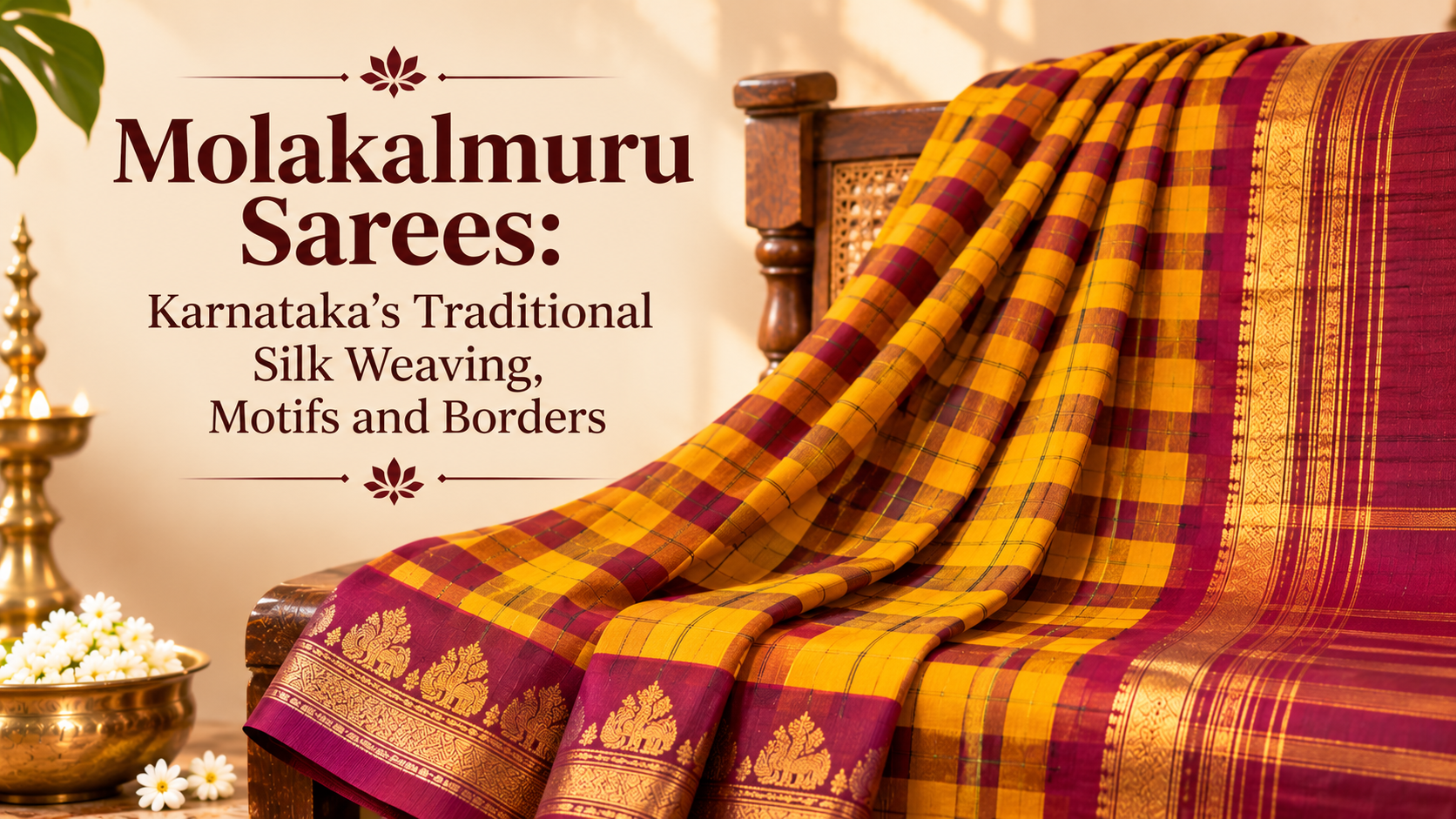
A Molakalmuru saree is easy to recognise once you know what to look for. The body is silk, usually in checks or stripes. The border and pallu are deliberately woven in a different colour. The whole saree feels lighter than many people expect from silk. It comes from a small town in Chitradurga district, in the rocky interior of Karnataka, where weaving has long sat alongside farming as a way of earning a living.
This guide explains where the Molakalmuru saree comes from, who weaves it, how it is made, which motifs and borders define it, and how it fits within Karnataka silk weaving, including how it differs from Mysore silk and other Karnataka handloom sarees. We have kept documented facts apart from stories that are only repeated in popular accounts, so you can rely on the first and treat the second as tradition. If you are new to buying silk in general, start with our saree for women buying guide for a wider look at fabrics, occasions and price factors, then come back here for the Molakalmuru details.
Molakalmuru saree at a glance
| Detail | What the sources say |
| Place | Molakalmuru taluk, Chitradurga district, Karnataka, roughly 245 to 250 km from Bengaluru |
| Fibre | Mulberry filature silk for the warp, charkha silk for the weft, with zari as extra warp and weft |
| Loom | Mainly pit looms, worked with a fly shuttle or throw shuttle |
| Technique | Three shuttles (one for the body, two for the borders), warp tie-dye in the borders, yarn-resist (chukka) in the body check |
| Signature look | Contrast border and pallu against a checked or striped body |
| GI status | Registered as “Molakalmuru Sarees”; serial 53, application no. 77, in the 2007-08 registration year |
Where Molakalmuru is, and why the name matters
Molakalmuru is a town and taluk in Chitradurga district, in the north-central part of Karnataka. Sources place it about 245 to 250 km from Bengaluru, and it sits against the Andhra Pradesh border, next to the Rayadurg taluk of Anantapur district. The surrounding country is rocky and hilly, and the wider district is best known for its forts and its temples. In older writing and some craft documentation you will also see the town spelled Molkalmuru.
Weaving is one of the main occupations here, alongside agriculture. That local concentration is the reason the saree carries the town’s name, and the name itself is protected: Molakalmuru sarees are listed in the Geographical Indications (GI) register, which ties the product to its place of origin.
The meaning of the town’s name belongs to folklore. Deccan Herald reported a local legend that translates the name as something like “broken knees” and links it to a battle story on the rocky ground around the town. We could not corroborate that with a second source, so we do not treat it as an established origin of the name.
History: what is documented and what is uncertain
What the sources support. By 1967, nearly half of the town’s population was already involved in silk weaving. The sarees are also said to have benefited from royal patronage in Mysore. Deccan Herald records the account that Nalvadi Krishnaraja Wodeyar admired their finish during a visit in 1914, and the Indian Culture portal describes special patronage under Krishna Rajendra Wadeyar, calling him the then prince of Mysore. Both are “it is said” accounts, and they describe his position differently, so we treat the patronage story as local tradition rather than a dated, documented event.
The GI date. The published GI Registry list places “Molakalmuru Sarees” at serial 53, application number 77, in the 2007-08 registration year, and Incredible India also gives 2008. Wikipedia and some craft portals give 2011 instead. Because the registry list is the primary record, we use 2007-08. If you need an exact date for a label or catalogue, check it against the GI certificate itself.
What we cannot say. One heritage portal says the saree has been produced since the 19th century, while an unreferenced blog mentions written records more than 500 years old. Neither points to a primary document, and they cannot both be right. This article therefore does not state when Molakalmuru weaving began. Wikipedia also records the nickname “Karnataka Kanchipuram” for the saree. We found no authoritative source explaining the comparison, so we do not rely on it.
The weavers: community, scale and change
Molakalmuru weaving has traditionally been carried out by the Sokulasali, Padmasali, Pattasali and Devanga communities. The present weaver community also includes Adidravida and Muslim families. Spellings vary between sources; Global InCH, for example, writes Sokula Sali, Pattu Sali and Padma Sali.
Heritage portals repeat a figure of more than 3,500 traditional weavers. Treat that as an undated headline number. A 2012 Deccan Herald report quoted the secretary of a local weavers’ cooperative describing seven cooperative societies in the town that employed nearly 1,000 people, with two more in Kondlahalli, about 18 km away. The same report said demand had fallen from earlier years: Bengaluru retailers who once travelled to Molakalmuru to buy now had to be approached by the weavers. The Vimor Handloom Foundation describes the saree as a craft in need of revival, and a study from 2000 archived on KrishiKosh, India’s agricultural research repository, interviewed 120 independent weavers to examine the saree’s history, weaving technology and economics.
The craft has also adapted. Weavers have blended computer-aided designs with traditional motifs for supply to boutiques, and butta sarees woven on dobby looms mix traditional and newer patterns.
How a Molakalmuru saree is woven
The steps below separate what Molakalmuru-specific sources document from general silk-handloom practice, which we label clearly. A saree that follows the documented method should match these points.
Yarn preparation
The documented raw materials are mulberry filature silk for the warp and charkha silk for the weft. The warp silk is twisted, and the weft carries less twist. Metallic zari is added as extra warp and extra weft, and Incredible India notes that the gold zari is sourced from Surat. Different varieties of pure silk yarn are twisted and set up to weave the body, the pallu and the border separately.
In silk generally, reeled yarn is degummed before dyeing to remove the natural gum. The Molakalmuru sources we found do not describe this step, so we mention it only as general background.
Dyeing and colour
Colour contrast is the defining feature, and it is built into the yarn. The borders and pallu are dyed using a tie-and-dye method, which produces a colour that stands apart from the body. Weavers also use a yarn-resist technique, called chukka, in the body check. Which colours sit together is decided by the weavers’ experience. The sources do not say whether natural or synthetic dyes are used, so ask the seller if that matters to you.
Loom preparation and weaving
Molakalmuru sarees are woven mainly on pit looms, using either the fly-shuttle or the throw-shuttle method. Three shuttles are used: one for the body and one for each border. Global InCH also names the korvai technique in connection with the shuttle work on the borders. Often the body is woven with a warp and weft in different colours, which gives a two-toned effect, while the border and pallu are set in contrast to it. Traditionally the borders carry a two-stripe design, while the body uses stripes and checks with motifs.
Time varies with the design. One account says a single saree takes about eight days, while Deccan Herald notes that elaborate designer pieces can take close to 40 days. For general background, any handloom warp must be wound, arranged and threaded through the loom before weaving begins. The Molakalmuru sources do not detail this stage.
Finishing
We found no Molakalmuru-specific documentation of finishing. In handloom silk generally, a saree is cut from the loom, loose threads are trimmed, the pallu ends are finished and the piece is inspected. Treat this as general practice and ask the seller how a particular saree was finished, including whether fall and pico are done.
Traditional motifs
Molakalmuru silk designs draw on a small, recognisable vocabulary. Incredible India lists the Hamsa (swan), Rudrakshi, Vanki, lotus, peacock and mango among the best-known Molakalmuru motifs. Rudrakshi refers to the seed of the Elaeocarpus ganitrus tree. Global InCH records the swan, lotus, peacock, mango and the Shiva seed as motifs considered auspicious. Deccan Herald describes the broader repertoire as fruits, animals, birds and flowers.
Deccan Herald also names specific border designs: peacock, mango, bugudi and chakra, typically on narrow-border sarees. It describes the peacock border saree as woven in pure mulberry silk and as a replica of a Maharaja peacock design.
One variety stands out for its structure. The temple motif saree is described as a speciality of Molakalmuru silk weavers, with the border interlocked with the body to form a temple design. The sources describe this construction only briefly, so we avoid explaining the mechanics further. We also do not assign a meaning or fixed placement to each motif, because the sources do not.
Borders, pallu and colour combinations
The border and pallu give a traditional Molakalmuru saree its look. Many are woven with an all-over patterned body, border and end-piece, with zari adding texture. The varieties below are the ones reported in the sources.
| Variety | Reported features |
| Two-stripe border | The traditional border form, with stripes and check patterns with motifs in the body |
| Long border | Multicolour checks in the body with a contrast border |
| Narrow or small border | Peacock, mango, bugudi and chakra border designs |
| Temple border | Border interlocked with the body to form a temple design; plain pallu; contrast colours |
| Butta | Woven on dobby looms, with buttas (small motifs) on both sides of the border |
| Double border | Two borders in contrasting colours |
| Zari brocade | Silk brocade with zari, described as a wedding saree |
The traditional palette includes maroon, red, blue, green, yellow, mustard, black, pink and a shade called snuff. One heritage portal notes that contemporary weaving also experiments beyond this palette, and Deccan Herald reports computer-aided designs being blended with traditional motifs.
Because contrast is the point, check how the colours meet. In natural light, the body, border and pallu should read as a deliberate pairing, with a clean line where one yarn colour ends and the next begins.
Texture, drape and design character
Global InCH distinguishes Molakalmuru silks from the Mysore and Bangalore silk traditions in two ways. The saree is lighter in weight and more translucent, and it uses the yarn-resist check in the body together with warp tie-dye in the borders. Incredible India likewise describes the saree as known for its sheer texture. The twisted warp, lighter twist in the weft and the added zari are what give the cloth its texture and drape.
In practice, a lighter silk usually falls more softly and is easier to carry through a long day than a dense, heavily brocaded one. The translucency also means you should choose the petticoat colour with care. If you like the lightness but want more cotton in the blend, our cotton silk saree guide explains how cotton-silk sarees compare in feel, price factors and care.
Using Molakalmuru sarees for weddings, celebrations and traditional occasions
Sources do not prescribe rules for when to wear a Molakalmuru saree, so the guidance here is practical rather than historical. The one documented link to weddings that we could verify is the silk brocade variety with zari, which Deccan Herald calls a wedding saree. The motifs are regarded as auspicious, which suits festive and ceremonial settings.
- Weddings: Zari brocade and broad contrast-border pieces suit the ceremony. As a guest, a lighter check with a rich border often works well for daytime functions.
- Festivals and pujas: Motifs such as the lotus, swan and mango suit festive wear, and a contrast border photographs well.
- Family and traditional occasions: A narrow-border saree with a peacock or mango border is a comfortable, dressy choice.
Weather and event length matter. If you are deciding between silk and a lighter fabric for a hot-weather function, our cotton vs silk sarees comparison sets out the trade-offs in comfort, care and cost.
Molakalmuru silk saree vs Mysore silk and other Karnataka weaves
Karnataka’s saree traditions differ in fibre, loom technique and design logic. Within Karnataka silk weaving, Mysore silk is the best-known comparison. Authentic Mysore silk is associated with the Karnataka Silk Industries Corporation, is GI-registered and is made from pure mulberry silk. Its zari is described as 65 per cent silver and 0.65 per cent gold. It is known for a high-twist crepe texture, with one source citing 2,200 twists per metre. Its most iconic form is a plain saree with a zari border. Molakalmuru, by contrast, is a handloom tradition built on colour contrast, checks and tie-dyed borders.
Ilkal, from Bagalkot district in north Karnataka, offers a different approach. The body is typically cotton, while the border and pallu use art silk, or sometimes pure silk. Its defining Tope Teni technique joins the body warp to the pallu warp with a series of loops. Ilkal and Molakalmuru both use three shuttles to give the border and pallu a colour that contrasts with the body, but they build that contrast in different ways. Udupi, another name on lists of Karnataka handloom sarees, is a cotton tradition described as one of the state’s richest cotton varieties.
| Feature | Molakalmuru | Mysore silk | Ilkal |
| Home region | Molakalmuru, Chitradurga district | Mysuru region; authentic production tied to KSIC | Ilkal, Bagalkot district |
| Main fibres | Mulberry filature silk warp, charkha silk weft, zari | Pure mulberry silk; gold-plated silver zari | Cotton body; art silk or pure silk border and pallu |
| Technique | Pit loom, three shuttles, tie-dyed warp borders, yarn-resist body checks | High-twist crepe texture | Pit loom, three shuttles, Tope Teni loop join |
| Signature look | Contrast border and pallu on a check or stripe; temple, peacock and mango motifs | Crepe texture; classic plain body with zari border | Pallu with temple-tower designs, usually red with white; broad borders |
| Feel | Lighter and more translucent than Mysore and Bangalore silks | Smooth crepe texture and rich sheen | Cotton body, richer fibre at the ends |
| GI registered | Yes | Yes | Yes |
How to buy and care for a Molakalmuru saree
Whether you ask us at Mahavir Cloth Center or any other seller, a few questions separate a documented Molakalmuru weave from a look-alike:
- Is the fibre pure silk, a blend or art silk, and is the zari real, tested or metallic?
- Is it handloom or powerloom, and where was it woven?
- Does the border show a distinct contrast, and does the pallu match the border treatment?
- Can you see the reverse side and a close-up of the border-body join?
If you are buying remotely, our guide to checking fabric, colour and seller details when shopping online lists what a good listing should show and which red flags to watch for.
For care, follow the label first. Silk sarees are usually dry cleaned, and they keep best folded in a cotton or muslin cloth, refolded now and then along different lines, and kept away from damp.
Conclusion
A traditional Molakalmuru saree rewards close looking. Its identity rests on a few documented choices: mulberry silk warp and charkha silk weft, three-shuttle work on a pit loom, tie-dyed borders and pallu, and a body of checks or stripes. The motifs are drawn from the swan, lotus, peacock, mango and the Shiva seed, among others. What remains uncertain is its deeper history, and a careful buyer should be wary of confident claims about exact origins. If you are choosing between Karnataka’s silks, remember the key difference: Molakalmuru is lighter and more contrast-driven than Mysore silk, with a different loom logic from Ilkal. Ask about fibre, loom and origin before you buy, and the weave will tell you the rest.
Frequently asked questions
1. What is a Molakalmuru saree? It is a traditional silk saree woven in Molakalmuru, Chitradurga district, Karnataka. It is known for a body in checks or stripes, with contrasting borders and pallu, woven mainly on pit looms.
2. Is a Molakalmuru saree pure silk? The documented method uses mulberry filature silk for the warp and charkha silk for the weft, with zari for metallic detail. The wider saree market has many silk look-alikes, so check the fibre description or ask the seller.
3. What motifs and borders are traditional? Documented motifs include the swan (Hamsa), Rudrakshi, Vanki, lotus, peacock and mango. Traditional borders use a two-stripe pattern, and narrow borders are reported with peacock, mango, bugudi and chakra designs.
4. How is a Molakalmuru silk saree different from Mysore silk? Molakalmuru is described as lighter and more translucent, with tie-dyed borders and yarn-resist checks. Mysore silk is tied to KSIC and is known for pure mulberry silk, a high-twist crepe texture and gold-plated silver zari.
5. Does the Molakalmuru saree have a GI tag? Yes. The GI Registry list shows “Molakalmuru Sarees” at serial 53, application number 77, in 2007-08. Some secondary sources give 2011, so confirm the date on the certificate if you need it.
6. Is it suitable for weddings? Yes, particularly the zari brocade variety, which Deccan Herald describes as a wedding saree. Lighter checks with a rich border suit wedding guests and daytime functions.
7. How long does it take to weave one? One account says about eight days for a single saree. Elaborate designer pieces can take close to 40 days.
8. How should I care for a Molakalmuru silk saree? Follow the care label. Silk is usually dry cleaned, and should be stored folded in cotton or muslin, away from damp, and refolded from time to time.
