
Blog
Chettinad Cotton Sarees: Bold Checks, Stripes and Tamil Nadu’s Weaving Heritage

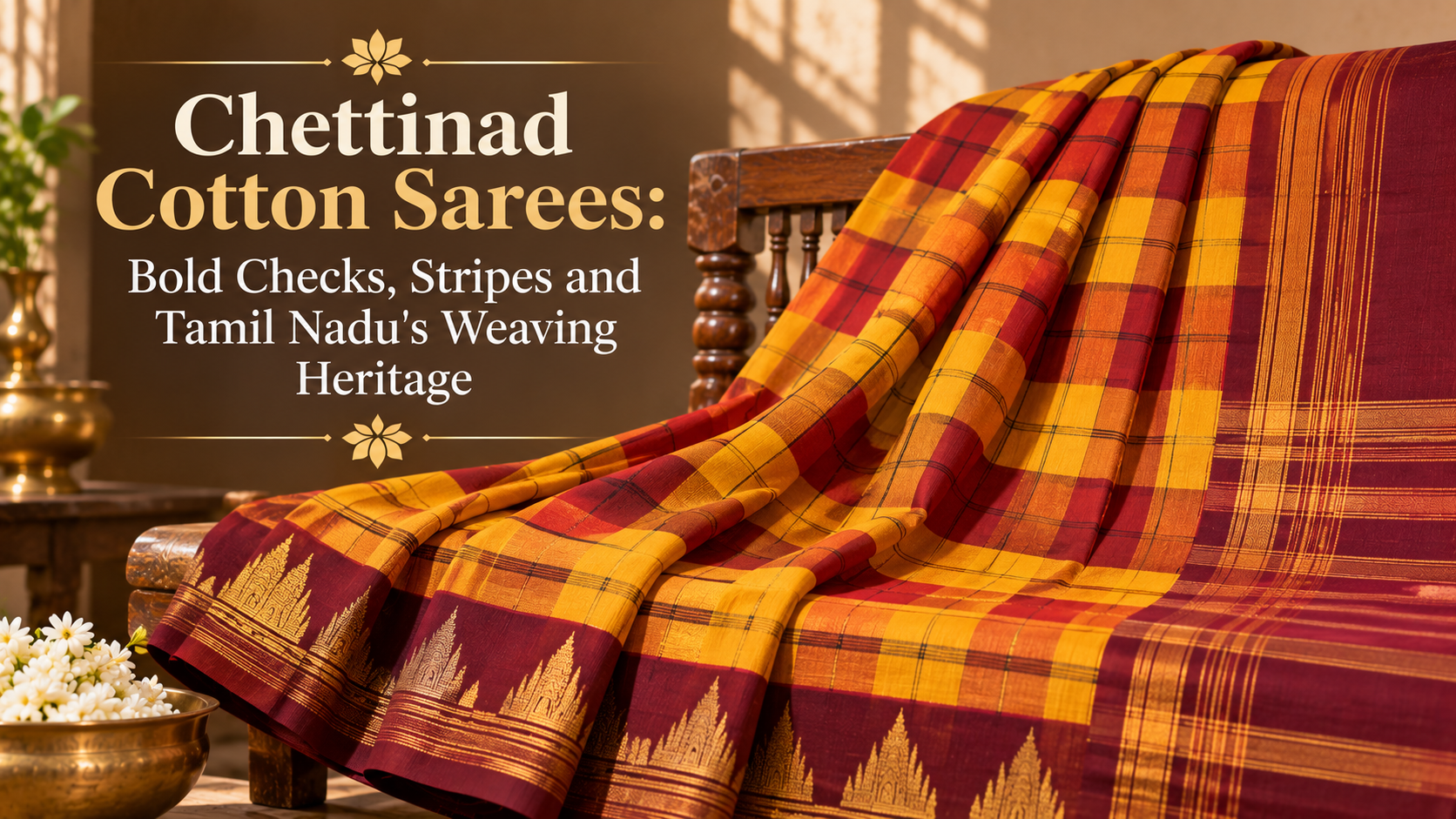
Some sarees whisper and some announce themselves. The Chettinad cotton saree belongs to the second group: strong checks or stripes in saturated colour, and a broad contrast border that can take up a large part of the cloth. It looks unmistakably South Indian, and it is rooted in one small corner of Tamil Nadu around Karaikudi.
The name causes some confusion, though. Shops and listings use Chettinad saree, Chettinad cotton saree and Kandangi saree almost interchangeably, even when the sarees are quite different. This guide untangles the terms, explains the history, the design vocabulary and the weaving process, and shows how traditional Kandangi weaving differs from the Chettinad-inspired cotton sarees widely sold today. It also suggests how to wear and choose them. Where sources disagree, the text says so.
The Chettinad region and its people
Chettinad is not an administrative district. It is the name given to a group of villages in southern Tamil Nadu that were the home of the Nattukottai Chettiars, also called Nagarathars, a community of merchants and bankers. According to the Geographical Indication application for Kandangi sarees, Karaikudi in Sivaganga district can be considered the centre of the group. Karaikudi is known for its grand Chettinad houses and temples, and the application describes it as a place with a strong tradition of local crafts.
That cultural setting matters for the saree. The cloth was made in the region and worn by the women of the community who lived there, and its look developed around local taste, local climate and local patronage.
Chettinad saree and Kandangi saree: getting the terms right
The most useful distinction is this. Kandangi is the traditional weave and the name under which the saree is registered as a Geographical Indication, which was granted in 2019. Chettinad is the region, and Chettinad cotton saree is a broader commercial label. A traditional Kandangi saree is a Chettinad cotton saree, but many sarees sold as Chettinad cotton are not traditional Kandangi sarees.
The GI application says the word Kandangi comes from the checked pattern that is the recurring motif of the saree. It also names the product Kandangi sarees, also called Kandangi cotton sarees. Another published description notes that Chettinadu and Koorainad are two regional styles of the Kandangi tradition, with Koorai described as a modified version made with silk and cotton threads. Since sources vary on these finer points, treat them as signals to ask questions, not as settled rules.
In practice you will meet at least three things under the Chettinad name: traditional Kandangi weaving from Karaikudi, handloom cotton sarees woven in a similar style with finer yarn and different borders, and mill or power loom sarees that borrow the look of checks and bold borders. This article keeps them separate.
History of Kandangi and Chettinad cotton weaving
Sources agree that Kandangi weaving is old but disagree on how old. The GI application says the art has been practised for more than a century and a half. Other published accounts say about 200 to 250 years. The GI application credits the Devanga Chettiars, a weaving community said to have migrated from the Karnataka region, with making the sarees for the women of the Nagarathar community. A different account says the weaving community came from the former Saurashtra region. These accounts conflict, so this article does not pick one, and the safe reading is that the weaving was carried out by migrant weaving communities and patronised by the Nagarathars.
One source adds that the Kandangi was first made in silk and only began to be made in cotton in the twentieth century, at the request of Nagarathar women who wanted something more affordable and practical in the heat. The GI application, by contrast, presents cotton as chosen for the tropical climate. Either way, cotton became the form that defined the saree. If you are weighing cotton against silk for everyday wear, our comparison of cotton vs silk sarees covers comfort, care and cost.
Over time the sarees spread beyond the community that first wore them. The GI application says women from other communities adopted them for their durability and their suitability for hot weather, and weavers sold them from door to door and in cities.
Bold checks, stripes and colours
The visual identity of the Kandangi saree is its pattern. The GI application describes a typical saree as checked or striped in vivid colours, with fine stripes and checks running both horizontally and vertically. Traditional hues listed in the application include mustard, earthy red, orange, brown and chrome shades, with black used sparingly. Earlier sarees are said to have used bright mustard, maroon and black in the usual arrangement of stripes, checks and large borders, and later weavers added more colours while keeping the saree lively.
The effect depends on balance. A body of fine checks in one colour family might be set against a border in a clearly different colour, and the stripes may be spaced evenly by the weaver through careful planning of the dyed yarn. The result is geometric, graphic and easy to recognise, even from a distance.
Contrast borders and pallu
The border is the other half of the saree’s identity. The GI application describes large contrast borders, and says some sarees have borders covering up to two thirds of the saree. The borders traditionally carry temple motifs or checks. The same application says dobby technique is used to make the pallu and the borders, which is why those parts can hold more detail than the body.
Not every Chettinad cotton saree on the market follows this arrangement. Many modern handloom versions have narrower borders, woven zari lines or small motifs scattered through the body. Those can be lovely, but they are not the same as the traditional broad temple or check border, so judge each saree by what is in front of you.
Cotton yarn, weave structure and fabric feel
The GI application states that traditional Kandangi sarees use cotton yarn of 40s count, which produces thick, coarse fabric described as able to withstand rough washing. It adds that 60s, 80s, 100s and 120s counts are also being used lately. Another source says the sarees currently made in Karaikudi with 60s count yarn are modified versions of the original Kandangi.
This matters for how the saree feels. A saree woven from coarse 40s yarn will be heavier and stiffer than one woven from finer counts. It tends to be sturdy and breathable, and many wearers find it softens with repeated washing, though that varies with the yarn and finishing. A finer count produces a lighter, softer saree with a more fluid drape. Both can be good cotton sarees, but they are not equivalent, and only the first is close to the traditional description. Ask for the yarn count or weight if feel matters to you.
How a traditional Kandangi saree is woven
The GI application describes the process in some detail. This is a summary, and workshops vary.
Dyeing and drying the yarn
Weavers buy cotton yarn and dye it in the colours they want. The application says natural dyes extracted from vegetables are preferred, with black, red and yellow named, and notes that synthetic dyes are also used nowadays. Yarn is dyed either at the weaver’s home or by a local dyer and dried in the open air to keep the colours bright.
Winding and warping
Dyed yarn is wound onto spools, with breakages checked and joined, using a winding machine or a charkha. The spools go to a warping machine to make the warp. Warping for Kandangi sarees is usually done for four sarees together, roughly 22 metres of cloth, according to the application.
Preparing the weft
The weft is wound onto smaller spindles and bobbins. The application notes that wefting is done after an order is made, so the weft colours can change from one saree to the next, while the warp colours stay fixed. Separate bobbins are used for borders and pallu.
Piecing and loading the loom
Before weaving, ends on the reed and heald set up are joined to the new warp by twisting the threads together on the warp beam. The prepared warp is then loaded on a fly shuttle loom.
Weaving
The weaver passes the fly shuttle through the warp. For stripes, the weaver plans the dyed yarn and its tying on the loom so that stripes are evenly spaced. The dobby technique makes the pallu and borders. A wooden frame is used to wrap the woven cloth at regular intervals so weaving can continue, and extra colours can be introduced by passing thread directly through the warp during weaving.
Artisan practices and the weaving community
The GI application says Kandangi sarees are woven in the homes of the weavers and describes the work as a team effort of the families of Karaikudi, with a saree taking about a week to complete. Several accounts describe a declining craft. One cultural source says Karaikudi once had nearly a thousand weavers organised in about fifty clusters and saw a steep decline, attributing it in large part to imitative designs from other parts of Tamil Nadu. Another says only three weaving groups remain of the original fifty. The numbers differ, but they point the same way: genuine traditional Kandangi weaving is a small and fragile craft today.
That context explains two things. It explains why the GI tag was sought, and it explains why Chettinad-inspired sarees made elsewhere are so common. Buying a Chettinad cotton saree that is clear about its origin and method helps keep the distinction visible.
How Chettinad cotton sarees were worn and how to style them today
Traditionally these sarees were worn by women of the Nagarathar community and, later, by women of other communities as everyday and household cotton. The GI application highlights their appeal in summer and their ability to endure frequent washing. Published sources I reviewed do not document specific drapes or ceremonial uses in detail, so this article does not invent any.
Today the saree is worn far more widely and in more ways. A body of checks and a bold border works well with a plain blouse in one of the border colours, or with a contrast blouse in a darker shade. Simple jewellery lets the weave carry the look, and a structured fabric holds pleats well. These are styling suggestions, not tradition. If you want a broader view of cotton for everyday use, our guide to cotton sarees for daily wear compares cotton traditions across India and explains what suits each routine.
For occasions, a Chettinad cotton saree suits daytime functions, family gatherings, festivals and work. Think about the weather, how long you will wear it and how formal the setting is. Our complete guide to buying sarees for women helps you match fabric and weight to the event.
Traditional Kandangi vs contemporary Chettinad-inspired cotton sarees
The table sums up general tendencies, not fixed rules. Individual sarees vary, and a seller’s description matters more than the label.
| Feature | Traditional Kandangi | Contemporary handloom Chettinad cotton | Chettinad-inspired mill or power loom cotton |
| Fabric | Thick, coarse cotton, traditionally 40s count | Often finer counts such as 60s and above, softer feel | Varies widely, often fine and lightweight |
| Patterns | Recurring checks or stripes, fine lines in both directions | Checks and stripes, plus extra weft motifs or zari lines | Printed or woven checks that imitate the look |
| Colours | Mustard, earthy red, orange, brown, chrome, minimal black | Wider palette, pastels and modern combinations | Any colour, often bright and uniform |
| Borders | Large contrast borders, sometimes up to two thirds of the saree, with temple or check designs | Broad or medium borders, sometimes with zari | Contrast borders that may be printed or woven |
| Production | Hand woven in weavers’ homes in and around Karaikudi on fly shuttle looms, dobby for borders and pallu | Handloom production in or beyond Karaikudi, methods vary | Machine made, often outside Tamil Nadu |
| Dyes | Natural dyes preferred, synthetic dyes also used | Mixed | Typically synthetic |
| Typical use | Everyday and household wear, summer, durable use | Daytime functions, work, festive casual | Everyday wear, budget purchases |
| Origin claim | Kandangi under the GI registration | Chettinad style, origin varies | Chettinad style only |
Treat the last row with care. A listing that says Chettinad is not a guarantee of Karaikudi origin, and a listing that says Kandangi should be able to explain where and how the saree was made.
How to choose a Chettinad cotton saree
Start by asking what you want. If you value the traditional weave, look for a seller who can say where the saree was woven, whether it is handloom, which yarn count is used and which dyes are used. If you simply like the look and want an easy everyday saree, a Chettinad-inspired cotton saree can be a perfectly good choice, as long as it is described honestly.
Then look closely at the cloth. Checks should be even, borders should sit cleanly, and colours should look consistent in natural light. Test for colour bleed if the label allows it, since bold colours can run in early washes.
If you are shopping online, our online saree shopping guide shows how to read descriptions, judge photographs and check seller details before you pay.
Caring for a Chettinad cotton saree
Follow the label. Wash a new saree separately at first because bold dyes can release colour. Use mild detergent and cool water, dry in shade to protect the colour, and iron while slightly damp. Store the saree folded in a clean cotton cloth and away from damp.
Frequently asked questions
What is a Chettinad cotton saree?
A Chettinad cotton saree is a cotton saree associated with the Chettinad region of Tamil Nadu, known for bold checks or stripes and broad contrast borders. The name is used for both traditional Kandangi sarees and many Chettinad-style sarees made elsewhere.
Is a Chettinad saree the same as a Kandangi saree?
Not always. Kandangi is the traditional weave and the registered GI name. Chettinad is the region and a broader commercial label, so a traditional Kandangi is a Chettinad cotton saree, but not every Chettinad cotton saree is a Kandangi.
Where is the Kandangi saree woven?
According to the GI application, in Karaikudi in Sivaganga district of Tamil Nadu and around it, mainly in the homes of weavers.
What colours are traditional for Kandangi sarees?
The GI application lists mustard, earthy red, orange, brown and chrome shades, with black used sparingly. Modern sarees use many more colours.
Are Chettinad cotton sarees handwoven?
Traditional Kandangi sarees are described as hand woven. Many Chettinad-style sarees on the market are woven on handlooms or made on power looms, so ask the seller how a specific saree was made.
Are Chettinad cotton sarees good for summer?
Cotton is widely worn in hot weather, and published descriptions highlight these sarees for summer use. Comfort still depends on yarn count and weave, so a finer count will feel lighter than a coarse one.
Why are checks so important in a Kandangi saree?
According to the GI application, the word Kandangi comes from the pattern of checks that recurs on these sarees, which makes checks central to the identity of the weave.
How should I wash a Chettinad cotton saree?
Wash it separately at first, in cool water with mild detergent, and dry it in shade. Follow the care label, because dyes and finishes differ between sarees.
Conclusion
The Chettinad cotton saree is a good example of how a regional weave can become a style that travels. Its bold checks, stripes and broad borders come from the Kandangi tradition of Karaikudi, a craft with a documented identity and a fragile present. The same look now appears in many forms, from careful handloom work to simple imitations.
Knowing the difference helps you choose well. Ask where a saree was woven, how it was made, what yarn and dyes were used, and then decide whether the traditional weave or an inspired version suits your wardrobe. Either way, a well chosen cotton saree in strong colour is a pleasure to wear.
