
Blog
Chikankari Sarees: Lucknow’s Traditional Embroidery, Stitches and Fabric Designs

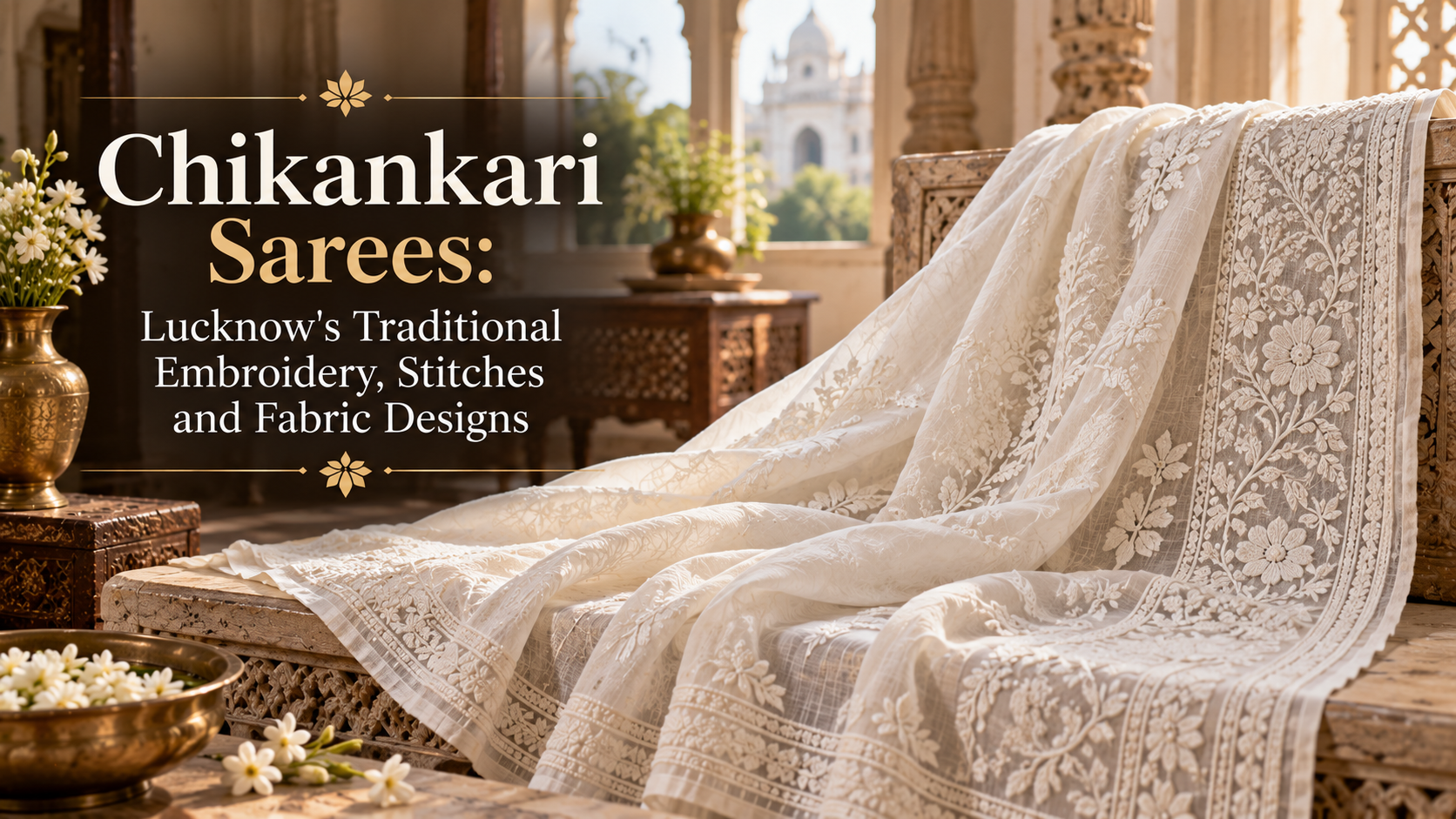
A Chikankari saree brings the fine needlework tradition of Lucknow to one of India’s most recognisable garments. Its appeal is not based on heavy ornamentation. Instead, delicate floral patterns, fine outlines, textured knots and openwork details create depth across the fabric. A white-on-white design may look understated from a distance, but closer inspection reveals the small changes in texture that make the embroidery distinctive.
Chikankari is a form of hand embroidery associated especially with Lucknow in Uttar Pradesh. It is used on garments and household textiles, including sarees, dupattas and kurtas. The craft has adapted to changing tastes and materials: traditional white thread on fine cotton remains an important reference, while contemporary work may use coloured threads, silk, georgette, chiffon, organza and other bases.
It is important, however, not to assume that every saree sold as “Chikankari” is entirely hand embroidered. The term may describe genuine handwork, machine embroidery, printed patterns or a combination of techniques. Understanding the stitches, fabric and production process helps a buyer ask better questions and judge what a particular saree actually offers.
This guide focuses on Chikankari sarees: their Lucknow identity, the stages of embroidery, the stitches and motifs used, how fabric affects the result, and the practical differences between hand embroidery and printed imitations.
1. What Is Chikankari?
Chikankari, also written as chikan or chikankari embroidery, is a decorative needlework tradition in which motifs are built from a repertoire of stitches. Floral forms, leaves, vines, buds and paisley-like shapes are common. The work can be flat and fine, raised to create small textured elements, or open and net-like through jaali work.
Traditional Chikankari is strongly associated with white embroidery on white or pale fabric. This restrained palette allows the stitch structure to create the design. The embroidery may be subtle when viewed straight on and more visible when light falls across the raised or recessed sections.
The craft is not defined by one single stitch. A design may combine outlining, filling, shadow work, knots and openwork. The selection depends on the motif, the fabric’s weave and thickness, and the effect the embroiderer intends to create. Technical and craft resources describe a much wider stitch repertoire than the six names most often introduced to new learners; counts vary across references because some list basic stitches while others include derivatives and specialised jaali forms.
A Chikankari saree applies this embroidery to the body, border, pallu or selected panels of a saree. The placement may be sparse, with small butis scattered across the body, or more elaborate, with floral vines and denser embroidery concentrated along the pallu and border.
2. Lucknow’s Chikankari Identity and Historical Background
Lucknow became the best-known centre of Chikankari and remains closely identified with the craft. The city’s courtly culture, textile trade and network of skilled embroiderers helped establish a distinctive regional practice. Today, Chikankari is also an important source of work for artisan communities and home-based embroiderers in and around the city.
The early history of Chikankari is not documented in one universally accepted account. Popular narratives connect its development with Mughal court culture and sometimes attribute its introduction to Noor Jahan. Other craft histories describe related forms of chikan work in Bengal and eastern centres, followed by the growth of a specialised Lucknow tradition. It is therefore more accurate to describe Lucknow as the craft’s major historic and contemporary centre than to present one romantic origin story as settled fact.
The craft’s regional identity is recognised in India’s Geographical Indications framework. “Lucknow Chikan Craft” is registered as a geographical indication, associating the recognised craft with Lucknow. A GI is an indication of geographical origin and reputation; it should not be treated as a blanket guarantee that every product using the word “Chikankari” in a retail listing is hand embroidered or made by a particular artisan.
Chikankari’s production has also changed over time. Traditional work was associated with fine cotton and white thread, but modern demand has expanded the range of fabrics, colours, products and price points. The craft is practised through different production arrangements, including specialist embroiderers who work on particular stitches or stages. That diversity is part of the present-day market, and it makes clear product descriptions especially important.
3. How a Chikankari Saree Is Made
A hand-embroidered saree passes through several stages. The precise sequence and division of labour can vary by workshop, fabric and design, but the broad process is commonly described through design printing, embroidery, washing and finishing.
Stage 1: Selecting and preparing the fabric
The base fabric is chosen according to the intended drape and embroidery. Fine cotton and muslin are associated with traditional Chikankari, while organza, chiffon, georgette, silk and other materials are used in contemporary products. The fabric must be suitable for the selected stitches: open jaali work, for example, requires a ground in which threads can be carefully separated and secured.
The fabric is checked for defects and prepared so that the design can be transferred evenly. On a saree, the placement plan matters because the body, border and pallu have different visual roles. A design intended for a narrow border will not necessarily work unchanged across a broad pallu.
Stage 2: Design transfer or chapai
The design is commonly transferred using carved wooden blocks and a temporary printing medium. This stage is often called chapai. The block is pressed onto the fabric to leave a guide for the embroiderer. Sources describe temporary colours such as neel and safeda; these marks are intended to be removed during washing after the embroidery is complete.
The printed outline is a guide, not the finished decoration. The final appearance depends on the accuracy of the hand stitches, the thread, the fabric and the embroiderer’s interpretation of the pattern. A saree may be passed through several hands, particularly when different artisans specialise in particular stitch types.
Stage 3: Hand embroidery or tankha
The embroidery stage is often referred to as tankha. Artisans work the selected stitches into the marked design. Some stitches outline a petal or stem; others fill a shape, create a raised bud or form a delicate open mesh. The reverse side can be important to inspect because some techniques, especially shadow work, are worked from the back to create their effect on the front.
On a saree, the embroiderer must also consider the fabric’s fall. Very dense work can make a lightweight fabric hang differently, while widely spaced motifs preserve fluidity. The density and location of the work are therefore design decisions as well as technical ones.
Stage 4: Washing and removal of guide marks
After embroidery, the fabric is washed to remove temporary printing marks and other residues. This stage is commonly called dhulai. Washing reveals the finished contrast between the thread and the base fabric. The fabric is then handled carefully so that the embroidery is not distorted.
Stage 5: Finishing and inspection
Loose threads are trimmed, the fabric is dried and pressed or finished according to its material. The saree is inspected for incomplete stitches, uneven tension, stains and damage. Edges, borders and the pallu are checked, and any required finishing work is completed.
For buyers, this process explains why handmade work can involve many hours and several skilled contributors. It does not mean that every product marketed as Chikankari has followed all these steps by hand. Ask the seller which stages are handmade and whether the embroidery is hand done, machine made or printed.
4. Traditional Chikankari Stitches and Their Visual Effects
Chikankari is recognised through its stitch vocabulary. The names and classifications can differ between craft references and practitioner traditions, and some sources group derivative stitches differently. The following are widely documented stitches relevant to understanding the look of Chikankari.
Tepchi
Tepchi is a running or long running stitch. It can form a simple line and is used to outline motifs or establish a foundation for further embroidery. Its visual character is relatively flat and linear. On a saree, it may define stems, leaf edges or the framework of a floral pattern.
Bakhiya
Bakhiya is commonly associated with shadow work. In ulta bakhiya, the stitch is worked from the reverse side of the fabric, producing a soft shadow-like effect on the front. The stitch is often described as a fine herringbone or related filling technique. It is especially effective on light, fine fabrics where the reverse stitching can be seen as a subtle tonal fill.
Some references also describe right-side or sidhi bakhiya work. The precise effect depends on how the stitch is executed and the fabric used. The important distinction for a buyer is that bakhiya creates a worked texture, not a printed grey fill.
Hool
Hool is a small detached eyelet stitch. The fabric threads are opened to create a tiny hole, and the opening is secured with fine stitches. It is often used at the centre of a flower or as a small decorative detail. Well-executed hool has a defined, controlled opening rather than a printed dot.
Murri
Murri is a raised, elongated knot-like stitch, often compared with a grain of rice. It is used to create small embossed details, commonly in flower centres, buds or other compact elements. Its raised texture catches light and gives the motif a dimensional quality.
Phanda
Phanda is a small rounded or pearl-like raised stitch. It is often used for tiny dots, flower centres and decorative accents. It is related in appearance to other knotted stitches but is generally described as shorter and more rounded than murri. Together, murri and phanda can give a floral design a textured, three-dimensional finish.
Jaali
Jaali creates a fine openwork or net-like effect. The fabric threads are carefully separated and secured so that small openings form a regular pattern. It is not simply a mesh printed onto the cloth. The technique requires control because the fabric structure itself is manipulated to create the open spaces.
Different jaali patterns have their own names, including forms such as sidhaul jaali and other regional or workshop-specific variations. The visual result can resemble a fine screen or lattice and is particularly striking when used in small panels or around floral motifs.
Stitch comparison table
| Stitch | General technique | Visual characteristic | Common design role |
|---|---|---|---|
| Tepchi | Running or long running stitch | Fine, flat line | Outlines, stems and basic motif lines |
| Bakhiya | Reverse-side or related herringbone-style work | Soft shadow or filled texture | Petals, leaves and shaded areas |
| Hool | Detached eyelet stitch | Small secured opening | Flower centres and tiny accents |
| Murri | Raised elongated knot-like stitch | Rice-grain or bud-like relief | Buds and embossed floral details |
| Phanda | Small rounded raised stitch | Pearl-like dot | Flower centres and dotted accents |
| Jaali | Threads separated and secured to form openwork | Fine net or lattice | Open panels and decorative mesh details |
These descriptions are practical visual guides rather than a complete technical manual. Stitch names, thread counts and local methods may vary. For detailed study, compare the front and reverse of a sample and consult craft documentation that records the specific technique being discussed.
5. Floral Motifs, Shadow Work and Design Language
Floral motifs are central to the visual language of Chikankari. Flowers, buds, leaves, creepers, vines and paisley-like forms appear in traditional and contemporary designs. Persianate and Mughal-era decorative influences are often discussed in relation to the craft, but individual motifs have evolved through local practice, changing fashion and the preferences of designers and buyers.
A floral motif can be built from several stitch types. Tepchi may outline the stem, bakhiya can shade a leaf, and murri or phanda can add raised detail to a bud or flower centre. Hool may create a tiny eyelet. Jaali can introduce a contrasting open texture beside solid embroidery. The interplay between these techniques is what gives a Chikankari design its visual richness.
Shadow work deserves particular attention. Because the stitching is worked from the reverse in common forms of bakhiya, the front can show a soft, shaded impression rather than a thick raised line. The effect is delicate and works especially well when the thread colour is close to the fabric colour.
On sarees, design placement changes the overall character:
- Scattered butis: Small motifs spread across the body create a light, balanced look.
- Floral vines: Creepers and leaves can run diagonally, vertically or along the border.
- Pallu-focused embroidery: A more elaborate pallu creates a focal point while leaving much of the body simple.
- Border work: Repeated flowers, leaves or geometric arrangements frame the saree.
- All-over work: Dense embroidery creates a more ornate surface and may change the weight and drape.
A restrained white-on-white saree may look very different from a pastel base with contrasting thread. Both can use Chikankari-inspired design, but the colour palette alone does not establish whether the work is hand embroidered.
6. Chikankari Sarees and Fabric Selection
The fabric influences the appearance, comfort, durability and price of a Chikankari saree. There is no single fabric that defines every authentic contemporary example. Instead, the base should be assessed alongside the stitch type and the seller’s description.
Cotton and muslin
Cotton and muslin have a strong association with traditional white-on-white Chikankari. Fine cotton can provide a stable surface for detailed work while remaining breathable. Depending on yarn, weave and finishing, cotton sarees may have a crisp or softer drape.
For a cotton Chikankari saree, inspect whether the fabric is even and whether the embroidery pulls or puckers the ground. Small, well-spaced motifs can suit everyday or daytime use, while denser borders may make the saree more formal. Fabric weight and weave vary, so “cotton” alone does not tell you exactly how the saree will feel. For a separate look at practical cotton options, see Mahavir Cloth Center’s guide to cotton sarees for daily wear.
Georgette
Georgette is a fluid fabric often used for contemporary embroidered sarees. It can create a soft drape and allow the embroidery to stand out against a flowing base. Because georgette can be delicate and may contain different fibre compositions, check whether it is silk georgette, polyester georgette or another blend.
Fine or open stitches need to be suited to the fabric’s stability. Avoid assuming that a georgette saree is hand embroidered simply because the listing uses the term Chikankari.
Chiffon
Chiffon is lightweight and sheer, giving a Chikankari saree a delicate appearance. It can work well with spaced motifs or carefully planned borders. Its lightness also means that heavy embroidery may affect the drape, and the fabric can require careful handling during wear and cleaning.
Ask for the exact fibre composition. Chiffon describes a fabric construction and finish, not necessarily a natural fibre.
Organza and other crisp fabrics
Organza offers a more structured, translucent base. Embroidery on organza can appear sharply defined because the fabric holds its shape differently from chiffon or georgette. The stiffness and transparency can make it suitable for formal or occasion-focused designs, although comfort depends on the fabric and finishing.
Other bases used in Chikankari include silk, voile, linen, mulmul, viscose, polyester and blended fabrics. Each has different properties. The stitch selection, thread thickness and embroidery density should be appropriate to the ground fabric.
For a broader understanding of how fabric blends affect drape, sheen and care, see Mahavir Cloth Center’s guide to cotton silk sarees and their fabric characteristics.
7. How to Recognise Hand Embroidery Versus Printed Imitations
A printed pattern can reproduce the outline and colour placement of Chikankari, but it does not reproduce the physical structure of hand stitches. Machine embroidery can also create stitched decoration, though its regularity and production method may differ from handwork. A careful inspection should focus on construction rather than the product title alone.
Look closely at the stitch surface
Hand embroidery usually has small variations in stitch length, direction and tension. These variations should be consistent with skilled work, not confused with loose threads, missed sections or poor finishing. Raised murri and phanda should have a visible tactile quality. Jaali should show openings formed in the fabric structure.
A printed imitation generally has a flat surface. The motif may look like embroidery in a photograph, but it will not have the same thread relief when touched or viewed from the side.
Inspect the reverse
The back of a hand-embroidered piece can reveal thread paths, knots, starts and ends. The reverse will not always look perfectly tidy, particularly when several stitch types and artisans are involved, but it should show evidence of thread work. In shadow work, the reverse is especially informative because bakhiya is worked from that side in common forms.
A printed fabric may show colour on the front without corresponding embroidery threads on the reverse. Machine embroidery can show stitching on both sides, so the reverse alone does not prove handwork; it is one part of the assessment.
Ask specific questions
Instead of asking only “Is this original?”, ask:
- Is the embroidery done by hand, by machine, printed, or a combination?
- Which stitches are used in the design?
- Which parts are embroidered: body, border, pallu or all three?
- What is the exact fabric and fibre composition?
- Where was the embroidery carried out?
- What care method is recommended?
A seller who can explain the fabric, stitch method and work placement gives you more useful information than a listing that relies only on broad terms such as “premium” or “traditional”.
For a practical checklist on checking fibre descriptions, technique claims and product details when shopping online, use Mahavir Cloth Center’s online saree shopping guide.
8. Chikankari Saree Designs for Different Occasions
Chikankari can be adapted to different settings through fabric, colour, motif scale and embroidery density.
Minimal everyday and daytime designs
A cotton or lightweight blend with small butis and a narrow border can create a restrained look. White-on-white embroidery is a classic option, while pale shades can provide a subtle contrast. For regular use, consider the fabric’s wash instructions and whether the embroidery is likely to snag during daily activities.
Office and semi-formal designs
A saree with a clean body, evenly spaced motifs and a modest pallu can look polished without appearing overly ornate. Cotton, voile and selected blends may offer practical options, depending on climate and personal preference. A smooth, comfortable blouse and a manageable drape help make the outfit suitable for longer wear.
Festive and occasion designs
For a celebration, a more detailed pallu, richer colour or denser floral embroidery can create a stronger visual focus. Organza, georgette and silk-based fabrics are used in contemporary occasion designs. If metallic embellishment or additional decoration is present, check whether it is part of the Chikankari work or a separate embellishment technique.
Contemporary colour combinations
White thread on ivory or pastel fabric remains a recognisable combination, but modern designs also use coloured embroidery. Tonal thread creates a subtle surface; contrasting thread makes the motifs more prominent. The choice should complement the fabric and the scale of the design rather than rely on colour alone to signal authenticity.
9. What Affects the Price of a Chikankari Saree?
Prices can vary considerably because “Chikankari saree” covers products made with different fabrics, stitch densities and production methods. A fair comparison should consider more than the number of motifs or the appearance in a product photograph.
- Embroidery method: Hand embroidery generally involves skilled manual work; machine embroidery and printed designs follow different production processes.
- Stitch complexity: Fine jaali, raised murri and phanda details may require more time and skill than simple outlines.
- Coverage and density: All-over work usually involves more embroidered area than a few scattered butis.
- Fabric and fibre: Cotton, silk, georgette, chiffon, organza and synthetic blends differ in cost, handling and finish.
- Thread quality: Thread fibre, thickness and colour can affect the result.
- Artisan labour and finishing: The number of work stages, specialist skills and quality checks can influence the price.
- Additional embellishment: Sequins, beads, mukaish, badla or other decoration may be added to some designs and should be identified separately.
Do not assume that a high price automatically proves handwork, or that a low price means the product is poor. Ask for clear details and compare products with similar fabric, embroidery method, coverage and finishing.
10. Care and Storage
Care instructions should be based on the actual fabric, thread, dye and embellishments. There is no universal washing method for every Chikankari saree.
- Read the care label and ask the seller for fabric-specific instructions.
- Avoid vigorous rubbing or wringing, which can distort delicate stitches.
- Do not soak a saree unless its care instructions specifically permit it.
- Keep the saree away from rough surfaces, sharp jewellery and accessories that can catch the embroidery.
- Dry delicate pieces away from harsh direct sunlight if the care instructions recommend shade drying.
- Store the saree clean and completely dry, folded in a breathable cotton or muslin cover.
- Refold periodically to reduce the chance of permanent creases along the same lines.
- For valuable, heavily embroidered or uncertain-fibre sarees, use a professional cleaner experienced with delicate textiles.
If the saree includes zari, sequins, beads or other additions, mention these when seeking cleaning advice. A method suitable for plain cotton may not be suitable for an embellished georgette or silk saree.
11. Buying Checklist: Questions to Ask Before Choosing
Use the following checklist to compare Chikankari sarees more confidently:
- Fabric: Is it cotton, muslin, silk, georgette, chiffon, organza or a blend? What is the fibre composition?
- Embroidery method: Is the work hand embroidered, machine embroidered, printed or mixed?
- Stitches: Are named stitches such as bakhiya, tepchi, murri, phanda, hool or jaali used?
- Placement: Is the embroidery on the body, border, pallu or across the entire saree?
- Density: Is the work light, medium or dense, and does it affect the drape?
- Reverse side: Can the seller provide a clear photograph of the back of the embroidery?
- Finishing: Are loose threads, uneven tension, stains or puckering visible?
- Care: What cleaning method is recommended?
- Product details: Is a blouse piece included, and what are the saree’s length and width?
- Return terms: Can the item be returned if the fabric or embroidery differs from the description?
When comparing the overall style and construction of different sarees, Mahavir Cloth Center’s complete saree buying guide offers a wider framework for evaluating fabric, design, drape and finishing.
12. Frequently Asked Questions
1. What is a Chikankari saree?
A Chikankari saree is a saree decorated with Chikankari-style embroidery, a needlework tradition especially associated with Lucknow. Designs commonly use floral motifs and combinations of flat, raised and openwork stitches. The actual production method can vary, so check whether a particular saree is hand embroidered, machine embroidered or printed.
2. Is Chikankari embroidery originally from Lucknow?
Lucknow is the best-known historic and contemporary centre of Chikankari and is the place associated with the GI-recognised Lucknow Chikan Craft. The wider early history is more complex, and accounts differ about the craft’s earliest origins. It is safest to describe Lucknow as its principal recognised centre rather than claim a single uncontested origin story.
3. Which stitches are commonly used in Chikankari?
Commonly discussed stitches include tepchi, bakhiya, hool, murri, phanda and jaali. Other documented stitches include zanzeera, rahet and specialised forms of jaali. Stitch names and classifications vary between craft references and practitioner traditions.
4. What is the difference between murri and phanda?
Murri is generally described as a raised, elongated knot resembling a grain of rice. Phanda is a smaller, rounded or pearl-like raised stitch. Both add texture and are often used for buds, flower centres and small decorative details.
5. What is bakhiya or shadow work?
Bakhiya is a stitch associated with shadow work. In a common form called ulta bakhiya, the embroidery is worked from the reverse side so that a soft shaded effect appears on the front. The exact appearance depends on the stitch execution and fabric.
6. Which fabrics are used for Chikankari sarees?
Cotton and muslin are closely associated with traditional Chikankari. Contemporary products may use organza, georgette, chiffon, silk, voile, linen, viscose, polyester and blended fabrics. The fabric should be identified by its actual fibre composition, not just its appearance.
7. How can I tell hand Chikankari from printed designs?
Look for thread relief, stitch variation and evidence of embroidery on the reverse. Raised stitches and jaali openings should have a physical structure. Printed patterns are generally flat, while machine embroidery is stitched but may have a more mechanically regular appearance. Ask the seller to specify the method rather than relying on the product title.
8. Is every Chikankari saree handmade?
No. The market includes hand-embroidered, machine-embroidered, printed and mixed-technique products. The word “Chikankari” in a listing is not enough to establish the production method. Ask which parts are handmade and request close-up photographs of the front and reverse.
Conclusion
A Chikankari saree brings together Lucknow’s embroidery heritage, a distinctive vocabulary of stitches and the character of its chosen fabric. Tepchi, bakhiya, hool, murri, phanda and jaali each create a different surface effect, while floral motifs and shadow work give the designs their familiar delicacy. Cotton and muslin connect the craft with its traditional visual language, while georgette, chiffon, organza and other bases allow it to evolve for contemporary saree designs.
The most useful way to choose is to look beyond the name. Check the fabric composition, identify the embroidery method, inspect the stitch details and reverse, and understand how the work is placed across the body, border and pallu. These details help distinguish a hand-embroidered piece from a printed or machine-made interpretation and make it easier to select a saree that suits the occasion and care routine.
