
Blog
Balaramapuram Sarees: Kerala’s Traditional Handloom Weaving and Kasavu Craftsmanship

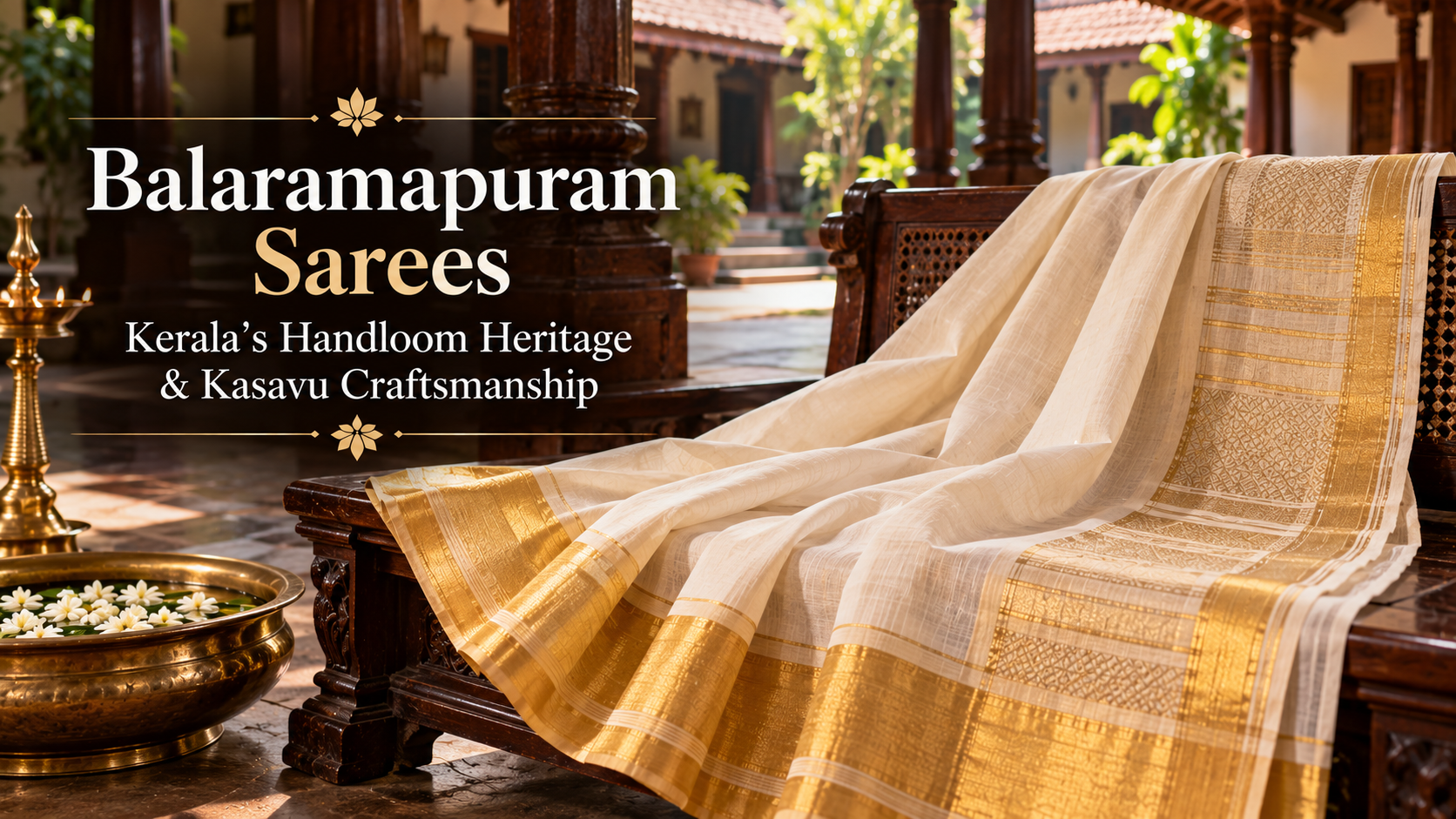
A Balaramapuram saree is recognised for a quiet combination: fine cotton, a natural off-white or cream ground, and the warm gleam of a Kasavu border. Rather than relying on dense all-over ornamentation, the textile makes its impression through the quality of its weave, the clarity of its borders and the skill required to create small, precise woven details. Its restrained appearance is part of its identity, not an absence of design.
The saree belongs to the wider handloom tradition of Balaramapuram in Thiruvananthapuram district, Kerala. The area is associated with a weaving history connected to the Travancore royal household and with generations of specialist weavers. Today, Balaramapuram textiles include sarees, dhotis or mundu, and set mundu, linking the saree to a larger family of Kerala garments.
This guide looks at the history, cotton, Kasavu, weaving methods, design vocabulary and regional significance of Balaramapuram sarees. It also explains what to check when a product is described as a Balaramapuram handloom.
What Is a Balaramapuram Saree?
A Balaramapuram saree is a traditional fine-cotton handloom textile associated with Balaramapuram and the surrounding weaving cluster in Thiruvananthapuram district. Its familiar form is a cream, ivory or natural cotton body finished with a Kasavu or zari border. Some versions feature a cross-border, a decorated pallu, small buttas or additional woven patterns; others retain a largely plain body.
The term should not be treated as a generic name for every white-and-gold Kerala saree. Balaramapuram refers to a particular place-based handloom tradition with documented construction features and a registered geographical indication. Kerala has other important weaving centres, and their products may share a cream-and-gold appearance while differing in local technique, structure and design.
The Government of Kerala’s handloom department identifies Balaramapuram as a historically important centre for fine cotton sarees and fabrics. The official India Handloom Brand profile also describes the traditional products as using fine, unbleached or non-dyed cotton yarn, with Kasavu used for the decorative elements.
Balaramapuram and the Travancore Weaving Heritage
A tradition linked to the royal household
The history of weaving in Balaramapuram is commonly traced back around two centuries and associated with the Travancore royal family. Government handloom documentation records that weaving families were brought from Valliyoor, in present-day Tamil Nadu, during the reign of Maharaja Balarama Varma. The initiative is associated with his Dewan, Ummini Thampi, and with the production of fine textiles for the royal household.
The same accounts describe the settlement of weavers in designated streets and the provision of support to establish their work. Over time, the locality developed as a centre for handloom weaving and other traditional occupations. This background helps explain why the craft is closely tied to place: the town’s identity, settlement pattern and weaving economy developed together.
Historical summaries do not always give identical dates or counts of the families who moved to the area. It is therefore more accurate to describe the tradition as having roots of roughly 200 years, rather than presenting one precise founding date as settled fact.
From royal textiles to a wider Kerala tradition
The craft was not limited to garments for the royal household. Balaramapuram developed a wider production base for fine cotton textiles, including sarees, mundu and set mundu. These products became part of everyday, ceremonial and wedding clothing in Kerala.
The Balaramapuram saree can also be understood in relation to the set mundu tradition. A set mundu is a two-piece garment, traditionally combining a lower cloth with an upper cloth or kavani/neriyathu. The saree offers a single-length drape while retaining visual elements associated with Kerala’s cream-and-Kasavu textile vocabulary.
This evolution is important: Balaramapuram is not simply a decorative saree style. It is part of a regional cotton-weaving ecosystem that produces several related garments.
The Cotton: Fine, Natural and Carefully Prepared
Unbleached cotton and the characteristic ground
Traditional Balaramapuram fabrics are associated with fine cotton yarn in a natural, unbleached or undyed state. This gives the cloth its familiar cream, ivory or slightly grey-white appearance. The exact shade can vary with the cotton, yarn preparation, finishing and the particular product. A natural-looking body should not automatically be described as organically grown or naturally dyed unless the maker provides evidence for that claim.
The restrained colour is functional as well as aesthetic. It allows the texture of the cotton and the metallic-looking border to remain visible without competing patterns. It also makes the saree adaptable to different occasions and blouse colours. For a broader look at how cotton weaves are chosen for comfort and everyday use, see our cotton sarees for daily wear guide.
Fine yarn counts and fabric density
Government and India Handloom Brand documentation lists fine cotton yarn counts, including 80s and 100s, among the traditional specifications. These numbers refer to yarn fineness; they are not a simple quality score that can be applied to every saree in the market. Product specifications can vary, and the count should be confirmed for the individual textile rather than assumed from its name.
A fine, evenly prepared yarn contributes to a clean surface and a light, comfortable fabric. Traditional product documentation also records relatively high thread density and particular reed and pick specifications for certain Balaramapuram products. These details matter because the identity of the cloth comes not only from its colour and border but from how closely and evenly the yarns are arranged.
Sizing and preparation of the warp
The India Handloom Brand description notes that warp yarn is sized with a brush. Sizing applies a protective coating that helps the warp threads withstand the stresses of weaving. The official description explains that the process helps the yarn become more regular in form and contributes to a clear fabric surface with fewer loose fibres.
This is a useful reminder that a fine handloom saree is not created only at the loom. Yarn selection, preparation, sizing and handling all influence the final result.
Understanding Kasavu: The Gold-Look Border
What does Kasavu mean?
Kasavu is the Malayalam term commonly used for zari in Kerala textiles. In traditional Balaramapuram descriptions, the decorative thread is described as a silk thread twisted with a fine silver wire and coated or electroplated with gold. In appearance, it creates the familiar gold-coloured line or band against the natural cotton ground.
The term Kasavu is often used broadly in product descriptions, so buyers should distinguish the visual description from the exact material composition. Not every gold-coloured border necessarily contains the same metal content. Some products may use pure zari, half-fine zari, tested zari or other metallic-effect yarns. The product specification should state what has actually been used.
How Kasavu changes the look of the saree
The contrast between a matte cotton body and a reflective border gives Balaramapuram sarees much of their visual character. A narrow border can make the saree look understated and suitable for a range of settings. A broader border or decorated pallu gives it a more ceremonial presence.
The border may be plain, striped or built around a cross-border effect. Some sarees include small motifs or buttas, while others keep the body largely unadorned. These choices alter the overall mood without changing the central visual relationship between fine cotton and Kasavu.
Border, cross-border and pallu
A Balaramapuram saree may use zari or dyed yarn along the lengthwise borders and across the width at the end or pallu. The cross-border is especially important in the traditional construction descriptions. Government documentation records the use of rib weave for the zari cross-border, creating a horizontal ribbed or bar-like effect.
Not every saree will have the same border width, pallu layout or zari specification. The exact arrangement depends on the design and product. It is better to describe a particular saree from its actual details than to claim that one border arrangement defines every Balaramapuram piece.
How Balaramapuram Sarees Are Woven
The handloom and the weaver’s control
The traditional Balaramapuram process uses handloom weaving, with the weaver controlling the warp and weft as the cloth is formed. The India Handloom Brand profile describes a method in which warp threads are individually controlled by hand to interlace with weft yarn wound on small pirns. This is a technical feature of the documented tradition, not merely a general statement that the saree is handmade.
Kerala Tourism describes traditional Balaramapuram weaving using throw-shuttle pit looms. The exact loom arrangement and equipment can vary across workshops and product types, but the central point is that the textile is associated with a specialised handloom process.
Bamboo reeds and the fine weave
A government cluster study describes traditional weavers’ use of bamboo reeds in the loom. The report records the view that bamboo allows adjustment of the gap between yarns and supports the close spacing associated with the fine fabric. This detail is part of the documented local practice; it should not be generalised to every contemporary loom or every saree sold under the name.
The closely set yarns contribute to the compact appearance and smooth surface of the fabric. The final feel also depends on yarn count, sizing, density, finishing and the care taken during weaving.
Hand-laced motifs and extra-weft designs
The India Handloom Brand description explains that certain butta and larger extra-weft motifs are created by following a printed motif outline. A wooden block may be used to transfer a washable guide design, after which the weaver inserts the extra threads individually along the motif contour.
This kind of hand-controlled work requires patience and precision. The same official description notes that the motif can appear similarly on both sides of the fabric, unlike some other patterning methods where the reverse may show only an outline or loose floats. This is a useful technical distinction when discussing documented Balaramapuram motif work.
Rib weave in the cross-border
The cross-border may use a rib structure produced with a treadle and additional cords. The result is a series of horizontal ridges or bars. This construction helps give the border its distinct visual and tactile character.
The technique also shows why a Balaramapuram saree should not be judged by its colour alone. Two cream sarees with gold borders may look similar from a distance but differ in yarn density, border construction and the way the motifs are integrated into the fabric.
Motifs, Colours and Design Vocabulary
Balaramapuram sarees are often recognised for restraint. The body may be plain, allowing the cotton surface and border to carry the design. Where motifs are present, they can include small buttas, geometric details, temple-inspired forms and decorative elements in the pallu or cross-border.
Gold-toned Kasavu against cream or natural cotton remains the best-known combination. Some contemporary versions introduce coloured borders, dyed yarn, contrast blouse pieces or more elaborate motif placement. These variations can broaden the appeal while retaining a connection to the traditional visual language.
It is important not to treat every motif seen on a Kerala saree as uniquely Balaramapuram. Similar temple, floral or geometric motifs may appear across multiple regional handloom traditions. The location, construction and documented weaving characteristics provide a stronger basis for identifying the tradition than a motif name alone.
Balaramapuram Sarees and Kerala’s Ceremonial Clothing
The cream-and-gold combination is strongly associated with Kerala’s festive and ceremonial clothing. Balaramapuram sarees may be chosen for weddings, temple visits, festivals and family occasions, while simpler cotton versions can also be worn in less formal settings.
The saree’s connection to Kerala’s traditional clothing is especially clear when viewed alongside mundu and set mundu. These garments share the use of natural cotton shades and Kasavu detailing, though their form and manner of wearing differ. The saree translates part of this visual tradition into a single draped garment.
For an occasion, the border width, pallu detail and blouse pairing can change the level of formality. A simple narrow-border saree can be styled with minimal jewellery, while a broader Kasavu border may work well with traditional gold-toned accessories. The textile itself does not require heavy embellishment to make an impact.
Balaramapuram Compared with Other Kerala Handloom Traditions
Kerala has several recognised weaving centres. They share aspects of the state’s textile vocabulary, but they should not be treated as interchangeable.
| Feature | Balaramapuram | Kuthampully | Chendamangalam |
|---|---|---|---|
| Main regional association | Thiruvananthapuram district | Thrissur district | Ernakulam district |
| Recognised products | Fine cotton sarees, fabrics, mundu and set mundu | Sarees, dhoties and set mundu | Dhoties, set mundu and other handloom textiles |
| Common visual character | Natural cotton ground with Kasavu or zari detailing | Often associated with cream-and-gold Kerala textiles | Traditional Kerala handloom products with regional design variations |
| Documented distinction | Fine cotton, specific handloom and motif techniques, registered GI | Separate regional handloom identity and GI products | Separate regional handloom identity and GI products |
| Best way to distinguish | Check origin, construction and product details | Check the named weaving centre and product label | Check the named weaving centre and product label |
The table is a broad guide, not a complete technical comparison. Each cluster contains variations, and the appearance of a saree alone may not establish its place of manufacture. When origin matters, look for a clear producer description and relevant certification.
How to Identify and Buy a Balaramapuram Handloom Saree
1. Check the stated place of origin
Look for a clear description naming Balaramapuram or the recognised production area. A listing that says only “Kerala saree” may describe a broad style rather than a Balaramapuram product.
2. Read the fibre description
Traditional Balaramapuram sarees are associated with fine cotton. Check whether the product is described as cotton, cotton blend or another fibre. Do not assume that a cream colour or a gold border proves the fibre composition.
3. Ask what the Kasavu contains
If the listing uses terms such as pure zari, half-fine zari or imitation zari, ask the seller to explain the material. Gold appearance alone does not establish the metal content. The actual zari specification should be stated clearly.
4. Examine the weave and reverse side
Look for an even surface, consistent thread spacing and a well-finished border. For a saree with hand-laced motifs, inspect the reverse side as well as the front. The official India Handloom Brand description identifies similar motif appearance on both sides as a feature of the documented technique.
5. Inspect the border and pallu
Check that the border runs evenly, the cross-border is finished cleanly and the pallu does not have loose or damaged threads. If the design uses extra-weft motifs, look for clear edges and consistent tension.
6. Ask about certification
Balaramapuram Sarees and Fine Cotton Fabrics is a registered Geographical Indication. The GI record identifies the Government of Kerala’s Directorate of Handlooms and Textiles as the applicant. A GI name is a geographical-origin designation; it should not be treated as a blanket guarantee of every product’s fibre or zari composition. Check the specific product’s label and seller information.
For a broader checklist on comparing saree fabrics, construction and seller descriptions, use our complete saree buying guide. If a product is described as a cotton-silk blend, our cotton silk saree guide explains why the fibre proportions and weave matter. For online purchases, our online saree shopping guide covers product descriptions, fabric claims and seller checks.
Caring for a Balaramapuram Cotton Saree
Care depends on the cotton, dye, zari and finishing used in the individual saree. Follow the maker’s instructions first, particularly when the border contains metallic thread.
- Store the saree clean and completely dry, folded in a breathable cotton or muslin cover.
- Avoid storing it in a damp cupboard or in direct sunlight for long periods.
- Do not scrub the Kasavu border or pull at loose metallic threads.
- If hand washing is permitted, use cool water and a mild detergent, and avoid prolonged soaking.
- Wash coloured or contrast-border sarees separately until colourfastness is known.
- Avoid wringing. Press water out gently and dry in shade.
- For valuable, older or zari-rich sarees, seek professional cleaning advice.
- Refold periodically so that the same crease does not remain under pressure for years.
Cotton can crease naturally. Ironing should be done at a temperature suitable for the fabric, preferably on the reverse and with a protective cloth where the zari is present. Do not assume every Balaramapuram saree can be machine washed simply because its body is cotton.
Conclusion
Balaramapuram sarees bring together Kerala’s fine-cotton handloom tradition, a history associated with the Travancore royal household and the distinctive use of Kasavu. Their character lies in the natural cotton ground, carefully prepared yarn, close weave, hand-controlled motifs and ribbed border details. The saree is also part of a wider textile tradition that includes mundu and set mundu, making it an important expression of the region’s clothing heritage.
When choosing one, look beyond the familiar cream-and-gold appearance. Check the stated origin, fibre, zari description, weave and finishing. These details help distinguish a documented Balaramapuram handloom textile from a saree that simply shares its colour palette.
Frequently Asked Questions
1. What is a Balaramapuram saree?
A Balaramapuram saree is a fine-cotton handloom saree associated with Balaramapuram in Thiruvananthapuram district, Kerala. It is commonly recognised by its natural cream or off-white body and Kasavu or zari border.
2. Where is Balaramapuram located?
Balaramapuram is in Thiruvananthapuram district in southern Kerala. It is known for its traditional handloom cluster and fine cotton sarees and fabrics.
3. What is Kasavu in a Balaramapuram saree?
Kasavu is the Malayalam term commonly used for zari. Traditional descriptions refer to a silk thread twisted with fine silver wire and coated or electroplated with gold. Product compositions can vary, so check the actual zari specification.
4. Are Balaramapuram sarees made of pure cotton?
Traditional Balaramapuram sarees are associated with fine cotton, often in an unbleached or undyed natural shade. Individual contemporary products may vary, so read the fibre composition on the product label.
5. What makes Balaramapuram weaving distinctive?
Documented features include fine cotton yarn, carefully sized warp threads, hand-controlled weaving, hand-laced extra-weft motifs and rib-weave cross-borders. Traditional equipment and workshop practices contribute to the fabric’s appearance.
6. Does Balaramapuram saree have a GI tag?
Yes. “Balaramapuram Sarees and Fine Cotton Fabrics” is a registered Geographical Indication. The official GI record lists the Directorate of Handlooms and Textiles, Government of Kerala, as the applicant.
7. How is a Balaramapuram saree different from other Kerala Kasavu sarees?
The cream-and-gold appearance is shared across several Kerala textile traditions. Balaramapuram is distinguished by its specific place-based weaving heritage and documented construction features. The origin and product details matter more than colour alone.
8. How should a Balaramapuram saree be washed?
Follow the care label and the seller’s instructions. Use gentle handling, avoid scrubbing the zari, keep coloured borders separate until colourfastness is known, and consider professional cleaning for valuable or zari-rich pieces.
