
Blog
Patan Patola Sarees: The Intricate Double Ikat Technique and Gujarat’s Weaving Heritage

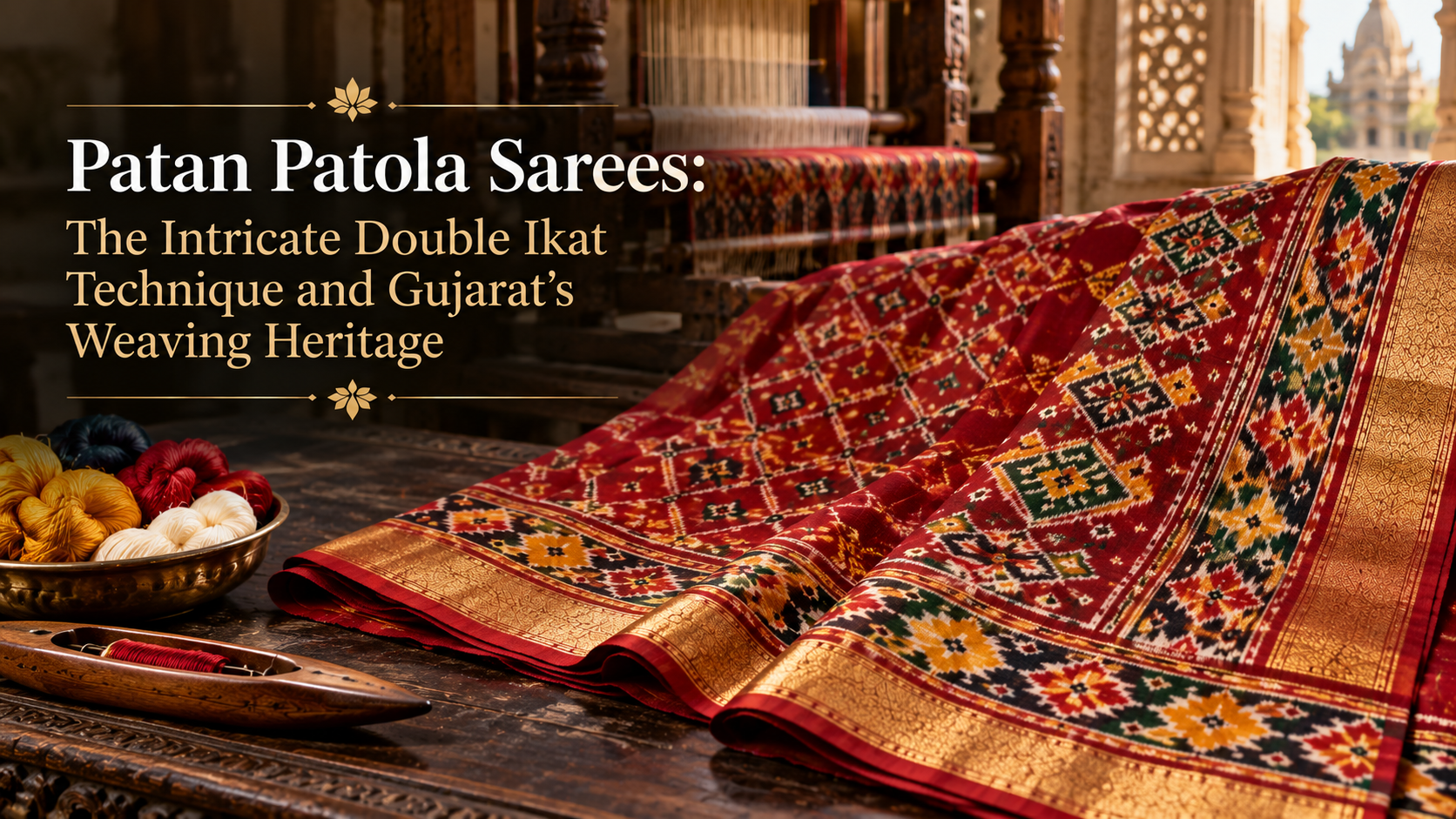
Hold a Patan Patola saree up to the light, then turn it over. The pattern on the back matches the pattern on the front, in the same colours and at the same strength. The Geographical Indications (GI) application for Patan Patola lists this reversibility as a defining feature, and it follows from how the cloth is made: both the warp and the weft are tied and dyed before weaving begins, then matched thread against thread on the loom.
This guide covers where the Patan Patola saree comes from, how the Patola weaving technique moves from raw silk to finished cloth, how geometric motifs and colour sequences are planned, and how Patan’s tradition differs from Pochampally Ikat. The facts come mainly from the GI Journal entry for Patan Patola, the GI Registry database and documentation by India’s National Innovation Foundation (NIF), with museum and press sources for context. Where sources disagree, the article says so.
What is a Patan Patola saree?
A Patan Patola saree is a double Ikat silk textile woven in the town of Patan in north Gujarat. The GI specification describes it as pure silk cloth, made predominantly by members of the Salvi community, entirely by hand and without machines. It gives the length as 5 to 8 yards, the width as 48 to 54 inches and the weight as 460 to 520 grams. A typical piece has two decorated pallavs, a border, and a gold zari band along one side.
Two claims in the specification help to separate Patan Patola from cloth that only looks similar. The design is the same on both faces, so the cloth is reversible. The geometric designs also look the same from any of the four corners.
Patan Patola is often grouped with the Gujarat handloom saree traditions because it is woven by hand. The application is more specific about the equipment. It describes a hand-operated frame loom, slanted at one end and with no foot pedal, and treats it as different from an ordinary handloom.
Patan’s association with Patola weaving
Patan lies about 130 km from Ahmedabad. The GI application says the town was founded in 745 AD by Vanraj Chavda, and NIF describes it as the capital of Gujarat under the Chavda, Solanki and Vaghela rulers until the early fifteenth century.
The link with Patola is recorded as tradition. According to the application, King Kumarpal, a follower of Jainism, wore a fresh patolu every day for worship. The cloths were then imported from the Jalna area in present-day Maharashtra, and the king learned that the ruler of Jalna wore them first, which made them unfit for worship. Kumarpal defeated the Jalna ruler and brought Salvi weavers to Patan. NIF and other accounts put the number at about 700 families and place the event in the second half of the twelfth century.
Scholars are more careful. A MAP Academy entry on Patan Patola says it remains unclear when and how the Salvi community arrived in Patan, and notes that historical literature names Ahmedabad, Patan, Baroda, Bharuch, Surat and Cambay as Patola centres. It adds that Patan is today the only centre in India following the traditional Patola technique. The GI application offers documentary support for the cloth’s age: a 1975 Gujarat gazetteer for Mehsana district that dates Patan Patola to the twelfth century, European accounts of Patola from 1516, an East India Company letter of 1616 and a 2002 Indian postage stamp.
Patola also travelled. A Drishti IAS summary says Indonesia was the major buyer before the Second World War, and a press note based on a government release says Patola became part of local weaving traditions there. MAP Academy records one example: in 1769 the ruler of Surakarta reserved the jlamprang motif for his own family.
For a wider view on saree, see our guide to Buying Sarees for Women.
GI recognition for Patan Patola
Patan Patola is registered as a GI under Application No. 232. The Patan Double Ikat Patola Weavers Association filed it on 9 March 2011 for goods in classes 24 and 25, and it was advertised in GI Journal No. 50 on 7 May 2013. A public GI database lists the certificate date as 9 September 2013.
The specification sets measurable standards, including raw silk of 20 to 22 denier plied eight-fold. It describes a two-tier inspection system: first by the weaving artisans, then by a committee of two association members and one independent agency. It also says Patan Patola is not sold through retail outlets. Customers view albums, agree the design, colour, delivery time and price, and receive the finished piece by hand after inspection.
Three clarifications help readers. Rajkot Patola holds a separate GI registration (Application No. 380, certified 3 October 2018, according to IP Press) and is generally described as single Ikat. A legal commentary notes that the Patan Patola registration protects the name. It does not cover the technique or the motifs, so similar-looking cloth made elsewhere can be sold if it avoids the name. And some weavers have said publicly that cheaper single and double Ikat cloth is sold under the GI name and that the tag has done little for them. Registration is useful, but it does not replace asking the producer about yarn, dyes and process.
The Patola weaving technique: how double Ikat works
Ikat is a resist-dyeing method. Sections of yarn are bound tightly so that dye cannot reach them, the yarn is dyed, and the pattern appears only when the yarn is woven. In single Ikat, only the warp or only the weft carries the pattern. In a double Ikat saree both do, and the weaver must bring the two sets together so that threads from both directions meet at the planned points. The woven structure of Patola is a simple plain weave. The pattern sits in the dyed yarn, and the loom adds no pattern mechanism of its own.
Double Ikat is also recorded outside Gujarat. NIF mentions Bali and Japan alongside India, and Pochampally in Telangana produces it too. The Patan version is defined by a specific combination in the GI specification: pure silk, eight-ply yarn, a hand-operated slanted loom and a set dyeing sequence.
Yarn preparation
The GI application specifies raw silk of 20 or 22 denier, which it says the association imports from China or Japan. Other sources describe different supply routes. NIF notes silk bought in Bangalore as well as imported silk. A 2020 release from the Khadi and Village Industries Commission (KVIC) says Patola makers buy silk yarn from Karnataka or West Bengal, and announced a silk processing plant at Surendranagar in Gujarat to supply the yarn locally.
Eight of the fine raw threads are lightly twisted together to make the yarn used for warp or weft. The hanks are then degummed in boiling water with soda ash and an oily soap made with coconut oil, which removes the sericin gum and leaves the silk soft. The yarn is wound under even tension and given further twist on hand-turned charkhas. Our overview of the saree making process gives the general sequence for any saree, from scouring and degumming to warping. Patola adds the tying stage described below.
Designing on graph paper
Designs are drawn on graph paper, with separate graphs for the body, pallav and border, because the tying follows them. The application borrows much of its process description from Alfred Bühler and Eberhard Fischer’s study The Patola of Gujarat. That text adds that tying is usually done without a sketched model, since weavers are expected to know the common designs well.
Setting up warp and weft
The warp is prepared on pegs fixed to a wall. In the documented example it is about 19 metres long, enough for three sarees, and is marked with a charcoal slurry into three equal sections. The example describes 1,344 warp threads in 112 groups of 12. The threads are counted into sets of seven and layered, so that six layers of warp carrying the same pattern can be tied together.
The weft is wound on a wooden beam in sets of twelve threads, and the weft for two sarees can be prepared in one step. When it is mounted for tying, the weft is stretched on a frame to 48.5 inches, the width it will have on the loom. Fixing these measurements before any dye is applied is what makes later alignment possible.
Tying and dyeing
Tying uses fine cotton cord. Charcoal lines about a centimetre apart guide the worker, who starts at the right end of the frame and moves left. Ties are removed with a wooden-gripped needle, and the yarn goes back onto the frame between baths to receive new ties. Because Patola has several colours, the cycle repeats.
The application states that red is dyed first, followed by yellow, blue and black. In the traditional natural-dye sequence it describes, the worker ties the parts that should stay white, dyes red, ties the parts that should stay red, opens sections for yellow, then ties again and opens sections for blue. Wrappings go on three times and come off three times. Overdyeing gives more colours than there are baths: yellow over red gives orange, and yellow with blue gives green. The finished yarn carries white, yellow, orange, red, blue, green and a violet-black.
The sources on dyes need careful reading. The application lists vegetable dyes such as turmeric, pomegranate skin, indigo and madder, and its materials list also includes chemical agents such as alum and potassium dichromate. In 2005, NIF reported that one family said it used vegetable dyes for some colours, depending on consumer demand. Whether a particular saree is naturally dyed is a question for its maker.
Alignment on the loom
After dyeing, the ties are removed and the bundles are laid out again in their planned order. This stage is slow. The application says about six people are needed for part of it, and broken threads are mended as they appear. The weft is wound onto numbered bobbins in sequence and kept in water until it goes into the shuttle.
The loom is unusual. Its parts are joined by ropes, cords and the warp sheet itself rather than by a rigid frame fixed to the floor, so each new warp amounts to rebuilding the loom. Two people weave. One works the heddle device, pressure bar and shuttle on the right, and a helper on the left keeps the bobbins in order and throws the shuttle back.
Alignment is checked constantly. Weavers confirm that the guide stripes in the warp coincide with the matching weft colours. After roughly five centimetres of cloth, the starch is rubbed off both sides with a steel plate and each weaver goes over the design with a needle, pulling warp threads one by one. The application says this adjustment takes about half an hour. It also says the design is refocused after about 6 to 7 inches of weaving by tugging the warp with an iron rod. Humidity matters as well: damp air makes the silk tangle, and during the monsoon a heater is kept beneath the loom. When the cloth is complete, a half-round plate gives the final smoothing.
Why the weaving process is complex
Patan Patola craftsmanship can be described accurately without superlatives, because the sources document specific reasons for the difficulty.
The pattern is fixed before the cloth exists. If a section was tied in the wrong place, no loom setting corrects it later. Both axes must agree, so an error can come from either set of threads. The yarn is a fine eight-ply silk that breaks and tangles in damp weather, as the application records. The loom is rebuilt for each warp. The Penn Museum summarises the result in plain terms: the weaving is labour intensive because weavers must match the dyed warp and weft in the right order.
The pace is slow. NIF reported that a weaver cannot produce more than 8 to 9 inches of cloth in a day, and that a saree takes about five to six months with three or four assistants, or close to a year if one person does every stage. A press explainer citing a Patan workshop gives three to six months. Design, team size and what is counted as part of the work all change the figure.
The craft is also small. Sources count the practising families differently, from two to four, and the number has shifted over time. NIF recorded four families in 2005. What stays consistent across sources is that very few workshops remain and that skilled workers take a long time to train.
Patola geometric motifs, symmetry and colour
The GI application says Patan Patola has about ten basic patterns, mostly plant, animal and geometric. It explains that in a technique this demanding, geometric motifs naturally predominate. Common figures include parrots, elephants, plants, women, flowers, trellises, baskets and leaves, combined in different ways across the body, border and pallav.
Named designs in the application include narikunjar, ratanchawk, navaratna and voragaji, along with many patterns called bhat, such as chhabdi bhat, chokhta bhat, pan bhat, phul bhat, laheriya bhat and sarvariya bhat. A nineteenth-century patola in the Cooper Hewitt collection has a central field in the ratan chowk bhat pattern, which the museum glosses as a jewel mosaic.
Geometry follows from the method. Each motif is built from units that correspond to counted sections of yarn, so squares, diamonds, stars and lattices are the easiest forms to plan on graph paper and to tie. The application adds that plant, animal and human figures are also arranged in symmetrical patterns, and that motifs are sometimes enlarged in the pallav. For a symmetrical design the layers of warp have to be rotated before weaving. One press explainer says many designs draw on local architecture, including the stone panels of Patan’s eleventh-century stepwell, Rani ki Vav, though the specification itself makes no such claim.
On colour, the specification names red or vermilion as the usual background, with yellow, orange, pink, green, blue, purple, white and black used alongside. Because colours are built up by overdyeing, the palette is planned together with the tying plan and is not chosen afterwards. Customary buyers also shaped design: the application says different buyer groups asked for different designs, usually following religious custom, and MAP Academy notes that among Bohra Muslim families patola are worn by the mothers of the bride and groom at weddings.
Designs have changed with the market. NIF observed that some motifs have been simplified and used for dupattas, scarves, ties and bags. Designers argue this helps keep the skills alive, while people familiar with patola want older designs rediscovered before they fade.
Patan Patola compared with Pochampally Ikat
Both traditions rest on resist-dyed yarn and both hold GI registrations. The differences below come from the registry entries and scholarly entries, and they concern place, scope and organisation more than the basic idea.
| Feature | Patan Patola | Pochampally Ikat |
| Place | Patan, Patan district, Gujarat | Pochampally and nearby villages in Telangana; the GI application names Pochampally, Koyalagudam, Puttapakka, Elanki and Chautupal |
| Local terms | Patola (plural of patolu), Patan na Patola | Pagdabandhu, buddavasi, chitki |
| GI registration | Application No. 232; certificate dated 9 September 2013 (GI database) | Application No. 4; certificate dated 31 December 2004 (GI Registry) |
| Applicant | Patan Double Ikat Patola Weavers Association | Pochampally Handloom Weavers Co-operative Society, with a tie-and-dye silk sarees manufacturers’ association as co-applicant |
| Ikat types | Double Ikat in pure silk, as defined in the specification | Single, compound and double Ikat are all produced |
| Fibres | Pure silk | Cotton, silk and silk-cotton (sico) |
| Production pattern | A few family-based workshops; made to order; not sold through retail outlets, per the application | A group of weaving villages with many weavers and a cooperative society |
| Design vocabulary | About ten basic patterns of plant, animal and geometric motifs; geometric forms predominate; named bhat patterns | Traditional geometric patterns, with a wide range of contemporary designs |
| Historical record | Kumarpal tradition; documentary mentions from 1516 | Scholars treat Ikat in Andhra and Telangana as a relatively recent development with undated origins; Pochampally grew into a centre as Chirala declined |
| Related traditions | Rajkot Patola, a separate GI, generally single Ikat | Telia rumal; Puttapaka Telia Rumal received a GI in 2020 |
Pochampally Ikat is a broad regional label covering several Ikat types and fibres, produced across a cluster of villages. Patan Patola is a narrower, specification-based product made in one town from pure silk. A given piece from either place may differ from these tendencies, since contemporary weavers in both regions produce varied work. For Pochampally’s own process, motifs and fibres, our guide to Pochampally Ikat sarees covers them in detail.
Buying a Patan Patola silk saree: practical checks
A Patan Patola silk saree is made to order and priced for the months of work behind it. These checks keep the questions specific.
Read the name. “Patan Patola” refers to the registered GI. Descriptions such as “Patola style”, “Patola design” or “Patola print” refer to other cloth.
Look at both faces. The design should appear on both sides, with the slight feathering that comes from yarn-dyed patterns. No single visual check is conclusive.
Ask about fibre. The specification calls for pure silk. Fibre labels deserve a close read, and our comparison of silk saree vs silk blend saree explains how to interpret them.
Ask about process. Who tied and dyed the yarn, which dyes were used, and how long did the weaving take? A producer who can answer in detail is a better guide than any visual test.
Compare price with time. Published price figures range from about ₹50,000 to ₹6,00,000 depending on the report and the design. A very low price for handwoven double Ikat silk deserves questions.
Conclusion
The Patan Patola saree is defined by a short list of documented facts. It is woven in one town in north Gujarat, in pure silk, from yarn whose warp and weft were tied and dyed to a shared plan before the loom was set up. The reversible design, the symmetrical geometric motifs and the colour sequence all follow from that method, and the same method explains the slow pace, the small number of workshops and the high prices reported.
Set beside Pochampally Ikat, it shows two regional traditions using the same principle at different scales and with different materials. A reader weighing a Patan Patola silk saree description can test it against four details: the name, the fibre, the dyeing and the weaving time.
Frequently asked questions
What is a Patan Patola saree?
A Patan Patola saree is a double Ikat silk saree woven in Patan, Gujarat. Both warp and weft yarns are resist-dyed before weaving, and the GI specification describes the cloth as pure silk, hand woven and identical on both faces.
Why is a Patola called a double Ikat saree?
Both sets of threads carry dyed pattern. The warp and the weft are each tied and dyed to a plan, and the design appears only where the two sets meet correctly on the loom.
Does Patan Patola have a GI registration?
Yes. Application No. 232 was filed by the Patan Double Ikat Patola Weavers Association on 9 March 2011 and advertised in GI Journal No. 50 on 7 May 2013. The GI database lists a certificate date of 9 September 2013.
How long does it take to weave a Patan Patola saree?
Reports differ. NIF recorded about five to six months with three or four assistants, and about a year for one person working alone. A press explainer citing a Patan workshop gives three to six months.
Is Patan Patola made only from silk?
The GI specification defines Patan Patola as pure silk. Patola-style cloth in cotton or other yarn is woven elsewhere, and it is a different product from the GI-defined Patan Patola.
What are the typical Patola motifs?
The specification lists about ten basic patterns of plant, animal and geometric motifs, with geometric forms predominating. Named designs include narikunjar, ratanchawk and navaratna, and many bhat patterns.
How is Patan Patola different from Pochampally Ikat?
Patan Patola is pure silk double Ikat from one town in Gujarat, made by a few family-based workshops. Pochampally Ikat is a Telangana tradition that includes single, compound and double Ikat in cotton, silk and silk-cotton.
How can I tell a Patan Patola from a printed or single Ikat copy?
Check both faces, read the description for “Patan Patola” versus “Patola style” or “print”, and ask about fibre, dyes, producer and weaving time. No single check is conclusive.
