
Blog
Mangalagiri Sarees: The Story Behind Their Distinctive Nizam Borders and Fine Cotton

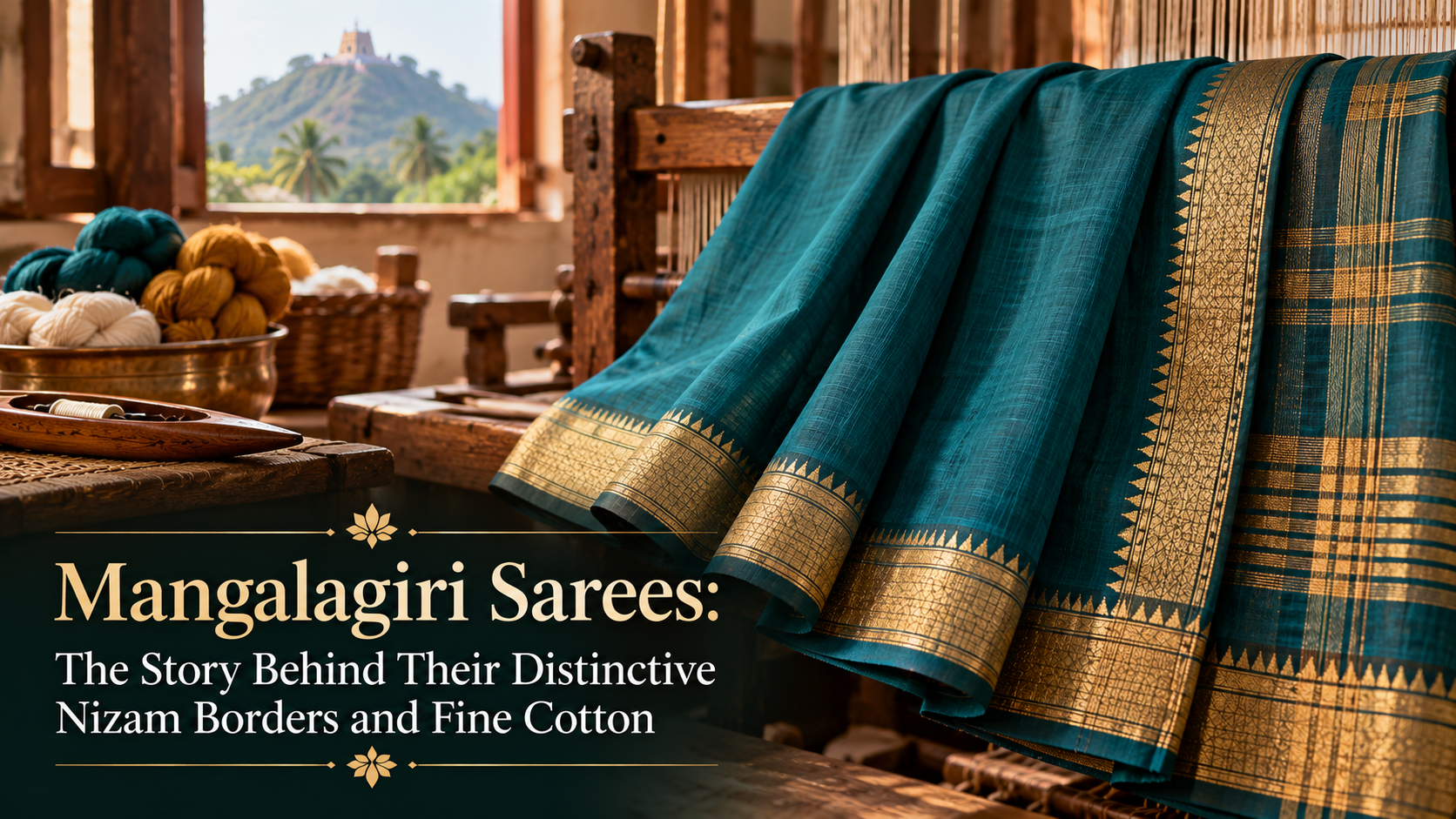
A traditional Mangalagiri saree looks plain from a distance. The body is a single colour, or a quiet check, with nothing woven across it. Then you reach the edge and see a band of gold zari, close to two inches wide, patterned with tiny inverted checks and dots. That band is the Nizam border, and together with the fine, crisp cotton behind it, it is the reason this saree has stayed recognisable for generations.
Mangalagiri is one of the best documented cotton handloom traditions in Andhra Pradesh. It has a Geographical Indication registration, a government handloom profile that describes how its borders are built, and a body of craft writing that is sometimes consistent and sometimes not. This guide sorts the documented facts from the repeated stories: where the weave comes from, how the cotton is prepared and woven, how the Nizam border is constructed, what the plain body and zari details look like, how colours and variations have developed, and how traditional and contemporary designs differ. For the wider variety and shopping experience, see our guide to Buying Sarees for Women.
Mangalagiri and its place in Andhra Pradesh
Mangalagiri is a town in Guntur district of Andhra Pradesh, on the Guntur to Vijayawada road, roughly 12 to 15 km from Vijayawada depending on the source. The name is usually translated as “auspicious hill,” from mangala (auspicious) and giri (hill).
The hill carries the Panakala Narasimha Swamy temple, and the weaving tradition is closely linked to it. A widely repeated account says that pilgrims were expected to buy a saree from local weavers after worshipping at the temple, which supported the weaving community and spread the saree’s name. This is a traditional story and is repeated by craft writers rather than documented in an official record, so it is best read as local tradition.
How old is the weave?
Sources give different ages. The Wikipedia summary of the GI documentation, citing the Andhra Pradesh tourism department, says weaving here is about 400 years old according to inscriptions found in the region. Many craft and retail sources say “over 500 years.” Neither figure is a firm date. The same summary notes that weavers migrated away during Qutb Shahi rule because of increased taxes, and that this hurt the town’s handloom industry before more favourable terms were offered. A safe statement is that Mangalagiri has been a weaving centre for several centuries.
The weavers are commonly described as belonging to the Padmasali community, which is traditionally associated with weaving in Andhra Pradesh. Historical estimates of how many weavers the town has differ widely between sources, so this article does not quote a figure.
The Geographical Indication
“Mangalagiri Sarees and Fabrics” is a registered Geographical Indication. The Geographical Indications Registry lists it as application number 198, filed on 26 February 2010 by the Mangalagiri Sarees and Fabrics Apex Society, Guntur district, under classes 24 and 25. It was advertised in the GI Journal number 45 on 11 September 2012, and the certificate is number 180, dated 15 January 2013. The Ministry of Textiles lists the same date in its register of GI handloom products.
The GI covers both sarees and fabrics, including the cotton dress material that became a major product in later decades. It protects the name and the place of origin. It does not by itself tell you how an individual piece was woven, which is why the construction details later in this article matter.
The traditional cotton weaving process
The GI journal description, summarised in public sources, sets out the production stages for a Mangalagiri saree. Our general explainer on the saree making process covers the stages common to all sarees. These are the ones documented for Mangalagiri:
- Cotton purification. Hank cotton is boiled to remove impurities, soaked overnight and rinsed so that it takes dye properly.
- Dyeing. White sarees are bleached, and coloured ones are dyed with vat dyes. The raw materials listed include pure cotton yarn, silver and gold zari, natural and synthetic dyes and some chemicals.
- Removing excess dye and drying. The dyed yarn is soaked in boiling water to cut out excess dye, then dried.
- Winding. A charkha, bamboo shift and bobbin are used to form the warp, and a pirn is used for the weft.
- Street sizing. The warp is stretched out and sprayed with rice conjee, a starch, which makes the yarn suitable for weaving. The sizing is also part of the saree’s crisp finish.
- Weaving. Weaving is on pit looms only. The ground is a plain warp and weft interlacement, and a dobby attachment forms the border design.
- Cutting, folding and inspection. The cloth is cut to length, and a master weaver checks it for flaws.
The documentation is specific that only pit looms are used. In a pit loom the weaver sits with the treadles below floor level, which suits the strong, even beating needed for a tight weave. Sources describe a plain Mangalagiri saree as quick to weave compared with figured sarees, in a day or two. That fits a saree with no pattern across the body, but weaving time still depends on the border, the zari and the count.
Fine cotton: the fabric and its texture
The Ministry of Textiles handloom profile describes the Mangalagiri saree as a fine count fabric, normally woven with 80s combed cotton yarn in both warp and weft. Some craft sources describe counts from 80s up to 120s, and the same accounts say that the older, coarser 20s and 40s cotton sarees were replaced as lighter fabrics became preferred. Treat 80s as the documented standard and finer counts as available on request.
Combed cotton matters because combing removes short fibres, leaving a smoother, stronger yarn. Combined with rice conjee sizing and the force of a pit loom beat, it produces the tight, even cloth that Mangalagiri is known for. Retailers describe the result as a crisp, firm texture with a gentle sheen and good durability. That is a consistent description across sellers and craft writers, though it is a qualitative one and not a measured standard.
A visible quality of the cloth is its plain weave. The Ministry profile says a genuine Mangalagiri saree has no extra weft designs on the body. The texture comes from the yarn, the sizing and the tightness of the weave and not from added pattern.
The Nizam border and how it is built
What it looks like
The Nizam border is the weave’s best known feature. In the Ministry profile it is the name of the extra warp design in the border, made with zari. Descriptions of finished sarees agree on its look: a band up to roughly two inches wide, in gold or silver zari, patterned with small inverted checks and dots, running along both edges of the saree. Craft writers describe the pattern as geometric and sometimes link it to tribal or temple forms, though those links are interpretations.
Other border patterns appear in the same tradition. Craft documentation lists names such as tilakam, cross button, bulb and rudraksha, usually as border motifs only.
How it is woven
This is the part most listings leave out, and the Ministry profile is clear on it. The Nizam border is an extra warp design. Extra warp means additional warp threads, here zari, are carried on the loom and lifted selectively to form the pattern within the border area. The profile says the border is made on a pit loom with a dobby attachment, using an 8 or 12 lever barrel dobby for the extra warp Nizam design.
That is a different mechanism from the extra weft technique used for the motifs in Venkatagiri or Uppada sarees, where design threads travel across the cloth with the weft. In Mangalagiri the pattern runs along the length of the saree in the warp direction, which suits a border.
A travel writer’s account of a weaving visit says the zari is superimposed over the regular weave and not woven alone as the border, giving a layered look. The Ministry profile does not use that phrasing, but it matches the idea of extra warp threads floating over a plain ground.
Reading a genuine border
The Ministry profile gives two markers for a genuine Mangalagiri saree. The extra warp designs are spread continuously without any gap up to the selvedge, and there are no extra weft designs on the body. Seller descriptions add that the border begins right at the edge of the cloth. These are useful construction clues, but they are not proof on their own, and they do not tell you about the fibre or the zari.
One caution: some retailer pages say the Nizam border is made by changing the weft colour in the border section. That contradicts the Ministry description of an extra warp dobby design, so this article follows the government source.
A note on the name
None of the official sources I reviewed explains why the border is called Nizam. Some craft websites say the Nizam court of Hyderabad was a patron of Mangalagiri cloth in the 18th and 19th centuries. That is repeated in commercial writing but is not supported in the GI or Ministry documentation, so the origin of the name should be treated as an open question.
The plain body, pallu and zari details
The plain body
The classic Mangalagiri body is plain. It may be a solid colour or a shot colour, where the warp and weft threads differ so that the cloth shifts tone in changing light. The plainness is the point of the design, since the border and pallu carry all the decoration.
The pallu
The pallu carries zari stripes. Summaries of the GI documentation describe it as a simple pallu with solid or striped zari threads, in keeping with the border. It does not hold the elaborate motifs found in sarees such as Venkatagiri or Uppada.
Zari
The GI raw materials list both silver and gold zari. In practice, “gold” and “silver” describe the colour of the metallic thread. Whether the thread is pure zari or imitation varies between pieces and sellers, so the type of zari is a separate fact to confirm. A craft writer’s account says zari for Mangalagiri comes from cities such as Surat, Ahmedabad and Bangalore, while the cotton yarn is sourced from the Guntur area, Tamil Nadu and the state handloom agency. These are individual observations, not a fixed supply chain.
Cotton thread borders
A Mangalagiri border does not always use zari. Craft documentation shows Nizam border sarees in which cotton threads replace zari, giving a quieter, tone on tone effect. These are legitimate variations and not a different weave.
Colours and variations
Traditional Mangalagiri sarees use clear, saturated colour. The vat dyes recorded in the GI process give strong colours in the yarn, and many sellers and writers describe them as holding well through washing, though that is a general reputation and not a tested claim.
The tradition has produced several documented variations:
- Shot colour sarees, with a different warp and weft colour, give the plain body a shifting tone.
- Check bodies, including what weavers call missing checks, are a development of the plain body.
- Cotton silk and silk versions exist. The Ministry’s weaver database describes Mangalagiri sarees in cotton and silk with Nizam zari borders, and sellers list silk cotton and silk sarees under the name. The classic fabric remains cotton.
- Silver zari borders and borders in cotton thread give lower key alternatives to gold.
- Dress material is a major product. The GI journal summary notes that from the mid 1980s the market shifted toward dress materials, which are woven with the same fine cotton and extra warp borders.
Traditional and contemporary Mangalagiri designs
Weavers and designers have kept the identity of the weave while changing its range. A craft council account of the Guntur weavers describes the older cloth as plain with Nizam and rudraksha borders, and the newer range as including missing checks, silver borders and other border variations to follow current tastes.
The main differences can be set out clearly.
| Feature | Traditional Mangalagiri | Contemporary adaptations |
| Body | Plain, solid or shot colour | Checks, missing checks and other small patterns |
| Border | Nizam extra warp border in zari, continuous to the selvedge | Silver zari, cotton thread, varied widths and border motifs |
| Fibre | Combed cotton, 80s documented | Cotton silk and silk versions, finer counts on request |
| Products | Sarees | Sarees plus dress material, dupattas and kurta fabric |
| Colour | Vat dyed solid and shot colours | Wider palettes, designer blouse pairings |
The contemporary range is not a departure from the weave’s logic, since the pit loom, the dobby border and the fine cotton are retained. Where a piece moves further away is in its body. A saree with extra weft designs across the body no longer matches the Ministry’s description of a genuine Mangalagiri, even if it carries a Nizam style border and is sold under the name.
I found no documentation on how widespread imitation is for Mangalagiri, so this article makes no claim about it. The practical advice is the same as for any GI weave: ask how the border was woven, what the fibre and zari are, and who wove it.
Mangalagiri compared with other Andhra Pradesh handloom sarees
| Weave | Place | Main fibre | Border and body | Technique notes |
| Mangalagiri | Mangalagiri, Guntur district | Fine cotton, with cotton silk and silk versions | Nizam zari border, plain body, no extra weft on the body | Pit loom with dobby, extra warp border; GI certificate 15 January 2013 |
| Venkatagiri | Venkatagiri, Tirupati district | Fine cotton, with silk versions | Narrow plain gold border, extra weft motifs on the pallu | Pit loom with jacquard for extra weft; GI certificate 11 May 2011 |
| Uppada Jamdani | Uppada, Kothapalli mandal, East Godavari | Silk, with cotton silk versions | Jamdani motifs across body and pallu | GI documentation describes hand woven motifs without dobby or jacquard; certificate 5 March 2009 |
| Dharmavaram | Dharmavaram, Anantapur district | Silk | Broad borders, gold brocade pallus, muted colours | Heavy silk, listed in the Ministry GI register in 2014 |
The comparison shows how differently Andhra weavers use the same loom. Mangalagiri puts its decoration into one extra warp border on a plain cotton ground. Venkatagiri and Uppada move the decoration into extra weft motifs, and Dharmavaram moves it into weight, width and brocade.
Two neighbouring Telangana weaves show the same border centred idea in different forms. A Gadwal saree joins a cotton body to silk borders and pallu on the loom, so the border differs in fibre as well as design. A Narayanpet cotton saree uses checks and bold borders in a related, but different, southern cotton idiom. Setting them beside Mangalagiri makes clear how particular the extra warp Nizam border is.
Frequently asked questions
What is a Mangalagiri saree?
A Mangalagiri saree is a handloom cotton saree woven in Mangalagiri, Guntur district, Andhra Pradesh. It is known for fine combed cotton, a plain body and a zari border called the Nizam border.
What is the Nizam border?
It is an extra warp design in zari woven along the saree’s edges, usually in small inverted checks with dots. The Ministry of Textiles profile says it is woven on a pit loom with an 8 or 12 lever dobby.
Is the Mangalagiri saree GI registered?
Yes. “Mangalagiri Sarees and Fabrics” is application number 198 in the GI registry, with certificate number 180 dated 15 January 2013, held by the Mangalagiri Sarees and Fabrics Apex Society.
What is a Mangalagiri saree made of?
The classic saree is fine cotton, documented as 80s combed cotton in warp and weft, with zari in the border. Cotton silk and silk versions are also woven under the name.
Why is the body of a Mangalagiri saree plain?
The tradition places its decoration in the border and pallu. The Ministry profile lists the absence of extra weft designs on the body as a marker of a genuine Mangalagiri saree.
What is the difference between Mangalagiri and Venkatagiri sarees?
Mangalagiri decorates its border with an extra warp pattern and keeps the body plain. Venkatagiri uses a narrow plain gold border and puts extra weft motifs on the pallu. Both are fine cotton weaves from Andhra Pradesh.
Are all Nizam border sarees from Mangalagiri?
No. Other weavers and mills copy the look. A saree from Mangalagiri weavers should show the extra warp border running to the selvedge, a plain body and a plain weave ground, and the seller should be able to say who wove it.
Are Mangalagiri sarees only made in cotton?
The traditional saree is cotton. The weavers also make cotton silk and silk sarees and a large range of cotton dress materials.
Conclusion
The Mangalagiri saree is built around one idea: a plain, fine cotton ground and a single, carefully made border. The Nizam border is an extra warp zari design woven on a pit loom with a dobby, the cotton is combed, sized with rice conjee and tightly beaten, and the body is left without extra weft pattern. That construction, more than any single motif or colour, is what the GI registration and the Ministry’s description point to.
Contemporary versions have added shot colours, checks, silver and cotton thread borders, silk blends and dress materials without discarding that structure. Some of the commonly repeated stories, such as the origin of the name Nizam, the exact age of the weave and the temple offering tradition, rest on tradition and not on documentation, and they are best treated that way.
Anyone reading about Mangalagiri weaving can use the same few facts as a reference point: the border runs continuously to the selvedge, the body carries no extra weft design, and the fabric is a fine combed cotton woven on a pit loom. A piece that fits those facts, from a seller who can say who wove it, matches what the documentation describes.
