
Blog
How to Build a Festive Capsule Wardrobe with Mix-and-Match Ethnic Pieces

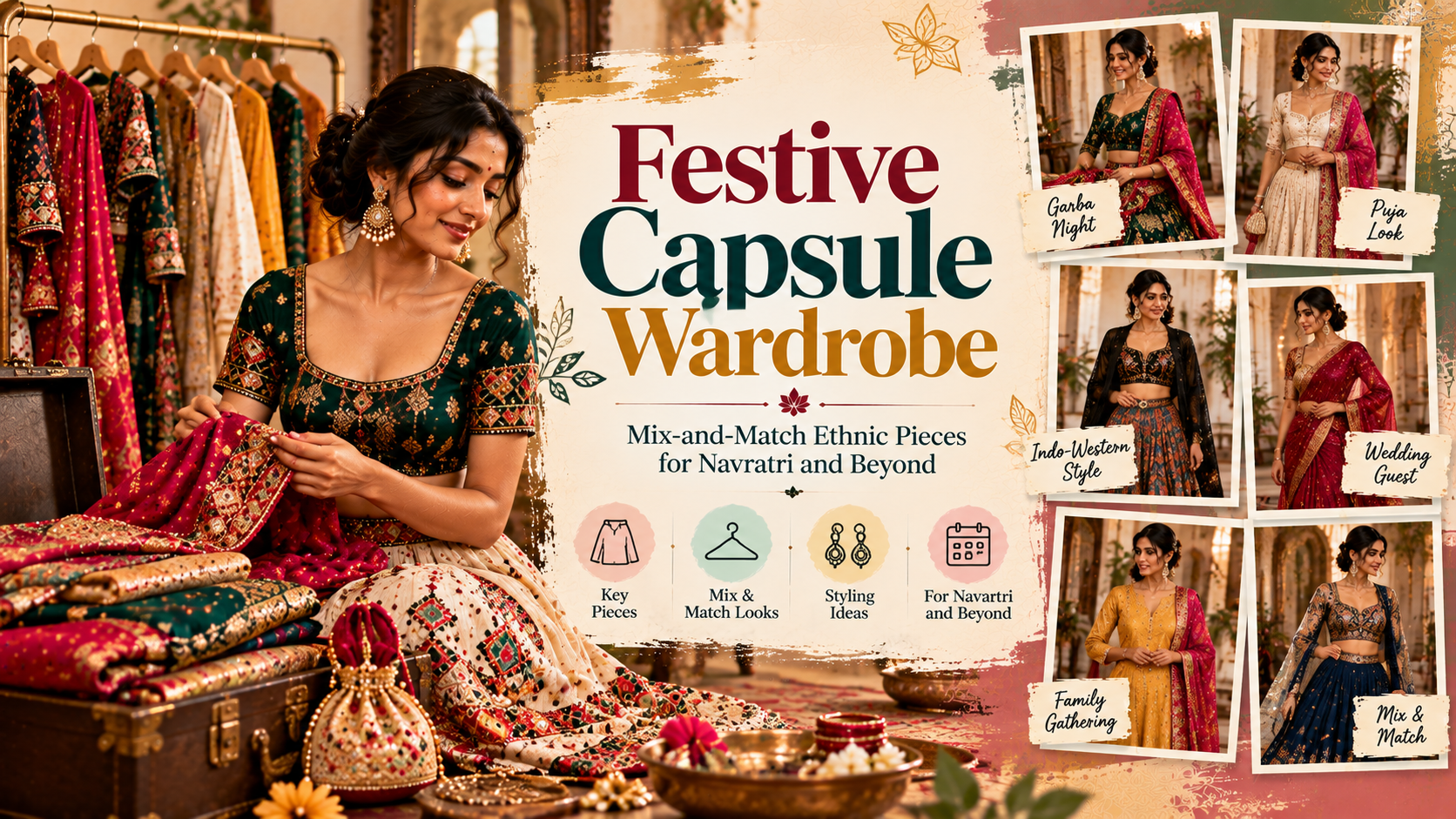
Festive seasons in India come close together. Navratri leads into Dussehra, then Diwali, then wedding season, with pujas and family gatherings in between. Buying a new complete outfit for every occasion fills the cupboard quickly, and many of those outfits are worn once or twice before being folded away.
A capsule approach works differently. Instead of buying complete sets, you build a small collection of pieces that combine with each other: a skirt that works with three blouses, a kurta that pairs with two kinds of bottoms, a dupatta that lifts four different outfits. This guide explains how to plan an ethnic capsule wardrobe, which pieces to prioritise, how to choose colours that work together and how to turn a handful of garments into a range of festive looks. If you are looking for outfit inspiration first, start with our Navratri Outfit Ideas 2026 guide.
What is an ethnic capsule wardrobe?
A capsule wardrobe is a small, planned collection of clothes that can be combined in many ways. The idea comes from everyday fashion, but it suits festive ethnic wear especially well, because so many ethnic outfits are already made of separate parts: a skirt, a blouse and a dupatta, or a kurta, bottom and dupatta.
An ethnic capsule wardrobe has a few features:
- Separates over fixed sets: pieces you can pull apart and recombine.
- A shared colour story: colours that work with each other, so most tops go with most bottoms.
- A few statement pieces: one or two standout items, such as an embroidered dupatta or a brocade skirt, supported by simpler basics.
- Accessories that change the mood: jewellery, belts and dupattas that take the same garment from puja to party.
There is no correct number of pieces. A capsule can be six items or twenty. What matters is that each piece works with several others.
Assess your existing wardrobe first
Before buying anything, see what you already have.
- Take everything out. Gather all your ethnic wear, including sets, separates, dupattas, blouses and jewellery.
- Try things on. Check fit and condition. Set aside pieces that need alterations or repairs.
- Separate sets. Treat each lehenga, suit and saree set as individual pieces. A lehenga skirt may work with a blouse from a different set.
- Group by colour. Look for colours that appear repeatedly. These can become the base of your capsule.
- Identify your favourites. Which pieces do you reach for most? Which ones make you feel good? These tell you what to build around.
- Note the gaps. Perhaps you have three skirts but only one blouse, or several kurtas but no neutral bottoms.
Keep a simple list or take photos of each piece. It makes planning combinations much easier. Our Navratri Shopping Checklist can help you track what you have and what you need.
Essential garment categories
These categories form the backbone of most festive capsules. You do not need all of them.
Versatile skirts
A reusable lehenga skirt in a solid colour, or with a border-only embellishment, pairs with many tops. Consider one flared skirt for Garba and one more structured skirt for weddings, if you need both.
Blouses and tops
Blouses carry much of the variety. A capsule might include:
- A solid blouse in a neutral or metallic shade, such as gold, ivory or black.
- An embroidered or mirror-work blouse for festive evenings.
- A crop top or peplum top for Indo-Western looks.
Choose blouses that can work with both your skirts and your sarees.
Kurtas
A solid or lightly embroidered kurta in a straight or A-line cut works with palazzos, churidars, shararas and even skirts. Our Navratri Suit Designs for Women guide covers cuts that suit festive styling.
Trousers and bottoms
Palazzos, straight pants, churidars, shararas and dhoti pants in neutral colours or in your base colour pair with several kurtas and tops.
Sarees
One or two sarees in colours that match your blouses give you more combinations. A solid saree with a contrasting border is especially flexible. For options, see the Best Sarees to Wear for Navratri 2026.
Dupattas
Dupattas change an outfit more than almost any other piece. A capsule might include one heavily decorated dupatta (such as bandhani, mirror work or zari) and one lighter, solid or sheer dupatta.
Layering pieces
A long jacket, cape, shrug or Nehru-style jacket can turn a simple kurta or skirt-and-top combination into an evening outfit.
Choosing colours that work together
Colour planning is what makes a capsule function.
Pick a base: choose one or two base colours for the pieces you will wear most, such as skirts, bottoms and sarees. Neutrals like ivory, beige, black, gold or navy pair easily, but a strong colour such as deep green or maroon can also be a base.
Add accent colours: choose two or three accent colours for blouses, dupattas and kurtas. These should work with the base and ideally with each other.
Use metallics as connectors: gold, silver and copper accents tie different colours together.
Example palette 1: base ivory and gold; accents rani pink, emerald and mustard.
Example palette 2: base black; accents red, silver and indigo, with mirror work.
Example palette 3: base maroon; accents gold, pink and bottle green.
You can also build monochrome outfits within a capsule by keeping pieces in tones of one colour. Tonal pieces in shades of one colour mix especially easily.
One lehenga skirt, many looks
Here is how a single solid emerald lehenga skirt with a narrow gold border can be styled:
- Traditional Garba: emerald skirt with a multicoloured mirror-work blouse and a red bandhani dupatta, oxidised silver jewellery.
- Puja: emerald skirt with a gold silk blouse with elbow sleeves and an ivory organza dupatta, small gold jhumkas.
- Wedding function: emerald skirt with a heavily embroidered gold blouse and a pink zari dupatta, statement necklace.
- Indo-Western party: emerald skirt with a plain black crop top and a long sheer jacket, statement earrings.
That is four distinct looks from one skirt, using three different blouses or tops and three dupattas or layers, several of which also work with other pieces.
One kurta, many looks
A solid ivory straight kurta with light gold embroidery at the neckline can be styled in several ways:
- Puja: with ivory palazzos and a mustard block-printed dupatta, gold studs and kolhapuris.
- Garba: with a flared emerald sharara and a red bandhani dupatta, oxidised jhumkas and juttis.
- Evening gathering: with straight black pants and a long embroidered jacket, a statement necklace.
- Family lunch: with blue jeans or straight trousers and a light silk stole, minimal jewellery, for a relaxed look.
Changing the bottom, the layer and the dupatta gives each look a different feel.
Reusing saree blouses, dupattas and jewellery
Saree blouses
A well-fitted saree blouse can also be worn with a lehenga skirt. A gold or black blouse, for example, may work with two sarees and one skirt in your capsule. Plan blouse colours around the sarees and skirts you already own.
Dupattas
A single bandhani dupatta might go with a plain kurta set for puja, a lehenga skirt for Garba and a solid saree as a stole for a dinner. A sheer organza dupatta might go with a heavy skirt for a wedding and a simple kurta for a gathering.
Jewellery
A small jewellery collection can cover many outfits:
- One set of gold-tone jhumkas.
- One oxidised silver set for folk and mirror-work outfits.
- Pearl studs or a pearl strand for soft and daytime looks.
- One statement necklace for weddings.
- A maang tikka or a set of bangles for extra occasions.
Rotating these between outfits changes the mood without adding garments.
Outfits for different occasions
Garba: flared skirts, chaniya-style combinations, shararas and Anarkalis with mirror-work blouses and secure dupattas. Prioritise breathable fabrics and movement.
Puja: kurta sets, sarees and skirts with modest blouses, in comfortable fabrics you can sit in. Lighter colours and simple jewellery suit daytime.
Weddings: your most embellished pieces, such as an embroidered blouse, zari dupatta or brocade skirt, with a statement necklace.
Family functions: mid-level styling, such as a kurta with a jacket or a skirt with a solid blouse and patterned dupatta.
Outfit-mixing matrix
Here is a sample capsule of ten pieces and the outfits they can produce. These are examples; your own pieces and colours will differ.
The pieces:
- A: Emerald lehenga skirt (narrow gold border)
- B: Ivory straight kurta (light gold embroidery)
- C: Maroon silk saree (gold border)
- D: Ivory palazzos
- E: Emerald sharara
- F: Gold silk blouse (fits both skirt and saree)
- G: Multicoloured mirror-work blouse
- H: Black crop top
- I: Red bandhani dupatta
- J: Ivory organza dupatta
Combinations:
| Outfit | Pieces used | Occasion |
| 1 | A + G + I | Garba |
| 2 | A + F + J | Puja or family function |
| 3 | A + H + J (worn as a cape) | Indo-Western party |
| 4 | B + D + I | Puja |
| 5 | B + E + I | Garba |
| 6 | B + D + J | Family gathering |
| 7 | C + F | Wedding or evening function |
| 8 | C + G | Festive evening |
| 9 | C + H | Contemporary evening look |
| 10 | E + G + I | Garba |
| 11 | E + H + J | Party |
| 12 | B + E + J | Evening gathering |
That is twelve outfits shown from ten pieces, before changing jewellery or footwear. Each outfit listed has been checked against the colours in the capsule, but how well each works for you will depend on fit and personal taste.
Selecting versatile fabrics, prints and embellishments
Fabrics: cotton silk, chanderi, georgette and soft silks move between daytime and evening well. Very heavy fabrics like velvet are lovely for some events but less versatile.
Prints: small prints and traditional prints such as bandhani and leheriya pair easily with solids. Keep most capsule pieces solid or subtly patterned, with one or two printed statement pieces.
Embellishments: pieces with embellishment only at borders, necklines or hems are easier to restyle than all-over embellishment. Gold or silver details connect with more pieces than coloured embroidery.
Construction: choose garments with enough seam allowance to adjust later, and pieces that are lined where needed, so they stay wearable for longer.
Shopping intentionally
Once you have assessed your wardrobe, shopping becomes more focused.
- List the gaps. For example: “a blouse that goes with both my green skirt and maroon saree” or “neutral bottoms for my kurtas”.
- Check each new piece against your capsule. Before buying, think of at least two or three existing pieces it will work with.
- Avoid near-duplicates. A second emerald skirt in a slightly different shade adds little.
- Prioritise quality and fit for core pieces. The pieces you will wear most deserve the most attention.
- Buy statement pieces deliberately. One striking dupatta or blouse can lift many outfits.
- Consider buying separates. Look for brands or tailors who sell blouses, skirts and dupattas individually.
Garment care, storage and alterations
- Care: follow care labels, and treat embellished and silk pieces gently. Dry clean where recommended.
- Storage: store pieces individually rather than as sets, so it is easier to mix them. Wrap delicate items in cotton or muslin.
- Labelling: keep a list or photos of your capsule pieces and the combinations that work.
- Alterations: adjust fit as needed, so every piece stays wearable. Ask for seam allowance on new tailored pieces.
- Repairs: fix loose hooks, embroidery and hems promptly.
Common capsule wardrobe mistakes
- Buying full sets only. Sets can be harder to mix. Fix: include separates, or break sets apart.
- No shared colours. Pieces do not combine. Fix: build around a base and a few accents.
- Too many statement pieces. Everything competes. Fix: keep most pieces simple and a few bold.
- Ignoring fit. Ill-fitting pieces stay unworn. Fix: alter them or let them go.
- Forgetting the occasion mix. A capsule full of Garba pieces will not cover a wedding. Fix: plan for each occasion you attend.
- Not trying combinations in advance. Fix: try outfits before the season and photograph the ones you like.
Step-by-step checklist
- List the occasions you need outfits for this season.
- Take out and try on all your ethnic wear.
- Separate sets into individual pieces.
- Note fit issues and send pieces for alteration.
- Choose a base colour and two or three accents.
- Identify your core pieces: skirts, kurtas, bottoms, sarees.
- Identify blouses, tops, dupattas and layers that link them.
- Map combinations on paper or in photos.
- List the gaps that would add the most new combinations.
- Shop for those gaps only.
- Plan jewellery and footwear for each look.
- Try on and photograph final combinations before the festival.
Frequently asked questions
1. How many pieces does a festive capsule wardrobe need? There is no set number. Start with what you own and add only the pieces that create new combinations.
2. Can I build a capsule from clothes I already own? Yes. Separate your sets, group by colour and you may find many combinations without buying anything.
3. Which piece is the most versatile? It varies, but solid blouses in neutral or metallic shades and bold dupattas often work with the most outfits.
4. Can a lehenga skirt be worn with a saree blouse? Often, yes, if the colours and fit work together.
5. Which colours work best for a capsule? Neutrals and metallics are easy bases. Choose accent colours you enjoy that work with the base and with each other.
6. How do I make the same outfit look different? Change the dupatta, jewellery, layering piece or footwear, or try a different drape.
7. Should I buy separates or full sets? Separates are easier to mix, but sets can be broken up too. Choose what suits your wardrobe and budget.
8. Will people notice I repeat pieces? Different combinations, dupattas and accessories make each outfit look distinct. Many people are also choosing to rewear clothes deliberately.
9. Does a capsule work for weddings as well as Navratri? Yes, if you include a few dressier pieces, such as an embroidered blouse, a silk saree or a zari dupatta.
Conclusion
An ethnic capsule wardrobe lets you dress well for every festive occasion with fewer, better-chosen pieces. The method is simple:
- Assess what you already own and separate sets into individual pieces.
- Choose a colour story with a base and a few accents.
- Map combinations for each occasion, using skirts, kurtas, sarees, blouses and dupattas.
- Fill only real gaps, choosing pieces that work with several items.
- Care for and alter your pieces so they stay wearable.
- Try and photograph combinations before the season begins.
Start with the clothes already in your cupboard. You may find you have more festive outfits than you thought.
