
Blog
Dhakai Jamdani Sarees: Bengal’s Fine Muslin Weaving, Intricate Motifs and Heritage

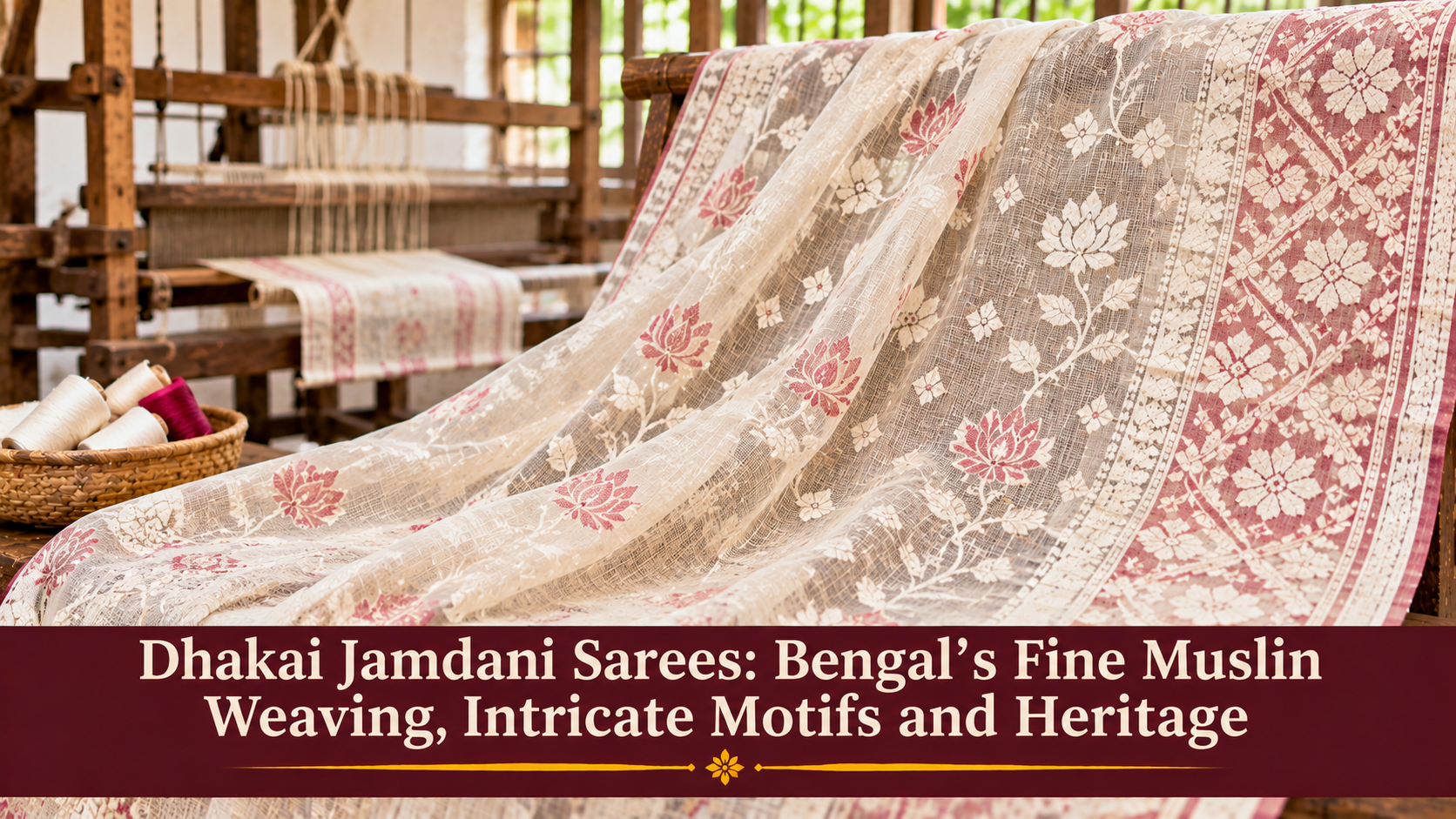
A Dhakai Jamdani saree can look plain from across a room. Up close, the motifs sit inside the cloth itself, formed by extra threads that a weaver places by hand while the saree is still on the loom. That one detail explains most of what people ask about Jamdani: why it takes so long to make, why no two pieces are exactly alike, and why printed copies and machine versions never quite match it.
This guide covers the history of Dhakai Jamdani, the weaving method, the main motifs and layouts, the difference between Bangladeshi and Indian Jamdani traditions, and what to check before you buy. If you are still deciding between fabrics in general, our complete guide to buying sarees for women is a useful place to start before you narrow down to one weave.
What a Dhakai Jamdani saree is
Jamdani is a patterned, sheer cotton fabric woven on a handloom. UNESCO describes it as a vividly patterned cotton textile traditionally woven by craftspeople and apprentices around Dhaka, with designs created directly on the loom using a discontinuous weft technique. The same description notes that the finished garments are highly breathable and that the weaving is slow because of how detailed the motifs are.
“Dhakai” simply means “of Dhaka.” Jamdani was originally known by that name, and many people still use “Dhakai” and “Jamdani” interchangeably. The word “Jamdani” is generally traced to Persian and became common under Mughal rule, though writers give different explanations for its exact roots, so it is safest not to build any claim on one particular reading.
Three features separate a Dhakai Jamdani from other light cotton sarees:
- The ground cloth is very fine and slightly translucent.
- The motifs are woven in with extra weft threads, so they are part of the fabric and not printed or stitched on top.
- The designs follow a long-established vocabulary of floral and geometric forms that weavers know by name.
Dhaka, Bengal and the muslin tradition
Dhaka was one of several textile centres in Bengal, and its muslin was famous for being extremely fine. Accounts of the Mughal period describe the best Jamdani being produced around Dhaka, with court patronage supporting the most delicate work. Bengal also had other weaving traditions, so Dhakai Jamdani is best understood as one distinct strand of a wider regional craft and not a synonym for all Bengal cotton.
Muslin was the broader category: very fine, plain or lightly figured cotton cloth. Jamdani is the figured version, with patterns added through supplementary weft. Writers on the subject often describe Jamdani as the surviving form of a muslin tradition that otherwise declined. The decline is usually linked to the colonial period, when cheaper mill-made cloth and changes in cotton supply reduced demand for hand-spun, hand-woven fine cotton. Historians discuss the details and causes at length, so a short summary like this one should be read as an overview, not a full account.
Several museums hold Jamdani pieces from the 19th century, including the Victoria and Albert Museum in London. Those collections are a good place to see historic examples in person or online if you want to compare older work with what is woven today.
Recognition in the modern era
Two formal recognitions matter for anyone writing or shopping with the Dhakai name:
- In 2013, UNESCO inscribed the “Traditional art of Jamdani weaving” from Bangladesh on the Representative List of the Intangible Cultural Heritage of Humanity.
- On 17 November 2016, Bangladesh’s Department of Patents, Designs and Trademarks registered Jamdani as the country’s first geographical indication product, following an application by the Bangladesh Small and Cottage Industries Corporation.
These recognitions concern the Bangladeshi tradition. They say nothing about quality of any individual saree sold today, so they are a reason to look into provenance and not a guarantee in themselves.
Bangladeshi Dhakai Jamdani and Indian Jamdani contexts
Jamdani is woven or claimed in more than one place, and the details differ. Because the topic is sensitive and sources disagree on some points, it helps to separate what is documented from what is disputed.
| Context | What sources document | Points to keep careful |
| Dhakai Jamdani (Bangladesh) | UNESCO inscription in 2013; Bangladesh GI registration in 2016; weaving traditionally around Dhaka and its surrounding areas, including Narayanganj and Rupganj | Avoid stating exact start dates or single villages as the only origin |
| Uppada Jamdani (Andhra Pradesh, India) | Listed in India’s GI registry as a silk saree from Uppada and nearby Tatiparthi; reports date the registration to 2009 | Different base fibre and regional style; Bangladeshi commentators have objected to the registration, so describe it neutrally |
| Jamdani-style weaving in West Bengal, India | Centres in Nadia district such as Shantipur and Phulia produce Jamdani-style and related cotton sarees today | Accounts differ on how far back Jamdani weaving goes in these places; some Bangladeshi writers dispute older claims, and Tangail-style sarees are a related but separate category |
The practical lesson for a buyer is simple. “Jamdani” on a label can point to several traditions. If a listing says Dhakai Jamdani, it is reasonable to ask where it was woven, because Bangladeshi Dhakai Jamdani is a specific tradition with its own recognition. If a listing says Uppada Jamdani or a West Bengal Jamdani, it describes a different regional product, which is neither better nor worse by default and has its own character.
How Jamdani is woven
The base cloth
The ground fabric is woven from fine cotton yarn. Traditional preparation of yarn includes steps such as the use of rice starch, and UNESCO notes that spinners, dyers, loom-dressers and other supporting craftspeople form part of the same community as the weavers. A Jamdani saree is therefore the output of a chain of skills, not one person’s work.
The fineness of the yarn gives the saree its light, airy hand. It also means the cloth rewards gentle handling, which matters in the care section below.
Supplementary weft: how the motifs appear
The core technique is discontinuous supplementary weft. In ordinary weaving, the weft thread travels across the full width of the cloth. In Jamdani, the base weft does that job, and separate extra threads are inserted only where a motif is needed. Because the extra thread does not run edge to edge, each motif looks as though it floats on the sheer ground.
Accounts of the process describe weavers interlacing individual spools of extra thread with the warp, often using fine bamboo sticks, in a zigzag manner. A small shuttle called a maku carries the ground weft, and a tool called a kandul is associated with placing the motifs. Documentation from a University of Dhaka anthropology project notes that two weavers often sit side by side at the loom, adding motifs by hand.
Two further points are worth knowing:
- Nothing is drawn onto the cloth. The same project notes that there is no written record of the many motifs and that nothing is sketched or outlined. Some retailer accounts mention a paper guide placed under the warp, but sources vary on this, so treat it as a description of some workshops and not a rule.
- Jamdani is not the same as Jacquard weaving. Both use extra weft, but Jamdani motifs are inserted by hand, not controlled by pre-arranged heddles or punched cards.
The loom and the pace of work
Because every motif is placed individually, a complex saree can take weeks or months. Retailer and cultural sources commonly give a range of a few months for detailed pieces, though no single figure applies to every design. The point for buyers is that fine Jamdani is slow work, and price usually reflects how dense the motifs are and how long the piece took.
Motifs and layouts
Jamdani motifs are mostly floral or geometric, because weavers count threads and the grid of the weave shapes the form. Sources on the craft describe a shared vocabulary:
| Term | What it describes |
| Butidar (buti) | Small floral sprays scattered across the body of the saree |
| Tercha or tesra | Diagonal, striped arrangements of motifs |
| Jhalar or jala | A network of motifs spread evenly over the whole ground |
| Panna hajar | “Thousand emeralds,” a dense, shimmering pattern |
| Kalka | Paisley |
| Fulwar | Flowers arranged in straight rows |
| Duria | Polka dots |
| Charkona | Rectangular motifs |
| Pati, ashrafi, kainchi, bagher paa, sandesh | Named motifs, described as petal, gold coin, scissors, tiger’s paw and sweet |
These names are drawn from Bangladeshi cultural documentation and museum-linked writing. Spellings vary between sources, and meanings can differ slightly between workshops, so use them as a guide and not a fixed dictionary.
Body, borders and pallu
In a classic butidar saree, the body carries evenly spaced motifs while the borders and pallu carry denser or larger patterns. In a jhalar saree, the network of motifs covers the field and the pallu may repeat or expand it. Tercha layouts run diagonally, which gives a more directional look.
Traditional Jamdani began in white or muted tones, often white motifs on an unbleached or pale ground. Colour has expanded over time, and weavers now also use coloured threads, and in some pieces metallic or silk threads. When you see a Jamdani with a dark ground and gold motifs, it reflects that wider range and not necessarily an older style.
If you are comparing Jamdani with sarees that blend cotton and silk yarns, our cotton silk saree guide explains how those blends differ in feel, sheen and care.
Handloom Jamdani, machine imitations and printed lookalikes
The Jamdani name is popular enough that many sarees borrow it. They fall into three broad groups.
| Type | How motifs are made | What to look for |
| Handloom Jamdani | Supplementary weft inserted by hand during weaving | Motifs woven into the cloth, small natural variations, ground cloth fine and even |
| Machine woven, Jacquard or powerloom | Motifs controlled by mechanical or electronic patterns | Very uniform repeats, often a firmer hand, sometimes longer floats on the back |
| Printed lookalike | Pattern applied to the surface with ink | Motifs sit on top of the fabric, the back may look washed out, no raised woven texture |
These are general tendencies. Some machine-made sarees are well finished and sold honestly as such, and handloom work can be uneven in ways that are part of its character. The issue is clarity. A listing that calls a printed or machine-woven saree “Dhakai Jamdani” is not describing the craft accurately.
Muslin is the wider term for fine, light cotton cloth, so a muslin saree is not automatically Jamdani. A plain muslin has no woven motifs. A Jamdani has them, set in by supplementary weft.
Traditional and contemporary uses
In Bangladesh, UNESCO describes the Jamdani saree as a symbol of identity and dignity and notes that it is the principal dress for many Bengali women at home and abroad. It appears at weddings and festivals and as everyday wear in some communities. Outside saree making, the same cloth is used for scarves, stoles and dupattas.
Contemporary designers use Jamdani in scaled-down formats, such as stoles and blouse pieces, and sometimes in cotton blends or with coloured and metallic thread. Those uses broaden the audience without changing the underlying technique.
Styling, blouse combinations and jewellery
Jamdani is light and sheer, so styling usually works best when it keeps the cloth in focus.
- Blouses: A plain cotton or silk blouse in a colour drawn from the motifs gives a clean look. Contrast blouses, such as a deep red or green with a white Jamdani, are common choices. A matching or lightly textured blouse lets the saree carry the design.
- Petticoat: Because the cloth is sheer, choose a petticoat in a shade close to the ground colour.
- Jewellery: Light gold, silver or oxidised pieces suit most colours. Temple jewellery or simple jhumkas work for festive occasions, and small studs suit daytime events.
- Draping: Fine cotton holds pleats softly. If you are new to draping, a pinned pallu helps with the lighter weight.
For comfort across seasons, it helps to compare fabrics before you buy. Our cotton vs silk saree comparison sets out how each behaves in heat, on long days and across occasions.
What to inspect when buying a Jamdani saree
A careful check takes a few minutes and answers most doubts.
- Ask about origin and weave. Is it Dhakai Jamdani from Bangladesh, Uppada Jamdani, a West Bengal Jamdani or a Jamdani-style saree? Ask whether it is handloom.
- Look at the motifs from both sides. Woven motifs show on the back as well as the front. A printed pattern usually looks faded or absent on the reverse.
- Check the ground cloth. Hold it to the light. Fine, even weaving is a good sign, while thin patches or snags are not.
- Compare motif spacing. Small variations are normal in handwork. Perfectly identical repeats across the full length point toward machine work.
- Inspect the border and pallu. They should be attached cleanly, with motifs complete and not cut off.
- Read the fibre details. Check for cotton, silk or metallic thread, and whether synthetic yarn is mentioned.
- Look for supporting marks or documents. Handloom marks or GI information can help where they apply, though a mark alone does not prove quality.
- Confirm the blouse piece, length and return terms.
When you are shopping from a screen, the same checks apply with a few extras. Our online saree shopping guide covers how to read descriptions, judge close-up photos and question a seller before you pay.
Care, storage and maintenance
Fine cotton is durable in daily use but shows damage quickly if handled roughly. These steps are general guidance. Follow the care label or the seller’s advice first, since dyes, yarn and finishing vary between pieces.
- Washing: Gentle hand washing in cold water with a mild detergent is the usual advice for fine handloom cotton. Avoid long soaking, and wash a new coloured piece separately in case dye runs.
- Wringing and drying: Press out water gently instead of twisting. Dry in the shade, since strong sun can fade colour.
- Starching and ironing: Light starch is traditional for fine cotton and helps the saree hold its drape. Iron on the reverse at a low to medium setting, using a thin cloth over woven motifs.
- Storage: Fold the saree in a soft cotton or muslin cloth, keep it dry and refold along different lines from time to time to avoid permanent creases. Avoid long storage in plastic.
- Handling: Remove rings or bracelets that could snag the weave when draping, and keep perfume away from the fabric.
- Repairs: If a thread pulls, do not cut it. A tailor or weaver can usually work it back in.
Frequently asked questions
1. What is a Dhakai Jamdani saree? It is a fine, sheer cotton saree associated with Dhaka, woven on a handloom with patterns created by supplementary weft threads. The motifs are woven into the cloth during weaving. “Dhakai” refers to Dhaka, where the tradition is documented.
2. Is Jamdani the same as muslin? Not exactly. Muslin is the broad name for very fine cotton cloth. Jamdani is a figured version of muslin, with motifs added through extra weft. Many writers describe it as the form of Bengal muslin that survived.
3. Is Dhakai Jamdani from Bangladesh or India? The Dhakai Jamdani tradition is documented around Dhaka in Bangladesh, and UNESCO’s 2013 inscription and Bangladesh’s 2016 GI registration refer to that tradition. India has its own Jamdani contexts, including Uppada Jamdani in Andhra Pradesh and Jamdani-style weaving in West Bengal. These are separate regional products.
4. How can I tell handloom Jamdani from a printed saree? Look at the back. Woven motifs appear on both sides of the cloth, while printed designs usually look duller on the reverse. You can also feel for the slight texture of woven threads where motifs sit.
5. Why are Jamdani sarees expensive? The motifs are inserted by hand, often by two weavers working together, and a detailed saree can take weeks or months. Fine yarn, motif density and the time spent usually drive the price. Price alone does not prove authenticity, so compare weave details and ask the seller.
6. What are the most common Jamdani motifs? Butidar (scattered florals), tercha or tesra (diagonal arrangements), jhalar or jala (all-over networks), panna hajar (a dense pattern), kalka (paisley), fulwar (rows of flowers) and charkona (rectangular shapes) are widely cited.
7. Can I wash a Jamdani saree at home? Many fine cotton Jamdani sarees can be hand washed gently, but dyes and finishes vary. Check the care label or ask the seller. For metallic thread, silk content or deep colours, dry cleaning may be safer.
8. How should I store a Jamdani saree? Fold it in soft cotton or muslin cloth, keep it dry and away from damp cupboards, and refold along different lines every so often. Avoid keeping it in plastic for long periods.
Conclusion
A Dhakai Jamdani saree is worth understanding before you buy because the craft is specific. The cloth is fine cotton, the motifs are woven in by hand using supplementary weft, and the tradition has formal recognition in Bangladesh through UNESCO and a national GI registration. India’s Jamdani contexts, such as Uppada Jamdani and the Jamdani-style weaving of West Bengal, are separate and have their own character.
When you shop, ask where the saree was woven, check the motifs from both sides, read the fibre details and look closely at the ground cloth. With those habits, you can tell a handloom Jamdani from a printed or machine-made copy and care for it so the fine weave lasts.
