
Blog
Kalamkari Sarees: India’s Traditional Hand-Painted Textile Art, Motifs and Techniques

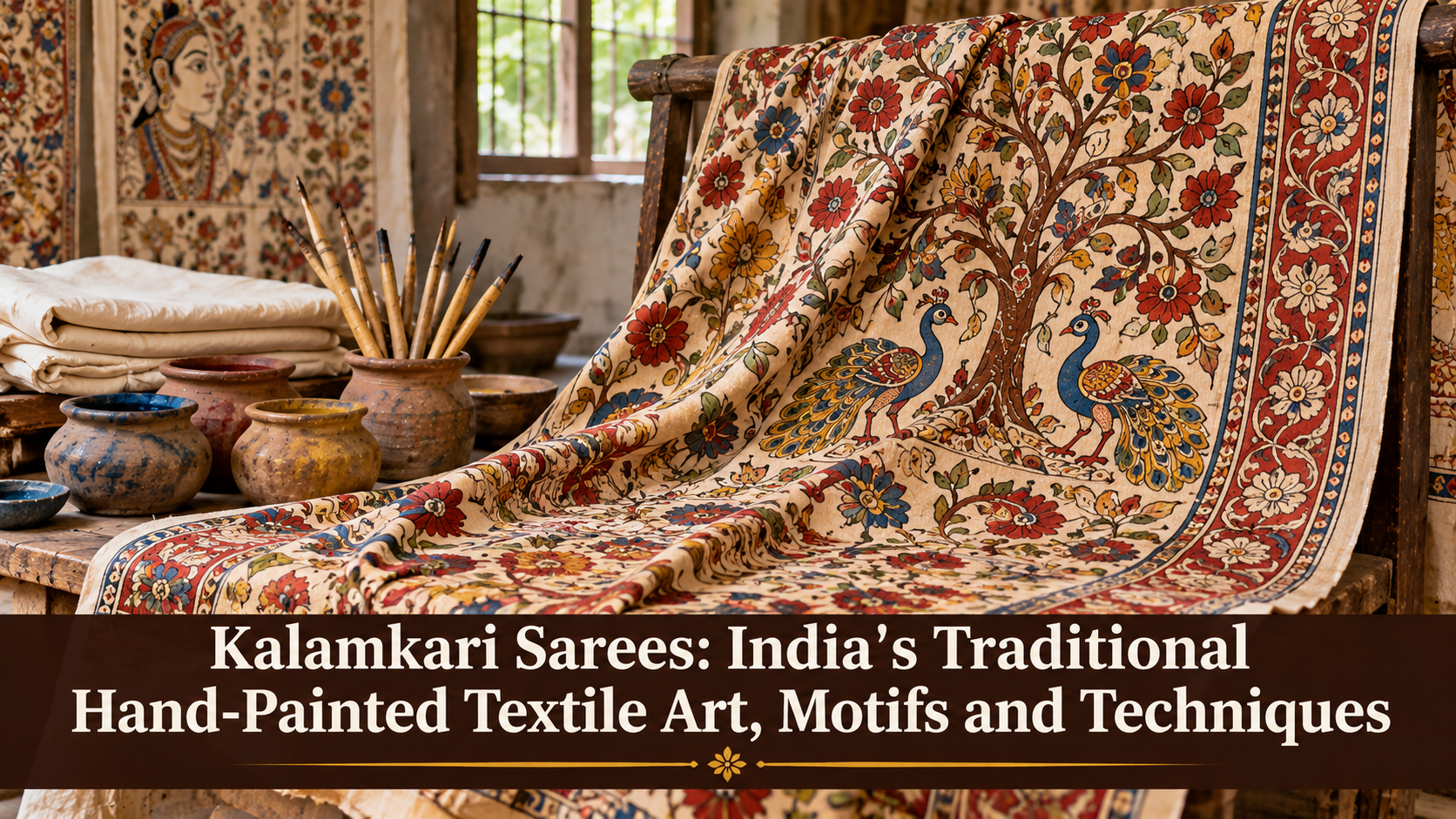
Kalamkari sarees pack a great deal of work into a few metres of cloth. Each one begins as plain cotton or silk and ends up carrying outlined deities, flowering vines or repeating floral patterns, coloured with dyes that take days to prepare. The word comes from the Persian “kalam” (pen) and “kari” (craft), and in Andhra Pradesh it covers two separate traditions: freehand pen painting around Srikalahasti and wooden-block printing around Machilipatnam.
The name is also used loosely. Many sarees sold as Kalamkari today are screen printed or digitally printed, and they sit next to genuine hand-painted pieces at very different prices. This guide covers the history, the production process, the tools, the dyes, the motifs and the fabrics. It then shows how to tell a Kalamkari hand-painted saree from a block-printed or digitally printed one. If you are still working out which kind of saree suits you in the first place, our complete guide to buying sarees for women covers fabrics, occasions and price factors across all saree types.
What Kalamkari means
Kalamkari is a family of textile techniques in which designs are drawn or printed on cloth and then fixed with mordants and natural dyes. The cloth is traditionally cotton. The outlines are usually dark, the fills are earthy reds, blues, yellows and greens, and the finished piece can look closer to a painting than to a print.
Two points are worth settling early, because they come up again in the buying sections below. First, Kalamkari is a process and not a pattern. A floral design printed by machine is not Kalamkari in the traditional sense, however closely it copies the look. Second, the term covers both painted and block-printed work. Srikalahasti is associated with the pen, and Machilipatnam with the block.
History and geographical origins in Andhra Pradesh
Painted and printed cottons from the Coromandel coast of south-eastern India were traded across Asia and later Europe for centuries. Some popular accounts trace Kalamkari back about 3,000 years to the Indus Valley. The firmer documentary record begins with the Coromandel trade textiles of the 17th and 18th centuries, which European buyers knew as chintz. Chintz was a trade name used loosely for both painted and printed fabrics, while Kalamkari describes how the cloth was made.
Two places anchor the story in Andhra Pradesh.
Srikalahasti lies on the banks of the Swarnamukhi River near Tirupati and is a temple town. Its tradition grew around the temple. Travelling storytellers and painters, often called chitrakattis in the literature, carried painted scrolls from village to village, and artisans produced temple hangings, chariot banners and depictions of deities and scenes from the Ramayana, the Mahabharata and the Puranas.
Machilipatnam, historically Masulipatnam, was the principal port of the Golconda Sultanate (1518 to 1687) and a major textile trading centre on the Coromandel coast. Under Golconda patronage the workshops absorbed Persian design ideas, and the term “kalamkari” is widely linked to that period and to the Persian-speaking court. The craft today is concentrated in Pedana, a small town about 13 km from Machilipatnam in Krishna district.
After independence, the All India Handicrafts Board under Kamaladevi Chattopadhyay is credited with helping revive the Srikalahasti style at a time when demand had fallen. Both styles are now registered as Geographical Indications of Goods under the Geographical Indications of Goods (Registration and Protection) Act, 1999. Published sources give slightly different registration years: roughly 2005 to 2006 for Srikalahasti Kalamkari and 2008 to 2009 for Machilipatnam Kalamkari. The Machilipatnam registration limits production to Pedana and its neighbouring villages of Machilipatnam, Polavaram and Kappaladoddi in Guduru mandal. Check the current GI Registry listing before quoting exact dates.
Srikalahasti and Machilipatnam: two traditions, two techniques
Srikalahasti Kalamkari is the hand-painted tradition. The artisan draws the composition freehand with a kalam, fills the colours one at a time and washes the cloth between stages. This is the style people mean when they search for Pen Kalamkari sarees. Its themes lean towards narrative and devotional subjects, although floral and tree-of-life compositions are also made, and the work is slow.
Machilipatnam Kalamkari is the block-printed tradition. Carved wooden blocks stamp the outline and then the colour areas onto mordant-treated cloth. The vocabulary is mostly floral, creeper and geometric, with the Persian influence mentioned above. It has historically served secular and commercial markets, including garments and furnishing cloth, which is why block-printed Kalamkari sits comfortably among traditional Indian printed sarees.
| Feature | Srikalahasti Kalamkari | Machilipatnam Kalamkari |
| Location | Srikalahasti, Tirupati district | Pedana and nearby villages, Krishna district |
| Core technique | Freehand drawing and colour filling with the kalam | Hand block printing with carved wooden blocks |
| Main tool | Bamboo or date-palm kalam, tamarind charcoal for sketching | Wooden blocks, printing table |
| Typical subjects | Mythological narratives, deities, epics, also floral and tree of life | Florals, creepers, geometric and Persian-influenced patterns |
| Historic purpose | Temple hangings, scrolls, chariot banners | Garments, furnishing cloth, trade textiles |
| Outline | Drawn by hand, line weight varies | Printed from a block, repeats with small variations |
| Colour application | Painted by hand, area by area | Printed in stages, with some painted or dyed-in areas |
| Visual character | Looks like a painting, rarely repeats exactly | Orderly repeats, regular spacing |
| GI registration | Srikalahasti Kalamkari (Geographical Indications Act, 1999) | Machilipatnam Kalamkari (same Act), limited to Pedana area |
| Speed of production | Slowest | Faster, but still multi-stage |
The traditional production process
Accounts of the process count anywhere from about 17 to 23 steps, depending on how a workshop groups the washing and drying. The sequence below follows the documented traditional method for Srikalahasti. The Machilipatnam sequence is the same in principle, with blocks replacing the pen for outlines and fills.
- Preparing the cloth. The unbleached (grey) cotton is soaked, kneaded and washed to remove starch and impurities, then dried in the sun. Some accounts also describe a bleaching step using dung solution.
- Treating with myrobalan and buffalo milk. The cloth is soaked in a solution of crushed myrobalan (karakkaya) and buffalo milk, then sun-dried. The milk proteins give the surface a slightly leathery feel that stops dye from spreading, and the myrobalan tannins help the mordants and dyes hold. It also tones down the smell of the milk.
- Sketching. The artisan draws the composition with a charcoal stick made from burnt tamarind twigs.
- Outlining in black. Using the kalam, the artist draws the outlines with a fermented iron-and-jaggery solution. On Machilipatnam cloth, a carved block applies the outline instead.
- Applying the mordant. Alum mordant is painted onto the areas that will turn red, and other mordants are used for darker tones.
- Washing. The cloth is rinsed in running water so the excess mordant and loose colour wash away. Only the mordanted lines and areas keep their colour.
- Dyeing red. The cloth is boiled in a bath containing madder-root dye (alizarin). The mordanted areas take the red, while the rest stays pale.
- Further washing and re-treatment. The cloth is washed again. Older descriptions mention a second buffalo-milk treatment before the colour is painted in, a step many workshops no longer follow.
- Painting the remaining colours. Yellow, blue and green are filled in by hand, one at a time, with washing and drying in between. Historically, wax resist was used to protect areas from the indigo vat.
- Final washing and drying. Another rinse and a sun dry set the colours and soften the cloth.
The Machilipatnam sequence is usually described as printing in two or more stages on a padded table: first the outline block, then blocks for the fill colours. Because each stage needs drying and washing, even block printing takes days rather than hours. One researcher’s account puts the full dyeing and printing cycle at roughly 20 to 40 days. Treat that as a general range, since timelines depend on weather, workshop size and design.
Contemporary workshops have also changed parts of the method. Documented accounts note that some Machilipatnam units now print the mordant with a block uniformly, have given up indigo vat dyeing and use iron acetate for large black areas. That is why a piece sold as Kalamkari can be genuine block-printed work and still differ from the older textbook description.
Traditional tools: the kalam and the rest of the workshop
The kalam gives the craft its name. It is a pointed stick of bamboo or date palm, sometimes tamarind wood, about four to six inches long. The thick end is wrapped with wool, jute or cloth, and a bundle of fine hair is often tied near the point. That bundle acts as a reservoir, holding dye and releasing it slowly when the artisan squeezes it against the cloth. A second kalam with a tapered, chisel-cut tip is used for filling colours.
Other tools matter just as much:
- Tamarind charcoal sticks for the first sketch
- Earthen pots for fermenting the iron-and-jaggery black
- Copper or large vats for boiling cloth in madder
- Carved wooden blocks for Machilipatnam outlines and fills
- A low, cushioned wooden table, with gunny cloth and a damp cloth under the fabric so it does not slip during block printing
- Running water or a river bank for the repeated washes
Natural dyes and traditional colour preparation
The traditional palette is built from plants, minerals and fermented preparations. The recipes vary by workshop, so read the table below as the commonly documented version.
| Colour | Traditional source | Notes |
| Black | Rusted iron filings fermented with jaggery in water, often called kasim kaaram | Left in a closed earthen pot for about 21 days, then filtered. It turns darker on myrobalan-treated cloth. |
| Red | Madder root (alizarin) with an alum mordant | The same madder bath gives different tones depending on the mordant used. Alum gives red, iron gives darker shades. |
| Blue | Indigo leaves | The vat process is labour-intensive, and some workshops have stopped using it. |
| Yellow | Pomegranate rind or myrobalan flower, with alum | Often applied before overlaying indigo to make green. |
| Green | A blend of yellow and blue, or a prepared mix based on myrobalan flower and alum | Recipes differ between workshops. |
| Cloth treatment | Myrobalan fruit and buffalo milk | Controls spreading and helps the dyes bond. |
Natural dyes are also why hand-made Kalamkari has a muted, earthy look. Colours tend to sit in the browns, rusts, indigos and olives, and a bright neon pink or electric blue is a signal to ask questions. Natural dyeing is also sensitive to water quality, weather and the exact preparation, so two sarees from the same workshop can differ slightly in shade.
Motifs documented in Kalamkari
Kalamkari motifs fall into a few broad groups. Their meanings are not fixed and sellers sometimes attach symbolism with little backing, so use the descriptions below as a guide to what is documented rather than as a code.
Mythological narratives. Srikalahasti work is best known for scenes from the Ramayana, Mahabharata and the Puranas, along with deities such as Vishnu’s avatars, Shiva and Ganesha. These were painted as long panels on temple cloths and scrolls, and on a saree they are usually condensed into a pallu panel or a repeated figure.
Tree of life. A flowering tree with branches, birds and sometimes animals is one of the best-known compositions. Painted Coromandel cottons with this motif were popular export items, and it was gradually brought into Srikalahasti work as well.
Flowers and creepers. Lotus, rose, marigold-like blooms and trailing vines fill borders and bodies. Machilipatnam printers use them heavily in repeating layouts.
Birds and animals. Peacocks, parrots, elephants and deer appear often, either as part of a scene or as single repeated motifs.
Geometric and Persian-influenced patterns. Machilipatnam work shows the strongest influence of the Golconda court, with orderly borders and floral-geometric repeats.
Fabrics used in Kalamkari sarees
Traditional Kalamkari is worked on cotton, because the myrobalan-and-milk treatment and the mordant dyes were developed for cotton fibre. Cotton Kalamkari sarees are soft, breathable and suited to daily and daytime wear. They also tend to be lower in price than silk versions.
Silk and blends are a later and growing category. Kalamkari silk sarees appear in mulberry silk, tussar, crepe and cotton-silk blends. Silk does not take mordants and dyes the same way as cotton, so the finished look can differ: silk often has a glossier surface with sharper colour. Some silk pieces are hand-painted, some are block-printed and many are digitally printed, so the fabric alone tells you nothing about the technique. Check the fibre content on the label, and ask whether the dyes are natural or synthetic.
If you are weighing fibres, two of our guides help. Our explainer on how cotton silk blends feel, price and wear is useful for blended Kalamkari pieces, and our cotton vs silk sarees comparison covers comfort, care and occasion across the two fabrics.
Pallu, border and body: how designs differ across regional styles
Layouts vary by workshop and designer, so these are general tendencies and not rules.
On Srikalahasti sarees, the pallu is usually where the strongest drawing sits. A hand-painted scene, a tree of life or a cluster of large motifs may fill the end piece. The body is often lighter, with scattered motifs, creepers or a plain field that lets the pallu stand out. Borders are commonly narrow bands of painted floral or geometric work, or a contrast woven border added to a painted body.
On Machilipatnam sarees, the body usually carries a repeating block pattern, with motifs spaced in rows or half-drops. Borders are printed with separate strip blocks that match the body, and the pallu may use a denser version of the same repeat or a larger floral block.
Designers also mix the two, pairing block-printed bodies with hand-painted pallus. When a seller describes a saree as “pen Kalamkari”, ask whether the whole piece is hand-painted or only the pallu.
Traditional techniques versus modern commercial adaptations
Not every product called Kalamkari is handmade or naturally dyed. The market now includes at least four types.
- Hand-painted pen Kalamkari with natural dyes, made by the traditional process.
- Hand block-printed Kalamkari, with natural or synthetic dyes depending on the workshop.
- Screen-printed fabric in Kalamkari-style patterns, made with synthetic dyes.
- Digitally printed fabric using photographs or scans of Kalamkari designs.
Each of these can be a good purchase if it is described honestly. Screen-printed and digital Kalamkari-inspired sarees are easier to care for and cost less. The problem arises when a printed saree is sold as hand-painted, or when “natural” is stated without any support. Reports from the craft community describe cost pressure pushing some units away from natural dyes and from the full multi-step process, which is one reason authenticity questions come up so often.
How to tell hand-painted, block-printed and digitally printed Kalamkari apart
No single check is conclusive, so combine several. A listing that reads well and shows close-up photographs of the reverse side is a better sign than one that only shows a model in flattering light. Our guide to reading saree listings when you shop online explains how to assess descriptions, photographs and seller information.
| What to check | Hand-painted (pen) | Block-printed | Digital or screen printed |
| Lines | Slight variations in thickness, small wobbles, no two figures identical | Consistent line weight within a block, small misalignments between blocks | Perfectly smooth, even and sharp |
| Repeats | Rarely repeats exactly | Repeats with small variations in ink and alignment | Repeats are identical, sometimes with a visible tiling seam |
| Colour fills | Fills may overlap or leave tiny gaps at the outline | Fills sit inside block outlines, with minor registration shifts | Gradients, shading and photo-like detail that natural dyes rarely produce |
| Reverse side | Colour has soaked through and looks nearly as strong | Colour has soaked through, often slightly lighter | Often visibly paler or white at the back |
| Colour range | Earthy reds, indigo, mustard, olive, black | Same earthy range for natural-dye work, wider range if synthetic | Any colour, including bright neons and metallic effects |
| Hand feel | Cloth may feel slightly stiff or leathery | Fabric feels natural, sometimes slightly stiff | Often smooth and uniform |
| Price and time | Highest, because of days of labour | Moderate | Lowest |
| Paperwork | Seller can explain the process and dyes | Seller can name the workshop or location, and in some cases GI authorised-user details | Usually sold as printed, not handmade |
Some practical habits help. Ask whether the dyes are natural or synthetic, and what the seller bases that on. Ask for photographs of the reverse side in daylight. Ask where the saree was made. A seller who can answer those three questions clearly is usually more reliable than one who relies on words like “authentic” and “pure”. Even then, natural dyeing cannot be confirmed from a photograph, so treat the claim as a statement from the seller until you have a way to verify it.
Cultural significance and Kalamkari in contemporary fashion
Kalamkari began as a working art form tied to temples, storytelling and trade. A temple cloth was a portable substitute for a shrine, and an export chintz was a luxury fabric for European homes. That double life, devotional in one place and commercial in another, explains why the style now sits so comfortably in everyday wear.
Today, Kalamkari appears on sarees, dupattas, blouse pieces, kurtas and home textiles. Designers pair hand-painted pallus with plain handloom bodies, use block-printed Kalamkari on cotton and silk, and combine the motifs with weaves such as Chanderi or cotton-silk blends. Interest in natural dyes has also given the craft a second audience of buyers who care about how a textile was made, not only how it looks.
For wearers, the appeal is practical as well as cultural. A cotton Kalamkari saree suits long daytime wear, and a silk or blended Kalamkari saree can handle festive occasions. Treat these as starting points, and choose by fabric, comfort and the occasion.
Caring for a Kalamkari saree
Care depends on the dyes, the fabric and the finish, so start with any label or seller instruction. For naturally dyed cotton, a common recommendation is to wash by hand in cold water with a mild detergent, to wash separately for the first few washes, to avoid long soaking, to dry in shade and to iron on the reverse. Colours may bleed slightly in early washes. For silk and heavily painted pieces, dry cleaning is often the safer route. If the saree is digitally printed on synthetic fabric, the care routine is different again.
Frequently asked questions
1. What is a Kalamkari saree?
A Kalamkari saree carries designs that are either hand-painted with a kalam (pen) or printed with carved wooden blocks, using mordants and dyes on cloth. The craft is rooted in Andhra Pradesh. Modern sarees sold under the name may also be screen printed or digitally printed, so check the technique.
2. What is the difference between Srikalahasti and Machilipatnam Kalamkari?
Srikalahasti Kalamkari is hand-painted freehand with a kalam and leans towards mythological and narrative subjects. Machilipatnam Kalamkari is block-printed with carved wooden blocks and favours floral, creeper and geometric patterns influenced by Persian design.
3. Are all Kalamkari sarees hand-painted?
No. Only the Srikalahasti tradition is hand-painted. Machilipatnam work is block-printed, and many sarees sold today are screen printed or digitally printed in Kalamkari-style patterns. Ask the seller how the saree was made.
4. Are Kalamkari sarees always dyed with natural dyes?
No. Traditional Kalamkari uses natural dyes, but commercial products often use synthetic dyes. Some workshops use mixed methods. Without verification, treat “natural dye” as a seller claim.
5. How can I identify a hand-painted Kalamkari saree?
Look for small variations in line weight, motifs that do not repeat exactly, colour that has soaked through to the reverse side and an earthy palette. Combine several checks, since no single sign is conclusive, and ask the seller about the process and the dyes.
6. Which fabric is best for Kalamkari sarees?
Cotton is the traditional base and suits daily and daytime wear. Kalamkari silk sarees and cotton-silk blends suit festive occasions. The best choice depends on climate, care and occasion.
7. Does Kalamkari have a GI tag?
Yes. Srikalahasti Kalamkari and Machilipatnam Kalamkari are both registered as Geographical Indications under the Geographical Indications of Goods (Registration and Protection) Act, 1999. Machilipatnam production under the tag is limited to Pedana and nearby villages. Verify exact registration details in the GI Registry.
8. How should I wash a Kalamkari saree?
Follow the care label first. Naturally dyed cotton is usually hand washed gently in cold water with a mild detergent, washed separately at first and dried in shade. Silk and heavily painted sarees often need dry cleaning. Expect some colour release in early washes of naturally dyed pieces.
Conclusion
Kalamkari sarees come from two distinct Andhra Pradesh traditions: freehand pen painting around Srikalahasti and wooden-block printing around Machilipatnam. Both depend on a long sequence of cloth treatment, mordanting, dyeing and washing, and both are registered Geographical Indications. The honest way to buy is to match the technique to the label. A hand-painted saree takes days of work and costs accordingly, a block-printed one sits in the middle, and a digitally printed one is a decorative fabric that borrows the look. Ask how the saree was made, what dyes were used and where, and choose the fabric and the style that fit the way you plan to wear it.
