
Blog
Moirang Phee: Manipur’s Traditional Weaving, Yarongphi Borders and Saree Designs

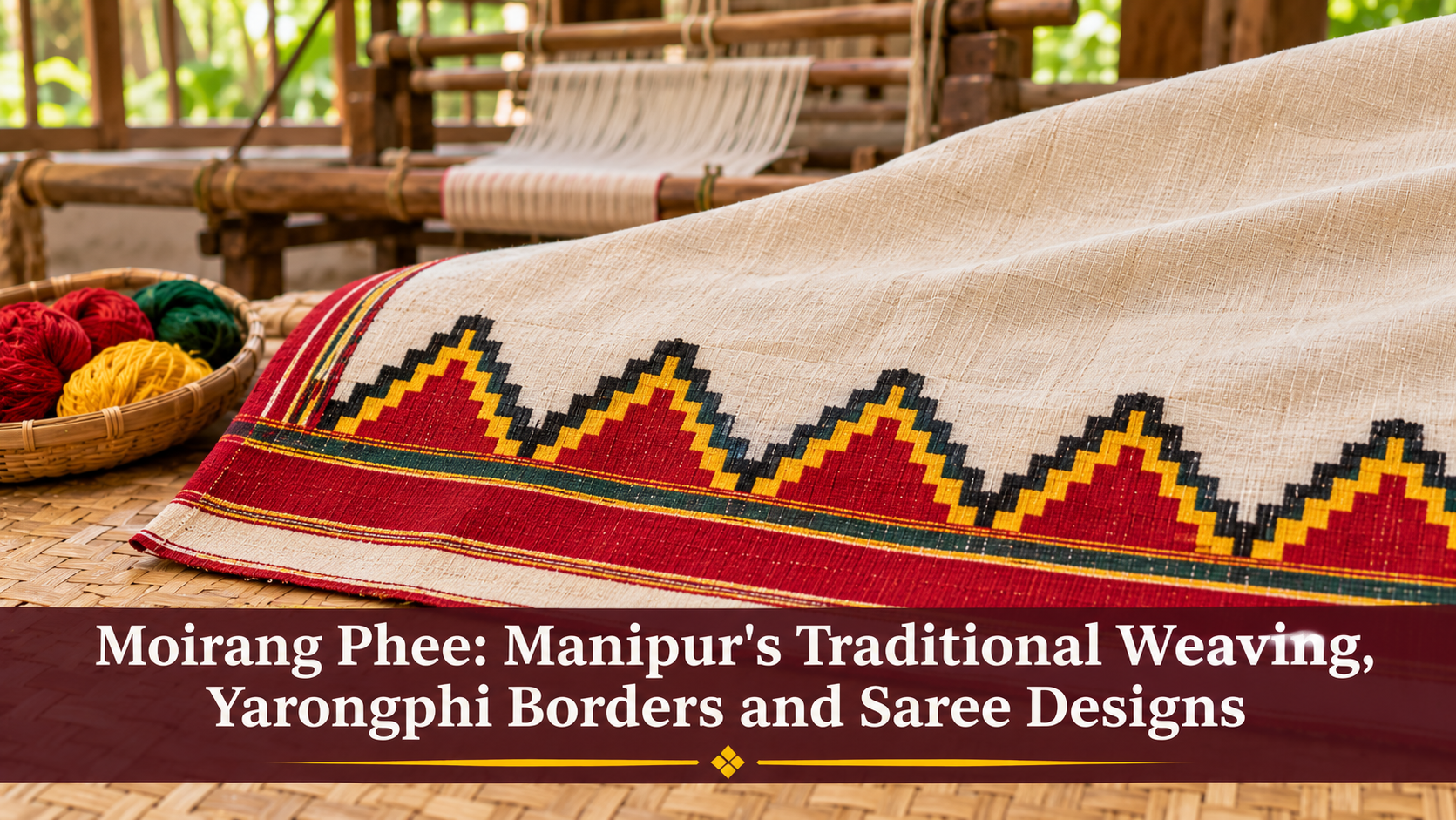
Moirang Phee is often described online as a saree, and that is only partly right. In the sources that record it most carefully, including the Geographical Indication (GI) application and the government handicrafts portal, Moirang Phee is a textile design and fabric tradition from Manipur. Its signature is a stepped, triangular border. The saree is one of the later garments to carry it.
This guide separates what is documented from what is modern. It covers where Moirang Phee comes from, who weaves it, how the Yarongphi border is made, what the GI tag protects, and how the design has moved into sarees. If you are comparing textiles for your own wardrobe, our saree for women buying guide covers general fabric, price and quality questions before you look at a specific regional tradition.
What Moirang Phee actually is
Moirang Phee is a Manipuri fabric defined by a particular border pattern. The name comes from Moirang, a village in the Bishnupur district, and phee, which is the Manipuri word for cloth. The border design itself is called Moirang Pheejin. According to the GI application, a wrapper or other cloth carrying this design along its lengthwise borders is also known as Yarongphi.
So there are three overlapping terms:
- Moirang Phee: the fabric tradition, named for its place of origin.
- Moirang Pheejin: the border design, which the GI document describes as a special design of the Manipuri textile.
- Yarongphi: the local name for the cloth with that border, and also the name commonly used for the border design.
The distinction matters because a buyer may meet a plain cotton shawl, a phanek, a stole and a saree that all carry the same border. They are different garments sharing one design language, not different versions of one saree.
Geography and documented history
Moirang lies in the Bishnupur district of Manipur, about 44 to 46 kilometres from Imphal, depending on the source. It sits on the banks of Loktak, Manipur’s freshwater lake, and is known for the legend of Khamba and Thoibi and for the raising of the first Indian National Army flag on Indian soil in 1944.
The strongest historical statement comes from the GI application. It says it is not possible to say exactly how old the design is, but that a manuscript called Loiyumba Silyen shows it existed in the time of King Meidingu Loiyumba, who reigned from 1074 to 1122 CE. According to the text as summarised in the application, the king assigned the weaving of the cloth to the family of Thongkapam, and the Moirang people later paid Yarongphi cloth as an annual tribute to the Meitei kings. Some retellings say the villagers made it as a gift for royalty. The tribute and royal link are drawn from the same documented source, so they are reasonable to repeat, but the exact age of the design is deliberately left open.
Be careful with more colourful claims. Articles that add ceremonial gun salutes for weavers or elaborate legends are repeating folklore, and this article does not rely on them.
The weaving community
Weaving in Manipur is traditionally the work of Meitei women, and the GI application states that women weavers use the extra-weft technique in making the Moirang Pheejin design. A craft profile from the Isha Foundation’s Save the Weave project adds that weaving was the responsibility of the woman of the family, that young girls were trained by their mothers, and that men took the lead in large-scale commercial weaving. These are descriptive accounts of practice, not rules.
Today the craft is not confined to Moirang. The handicrafts portal says it began in Moirang but is now widespread in Manipur. The GI application, by contrast, names four valley districts as the area of production: Imphal East, Imphal West, Thoubal and Bishnupur. A trade article lists loin-loom weavers in the hill districts of Ukhrul and Churachandpur as also making Moirang Phee. The registered production area and present-day practice therefore do not match exactly, and readers should not assume either source gives the complete picture.
The Yarongphi border: stepped, triangular and woven in odd numbers
The GI application describes the Moirang Pheejin as a continuous series of triangles. It was first woven by taking the pattern of the pronged teeth of Pakhangba, the python deity of Meitei mythology. The name explains it: ya means tooth, rong means long, and longba means pronged. The application says teeth with upward pointed tops, arranged in a regular series, are appealing to the Manipuri eye.
The technical detail is more useful than the symbolism for anyone trying to recognise the design. The application states that the steps of the triangle are always in odd numbers: three, five, seven, nine, eleven, and higher. The registered documents include diagrams for 3-step, 5-step, 7-step, 9-step, 11-step and 13-step versions. The handicrafts portal repeats the odd-number rule. In the GI document’s illustration, the border is woven in a dark weft against a white body, which shows the principle (contrast between border weft and body) rather than fixing the colours.
The same application notes that the presence of this border is significant because it shows a fabric originates from Manipur, a claim also repeated in the Government of India’s MyGov blog on Manipur’s GI textiles. That is a statement about the border’s role as a marker of Manipuri weaving, not a legal test of authenticity for any single piece.
On cultural meaning, the documented statement is the link to Pakhangba. Beyond that, be cautious. Articles that attach further symbolism to colours, steps or individual triangles often have no source, and none is asserted here.
Extra-weft technique, yarns and looms
The GI application and the handicrafts portal agree on the core technique. The border is made with extra weft, also called supplementary weft. In ordinary weaving, the weft passes across the warp to form the cloth. In extra-weft weaving, additional weft threads are inserted in selected places to form a pattern on top of, or woven into, the ground cloth. The portal says two shuttles are used, one for the border motif and one for the main body, and that the motif weft is interlocked in the stepped triangular pattern.
Further documented details:
- Looms: the craft is woven on loin looms, throw-shuttle looms and fly-shuttle looms.
- No attachments: the portal says weaving is done on handlooms without jacquard or dobby attachments, with shuttles, warp beams, heddles and reeds as the essential tools.
- Yarn: traditionally cotton and silk, with acrylic and artificial silk now common, according to the portal.
- Motif yarn: the portal says the motif’s weft threads are thicker and double-ply, and a trade article describes a bolder 2-ply yarn for the border.
- Weavers per piece: one trade article says a saree takes two skilled weavers working in sync, each managing different parts of the cloth. This is a single-source claim about one kind of piece, so it should not be generalised.
What the sources do not document in detail is yarn preparation and finishing specific to Moirang Phee. General handloom practice applies: yarn is dyed or prepared, the warp is arranged on the loom, the body is woven with one shuttle while the border is built with the other, and the cloth is cut and finished at the ends. The ends of shawls and wrappers may be finished differently from a saree. Treat these as general steps, not as a documented Moirang Phee protocol. The mention of a separate shuttle for the pattern is the point where Moirang Phee differs clearly from plain weaving.
Because the border is made by hand-inserted extra weft, it cannot be reproduced the same way on a power loom without a pattern mechanism. A craft profile makes this point for the silk saree version, describing its extra weave as something a power loom could not do.
Motifs, colours and fabric variations
Be precise about what counts as the motif. The documented motif is the Moirang Pheejin border: stepped triangles. Other designs appear on related Manipuri fabrics and should not be confused with it.
A MyGov blog on the three Manipur GI textiles gives a useful verified example. Wangkhei Phee is a white cotton cloth worn by Manipuri women at marriage ceremonies and festive occasions. Its weavers use extra-weft designs named Kheiroithek, Thangjing Tangkhai, Kabok Chaiba and others, with Moirang Phee designs along both longitudinal borders. The same blog describes Shaphee Lanphee, a separate GI textile, as a shawl with a black background, a red border and ten stylised motifs, made by needlework over loin-loom fabric. That is a different technique and a different textile.
On colour, the handicrafts portal says fabrics are traditionally woven in natural silk and cotton with colours such as red, black, yellow and green, often contrasting against lighter backgrounds. That is a general description, not a fixed palette, and weavers vary it. Fibre also varies: cotton and silk are traditional, and acrylic or artificial silk are now common, so two pieces with the same border can feel very different.
Cultural and traditional uses
The GI application says the design is used in almost all kinds of innaphi (a shawl or chaddar) and in the phanek or sharong, the wrapper worn by Manipuri women. It describes these as luxurious items for occasions such as marriage, the Lai Haraoba festival and public gatherings, and adds that the design is commonly used on the border of a girl’s loin cloth. A trade article adds that it appears as a gift of honour at temples and during Lai Haraoba. A traditional Manipuri women’s costume is described in a Madhyamam feature as an innaphi, a phanek and a stiff skirt-type sarong.
Those are the established uses. The ceremonial role is real, but individual families, communities and occasions differ, and this article does not assign rules about who may wear what.
From textile to saree: what the evidence supports
The handicrafts portal says Moirang Phee, traditionally used for innaphi and phanek, is now incorporated into dhotis, saris, skirts and even school uniforms. A fashion-retail blog and a trade article both describe Moirang Phee sarees, and the Save the Weave profile mentions the Ranee Phee, a silk saree version of Moirang Phee with an extra weave. These sources support a clear conclusion: the saree is a documented contemporary application of the border, not the original or only form.
That has practical consequences for the reader:
- A Moirang Phee saree is a saree that carries the Moirang Pheejin border. It is not a separate traditional saree type with its own fixed body pattern, length or drape in any source reviewed.
- Saree-specific features such as pallu design, fabric weight, border width and body motifs vary by weaver and brand. Sources do not set a standard.
- No source reviewed documents a traditional Manipuri saree draping style tied to Moirang Phee. If you are new to wearing a saree, a general method like the one in our saree draping styles for beginners is a sensible starting point for a Moirang Phee saree.
Contemporary designers and brands also use the border on stoles, dresses and other garments. Those are modern adaptations. They show the design’s current popularity but are not evidence of older tradition.
What the GI tag protects
Moirang Phee is one of three Manipur textiles registered under the Geographical Indications of Goods (Registration and Protection) Act, 1999, with Wangkhei Phee and Shaphee Lanphee. It is registered under application number 373 in Class 25 (clothing). The MyGov blog, the handicrafts portal and trade articles describe the GI as awarded in 2014, while one reference page lists a December 2011 date. Sources therefore differ on the dating, and the exact registration and certificate dates should be confirmed on the GI Registry before you quote them.
What is protected is the geographical indication: the right to use the name for goods from the registered area and made to the registered specification. The specification centres on the Moirang Pheejin design and the extra-weft method. The tag does not decide quality, and it does not on its own certify a particular fibre. As noted above, the application lists four valley districts as the area of production, so check the current registration if a seller makes claims about where a piece was woven.
How to recognise authentic traditional design features
No single check proves a piece is authentic, and the following list sticks to features in the documented specification.
- Look at the border shape. It should be a continuous row of triangles with stepped edges. Counting the steps on one triangle should give an odd number, such as 3, 5, 7, 9 or 11.
- Check where the border runs. Per the application, the design runs along the lengthwise borders, so it should appear on both long edges of a shawl or wrapper, and along the saree’s edges.
- Look at the weave structure. The pattern should be formed by extra weft in the cloth, using a thicker yarn than the body. On the reverse, expect to see the motif threads as part of the weave, not a printed or stuck-on surface.
- Compare the border yarn with the body. The portal says the motif weft is thicker and double-ply, so the border should look bolder than the ground.
- Examine regularity. Handwork allows small variations between triangles, while printed or machine-embroidered imitations repeat with exact uniformity.
- Ask for fibre and loom details. Cotton, silk, acrylic and artificial silk are all in use, so ask which is present, and whether the piece was woven on a loin, throw-shuttle or fly-shuttle loom.
- Ask about the weaver or source. Because the craft is widespread across Manipur, a named weaver or cooperative is more useful than a general claim of origin.
When shopping online, our online saree shopping guide covers how to read listings, check photographs and question sellers, which applies well to a regional handloom claim.
How Moirang Phee compares with other Northeast Indian textile traditions
Northeast India has many distinct textile systems, and they should not be read as variations of one thing. The table compares Moirang Phee with three well-known traditions using sources reviewed for this article. It is a simplified overview, since each tradition also contains many community-specific styles.
| Feature | Moirang Phee (Manipur) | Naga shawls (Nagaland and Naga communities) | Mizo puanchei (Mizoram) | Assamese mekhela chador (Assam) |
| What it is | A border design and fabric tradition, used on shawls, wrappers and now other garments | Shawls, often tribe-specific, rectangular, and woven on backstrap or loin looms | A woman’s wrapped garment worn for festive dances and ceremonies | A two-piece garment worn by women that, once worn, looks similar to a saree |
| Signature feature | Stepped, triangular Moirang Pheejin border in odd-numbered steps | Bold, tribe-specific patterns, often with three panels stitched together | Bright colours, predominantly red, with black and white patterns | Traditionally woven designs, never printed, often in Muga, Eri or Pat silk |
| Technique emphasised | Extra weft with a separate shuttle for the border | Loin or backstrap loom weaving with panels joined | Handwoven patterned cloth | Handloom silk weaving |
| Typical use | Innaphi, phanek, loin cloth border, now sarees and other garments | Status and identity shawls; designs differ for men and women | Festive and ceremonial wear | Daily wear and festivals such as Bihu |
| Relationship to sarees | Border now used on sarees as a contemporary adaptation | Not a saree tradition | Not a saree tradition | Resembles a saree when worn, but is a separate two-piece garment |
Two cautions apply. First, Moirang Phee is a Manipuri Meitei tradition. Naga, Mizo and Assamese textiles belong to other communities, and the Manipur valley and hills include several communities with their own textiles. Second, comparisons in popular articles sometimes treat all Northeast textiles as symbolic code systems. The meanings attached to Naga motifs, for example, are specific to those communities and should not be transferred to Moirang Phee.
Caring for a Moirang Phee piece
No care protocol specific to Moirang Phee appears in the sources reviewed. General handloom care applies and depends on the fibre. For cotton, a gentle wash in cold water and drying in shade is usual. For silk or silk-blend pieces, follow the label and consider dry cleaning. For blends that include acrylic or artificial silk, check the label. Our cotton silk saree guide is a general reference for blends. Because the border is built from thicker extra-weft yarn, avoid harsh wringing and store pieces folded in cotton cloth.
Conclusion
Moirang Phee is best understood as a Manipuri textile tradition defined by one design, the stepped triangular Yarongphi border, woven by hand with extra weft. Its documented roots reach back to the reign of Meidingu Loiyumba and the tribute cloth of Moirang, its established uses are the innaphi and the phanek, and its GI registration covers the border design under Manipur’s three registered textiles. Sarees that carry the border are a real and growing contemporary use, but no source treats them as the traditional form. Read listings with that in mind, check the border steps and weave, and treat strong claims of symbolism or heritage with the same care you would apply to the cloth itself.
Frequently asked questions
1. Is Moirang Phee a saree? Not originally. It is a textile design and fabric tradition from Manipur, defined by the Moirang Pheejin border. It was traditionally used for innaphi shawls and phanek wrappers, and it is now also used for sarees, dhotis and other garments.
2. What does Yarongphi mean? In the GI application, ya means tooth, rong means long, and longba means pronged, referring to the pronged teeth of Pakhangba, a python deity in Meitei mythology. The name is used for the cloth with the Moirang Pheejin border and for the border design.
3. What does the Yarongphi border look like? A continuous row of stepped triangles woven along the lengthwise borders. The steps are in odd numbers such as 3, 5, 7, 9 and 11, according to the GI documentation.
4. How is the border woven? With the extra-weft technique, using a separate shuttle for the border motif and another for the main body. The motif weft is thicker and double-ply, per the handicrafts portal. Looms include loin, throw-shuttle and fly-shuttle looms.
5. Does Moirang Phee have a GI tag? Yes. It is registered under application number 373 in Class 25 and is one of three Manipur textiles with GI status, along with Wangkhei Phee and Shaphee Lanphee. Sources differ on the year (2011 or 2014), so confirm with the GI Registry.
6. Are all Moirang Phee sarees woven the same way? No. Fibre, border width, body design and weaving setup vary between weavers and sellers. Cotton, silk, acrylic and artificial silk are all in use, and no source sets a single standard for sarees.
7. How is Moirang Phee different from Naga or Mizo textiles? Moirang Phee is a Meitei design tradition centred on one border, while Naga shawls are tribe-specific and Mizo puanchei is a distinct festive garment. They come from different communities and should not be treated as variations of each other.
8. How can I tell if a Moirang Phee piece is genuine? Check for an odd-numbered stepped triangle border on the lengthwise edges, extra-weft construction with a thicker border yarn, small handwork variations, and a clear statement of fibre and weaver or source.
