
Blog
Negamam Cotton Sarees: Tamil Nadu’s Traditional Handloom and Everyday Elegance

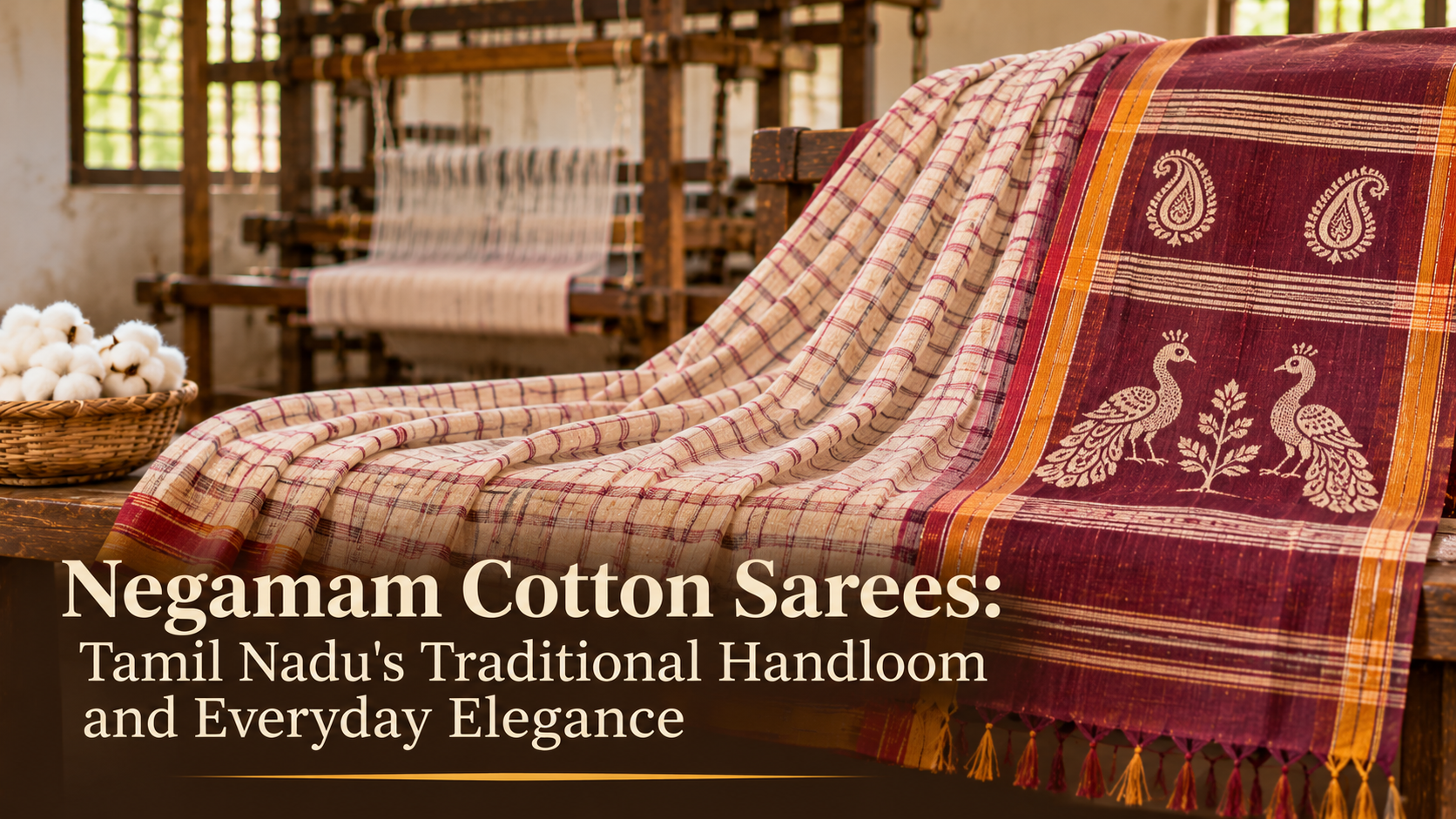
Some cotton sarees are chosen for the occasion. The Negamam cotton saree is chosen for the day. It is a firm, long-wearing handloom cloth from a small weaving cluster in western Tamil Nadu, and it has a loyal following among people who wear sarees to work, to temples and to family gatherings without wanting to think about fragile fabric.
This article covers where Negamam is, how its weaving community developed, how the cloth is made, what the sources actually document about its checks, stripes, borders and pallus, and how to tell a handloom piece from a machine-made copy. It also compares Negamam with other Tamil Nadu cotton traditions, and it is careful about one point: not every cotton saree from Tamil Nadu is a Negamam handloom product, and the difference matters when you buy.
1. Where Negamam is and why it matters
Periya Negamam is a panchayat town in Pollachi taluk of Coimbatore district, in the north-western part of Tamil Nadu. Wikipedia’s entry puts its area at 10.88 square kilometres and its 2011 census population at 7,098, and notes that the town is known for its handloom industry and for Negamam cotton sarees. Travel writers place it roughly 15 kilometres from Pollachi town, among coconut groves, and about 40 kilometres from Coimbatore city.
The weaving does not sit in one street. It spreads across Negamam and nearby villages in the Pollachi belt, which is why you will see the cloth described as coming from “Negamam and surrounding villages.” The Geographical Indication (GI) registration reflects this: Negamam Cotton Handloom Sarees received a GI tag in March 2023, as reported by 101Reporters.
If you are new to sarees in general, our complete guide to buying sarees for women explains fabrics, weaves and price factors across India. This article goes deep on one cluster.
2. The weaving history of Negamam
Local reporting describes handloom weaving in this part of Coimbatore district as more than two centuries old. A feature in The News Minute puts it at over 200 years in Negamam, and 101Reporters says weaving has thrived for over two centuries across the Pollachi, Negamam, Kinathukadavu and Sulur region. The same report says the region had more than 4,650 handloom units about three decades ago.
The GI application process pulled together some documentary evidence. According to an account of the effort by IAS officer Saranya Ramachandran, who worked with the Coimbatore handloom team, the file drew on district gazetteers and census material. It cites a 1961 Census handbook for Coimbatore stating that most weavers belong to traditional communities of the Devanga people. The team also gathered oral testimony and examined sarees woven 40 to 50 years earlier. The same account says references to Negamam sarees go back to the period before 1947.
A tradition like this tends to be family based, and Negamam’s is. The Gulf News profile and the 101Reporters story both describe weavers whose parents, grandparents and spouses also weave, with the work shared at home. Looms and tools pass between generations.
3. The weaving community today
The community is shrinking. The same reporting that praises the cloth also records hard numbers. According to 101Reporters, a weaver named Nagaraj, with over thirty years at the loom, takes two full days to weave one saree and earns roughly Rs 1,000 to Rs 1,250 for it, while genuine handwoven pieces typically retail from about Rs 1,600 and can reach Rs 6,000 depending on weave, design and finish. Weavers and shop owners quoted there say the GI tag has not yet changed incomes much, and that many customers do not know the tag exists.
The News Minute reports a related pressure: powerloom sarees often sell at about half the price of handloom ones, and copy the same designs closely enough that buyers struggle to tell them apart. A designer working with Negamam weavers in that report says few people under 40 now weave.
This is background worth knowing when you see the price of a real Negamam handloom piece. The cloth takes days of skilled work by a household, and a very low price should raise questions.
4. How a Negamam saree is made
The steps below follow what published sources describe for Negamam and its neighbouring cluster. Where sources differ, the difference is stated.
Yarn. Isha Foundation’s weave profile says the process begins with drawing and spinning fibre into thread. A local weaver quoted by Covai Post describes it differently: grey yarn is bought from mills, then prepared for dyeing and weaving. Both descriptions exist in print, so a safe statement is that the yarn is cotton, prepared and coloured before weaving, and that the source of the spun yarn can vary. Do not assume every Negamam saree uses hand-spun yarn.
Dyeing. The yarn is dyed to the colours of the design and dried. Published material for Negamam does not specify one dye type, so this article does not claim natural dyes. If a seller says a particular piece is naturally dyed, ask for evidence.
Warping. The dyed yarn is stretched out and wound on a large drum-like frame to set the length of the warp threads. Isha’s profile says a typical warping setup holds enough thread for 12 sarees.
Sizing. The warp is then starched with rice, maize or potato starch. This is called sizing. It stiffens and protects the warp threads so they survive the tension and friction of weaving.
Loom setup. The sized warp is mounted on the loom, threaded through the healds and prepared for weaving. The Covai Post account describes yarn wound onto bobbins and set up on shuttle looms, and the same weaver says the looms in his community are nearly 200 years old. Local reporting also mentions that designs and colour combinations are often decided in advance by shop owners and designers who supply the warped yarn.
Weaving. The weaver passes the weft through the warp by shuttle. According to the Indian Masterminds account, border designs are woven with an extra weft, meaning additional thread laid into the cloth during weaving rather than printed or embroidered afterwards. The Isha profile adds that half-fine zari is sometimes included for richness in the pattern.
Time. Sources disagree on timing. The older Isha profile says three to five days per saree, while recent reporting says about two full days for a weaver working from morning until evening, and a weaver in The News Minute says three days. The difference likely reflects design complexity and who is counting. Treat any single number with caution.
5. Fabric texture, weight, drape and breathability
Here the documented facts are thinner than marketing copy suggests, so it helps to separate what sources state from what cotton generally does.
What sources document for Negamam:
- The saree is made from cotton; Isha’s profile lists the cloth as an 80 by 80 count fabric.
- The Indian Masterminds account describes the cloth as thick and durable and gives a density of 86 to 90 picks per inch.
- The same account links the quality of the cloth to the humid air that moves in from the Western Ghats, and says the main weaving season runs from June to November.
- The Hindu’s coverage of the GI application describes the cloth as a practical balance of softness and strength.
- Isha’s profile says the cloth softens with every wash and notes its popularity as office wear.
What can be said generally about handloom cotton, not as a Negamam finding: cotton absorbs moisture and lets air move through it, which is why it suits hot, humid weather, and a cloth with a firm hand and moderate weight holds pleats and a pallu better than a very light, slippery fabric would.
No published source I could find gives a gram weight (GSM) for Negamam sarees, so this article does not state one. If a listing gives a precise weight, it should say how it was measured.
In practice, expect a saree that feels crisp and substantial when new, drapes with some structure rather than flowing like georgette, and relaxes with washing. People who like a softer fall often wash a new piece a few times before wearing it for the first time; this is a common habit with firm cotton, not a documented Negamam step.
6. Checks, stripes, borders, pallus and colours
This is the part where it pays to stay close to the sources.
Body: checks and stripes. Several independent descriptions agree that checks and stripes are the signature of the Negamam body. Isha calls the designs simple checks and stripes, and the Dinamalar listing for the GI product refers to traditional check borders. The Indian Masterminds account describes a striped or checked body with narrow borders.
Borders. The documented description is a narrow border. The Indian Masterminds piece says the border is woven with extra weft thread work. Isha says the borders are typically narrow.
Pallu. Isha describes intricate pallus with traditional motifs such as peacock, elephant, swan and paisley, repeated and mirrored across the fabric. A Tamil Nadu handloom roundup in DT Next singles out heavy cotton thread work in the pallu as the specialty of Negamam sarees. Indian Masterminds mentions parrots among the motifs and small tassels along the edges.
Colour. Sources use words such as vibrant and contrasting. Specific colour combinations are not documented as rules. Shops sell plain pastels, dark solids and multicolour checks, and customers should treat those as market choices rather than traditional requirements.
Fibre variations. Isha says Negamam sarees are woven from kora silk, silk cotton or pure cotton, while the GI product is named a cotton handloom saree. When you buy, read the fibre content on the label instead of assuming.
7. Everyday wear, festivals and traditional occasions
Negamam’s reputation rests on practicality. Isha describes the saree as popular office wear, and The Hindu’s description of a balance of softness and strength fits that. For anyone building a working wardrobe, our guide to choosing a cotton saree for daily wear covers fabrics, care and styling across several Indian cotton traditions, and Negamam fits comfortably alongside them.
For festivals and family occasions, a Negamam saree in a strong colour with a well-worked pallu is a reasonable choice for daytime pujas and gatherings. This is a use case rather than a documented ritual role: the sources do not say Negamam sarees are required for any specific ceremony. For weddings and evening events many people reach for silk. If you are weighing the two for a particular event, our cotton saree vs silk saree comparison lays out the trade-offs in comfort, price and care.
One sobering line from the weaver reporting is worth repeating. A weaver quoted by 101Reporters says she had worn a Negamam saree only once, at her daughter’s wedding, and that even then the family bought the cheapest one. Buying a genuine handloom piece directly supports households that depend on it.
8. How to identify handloom construction
No single test is perfect, and a label proves less than a good look at the cloth. Use these checks together.
- Look for small irregularities. Handwoven cloth often shows slight variation in thread thickness and spacing. Perfect uniformity across a long length points toward a powerloom, though a good powerloom can still look regular.
- Check the pallu and border on both sides. Extra weft designs that are woven in appear on the front and the reverse, usually with floating thread ends or short tails on the back. A printed design shows on the front only and the back looks flat or faded.
- Look at the selvedge. Fly-shuttle handloom cloth tends to have firm, even edges. Check that the edges are clean and consistent with the body weave.
- Count the repeat. Mirrored pallu motifs on handloom are laid out by the weaver and can differ slightly between repeats.
- Ask for provenance. A genuine seller should be able to say where the saree was woven, whether it is handloom or powerloom, and what the fibre is. Look for a GI tag reference and a Handloom Mark where the seller has them. A label alone does not prove origin, so combine it with the physical checks above.
- Compare the price with the work. As reported by 101Reporters, handwoven Negamam sarees typically retail from about Rs 1,600. Pieces far below that, sold under a Negamam name, deserve questions.
- Do the unpleasant test last. If you can, wash a swatch or the saree itself according to the care label and see whether colour bleeds. Many handloom cottons release colour in the first wash.
If you are buying online, our online saree shopping guide lists the questions to ask a seller about fibre, weave, zari and returns before you pay.
9. Negamam and other Tamil Nadu cotton traditions
Tamil Nadu has many cotton weaving clusters, and sellers sometimes blur them together. The comparison below uses documented descriptions only; where a source is missing, the cell says so.
| Feature | Negamam cotton (Coimbatore and Pollachi) | Kandangi or Chettinad cotton (Karaikudi region) | Dindigul cotton | Manalmedu cotton (Tiruchy cluster) |
| Home region | Negamam and villages around Pollachi, Coimbatore district | Karaikudi and nearby towns, Sivaganga district | Dindigul district | Tiruchy cluster |
| Weaving community in sources | Devanga weavers, per 1961 census handbook cited in the GI effort | Devanga Chettiars, weaving for Nattukottai Chettiar women, per the GI application | Not specified in the sources used | Not specified in the sources used |
| Body design | Checks and stripes | Bold checks and stripes in the traditional Kandangi pattern | Not documented in the sources used | Simple designs, described as incorporating contemporary patterns |
| Border and pallu | Narrow border, extra weft thread work, mirrored pallu motifs, heavy thread work in the pallu | Border and pallu woven with separately dyed weft bobbins | Not documented in the sources used | Not documented in the sources used |
| Yarn and hand | 80 by 80 count (Isha); 86 to 90 picks per inch (Indian Masterminds); firm and durable | Traditionally 40s count warp, thick and coarse, per the GI application | Described as soft, durable and fine | Described as simple and stylish |
| GI status | GI registered (March 2023) | Kandangi saree GI application on record | Not checked | Not checked |
What the table tells you. Kandangi cotton is the closest neighbour in character, since both use checks and Devanga weaving families, but the GI document for Kandangi describes a thicker, coarser traditional yarn and warping done for several sarees at a time. Negamam’s own descriptions stress narrow borders and detailed pallus. When a seller calls any Tamil Nadu cotton saree “Negamam,” ask which village it was woven in and who the weaver or society is.
On Chettinad. “Chettinad cotton” is often used for the bold-check sarees of the Karaikudi area, which Kandangi covers. It is a separate tradition from Negamam, with its own community, geography and cloth structure. It can look similar in a photograph, which is exactly why a seller’s claims need checking.
10. Caring for a Negamam cotton saree
These tips are general care for handloom cotton and are not documented Negamam rules.
- Wash the first time separately in cold water with a mild detergent, in case the dye bleeds.
- Do not wring hard; press out water and dry in shade, which preserves colour.
- Iron while slightly damp, with the pallu and border pressed from the reverse side.
- Re-fold along different lines every few months so the creases do not set into the cloth.
Conclusion
The Negamam cotton saree is a firm, durable handloom cloth from a weaving cluster near Pollachi in Coimbatore district, tied to Devanga weaving families and recognised with a GI tag in March 2023. Its documented signatures are a checked or striped body, narrow borders with extra weft thread work and pallus carrying mirrored traditional motifs. Everything else, from how it drapes to how it feels after washing, is best judged by looking closely at the cloth itself. If a seller can tell you where it was woven, what it is made of and whether it is handloom, you are likely dealing with someone who knows the product, and that knowledge is the best protection for both the buyer and the weaver.
Frequently asked questions
1. What is a Negamam cotton saree? It is a handloom cotton saree woven in Negamam and nearby villages in Pollachi taluk, Coimbatore district, Tamil Nadu. It is known for checks and stripes, narrow borders and detailed pallus. It received a GI tag in March 2023.
2. Is every cotton saree from Tamil Nadu a Negamam saree? No. Tamil Nadu has several cotton clusters, including Kandangi or Chettinad, Dindigul and Manalmedu, each with different weaving traditions. A Negamam saree should be woven in the Negamam cluster.
3. Which community weaves Negamam sarees? Sources describe the bulk of weavers as belonging to the Devanga community, citing the 1961 Census handbook for Coimbatore. Weaving is usually done at home with the whole family involved.
4. What are the documented design features? A checked or striped body, narrow borders woven with extra weft thread work, and pallus with motifs such as peacocks, elephants, swans, paisleys and parrots. Half-fine zari is sometimes added.
5. How can I tell handloom from powerloom? Look for small natural variations, a clean reverse side on woven designs, firm selvedges and a price that fits the work involved. Ask about provenance, a GI reference and a Handloom Mark. A single check is never conclusive.
6. How much does a genuine Negamam handloom saree cost? Reporting by 101Reporters says genuine handwoven pieces typically retail from about Rs 1,600 up to about Rs 6,000, depending on weave, design and finish. Prices can fall outside this range, so treat it as a guide.
7. Is a Negamam cotton saree suitable for summer? Cotton generally breathes well in hot weather, and Negamam sarees are popular as work wear. The cloth is firm rather than sheer, so it will feel more substantial than very light cottons.
8. How do I care for a Negamam cotton saree? Wash the first time separately in cold water, dry in shade, and iron while slightly damp. Check any label from the seller, since fibre and dye can vary between pieces.
