
Blog
Kotpad Sarees: Odisha’s Tribal Cotton Weaving and Natural Vegetable Dyes

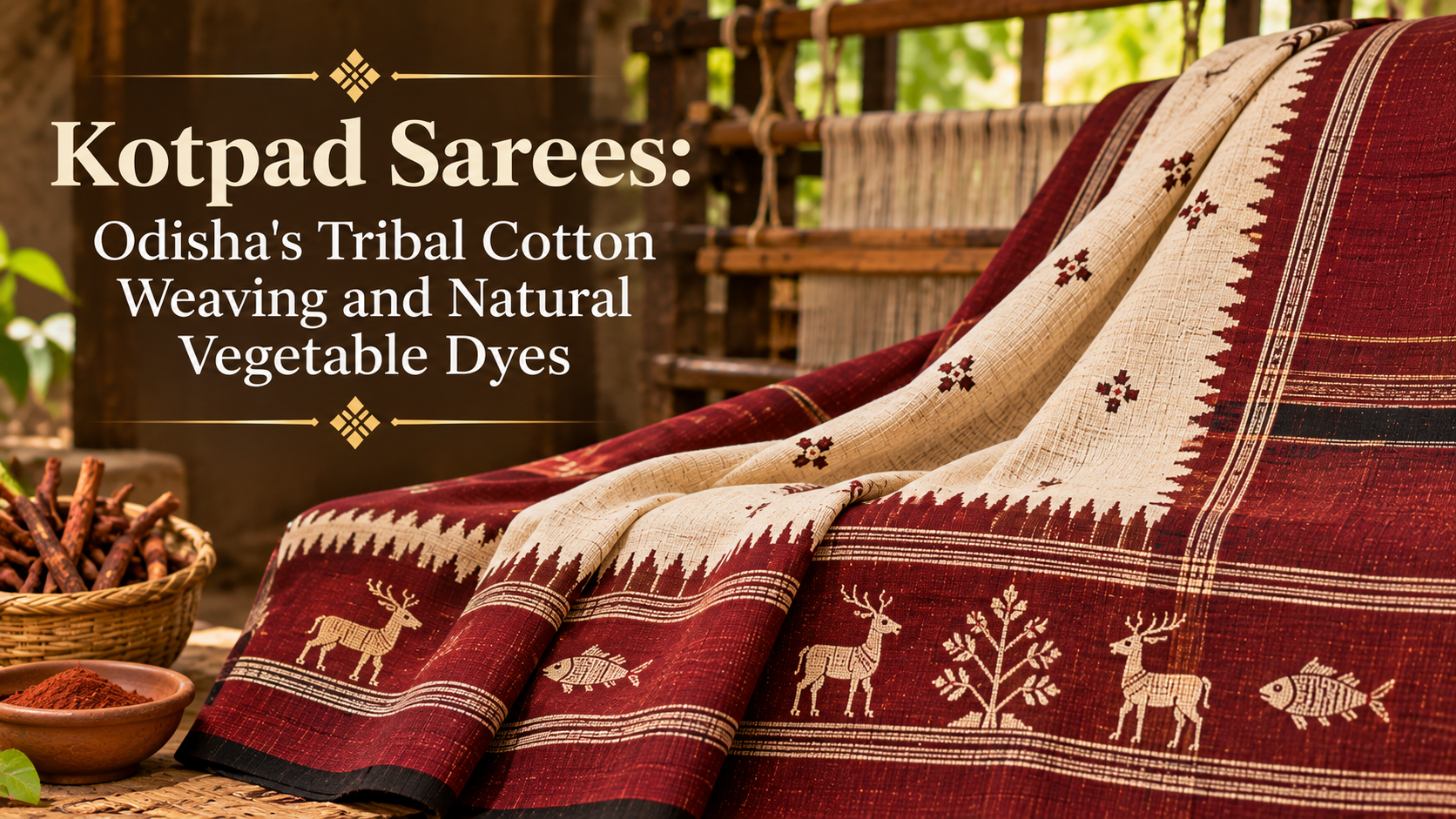
Most cotton sarees get their colour from a dye house. A Kotpad saree gets much of it from a tree root, cow dung, wood ash and castor oil, worked into the yarn by hand over days or weeks before a single thread reaches the loom. The result is a coarse, earthy handloom cotton in deep maroon, brown and black, with simple borders and small woven motifs. A Kotpad saree looks like nothing else on a shelf of cotton sarees, and it has a story to match.
This guide explains where Kotpad weaving comes from, who weaves it, how the dyeing and weaving work and what the cloth and its motifs look like. It also covers the community, the sustainability questions around the dye and the difference between naturally dyed Kotpad and commercially dyed cotton. A note on method: craft writing about Kotpad mixes careful documentation with promotional claims, so we say clearly what is well supported and what is only reported by one source.
Where Kotpad weaving comes from
The place
Kotpad is a small town in Kotpad block of Koraput district, in the hill country of southern Odisha. One craft encyclopedia places it about 5 kilometres from the tehsil headquarters and about 72 kilometres from Koraput town, and describes it as a nodal point for the region’s weaving economy. Weaving is not limited to the town itself. The same source lists nearby weaving settlements, including Bhansuli and Dungriguda, and says that a larger base of weavers in surrounding villages supplies yarn, cloth or finished textiles to Kotpad-based looms.
Other sources describe the craft as practised in the tribal regions of southern Odisha, and one government investment blog adds Chhattisgarh. Because Kotpad sits near the border zone with Bastar, you will see both states mentioned. When a listing says “Kotpad”, it is worth asking where the cloth was actually woven.
A protected name
Kotpad Handloom Fabric is a registered Geographical Indication (GI) of India. Several sources say it was Odisha’s first GI-tagged product, registered in 2005, and one earlier article describes the tag as covering the natural dyeing process involved in the weaving. The GI matters for buyers because it ties the name to a place and a method. A product that borrows the name for printed or chemically dyed cloth from elsewhere is using a protected term loosely, and trade writing notes the importance of enforcing the tag against synthetic-dyed imitations.
The Mirgan weavers and their traditional role
Most sources agree that Kotpad cloth is woven by the Mirgan community of Kotpad, and they are often described as tribal weavers. The descriptions are not identical, though. A craft encyclopedia run by the Craft Revival Trust says the Mirgan and Tanti communities have historically been the main custodians of the craft, producing patta cloth for neighbouring tribal communities such as the Bhatra, Durua, Paraja, Madia and Koya. A documentation project on handloom adds that some communities, including the Bhutra, Gond and Durva, traditionally wear sarees in deep red shades and generally avoid black. If this is accurate, it shows that Kotpad cloth was originally made for the weavers’ neighbours and for local use, and not for a distant market.
Several sources also describe a division of labour. Accounts say women carry out the natural dyeing and men do the weaving. This is widely repeated, but it comes from descriptive and promotional writing rather than a formal study, so treat it as a common account. It is also worth knowing that the number of active weavers is small. The Craft Revival Trust estimates around fifteen active weavers within the Kotpad municipal area, with roughly 108 beneficiary weavers across the wider cluster of Kotpad and nearby villages. Named master weavers include the Padma Shri awardee Gobardhan Panika, and weaving serves as both livelihood and a way of passing on inherited knowledge.
The products made go beyond sarees. Reported items include saris, stoles, dupattas, yardage, a woman’s wrap called patta, and the angocha (gamcha) and tuvaal worn by men on ceremonial and festive occasions. The saree is the most emblematic item, and many descriptions note its temple border.
Natural vegetable dyes: the aal root
What aal is
The defining colour source of Kotpad is the root of the aal tree, also spelled aul and, in Odia, aachhu or achu gachi. English-language sources call it Indian madder, and several name it as Morinda citrifolia. A note of care is needed here. The term “Indian madder” is used in dye literature for more than one plant, and aal is sometimes listed under another Morinda species name. For this reason, we use the local name aal and mention the English label only as a pointer. The root yields a deep red, and with additions it gives maroon, brown and black.
The dyeing process
Documentation of the process is fairly consistent, though the exact steps and timings vary. The summary below follows the account in the Craft Revival Trust’s encyclopedia, with other sources noted where they differ.
- Yarn preparation. Cotton yarn is washed, soaked and gently wrung. It is then worked by hand with heated castor oil and, after a further soaking and a brief drying period, with a slurry of cow dung and water. The yarn is then dried, and the treatment is repeated over about fifteen days. The source describes this stage as a natural mordanting process, which means a treatment that helps the dye bind to the fibre and improves colour fastness.
- Making the red. Aal root powder is mixed into hot water in an earthen pot. The yarn is dipped into the dye, left in the sun for about a day, and then reheated and dried again. A clear solution made from wood ash and water is sprinkled over the yarn, which is worked with the feet to spread it evenly. The dipping and drying are repeated.
- Making the black. For black, aal is combined with harad (myrobalan) and heerakashi (ferrous sulphate, an iron compound). Some accounts say aal and heerakashi alone are used.
- Yellow, where used. Some documentation records turmeric being used to dye yarn yellow, and one craft article says some artisans add a vibrant yellow in this way.
How long it takes
Sources do not agree on duration. Reports range from about 15 to 20 days for dyeing the yarn, to nearly a month for the whole treatment, with seller pages mentioning 30 to 35 days. These figures describe different stages and different workshops, so we do not give a single number. What the sources agree on is that the dyeing is slow, repeated and done before weaving begins.
Sustainability and supply
Natural dyeing here depends on a tree. Several sources note that aal trees have declined and that the State Forest Department in Koraput restricts the plucking of roots because it affects the life of the tree. An Invest India blog reports that the Government of Odisha planted an aal plantation of roughly two acres in Thenguda village in Kotpad block in 2019, and raises the question of whether the dye supply is sustainable. Another documentation source points to a different pressure: the move to concrete housing has reduced the open space needed for dyeing, preparing yarn and setting up looms. These points are useful for buyers, because they explain both why genuine natural-dyed Kotpad is slow to produce and why claims about it deserve a careful look.
Colours: deep red, maroon, brown and black
The documented core palette is red to maroon and brown, and black. One source describes the shades ranging from deep maroon to dark brown depending on the age of the root bark and the proportion of dye used, with iron sulphate added for darker tones. The dyed yarn is often set against the natural off-white of the cotton, which one documentation project describes as the contrast that sets Kotpad apart.
Yellow is documented as an occasional addition, using turmeric, and not as part of the core palette. Some modern sellers list a wider range, including blue and green, on natural-dye collections made with tussar or cotton silk. These may be genuine contemporary developments, but they go beyond the traditional maroon, brown and black described in the heritage sources, so ask what was used for each colour. A claim that a given shade comes entirely from aal root deserves a follow-up question.
The cloth, weave and texture
The fibre
Traditional Kotpad is cotton. Sources describe it as coarse handspun or hand-prepared cotton yarn, often in thick counts such as 10 to 20, with thicker yarns of around 10 to 14 count favoured for extra-weft patterning. The cloth is therefore sturdy, a little rough to the touch and breathable, and softens with use and washing. Other sources mention tussar silk, and Wikipedia and several sellers describe Kotpad tussar saris. So not every product sold under the name is plain cotton, and the fibre should be checked in each listing. If you want to compare how cotton and silk behave in a saree, our comparison of cotton vs silk sarees explains the differences in comfort, care and cost.
The weave
The cloth is woven in plain weave on pit looms. Sources describe a three-shuttle technique for the border, with multiple shuttles and interlocking of threads used to give a solid border effect. Motifs are made with the extra-weft method, in which an additional set of threads is inserted between the regular weft threads to form a pattern. In practice, this means that the body of the saree stays simple while borders and pallus carry the decoration.
What it feels like
Expect a textured, matte surface, a firm hand and the earthy colour of root dye against raw cotton. It is not a fine, sheer cotton. It is a robust handloom cloth with visible character, and small irregularities in colour and weave are part of the product.
Traditional Kotpad motifs and borders
The Craft Revival Trust lists simple geometric motifs, lines, dancing girls, deer, lions, elephants, tribal figures, birds, umbrellas, pots, fish, tortoises, crabs and temples. Other sources add conch shells, boats, axes, fans and bows, and the peacock appears in the encyclopedia’s images. The saree is recognised for a temple border, and a stepped temple outline appears in several descriptions.
A word on meaning. One heritage source says the patterns encode ideas of kinship, ritual and social balance, and another says the motifs reflect cross-cultural links in the Kotpad area. These are interpretive statements, and we have not found a documented explanation for the meaning of individual motifs. When a seller attaches a specific symbolism to a motif, ask for the source. A temple border is also not unique to Kotpad, since other Odisha weaves use similar forms, so the motif alone does not prove origin. The dye, the yarn and the way the motifs are woven give better evidence.
Craft, community and traditional knowledge
Kotpad is a good example of knowledge that lives in practice and not in a manual. The recipes for preparing yarn, mixing the dye and judging the colour are passed on through families, and they rely on local materials such as cow dung, ash, castor oil and a particular root. The craft also fits the local environment: the dye plant grows in the area, and the cloth was originally made for neighbouring communities. One source describes the textile as reflecting the rhythms of the forest and the land.
Some caution applies. Several seller pages claim very old origins, with one describing a third-century tribal legacy. We found no documentation to support a specific date, and heritage sources use more general terms such as centuries-old. The safest statement is that the craft is long-standing and its exact origin is undated. The same caution applies to the claim that the process “uses no chemicals at any stage”. The documented recipe uses natural materials, but iron sulphate is a chemical compound used for black, and modern workshops may differ from the traditional method. Where the details matter to you, ask.
Naturally dyed Kotpad vs commercially dyed cotton
The difference is less about appearance than about process and evidence. The table below compares a traditional, naturally dyed Kotpad saree with a typical commercially dyed cotton saree. Real products vary, and many sit between the two.
| Feature | Traditional naturally dyed Kotpad | Typical commercially dyed cotton saree |
| Fibre | Coarse handloom cotton, often thick counts of around 10 to 20, with tussar versions also made | Cotton of varied counts, from coarse to fine, often mill-spun |
| Dyeing | Yarn is oiled, treated with cow dung and ash, then dyed with aal root and iron or myrobalan for black, before weaving | Dyed with commercial or synthetic dyes, often after weaving or in large batches |
| Time | Slow, repeated treatment reported from about 15 days to nearly a month | Fast, often completed in hours or days |
| Colour | Maroon, brown and black, with occasional turmeric yellow; shades vary between pieces | Wide range, highly consistent and often brighter |
| Weaving | Plain weave on pit looms, three-shuttle borders and extra-weft motifs | Handloom, powerloom or printed, depending on the product |
| Design | Simple temple borders and small motifs such as fish, deer, birds and geometric forms | Wide range of prints, woven designs or embellishments |
| Feel | Firm, textured and earthy, softening with wear | Varies, often smoother and more uniform |
| Colour behaviour | Natural dyes may release some colour early on, and shade can vary | Varies by dye quality and finishing |
| Verification | Ask for the dye source, weaving place and GI details | Check fibre and care label |
Remember the central rule: the word “Kotpad” on a listing is not proof. Heritage and trade sources both warn that synthetic-dyed imitations are sold under the name. Do not assume that a Kotpad product is naturally dyed or handwoven unless the seller can explain how it was made.
Wearing and caring for a Kotpad saree
A cotton Kotpad saree is a practical choice for people who like substantial handloom cloth. It suits daytime wear, cultural events and everyday use if you prefer a firm drape and an earthy palette. For a wider look at how cotton fabrics perform in daily wear, our guide to cotton sarees for daily wear compares fabrics, weights and care.
Care for naturally dyed cloth is gentle by default. Ask the seller for instructions, wash the saree separately at first because natural dyes can release colour, avoid harsh detergent and long soaking, and dry it in shade. These are general good practice for natural-dyed cotton, and the seller or weaver’s advice should take priority. Because no two pieces are identical, expect some variation in shade between your saree and the photograph.
How to check what you are buying
A short checklist helps whether you shop in a store or online.
- Ask where it was woven. A genuine piece should be traceable to the Kotpad area.
- Ask about the dye. Find out whether the colour is aal root, what was used for black and whether any synthetic dye was added.
- Ask about the yarn. Cotton counts, handspun or mill-spun, and whether the saree is cotton, tussar or a blend.
- Look at the motifs. Extra-weft motifs are woven into the cloth, with floats or trimmed ends on the back.
- Expect variation. Handwork and natural dye mean slight differences in shade and finish.
- Ask about the GI. A trustworthy seller can explain what the tag covers.
For a broader framework covering fabric, weave, price and finishing across saree types, see our complete guide to buying sarees for women.
When you buy online, the listing and photographs carry most of the evidence, so a careful read matters. Our online saree shopping guide shows how to read descriptions, ask the right questions and check policies before you pay.
Frequently asked questions
What is a Kotpad saree?
It is a handloom saree from Kotpad in Koraput district, Odisha, traditionally woven in coarse cotton by the Mirgan community and dyed with natural materials, above all the root of the aal tree. It is known for deep maroon, brown and black colours, simple temple borders and small extra-weft motifs.
Who are the Mirgan weavers?
The Mirgan are the community most often named as the weavers of Kotpad cloth, and many sources describe them as tribal weavers. One craft encyclopedia says the Mirgan and Tanti communities have historically been the main custodians of the craft, producing cloth for neighbouring tribal communities. Descriptions of the community differ slightly from source to source.
What is aal and how is it used?
Aal, also spelled aul, is a tree whose root is dried and powdered to make the red dye used in Kotpad weaving. It is often called Indian madder in English. The yarn is prepared with castor oil and cow dung, dipped in the dye, dried and treated with ash water. For black, iron sulphate and myrobalan are added.
Are all Kotpad sarees naturally dyed?
No one can say that of every product marketed as Kotpad. Heritage and trade sources note that synthetic-dyed imitations exist. Traditional Kotpad is naturally dyed, but you should ask the seller how a particular saree was made and where it was woven.
Are Kotpad sarees made of cotton or silk?
Traditionally cotton, usually coarse handloom yarn. Tussar silk and cotton-silk versions are also made and sold, so read the listing for the exact fibre.
What colours are traditional for Kotpad?
The documented colours are deep red or maroon, brown and black, set against the natural off-white of the cotton. Turmeric yellow is recorded as an occasional addition. Other shades sold today may be modern variations.
Does Kotpad have a GI tag?
Yes. Kotpad Handloom Fabric is a registered Geographical Indication, reported as Odisha’s first, registered in 2005.
How should I wash a naturally dyed Kotpad saree?
Follow the seller’s or weaver’s instructions first. In general, wash it separately in cool water with a mild detergent, avoid long soaking and harsh scrubbing, and dry it in shade, since natural dyes can release colour and fade in strong sun.
Conclusion
A Kotpad saree rewards the buyer who values process as much as appearance. Its colours come from a slow natural dyeing method built on the aal root, its cloth is sturdy handloom cotton, and its motifs are woven in by hand on simple pit looms. It also carries real questions about supply, authenticity and the future of a small weaving community.
Look for a clear answer on where the saree was woven, how it was dyed and what fibre it uses, and treat dramatic claims about age or symbolism with care. A well-made Kotpad piece is not meant to look uniform or glossy. Its character lies in the earthy shades and the texture of handwork. If you would like to see handloom cotton sarees in person, visit Mahavir Cloth Center in Shirol, Kolhapur, or browse the saree range on the website.
