Blog
Dharmavaram Sarees: The Rich Silk Weaving Tradition of Andhra Pradesh

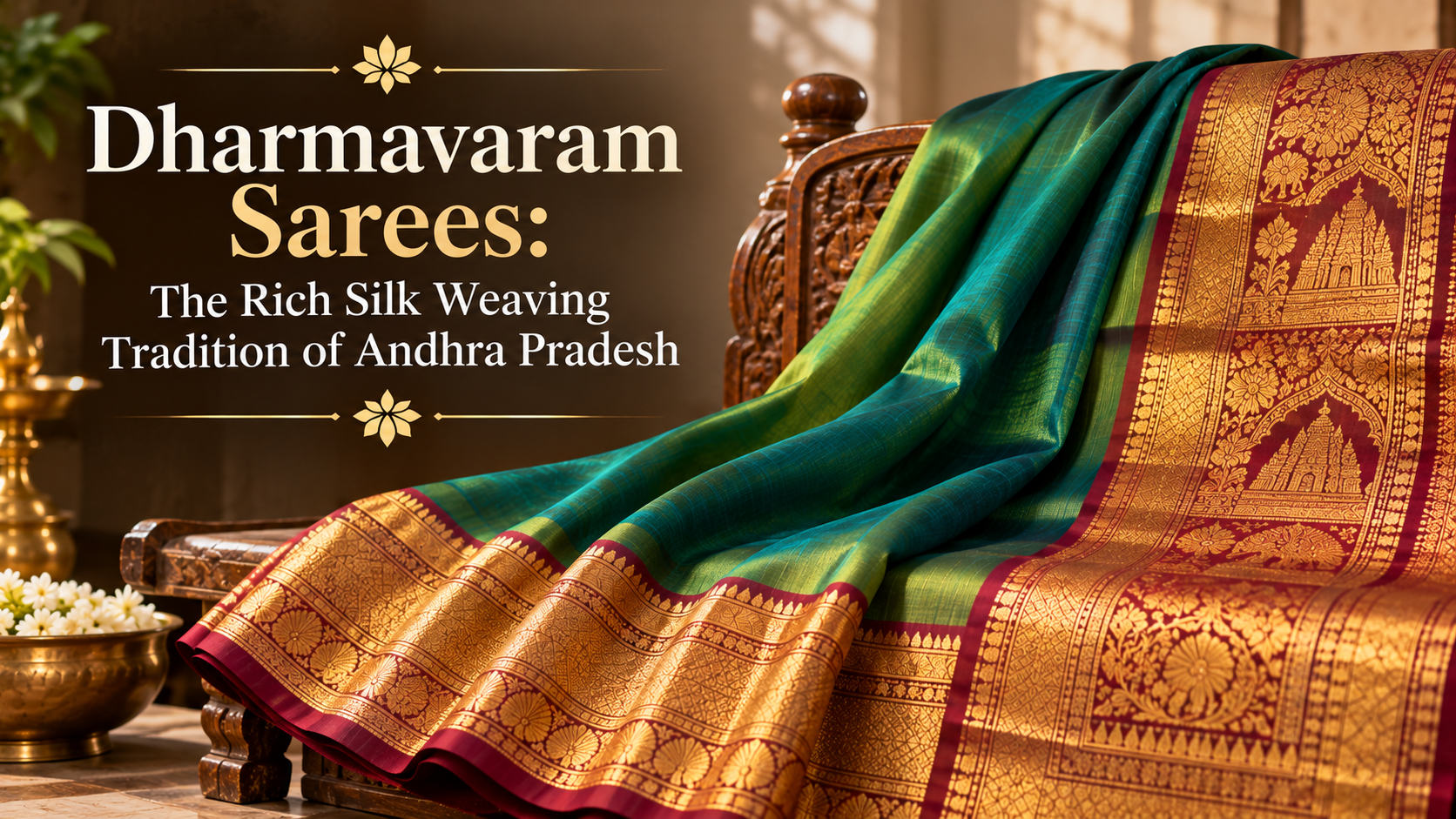
The first thing many people notice about a Dharmavaram saree is how the colour sits on the cloth. The body often carries a soft, shifting double shade, the border is solid and broad, and the pallu ends in a flash of gold zari. It is a look built for ceremonies, and it comes from a single town in the Rayalaseema region of Andhra Pradesh.
This guide explains where the Dharmavaram saree comes from, how the silk is prepared and woven, what the borders, pallus and motifs usually look like, and how the saree compares with other South Indian silks. It also covers wedding use and practical points for choosing one. Where sources disagree, the text says so, and it avoids claims about purity or handmade production that cannot be checked from a photograph or a label.
Where Dharmavaram sarees come from
Dharmavaram is a town in Sri Sathya Sai district of Andhra Pradesh, a district formed from what was formerly Anantapur district. It is often called the silk city of Andhra Pradesh, and weaving remains central to its economy. Sarees made here are known as Dharmavaram silk sarees, and locally the cloth is also described as Dharmavaram pattu, since pattu is the Telugu word for silk.
Local tradition holds that the town was named after Dharmambai, the mother of a saint called Kriya Shakthi Vodavaru Swamy, in the twelfth century. This is a traditional account and not a documented history of weaving. The more concrete record is that by the nineteenth century silk handloom weaving had become the main occupation of the town, according to the geographical indication description for the product. That description also states that paintings in the Lepakshi temple depict designs similar to those found on Dharmavaram sarees, which hints at a long visual link between local temple art and local cloth.
Dharmavaram handloom pattu sarees and paavadas hold a Geographical Indication tag, which ties the name to the place and its production methods. The silk sarees have also been selected for the One District One Product initiative for Sri Sathya Sai district. Paavadas, the silk skirts worn by girls in South India, are woven here alongside sarees.
Why the region became a silk centre
One commonly repeated explanation is the presence of mulberry in the area, which supported silk production and then silk weaving. Treat this as a general explanation and not a precise economic history. Whatever the exact causes, the town developed a dense cluster of weavers, dyers and traders over generations, and that concentration of skill is a large part of why the name carries weight today.
How a Dharmavaram silk saree is made
The process described in the geographical indication application and in other published accounts follows a recognisable sequence. Details vary between workshops, so read this as a general outline.
Yarn preparation
The saree begins with mulberry silk yarn. Cocoons are processed to obtain yarn, and the raw silk then goes through degumming, in which it is boiled with soap and soda ash to remove natural gums. The yarn is plied to create a balanced thread, which matters for both sarees and paavadas.
Dyeing
Dyed yarn is what gives the saree its colour before a single thread is woven. The application describes the use of acid dyes, with the plied yarn absorbing dye in hot water, and notes that factors such as temperature and the dye bath ratio matter. A tie and dye method is associated with a variety known as kuttu. After dyeing, the yarn is dried indoors on bamboo sticks.
Loom preparation
The dried hanks are wound into warp and weft. A charkha, bamboo and bobbins are used for the warp, and a pirn carries the weft. The stretched warp is then treated with rice conjee, a starch preparation that stiffens the threads and helps them weave smoothly, and it is dried before weaving begins.
Weaving
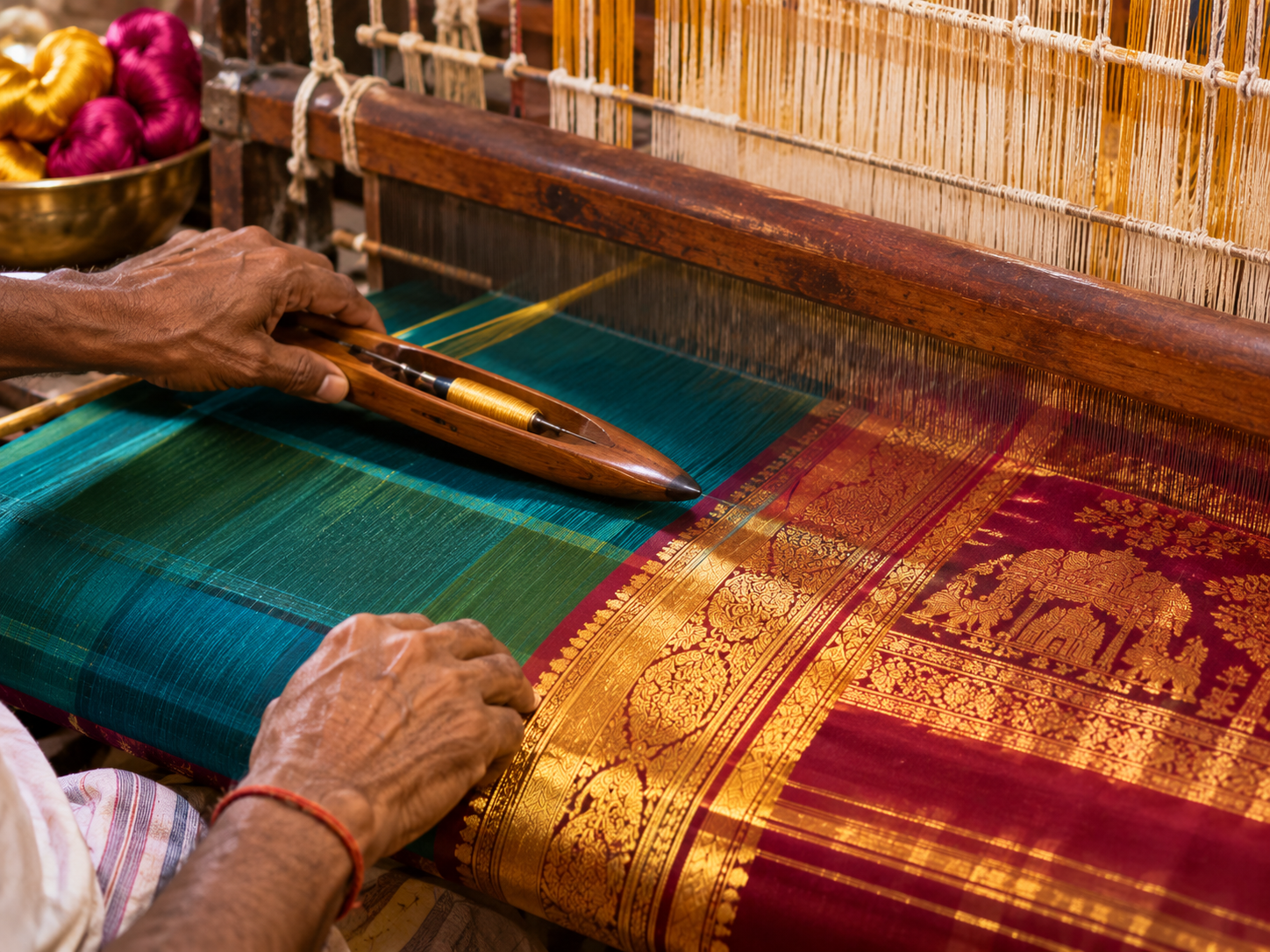
The sarees are woven on looms with the warp and weft method. The published description names pit looms and says powerlooms are not used for the registered product, and it mentions the interlocking technique commonly known as petni. It adds that jacquard or dobby mechanisms may sometimes be used to produce designs. Other published accounts say that both handloom and powerloom versions exist in the market, and one account suggests two weavers working together can take several days to complete a single saree. These accounts do not agree, which is a good reason to ask any seller exactly how a particular saree was made. A saree described as Dharmavaram is not automatically handwoven.
Characteristic design features
Dharmavaram sarees are recognised for a handful of visual signatures. No single saree has all of them, but together they describe the look.
Contrasting body and border
Many Dharmavaram sarees combine a body in one colour family with a border in a clearly different colour. The contrast gives the saree structure and makes it easy to coordinate with a blouse.
Double shading
A frequently cited feature is a body woven with two colours, which creates a soft, muted double shade. This effect comes from the way different coloured threads are used in warp and weft. Because it depends on yarn colour choices, it appears in some sarees and not in others.
Broad zari borders
Broad borders with gold zari work are one of the most recognisable features. The zari may be geometric, floral or temple inspired. Zari threads used in the registered product are listed in colours such as red, green, silver and gold. Whether any particular saree uses real or imitation zari varies, so look for the seller’s statement and not assume.
The pallu
The pallu tends to be rich and elaborate, often with dense gold zari at the edge and woven motifs across the field. It is where weavers show the most detail, and it is the part most people check first.
Motifs and their meaning
Motifs on Dharmavaram sarees often draw on temple art. Published accounts commonly mention elephants, peacocks and lotuses, along with floral and geometric patterns. Each of these is a widely used auspicious symbol in Indian art, but specific meanings vary between communities and between individual designs, so treat any single interpretation with caution. If a seller claims a documented meaning for a particular motif, ask where the claim comes from.
Colours also carry associations. One published account notes that weavers traditionally leaned on red and yellow, colours widely seen as auspicious in Hindu ceremonies, and later broadened their palette to follow market trends. Today you will find many shades, from deep maroons and greens to pastel and contemporary combinations.
Silk quality, zari and texture
A Dharmavaram saree is typically described as woven from mulberry silk and zari. The silk yields a smooth, slightly crisp hand, and the saree is usually described as having body and structure. How heavy or light a particular piece feels depends on yarn thickness, weave density and the amount of zari work, so there is no single weight for the whole category.
For readers weighing silk against more everyday fabrics, our comparison of cotton vs silk sarees explains the differences in comfort, care and cost in plain terms.
Draping characteristics
Silk of this kind tends to hold pleats well and gives a defined, structured fall. The geographical indication description notes that these sarees are better suited to cool or cold weather, and that they are mostly worn for functions. That fits the experience of many wearers, who find heavy silk comfortable in cooler months and warm in peak summer. If you plan to wear one in hot weather, consider the length of the event and the venue.
Blends and lighter variations
Not every saree sold with the Dharmavaram name is pure silk. Some weavers have experimented with other fibres, including cotton silk, and market descriptions vary. If you are interested in a lighter blend, our cotton silk saree guide explains what blended sarees offer and what to check on the label.
Dharmavaram sarees at weddings and ceremonies
Dharmavaram sarees are often described as wedding sarees, and they appear in bridal trousseaus and at family functions across Andhra Pradesh and neighbouring regions. The combination of contrast, zari and a rich pallu suits ceremonies where the saree is expected to be seen and photographed.
The published description of the registered product also notes that these sarees are worn for functions and used by dancers of Bharatanatyam and Kuchipudi, which points to their place in performance as well as ceremony. Younger girls wear the related paavadas on festive days.
Choosing for a wedding involves more than the saree itself. Think about the time of year, the length of the ceremony, the jewellery you plan to wear and whether you will be seated or moving. Our complete guide to buying sarees for women walks through those decisions across occasions and fabrics.
Traditional wedding silk sarees from other regions fill a similar role, and many families own several. A Dharmavaram can sit beside a Kanjivaram or Banarasi in a wardrobe without competing, because each has its own look.
Dharmavaram vs Kanjivaram and other South Indian silks
These traditions are related but distinct, and it helps to keep them apart. All are silk, and all use zari. What differs is the place of origin, the characteristic styling and the way each is commonly described. The table gives general tendencies only, since individual sarees vary widely by weaver and design.
| Feature | Dharmavaram | Kanjivaram | Mysore silk |
| Place of origin | Dharmavaram, Andhra Pradesh | Kanchipuram, Tamil Nadu | Karnataka |
| Typical impression | Contrasting borders, often a double shaded body, a rich pallu | Heavy silk with strongly contrasted borders and woven temple motifs | Smooth, soft silk with a gentle sheen |
| Common motifs | Temple inspired motifs such as elephants, peacocks, lotuses | Temple borders, checks, florals and other traditional motifs | Often simpler patterns with zari borders |
| Typical use | Weddings and festive functions | Weddings and major celebrations | Festive and formal wear |
| Weight and feel | Structured silk, often substantial | Often described as heavier and more rigid | Often described as lighter and softer |
| GI status | Registered as Dharmavaram handloom pattu sarees and paavadas | Registered separately under its own name | Registered separately under its own name |
Two cautions apply. First, similar vocabulary appears across traditions, such as temple borders and zari, so do not identify a saree by those features alone. Second, imitation sarees exist in every category, so a regional name on a listing is not a guarantee of origin. Ask for details and check labels.
Neighbouring Andhra Pradesh weaves, such as Venkatagiri and Uppada, are different traditions again and deserve their own reading.
How to choose a Dharmavaram saree
A few practical checks help whether you are buying in a shop or choosing between listings.
Start with the occasion. A ceremony with a long timetable suits a saree you will be comfortable wearing for hours, and a saree with heavy zari may be best saved for the main event.
Next, look at the weave. The body should look even, the border should sit cleanly against the body, and the pallu should appear well finished. Colour should be consistent across the length, and you should view it in natural light if you can.
Then ask direct questions: Is the fibre pure silk or a blend? Is the zari real or imitation? Was the saree woven by hand, or on a powerloom or jacquard loom? Does it carry a Silk Mark label or other tag? These questions matter because purity, zari composition and production method cannot be judged from a photograph. The simple home tests often passed around online, such as burning a thread, are not reliable on their own and can damage the saree.
If you are shopping remotely, our online saree shopping guide covers how to read descriptions, judge photographs and check seller details before you pay.
Caring for a Dharmavaram silk saree
Silk and zari reward gentle handling. Follow the care label first, and if there is no label, ask the seller. Dry cleaning is often the safest option for sarees with heavy zari. Store the saree folded in a soft cotton or muslin cloth, keep it away from damp, and refold it along different lines now and then so that creases do not set in the same place. Avoid hanging heavy silk for long periods, and keep perfume and hair products away from the fabric and zari.
Frequently asked questions
What is a Dharmavaram saree?
A Dharmavaram saree is a silk saree woven in Dharmavaram, a town in Sri Sathya Sai district of Andhra Pradesh. It is known for contrasting borders, zari work and a rich pallu.
Is a Dharmavaram saree pure silk?
Many Dharmavaram sarees are described as woven from mulberry silk and zari, but not every saree sold under the name is pure. Ask the seller for fibre details and check labels.
Are Dharmavaram sarees handwoven?
The registered product is described as woven on pit looms, but powerloom and jacquard versions also circulate in the market. Ask how a specific saree was made.
What is the difference between Dharmavaram and Kanjivaram sarees?
They come from different places, Andhra Pradesh and Tamil Nadu, and are commonly associated with different styling. Both are silk sarees with zari work, so check origin details instead of judging by a single feature.
What is a Dharmavaram pattu saree?
Pattu means silk in Telugu, so a Dharmavaram pattu saree is a Dharmavaram silk saree. The terms are used interchangeably.
Are Dharmavaram sarees good for weddings?
They are widely worn for weddings and festive functions. Comfort depends on the weather, the length of the event and the weight of the saree you choose.
What motifs appear on Dharmavaram sarees?
Published accounts mention temple inspired motifs such as elephants, peacocks and lotuses, along with floral and geometric patterns. Meanings vary and are not always documented.
How should I care for a Dharmavaram silk saree?
Follow the label. Dry cleaning is often preferred, especially for heavy zari. Store it in soft cloth in a dry place and refold it periodically.
Conclusion
The Dharmavaram saree rewards a closer look. Its contrast, zari and pallu come from a town where silk weaving has shaped daily life for generations, and its name is tied to a registered place and a documented set of production methods. The details that matter when you choose one are practical: the occasion, the fibre, the zari, the way it was woven and whether the seller can answer plain questions about all four.
Treat regional names as a starting point, not a guarantee, and take your time with the weave, the border and the pallu. A well chosen Dharmavaram saree can be worn and treasured for many years.
