
Blog
How to Drape a Dupatta for Navratri: 7 Styles That Stay in Place

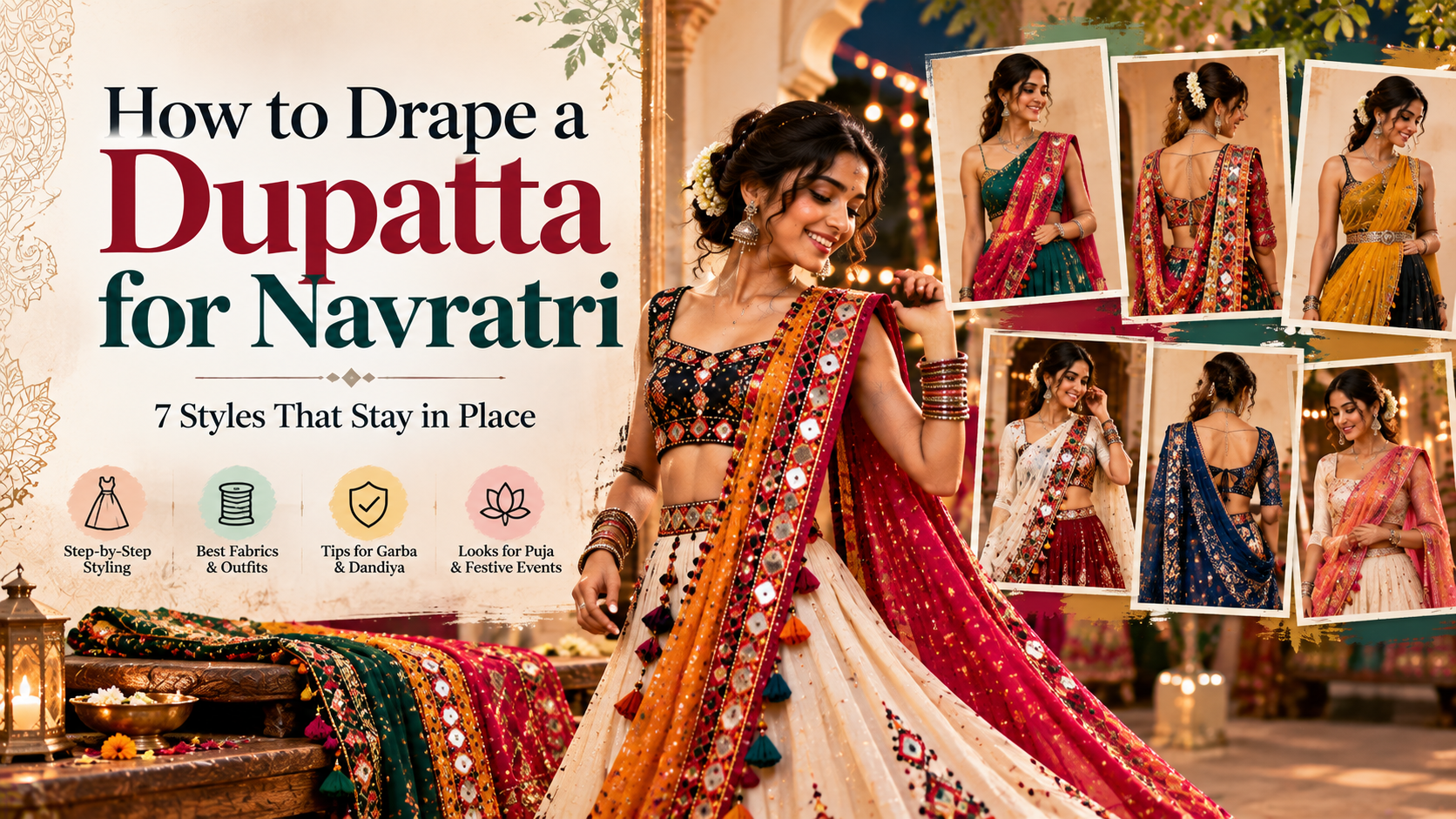
A dupatta decides more about a festive outfit than most people expect. The same lehenga can look regal with a front pallu, relaxed with a single-shoulder fall, or sharp and modern with a belted drape. It also decides how comfortable you are. A badly pinned dupatta slips during aarti, drags on the floor during Garba, and needs fixing every ten minutes. A well-chosen drape stays where you put it, so you can stop thinking about it.
This guide covers seven dupatta draping styles that work for Navratri, with steps, the outfits and fabrics each one suits, and where each one falls short. It also covers how to secure a dupatta for dancing, how to drape for puja, which fabrics behave best, and how to get several looks out of one dupatta. If you are still planning the outfits themselves, start with our Navratri Outfit Ideas 2026 guide and come back here for the finishing touch.
What to consider before choosing a dupatta style
Before picking a drape, look at five things. They will narrow your options quickly.
Fabric
Fabric controls how a dupatta falls and how well it holds a pin. Chiffon and georgette are soft and flowing, so they suit open drapes but slide off the shoulder unless pinned. Net is light and see-through and holds pleats reasonably well. Cotton has grip and body, which makes it easy to manage but less fluid. Heavily embroidered or mirror-work dupattas are dramatic but heavy, and they pull on whatever is holding them.
Length and width
Most dupattas are around 2.25 to 2.5 metres long, but sizes vary by maker, so measure yours. A longer dupatta gives you room for a front pallu or a pleated drape. A shorter one is better suited to cross-body and cape styles. Width matters too: a wide dupatta can be folded lengthwise to make pleats neat, while a narrow one works better left open.
Weight
A heavy dupatta needs more pins and a sturdier blouse to anchor to. If your blouse is in a thin fabric, a heavy dupatta can drag its neckline down. For long dancing nights, lighter is almost always better.
Outfit silhouette
A flared lehenga or chaniya choli has a wide hem, so a dupatta that falls straight down the side keeps the shape balanced. A sharara or palazzo set has volume at the bottom too, which suits drapes that stay above the waist. A straight kurta or anarkali looks tidy with double-shoulder or simple one-shoulder drapes.
Occasion and coverage
Garba and Dandiya call for a drape that stays tight to the body. Puja and family functions often call for more coverage, sometimes including a head covering. Decide how much of your blouse and arms you want covered before you choose.
Seven dupatta draping styles for Navratri
1. One-shoulder drape
This is the simplest drape and the one most people already know.
Steps:
- Make soft pleats along the length of the dupatta, about 3 to 4 cm wide, or fold it in half lengthwise if the fabric is wide.
- Place one end over your left shoulder so it falls down your back to about knee height.
- Pin the pleats to the blouse at the shoulder seam with a safety pin from the inside.
- Let the front portion fall loosely, or tuck its end into the lehenga waistband at your right hip.
Suitable outfits: lehengas, chaniya cholis, anarkalis and sharara sets.
Recommended fabrics: georgette, chiffon, light net.
Visual effect: it shows most of the blouse and leaves one arm completely free, which looks clean and lets embroidery on the blouse stand out.
Advantages: quick to do, easy to adjust and suitable for nearly any outfit.
Limitations: with only one pin, the free end swings. For dancing, tuck the front end into the waistband so it cannot fly out.
2. Gujarati front-pallu drape
This is the drape many people picture first when they think of Gujarati dupatta draping, and it suits Navratri well because it shows off the decorated border or pallu of the dupatta across the front.
Steps:
- Tuck one end of the dupatta into the back of your lehenga waistband, slightly to the right.
- Bring the dupatta around the back and over your right shoulder from behind, so the decorated end falls across your front.
- Spread the front portion so it covers your torso diagonally and the pallu hangs at the front, roughly to knee or mid-shin level.
- Pin it at the right shoulder. Add a second pin at the left side of the waist where the pallu edge meets the lehenga, so the front panel stays flat.
Suitable outfits: chaniya cholis, ghagras and lehengas, especially those with a matching bandhani or embroidered dupatta.
Recommended fabrics: bandhani, cotton silk, georgette with a heavy border, mirror-work fabric.
Visual effect: traditional and full. The pallu becomes the focal point of the outfit, which is why it works best with a dupatta that has a strong border or motif. Our Chaniya Choli Styling Guide has more ideas for pairing a front-pallu dupatta with jewellery and footwear.
Advantages: good coverage, photographs well and stays secure once pinned at two points.
Limitations: it covers much of the blouse, so it hides blouse embroidery. A very heavy pallu can feel warm during long dancing sessions.
3. Cross-body drape
A cross-body drape runs diagonally from one shoulder to the opposite hip, like a sash.
Steps:
- Fold the dupatta lengthwise into a band about 15 to 20 cm wide.
- Place one end over your left shoulder, letting a short length hang down the back.
- Bring the front portion diagonally across your chest to your right hip.
- Tuck the end into the waistband at the right hip, or knot it loosely there, and pin it.
- Pin the shoulder end to the blouse.
Suitable outfits: lehengas, chaniya cholis, sharara and gharara sets.
Recommended fabrics: georgette, crepe, soft net, light silk.
Visual effect: it creates a diagonal line across the body, which adds definition at the waist.
Advantages: both ends are anchored, so it barely moves while you dance. It also uses less fabric, so shorter dupattas work well.
Limitations: it covers part of the blouse and does not suit very stiff or heavily embroidered fabrics, which bunch at the hip.
4. Double-shoulder drape
This style rests the dupatta across the back with an end falling over each shoulder.
Steps:
- Hold the dupatta behind you at the centre so it lies across your upper back.
- Bring one end over each shoulder to the front.
- Pin each side at the shoulder seam of the blouse.
- Let both ends hang straight down at the front, or drape one over the opposite arm.
Suitable outfits: kurta sets, anarkalis, straight suits and lehengas. Many of the designs in our Navratri Suit Designs for Women roundup pair naturally with this drape.
Recommended fabrics: cotton, chanderi, organza, light georgette.
Visual effect: balanced and symmetrical, with a soft frame around the shoulders.
Advantages: comfortable for sitting and walking, and good for puja since it gives coverage across the back and shoulders.
Limitations: the two front ends hang loose, which makes it a poor choice for energetic Garba unless you tuck them into a belt or waistband.
5. Waist-tucked drape
This drape secures the dupatta at the waist, either with a belt or by tucking it into the waistband.
Steps:
- Drape the dupatta over one shoulder as in the one-shoulder style, or across the front as a pallu.
- Gather the front portion at your waist.
- Tuck it into the lehenga waistband, or place a kamarbandh, fabric belt or embroidered belt over it to hold it flat.
- Arrange the length below the waist so it falls along the side of the skirt.
Suitable outfits: lehengas, chaniya cholis and lehenga-style skirts with crop tops.
Recommended fabrics: net, georgette, chiffon, light embroidered fabrics.
Visual effect: it defines the waist and keeps the silhouette neat.
Advantages: it is one of the most secure styles for dancing, because the waist anchor stops the dupatta from swinging.
Limitations: a thick fabric adds bulk at the waist. It also needs a belt or a firm waistband to stay in place.
6. Cape-style drape
The dupatta sits across the shoulders like a cape and falls down the back.
Steps:
- Place the centre of the dupatta across the back of your neck so both ends hang in front.
- Flip both ends back over the shoulders so the fabric falls down your back.
- Pin the dupatta at each shoulder seam, slightly towards the back, so the front of the blouse stays visible.
- If the dupatta is long, pin the two hanging ends together at mid-back so they move as one panel.
Suitable outfits: lehengas with statement blouses, crop-top lehengas, sharara and Indo-western sets.
Recommended fabrics: sheer net, organza, tulle, light georgette.
Visual effect: contemporary and dramatic, especially with a sheer dupatta that shows the blouse back through it.
Advantages: it keeps the front of the outfit clear and both arms free.
Limitations: the back panel can trail if the dupatta is long, so it needs to be measured or pinned up for dancing. It gives no front coverage.
7. Pleated shoulder drape
This is a more structured version of the one-shoulder drape, similar to how a saree pallu is pleated.
Steps:
- Make even pleats along the full length of the dupatta, about 3 cm wide. Iron them if the fabric allows.
- Hold the pleats together and pin them at the centre with a small pin to keep them aligned.
- Place the pleated length over your left shoulder so it falls to the back.
- Pin it firmly at the shoulder seam with two pins, one near the neck and one near the arm.
- Take the front end across your waist and tuck it into the right side of the waistband.
Suitable outfits: lehengas, half-saree sets and lehenga-saree styles. If you prefer an actual saree for the festival, see our guide to the best sarees for Navratri.
Recommended fabrics: georgette, crepe, silk blends and other fabrics that hold a pleat.
Visual effect: neat and polished, close to a saree drape without the full wrap.
Advantages: very tidy, holds its shape all evening and photographs well.
Limitations: it takes the longest to set up. Pure chiffon struggles to hold sharp pleats.
Dupatta draping for Garba and Dandiya
Garba and Dandiya involve spinning, clapping, bending and moving through crowds for hours, so the dupatta has to stay close to your body. These habits help:
- Anchor it in at least two places. A shoulder pin alone is not enough. Add a second anchor at the waist, either by tucking the end or using a belt. Cross-body, waist-tucked and pleated shoulder drapes all do this.
- Use the right pins. Medium safety pins pinned from the inside of the blouse hold better than decorative brooches alone. If you want a brooch on top for looks, still use a safety pin underneath.
- Check the hem length. No part of the dupatta should hang lower than your mid-calf. A trailing end can get stepped on or caught under your own feet while spinning.
- Keep the loose ends away from your hands. During Dandiya, a loose front end can tangle with the sticks. Tuck the front portion into the waistband so your hands are clear.
- Choose lighter fabric. A light georgette or cotton dupatta is easier to control than a heavy embroidered one during several hours of dancing.
- Do a test spin at home. Turn quickly a few times in front of a mirror. If anything flies out or slips, pin it again before you leave.
For more on staying comfortable through the night, read our guide to Comfortable Navratri Outfits for Long Garba Nights.
Dupatta draping for puja and family gatherings
Puja and family functions are slower, and you may spend a lot of time seated on the floor or bending to perform rituals. Coverage and comfort matter more than security during movement.
The double-shoulder drape and the Gujarati front-pallu drape both give good coverage. If you want to cover your head during the puja, the one-shoulder drape works well: pin it at the shoulder, then bring the free back end up and over your head, letting it rest lightly without pins so you can lower it afterwards.
For sitting on the floor, avoid styles where the dupatta reaches the ground in front, since you will end up sitting on it. Tuck the lower end into your waistband before sitting, or drape it loosely over your lap. Keep the dupatta well clear of diyas and lit lamps during aarti. Synthetic fabrics in particular can catch fire easily, so loose, trailing ends near flames are a real risk.
Choosing the right dupatta fabric
| Fabric | Weight | Drape | Holds pins and pleats | Maintenance |
| Cotton | Light to medium | Structured, less fluid | Holds well | Easy; can usually be washed at home, may wrinkle |
| Chiffon | Very light | Soft and flowing | Slips; pleats are soft | Delicate; gentle hand wash or dry clean |
| Georgette | Light | Fluid with some body | Holds reasonably well | Fairly easy; resists wrinkles |
| Net | Light | Airy, slightly stiff | Holds pleats and shape | Can snag; store flat or rolled |
| Embroidered or mirror-work | Heavy | Stiff, falls straight | Needs several pins | Usually dry clean; store carefully to protect work |
Always check the care label, as blends and finishes vary.
For Garba, georgette and cotton are the most practical. Chiffon looks graceful for puja and evening gatherings but needs extra pins. Net suits cape and pleated drapes. Save heavy embroidered dupattas for drapes that are firmly anchored, such as the front pallu, and for occasions where you will not dance for long.
Colour coordination
Matching dupattas
A dupatta in the same colour as the outfit makes it look like one long line, which is elegant and easy. It suits outfits where the embroidery or texture is already the main feature.
Contrast dupattas
A contrasting dupatta changes the look of an outfit more than any other single item. A pink lehenga with a green bandhani dupatta, or a mustard suit with a deep maroon dupatta, gives a strong festive look. A simple approach is to pick up a colour already present in the outfit’s embroidery or print and use it as the dupatta colour, so the contrast still feels connected.
Refreshing existing outfits
You do not need new outfits for every night. A plain black or white chaniya choli, for example, can look very different with a multicoloured bandhani dupatta one night and a mirror-work dupatta the next. A printed dupatta also lifts a plain kurta set enough to make it suitable for an evening event.
Common dupatta draping mistakes and how to fix them
- Pinning only at the shoulder. The dupatta slides forward or swings. Fix: add a second anchor at the waist.
- Pinning to thin blouse fabric. The pin pulls the fabric and leaves a mark or tear. Fix: pin through the blouse seam or the lining, where the fabric is doubled.
- Letting the dupatta hang too long. It drags or trips you. Fix: fold or pleat it shorter, or tuck the excess into the waistband.
- Using the wrong drape for the fabric. A heavy dupatta in a cape style pulls at the shoulders. Fix: match heavy fabrics to drapes anchored at both the shoulder and waist.
- Uneven pleats. They look untidy in photos. Fix: pleat on a flat surface first and hold them with a small pin before draping.
- Covering the best part of the outfit. A front pallu hides an embroidered blouse. Fix: switch to a one-shoulder or cape style.
- Not checking in a full-length mirror. Problems at the back go unnoticed. Fix: check front, sides and back before leaving.
How to restyle one dupatta across multiple outfits
Navratri lasts nine nights, and one good dupatta can do a lot of the work. Take a single red bandhani dupatta as an example:
- Night one: Gujarati front-pallu drape over a matching or contrasting chaniya choli for a traditional look.
- Night two: cross-body drape over a plain lehenga, secured for a long Garba session.
- Night three: double-shoulder drape with a plain cotton kurta and palazzos for a family puja.
- Night four: belted waist-tucked drape with a crop top and lehenga skirt for a more modern look.
Changing the drape changes how much of the dupatta and the outfit is visible, so the same piece reads differently each time. Neutral outfits in black, white, beige or a single solid colour give you the most room to repeat a dupatta.
Dupatta draping styles compared
| Draping style | Suitable outfit | Best occasion | Practical considerations |
| One-shoulder drape | Lehenga, chaniya choli, anarkali, sharara | Garba, gatherings, puja | Quick; tuck the front end for dancing |
| Gujarati front-pallu | Chaniya choli, ghagra, lehenga | Traditional Garba, puja | Good coverage; pin at shoulder and waist; can feel warm |
| Cross-body drape | Lehenga, chaniya choli, sharara | Garba and Dandiya | Very secure; covers part of blouse |
| Double-shoulder drape | Kurta set, anarkali, suit | Puja, family gatherings | Comfortable for sitting; loose ends need tucking to dance |
| Waist-tucked drape | Lehenga, chaniya choli, crop-top sets | Garba, evening events | Very secure; needs a belt or firm waistband |
| Cape-style drape | Statement-blouse lehenga, sharara, Indo-western | Parties, photo-heavy events | Shows blouse; check back length |
| Pleated shoulder drape | Lehenga, half-saree, lehenga-saree | Formal functions, puja | Neat all evening; takes time; needs pleat-holding fabric |
Frequently asked questions
1. Which dupatta drape is best for Garba? The cross-body and waist-tucked drapes are the most secure, because the dupatta is anchored at both the shoulder and the waist and nothing hangs loose.
2. How do I stop my dupatta from slipping off my shoulder? Pin it from the inside of the blouse at the shoulder seam with a medium safety pin, and add a second pin or tuck at the waist. For slippery fabrics such as chiffon, use two pins at the shoulder.
3. How many pins do I need to drape a dupatta? Usually two to four. One or two at the shoulder, and one at the waist if the drape crosses the body. Heavy embroidered dupattas may need more.
4. What is the traditional Gujarati way to wear a dupatta? The front-pallu style, where the dupatta is tucked at the back, brought over the right shoulder and spread across the front so the decorated pallu is displayed.
5. How do I wear a dupatta with a lehenga without hiding the blouse? Choose a one-shoulder or cape-style drape. Both keep most of the blouse front visible.
6. Which dupatta fabric is easiest to manage for beginners? Cotton and georgette. They hold pins and stay in place better than chiffon, and they are light enough to drape easily.
7. Can I wear a heavy embroidered dupatta for dancing? You can, but anchor it at the shoulder and the waist and keep the dancing session short if it feels heavy. For long Garba nights, a lighter dupatta is more comfortable.
8. How do I keep my dupatta from catching on Dandiya sticks? Tuck the front end into your waistband so no loose fabric hangs near your hands, and keep the overall length above mid-calf.
Conclusion
The right dupatta drape depends on what you will be doing that evening. For Garba and Dandiya, choose a drape anchored at two points, such as cross-body, waist-tucked or pleated shoulder, and keep the fabric light. For puja and family gatherings, the double-shoulder and Gujarati front-pallu drapes give coverage and are comfortable to sit in. For parties and photographs, the cape-style and one-shoulder drapes show off the blouse.
Practise your chosen drape once before the event, pin through seams rather than thin fabric, and do a quick spin in front of the mirror. With a few safety pins and one versatile dupatta, you can create a different look for each of the nine nights.
