
Blog
Chanderi Sarees: History, Fabrics, Motifs and Weaving Techniques

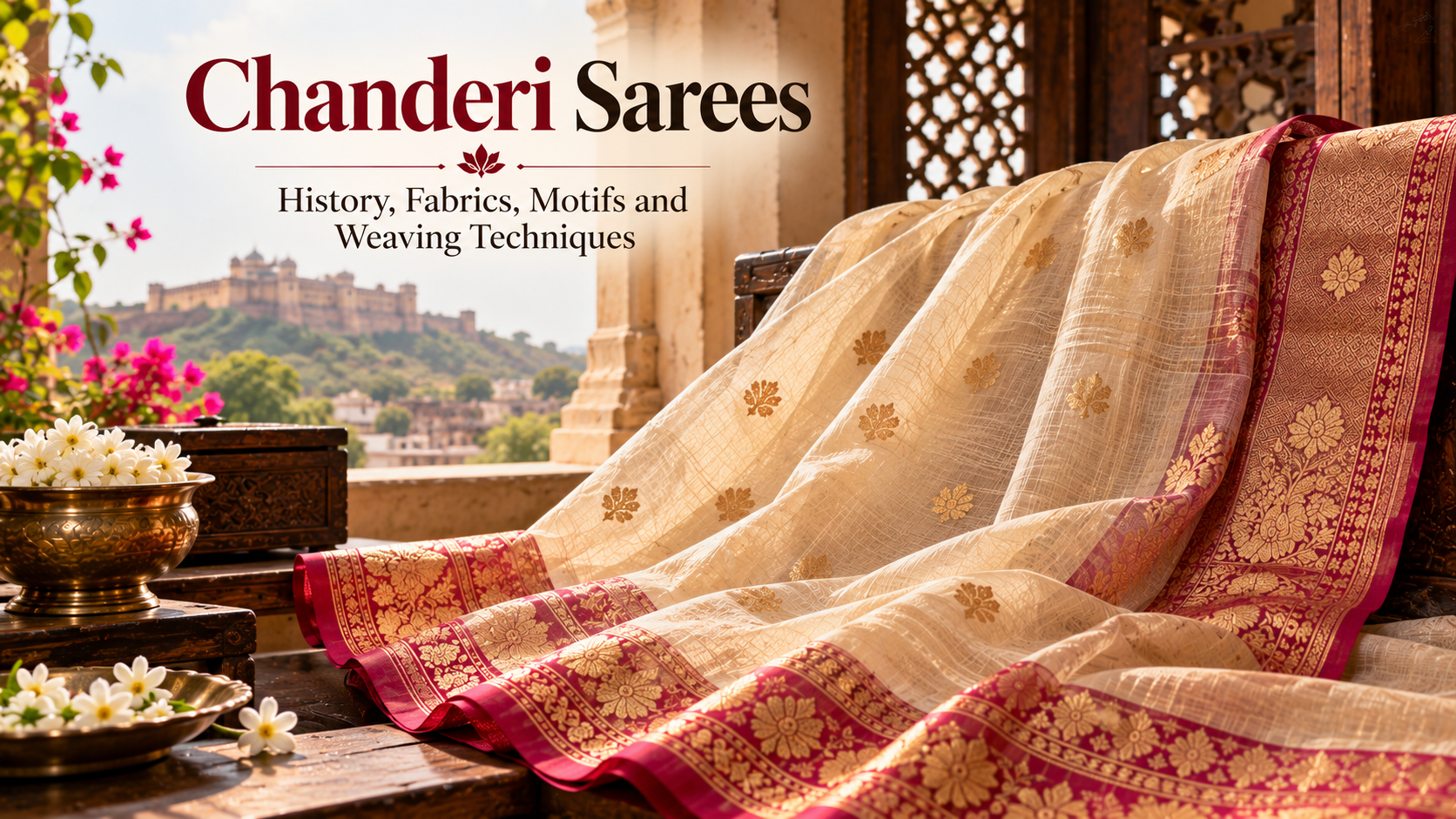
Hold a good Chanderi saree up to a window and you can see light through it. The fabric is fine enough to look almost sheer, yet it holds its shape, and the small gold motifs scattered across it catch the light without weighing the drape down. That combination is why the Chanderi saree has stayed in demand for centuries, through royal courts and into modern wardrobes.
This guide covers where Chanderi weaving comes from, what the fabric is actually made of, how the motifs are woven and how to read a product description so you know what you are buying.
Where Chanderi weaving comes from
Chanderi is a hill town in the Ashoknagar district of northern Madhya Pradesh, in the Bundelkhand region. The town sits on old trade routes between the Malwa plateau and the Gangetic plains, and its weaving tradition grew alongside that trade.
Dates for the beginning of the craft vary widely between sources, and many of the oldest claims rest on legend rather than records. What is well documented is the medieval and later history. Chanderi was a fortified town ruled in turn by several dynasties and sultanates, and fine Chanderi textiles became a favoured cloth among the Mughal nobility. In the 19th and early 20th centuries the Scindia rulers of Gwalior supported the weavers, and the use of finer imported yarns from this period helped shape the sheer, lustrous cloth known today.
The weaving has long been a community skill passed from parent to child. Government craft records mention the Momin and Koli communities among the traditional weavers of Chanderi cloth.
Geographical Indication status
In 2005, Chanderi fabric received a Geographical Indication (GI) tag, one of the earliest GI registrations from Madhya Pradesh. The GI covers handloom fabric woven in the defined Chanderi region using the traditional methods described in the registration. It is the legal basis for calling a saree “Chanderi” in the strict sense.
In practice, the word is also used loosely in the market for any sheer, Chanderi-style fabric, including powerloom cloth woven elsewhere. That gap between the legal meaning and everyday use is the main reason buyers need to read descriptions carefully, which is covered further below.
What makes Chanderi fabric different
Three qualities define a traditional Chanderi saree.
Fine, sheer weave. Chanderi uses very fine yarns set close together in a plain weave. The result is a light, semi-transparent cloth that drapes softly and feels cool in warm weather.
A gentle sheen. Silk in the warp gives the fabric a soft lustre. Many sarees are lightly finished after weaving, which gives the cloth its slightly crisp hand when new.
Small woven motifs. Instead of dense all-over patterns, Chanderi usually has scattered motifs called buttis, plus a border and a decorated pallu. The plain ground between motifs stays sheer, so the decoration never makes the saree heavy.
Because the weave is so fine, a Chanderi saree weighs far less than a brocade silk of the same length. It suits daytime functions, office wear and hot months, and it is often chosen as a lighter alternative to heavy wedding silks.
Chanderi fabric types: not every Chanderi is the same
The label “Chanderi” tells you about the weaving tradition and the look. It does not tell you the fibre. Chanderi sarees are woven in three main fabric types, and the difference affects feel, care and price.
Chanderi silk saree
A pure Chanderi silk saree uses silk yarn in both the warp (lengthwise threads) and the weft (crosswise threads). It has the strongest sheen and the softest drape of the three types and is usually the most expensive. It suits festivals, receptions and family functions.
Chanderi cotton saree
A Chanderi cotton saree uses fine cotton yarn throughout. It is matte or only faintly lustrous, very breathable and well suited to daily wear and humid weather. Cotton was the original fibre of Chanderi weaving before silk became common.
Silk-cotton Chanderi
The most widely made type combines a silk warp with a cotton weft. The silk adds shine and strength along the length, and the cotton adds softness and breathability. Many sarees sold simply as “Chanderi” are this mix, so it is worth checking the description rather than assuming the fabric is pure silk.
Handloom versus powerloom
Fibre is one question; how the saree was woven is another. A traditional Chanderi handloom saree is woven by hand in the Chanderi cluster. Powerloom sarees in a Chanderi style are also made, often in other centres, and some use polyester or viscose yarn and plastic-based metallic thread in place of silk, cotton and zari.
Powerloom and synthetic versions are not wrong to buy. They are cheaper and easier to care for. They are simply a different product from a handwoven, GI-region Chanderi, and the price and description should reflect that. Our guide to silk and silk blend sarees explains how blended fibres change feel and value in more detail.
Chanderi saree motifs and their meaning
Chanderi saree motifs are small and placed with space around them. Many draw on nature, coins and temple imagery. Common traditional motifs include:
- Asharfi butti: a round, coin-like motif named after the gold coin. It is one of the most recognisable Chanderi designs.
- Lotus and flowers: stylised blossoms and vines, used as buttis or in borders.
- Peacock and swan: birds appear in borders and pallus, often in pairs.
- Paisley (keri or ambi): the mango-shaped motif common across Indian textiles.
- Geometric and temple forms: small checks, stripes, chakra-like wheels and stepped shapes inspired by local architecture.
- Nalferma and other border patterns: repeating border designs that frame the body of the saree.
Motif names and forms vary from workshop to workshop, and contemporary weavers add newer designs alongside the classic ones. A traditional Chanderi saree typically keeps the motifs sparse on the body, places a band of pattern along the border and gives the pallu the densest decoration.
Chanderi zari work
Zari is metallic thread woven into the fabric. In Chanderi, it is used for buttis, border lines and pallu patterns, and it contrasts with the sheer ground to give the saree its glow.
Historically, zari was made by wrapping fine silver or gold-coated silver around a silk core. Today, three broad kinds are used:
- Real zari: silver or gold-plated silver wire. It is costly and now rare in everyday sarees.
- Tested zari: copper wire coated with silver or a gold-coloured finish. This is the common choice in good-quality handloom sarees.
- Imitation or metallic zari: polyester film or other synthetic thread with a metallic coating. It is light and inexpensive, and it is common in powerloom sarees.
Chanderi zari work is usually restrained compared with heavy brocade traditions. A few gold buttis and a fine zari border are more typical than a fully zari-covered pallu, although heavier festive pieces are also woven.
How Chanderi weaving works
The Chanderi weaving process combines a plain sheer ground with motifs added by hand during weaving. The broad steps are:
1. Preparing the yarn
Silk and cotton yarns are cleaned, dyed and wound onto bobbins. Silk is sometimes degummed to make it softer. Many weavers buy yarn already dyed; others dye in small batches to match a design.
2. Warping and setting up the loom
The warp threads are measured, stretched and drawn through the heddles and reed of the loom. Because Chanderi yarns are so fine, the warp has a very high number of threads, and setting it up accurately takes patience. Many looms carry a dobby or jacquard attachment that lifts specific warp threads to form borders and patterns.
3. Weaving the ground
The weaver passes the shuttle carrying the weft across the warp and beats each pick into place. The fine plain weave creates the light, translucent body of the saree.
4. Adding motifs by hand
Buttis are woven with extra-weft threads. For each motif, the weaver inserts the coloured or zari thread by hand only across the area of that motif, using small separate spools or needle-like tools, then continues with the ground weave. This is slow work, because each butti is built row by row as the fabric grows. It is also the source of the small irregularities that mark a handwoven piece.
5. Finishing
After weaving, the saree is cut from the loom, checked for faults and often given a light finish to bring out its sheen and crispness.
A plain Chanderi saree can take a few days to weave, while one with dense motifs and a decorated pallu takes considerably longer. The exact time depends on the design and the weaver, so be wary of any single figure presented as standard.
Chanderi compared with other lightweight traditional sarees
Chanderi is often mentioned alongside a few other light handloom traditions. The table below compares them only on the points most likely to cause confusion.
| Feature | Chanderi | Maheshwari | Kota Doria | Bengal Tant |
| Origin | Chanderi, Ashoknagar district, Madhya Pradesh | Maheshwar, Khargone district, Madhya Pradesh | Kota region, Rajasthan | West Bengal |
| Usual fibres | Silk, cotton or silk warp with cotton weft | Silk, cotton or silk-cotton | Cotton, silk or cotton-silk | Cotton |
| Texture | Very fine, sheer, soft sheen | Light, slightly firmer, smooth | Very airy with a visible square check | Crisp, starched, light |
| Signature detail | Scattered buttis, zari border and pallu | Striped or checked body, reversible border | “Khat” square check pattern in the weave | Thick decorative borders, plain body |
| Typical use | Day functions, festive and office wear | Day and festive wear | Summer and daily wear | Daily and puja wear |
Chanderi and Maheshwari both come from Madhya Pradesh and both use silk and cotton, so they are confused often. Chanderi usually looks more sheer and relies on buttis; Maheshwari leans on stripes, checks and its distinctive reversible border. Kota Doria is easy to tell apart once you notice its woven square grid. If you are choosing between light fabrics for hot weather, our article on summer fabric trends gives a wider view.
How to read a Chanderi saree product description
Product listings vary in how much they tell you. These checks help you understand what you are actually getting.
Check the fibre line
Look for clear wording such as “pure silk”, “pure cotton” or “silk-cotton”. A listing that says only “Chanderi” or “Chanderi style” with no fibre stated may be a blend or a synthetic. If the price seems low for pure silk, ask.
Check how it was woven
“Handloom” or “handwoven” indicates hand weaving. “Chanderi style”, “Chanderi pattern” or no mention of the loom often points to powerloom production. The Handloom Mark and GI-related labels, where a seller provides them, add confidence.
Look closely at the motifs
On a handwoven saree, buttis show small variations in size and spacing, and the back of the fabric shows the extra-weft threads cut or floating around each motif. Machine-made patterns tend to be perfectly uniform. These signs suggest the weaving method; they are not proof by themselves.
Ask about the zari
A good seller can tell you whether the zari is real, tested or metallic. The answer affects price, weight and how the shine ages over time.
Note length and blouse piece
Check whether the saree includes a blouse piece and what its fabric is. For general advice on fabric choice, budget and occasion, see our complete saree buying guide.
Caring for a Chanderi saree
Fine yarns need gentle handling.
- Dry clean silk and silk-cotton Chanderi, especially pieces with zari.
- Hand wash cotton Chanderi in cold water with a mild detergent if the label allows, and do not wring it.
- Dry in shade, since strong sun can fade colours.
- Iron on a low to medium setting, with a cloth between the iron and any zari.
- Store folded in a cotton or muslin cloth, and refold every few months so creases do not weaken the threads.
- Keep perfume and deodorant away from zari, as chemicals can tarnish metallic thread.
Choosing your Chanderi
The right Chanderi saree depends on where you will wear it. Pure silk suits festive and evening events. Silk-cotton gives you sheen with more comfort for long day functions. Cotton Chanderi is the practical pick for office wear and summer. Whatever you choose, read the fibre and weaving details first, and match the price to what the description promises.
You can browse current styles in our saree collection.
Frequently asked questions
Where are Chanderi sarees made?
Traditional Chanderi sarees are woven in and around Chanderi town in the Ashoknagar district of Madhya Pradesh. The GI tag registered in 2005 ties the Chanderi name to handloom fabric from this region.
Is every Chanderi saree made of silk?
No. Chanderi sarees are woven in pure silk, pure cotton and a silk-cotton mix with a silk warp and cotton weft. Powerloom versions may also use synthetic yarns. Always check the fibre stated in the description.
What is the difference between a Chanderi silk saree and a Chanderi cotton saree?
A Chanderi silk saree has a stronger sheen, a softer drape and usually a higher price. A Chanderi cotton saree is matte, more breathable and easier to wear daily in warm weather.
What are the common Chanderi saree motifs?
Popular motifs include the coin-shaped asharfi butti, lotus and floral forms, peacocks, swans, paisleys and small geometric shapes. They are usually scattered across the body, with denser work on the border and pallu.
How can I tell if a Chanderi saree is handloom?
Look for small irregularities in the motifs, loose or cut extra-weft threads on the back of each butti, and clear “handloom” labelling such as the Handloom Mark. Ask the seller about origin and weaving method if these details are missing.
What kind of zari is used in Chanderi sarees?
Chanderi zari work may use real zari (silver or gold-plated silver), tested zari (coated copper) or imitation metallic thread. Tested zari is common in good handloom pieces, and imitation zari is common in powerloom sarees.
Is a Chanderi saree good for summer?
Yes. The fine, open weave lets air through, and cotton or silk-cotton Chanderi is especially comfortable in hot and humid weather.
How should I wash a Chanderi saree?
Dry clean silk, silk-cotton and zari pieces. Plain cotton Chanderi can usually be hand washed gently in cold water if the care label allows. Dry in shade and iron on low heat.
