
Blog
Gharchola Sarees: Gujarat’s Traditional Wedding Textile, Bandhani Patterns and Zari Checks

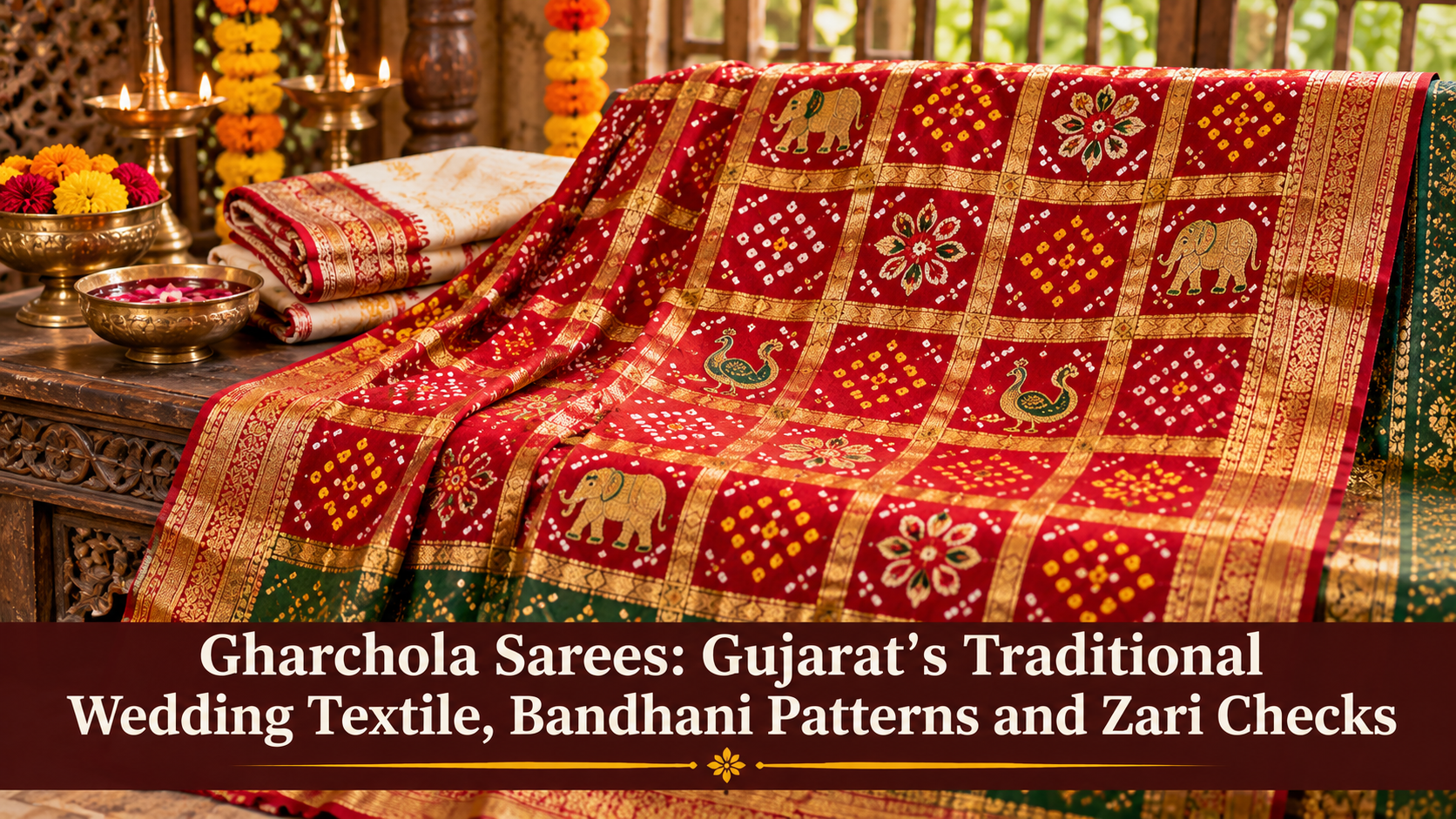
A Gharchola saree is made in two crafts at once. One is weaving, which builds a grid of large squares in gold zari on silk or cotton-silk cloth. The other is Bandhani, the tie-and-dye technique that fills those squares with small dots and motifs. The result is a textile that Gujarati families have long used at weddings, and in the last few years it has also gained formal recognition as a Geographical Indication product of Gujarat.
It is also one of the most copied designs in the saree market. Plenty of red-and-gold checked sarees now carry the Gharchola name, but only some of them are woven and tied in the traditional way. This guide explains the history, the wedding customs, the construction of the grid, the role of zari and Bandhani, the colours and motifs, the materials and the production process. It ends with a practical section on telling a genuine piece from a printed imitation. If you are still comparing sarees in general, our complete guide to buying sarees for women covers fabrics, occasions and price factors across all types.
What a Gharchola is
The word Gharchola is commonly translated as “robe for home” or “outfit for the home”, and in wedding practice it points to the home of the husband. The textile is also spelled Gharcholu, and some sources give Ghatchola as an alternate name.
The Government of India’s handicrafts portal describes the Gharchola as a blend of weaving and tie-dye, with zari threads forming a checkered pattern on silk. The design has four defining features:
- A grid of large squares made with zari or metal thread
- Bandhani tie-dye inside the squares
- A deep red, maroon or scarlet field in the classic version
- Motifs placed within the squares, often small and symbolic
A red-and-gold saree that has a printed check pattern, or a woven check without tie-dye, is a different textile. It can still be attractive and well made, but it is not a traditional Gharchola and should not be sold as one.
History and geographical identity in Gujarat
The craft sits at the meeting point of weaving and Bandhani, which is one reason its geography is described in slightly different ways. The Government of India craft page says the Gharchola originated in Khambhat (Cambay), where traditional artisans wove it, and that it was later dyed in Jamnagar, which is known for water that helps produce deep red shades. Other cultural sources describe a division of labour in which the intricate tying is done in Kutch and the cloth is then sent to Jamnagar for dyeing. Both accounts agree that more than one town takes part and that Jamnagar is central to the dyeing.
The craft is closely tied to the Khatri community. Khatri artisans, both Hindu and Muslim, have been the main Bandhani producers for centuries, and some accounts place the community’s arrival from Sindh as early as the 16th century. Bandhani itself is often said to be far older, and some popular accounts trace tie-dye to the Indus Valley, though that is a long-range claim and the better documented history belongs to the last few centuries. Bandhani is made across Gujarat in towns such as Jamnagar, Bhuj, Anjar, Mandvi and Rajkot, and tying is often a family trade in which women work at home.
In late November 2024, Gharchola received a Geographical Indication tag, which news coverage described as Gujarat’s 27th. The GI links the textile to its place of origin and helps protect the name against misuse. If you plan to quote registration details, check the GI Registry journal for the applicant, the registration number and the defined production area.
Gharchola and the Gujarati wedding
The Gharchola is traditionally worn at weddings in Hindu and Jain communities in Gujarat, and similar traditions exist among Marwari families. Several customs recur in the sources, though practice varies by family, community and region.
The saree is a gift from the groom’s side. The groom’s family, often the mother-in-law, gives the Gharchola to the bride as a gesture of welcome into the new household. This is why the name refers to the home.
It sits alongside the panetar. The panetar is a white silk saree with a red border, traditionally given by the bride’s maternal uncle. Historically, the bride wore the panetar at the start of the wedding and then changed into the Gharchola near the end, which marked her move to her husband’s family.
Many brides now wear the Gharchola differently. A common modern practice is to drape a Gharchola odhani (a scarf-length piece) over the head and shoulders on top of the panetar, and some accounts describe one end being tied to the groom’s shawl during the seven pheras. Some brides wear the Gharchola as a full saree. These are customs, not fixed rules, and families follow their own versions.
Because the garment has this ritual meaning, it makes a difference whether a buyer wants a ceremonial Gharchola or a fashion saree inspired by it. The first usually follows a more traditional specification. The second is more flexible.
The checked grid pattern and how it is built
The grid is the signature of a Gharchola. Rather than a printed check, the squares are formed by zari threads that are woven into the cloth, so each square is outlined by metallic thread that is part of the fabric structure.
The Government craft page describes traditional grids in 9, 12 or 52 squares. Cultural sources add traditional names: a 12-square layout is sometimes called Bar Bagh, and the 52-square layout is called Bavan Bagh. These are layout categories, and weavers also make single and double check patterns of varying density. One account says a double check pattern takes 10 to 12 days to weave, which gives a sense of how much of the work happens at the loom.
Construction follows this logic:
- The weaver sets up a silk or cotton-silk warp and weaves the base cloth.
- Zari threads are introduced at planned intervals to form horizontal and vertical lines.
- Where the lines cross, they close off a square, so each square is a bounded compartment.
- The compartments are then used as the field for Bandhani tying.
A typical Gharchola saree is about 5.5 metres long and 46 inches wide, according to one cultural reference. Shorter, scarf-sized pieces are made as odhanis and stoles.
How zari is built into the grid and borders
Zari is the metal-wrapped thread that gives the Gharchola its gold or silver lines. Traditionally, zari is made by winding a thin metallic strip around a silk or cotton core. In the grid, the zari lines are woven in as part of the fabric. In the borders, zari is woven in a more continuous band, often in a narrow or medium width, which frames the saree.
The quality of zari varies. One source notes that Gharcholas are available in two broad grades depending on the zari used in the checks. Zari can be made from real silver with a gold wash, from tested (partly metallic) thread or from synthetic metallic thread. These differ in price, tarnish behaviour and feel. If a seller claims real zari, ask what the zari is made of, and ask whether any assay or testing document exists. Treat a general claim of “pure zari” without detail with caution.
Bandhani and Gharchola: how the two crafts meet
Bandhani is a tie-resist dyeing technique. The artisan pinches a small point of cloth and binds it tightly with cotton thread, over and over, to form a dot. When the cloth is dyed, the tied points resist the dye and stay in the original colour. When the threads are removed, the dots appear against the dyed ground.
In a Gharchola, tying happens inside the zari squares. Each square can hold a cluster of dots in white or yellow, sometimes arranged into small motifs. Cultural references describe the oldest, simplest Gharcholas as having plain dots, with more figurative designs added later. The Government craft page notes that cotton thread is used for tying and that each square is tied and dyed, followed by a second round of dyeing in red, maroon or scarlet.
Because the tying is done by hand and each dot is made individually, density and fineness are a mark of skill. A saree with very fine, tightly packed dots takes far more time than one with sparse, larger dots. Bandhani work in Gujarat is often split between specialists: one person plans the design, another ties, another prepares the dye and another dyes. That division of labour is one reason a genuine Gharchola is expensive.
Colours: red, green and other combinations
The traditional colour of a Gharchola is red. Government documentation lists red, maroon and scarlet as the dominant shades, associated with auspiciousness, and says classic Gharcholas are uniform in colour with zari embellishment. Dots are typically white or yellow, and a typical piece is described as red with yellow and white dots.
Sources disagree on green. Some popular accounts say red and green is a traditional pairing along with red and white, linked to prosperity. The Government craft page describes green as something added in contemporary versions, often as a separately woven green pallu, and describes traditional Gharcholas as one uniform colour. The careful reading is that red is the documented traditional ground, and green appears in many pieces now sold as Gharchola, with the history of that combination less clearly settled.
Other colours, such as pink, orange, maroon with a green or blue border or pastel shades, appear in modern wedding collections. Treat these as contemporary variations. A red Gharchola saree is the version most buyers and families mean when they use the term in a ceremonial context.
Jamnagar’s water is often credited with helping deepen reds, which is why dyeing centres there are so closely tied to the craft.
Motifs and their meanings
The Government craft page lists these motifs: parrots, peacocks, elephants, flowers (phulwari) and hunting scenes (shikari). Some sources attach meanings, such as peacocks for beauty and flowers for prosperity, but these readings are interpretive and vary between sources. A safer way to put it is that these motifs belong to the documented vocabulary of the craft, and that families and sellers often attach auspicious meanings to them.
Dots themselves are the oldest and simplest motif. One cultural source reads dots as seeds and links them to fertility and abundance. Treat that as a common interpretation, not a rule.
In practice, you will see motifs inside the squares, with the density of design increasing in more elaborate pieces. A plain-dot Gharchola is closer to the older style, and a saree with many figurative motifs is a more decorated variant.
Fabrics and materials
The Government craft page says Gharchola sarees are woven from silk, primarily gajji silk, with zari threads forming the checks and cotton thread used for tying Bandhani. Other references describe the textile as woven on cotton or silk, and some describe a cotton-silk base. Gajji silk is a fabric commonly associated with the panetar, so it is the base most closely linked to traditional wedding pieces.
Common material variations include:
- Silk (including gajji silk): the traditional choice for ceremonial pieces, with a smooth drape and natural sheen.
- Cotton-silk: lighter and often more affordable, and suited to daytime functions or warmer weather. Our cotton silk sarees guide explains how these blends feel, price and wear, which helps if you are considering a cotton-silk Gharchola.
- Georgette and chiffon: used in many Bandhani sarees sold today. A georgette Bandhani saree with a check-style print or light embroidery is a contemporary product and not a traditional Gharchola.
Whatever the base, ask what the fibre is. A label that says “silk” can mean different things, and printed imitations are often made on synthetic cloth.
The production process
The full process involves weaving, tying, dyeing and finishing, with several artisans involved. The sequence below follows the Government craft documentation, with notes where other sources differ.
- Fabric and yarn preparation. Silk or cotton-silk yarn is prepared for the loom, and zari thread is made or sourced.
- Weaving the grid. The weaver builds the base cloth and weaves zari into it to form the grid, borders and any woven pallu. Weaving a double check pattern is reported to take 10 to 12 days.
- Planning the design. Dot positions and motifs are marked within the squares.
- Tying the Bandhani. Artisans pinch small points of fabric and bind them with cotton thread. This is the slowest stage. Some accounts say the intricate tying is done in Kutch.
- Dyeing. The tied cloth goes into dye vats, and a second round of dyeing in red, maroon or scarlet follows. Dyeing is traditionally associated with Jamnagar. The Government page says traditional artisans continue to use natural dyes, though many contemporary pieces use synthetic dyes, so ask what was used.
- Opening the ties. After dyeing and drying, the threads are removed or opened, and the dots appear in the original colour.
- Finishing. The craft page notes hand embroidery as a finishing step. The saree is pressed, checked and prepared for sale. Many Bandhani fabrics are also sold with some thread left in for a crinkled effect, which is a market preference and not a requirement.
The same page notes that traditional Gharcholas are uniform in colour, while modern adaptations include separately woven green pallus.
Regional differences
Gharchola is closely tied to Gujarat, but its edges overlap with neighbouring traditions.
In Khambhat and Jamnagar, the Government page places the weaving and dyeing history. In Kutch towns such as Mandvi, Bhuj and Anjar, Bandhani tying is a long-standing craft. Rajkot and other towns also produce Bandhani. Surat is Gujarat’s major saree manufacturing hub, and large volumes of printed and machine-made sarees come from there, including products styled after Bandhani and Gharchola. Production at that scale is a different category from the hand-tied textile described here.
Marwari and Jain families in Rajasthan and Gujarat also wear the Gharchola at weddings, and Rajasthan has its own Bandhej traditions with different colours and ritual roles. For example, pregnancy and childbirth traditions in Rajasthan involve a yellow Bandhani saree with a red border. These traditions are related but not the same as the Gujarati Gharchola.
Comparison: Gharchola, Bandhani and other Gujarati wedding textiles
| Textile | What it is | Technique | Typical look | Wedding role |
| Gharchola | A Gujarati wedding textile from silk or cotton-silk, with GI recognition | Woven zari grid combined with Bandhani tie-dye | Red field with a gold check grid and dots in white or yellow | Gift from the groom’s family, worn by the bride in the ceremony or as an odhani |
| Bandhani (general) | A tie-dye technique used across sarees, dupattas and fabric | Hand-tied resist dyeing | Dots, waves, ovals and other patterns in many colours | Widely worn at weddings and festivals, with no single ritual role |
| Panetar | A white silk saree with a red border | Plain gajji silk with Bandhani dots on the border and pallu in traditional versions | White body, red border | Traditionally worn by the bride at the start of the ceremony, a gift from the maternal uncle |
| Patola | Double-ikat silk from Patan in Gujarat, with a GI | Both warp and weft are resist-dyed before weaving | Geometric and floral patterns with sharp, even edges | Worn by some communities for weddings and major occasions |
| Chandrokhani | A Bandhani textile used among some Muslim Khatri families | Tie-dye | Moon-like round patterns | Worn by the bride and groom on different occasions |
The key point of the table is that Bandhani is a technique, while Gharchola is a specific textile that uses the technique inside a woven zari grid. Not all Bandhani is Gharchola, and a Gharchola is always a Bandhani and weaving combination.
How to identify an authentic Gharchola
No single check proves authenticity, so combine several. A hand-made Gharchola takes weeks of skilled labour, and its price should reflect that. If the price is very low for a “silk Gharchola with real zari”, ask why.
| What to check | Traditional woven and tied Gharchola | Printed or imitation “Gharchola” |
| Grid lines | Woven zari that is part of the cloth. You can feel the raised metallic thread and see it on the back | Printed gold lines that sit on the surface, often flat, and may flake or wear off |
| Bandhani dots | Raised small dots with slight variation in size and spacing. Each has a tiny pinpoint where it was tied | Perfectly identical dots that look flat, sometimes with a repeating pattern |
| Back of the cloth | Dye has soaked through and looks similar to the front, and zari lines are visible as woven thread | Back is paler or white, the grid is missing or only faintly visible |
| Colour | Even deep red with slight variation across squares | Flat colour that may look too uniform, or bright synthetic shades |
| Fabric | Silk or cotton-silk with a natural feel. The seller can state the fibre | Often synthetic. The surface may feel smooth and plasticky |
| Edges and borders | Woven borders and a clean pallu, with zari integrated into the weave | Printed borders that stop abruptly or do not match the grid |
| Seller information | Can explain where it was woven, tied and dyed, and whether the zari is real, tested or metallic | Vague descriptions that rely on words like “authentic” |
Two further habits help. Ask for a close-up photograph of the back of the saree in natural light. And ask whether the seller can name the weaving and dyeing locations and, where relevant, whether they are an authorised GI user. For a broader checklist on reading descriptions and photographs, see our guide to checking fabric, colour and seller details when you shop online.
Keep in mind that a printed red-and-gold checked saree can still be a good fashion purchase when it is described honestly. The issue arises when it is sold as a traditional Gharchola.
Contemporary adaptations and how Gharchola is worn today
Today’s Gharchola range is wider than the classic red saree. The Government craft page notes that the craft has expanded into dupattas, stoles, men’s clothing and home décor, and that weavers are blending traditional and modern designs. Common adaptations include:
- Separately woven green or contrast pallus
- Lighter silks and cotton-silk bases for easier wear
- Pastel and multicolour versions in addition to red
- Gharchola dupattas and odhanis to wear with lehengas or plain sarees
- Printed Gharchola-style fabric in georgette or crepe, sold as a lower-cost alternative
All of these have a place, as long as the product is described accurately. A woven and tied Gharchola, a Gharchola-inspired Bandhani saree and a digitally printed check saree belong to different price and quality categories.
Wearing a Gharchola saree follows the same basic steps as any saree, with a few regional choices. If you are new to sarees, our guide to saree draping styles for beginners explains a common basic drape, the pleats and how to secure the pallu. That guide also notes that regional and community drapes have their own methods, so a Gujarati bride who wants a traditional wedding drape will want instructions specific to that style, or help from a family member or professional.
Heavy silk and zari add weight, so practise the drape before the event and test sitting and walking.
Care for a Gharchola saree
Follow the seller’s label and instructions first. Silk and zari pieces usually need dry cleaning, and the dyes in traditional work may release colour in water. Store the saree folded in a clean cotton or muslin cloth, keep it away from damp and refold it along different lines from time to time. Avoid storing zari textiles in plastic for long periods, since trapped moisture can tarnish metallic thread.
Frequently asked questions
1. What is a Gharchola saree?
A Gharchola is a traditional Gujarati wedding textile woven with a grid of zari squares, with Bandhani tie-dye inside the squares. The classic version is red, on silk or cotton-silk, and is traditionally given to the bride by her husband’s family.
2. Why is it called Gharchola?
The name is commonly translated as “robe for home” or “outfit for the home”. In wedding practice it refers to the bride’s new home, which is why it is a gift from the groom’s side.
3. Is every red and gold checked saree a Gharchola?
No. A traditional Gharchola has a woven zari grid and hand-tied Bandhani dots inside the squares. Printed checks, plain woven checks and machine-made imitations are different products and should be described as such.
4. How is a Gharchola different from a Bandhani saree?
Bandhani is a tie-dye technique used on many sarees and fabrics. A Gharchola is a specific textile that combines Bandhani with a woven zari grid, and has a ritual role at Gujarati weddings.
5. What is the difference between a Gharchola and a panetar?
A panetar is a white silk saree with a red border, traditionally given by the bride’s maternal uncle. A Gharchola is the red tie-dye and zari textile given by the groom’s family. Historically the bride wore the panetar first and changed into the Gharchola later in the ceremony.
6. Are green Gharcholas traditional?
Sources differ. Some popular accounts list red and green as a traditional pairing, while the Government craft documentation describes classic Gharcholas as a uniform red and green pallus as a contemporary addition. Red remains the documented traditional ground colour.
7. Which fabric is best for a Gharchola saree?
Silk, particularly gajji silk, is the traditional base. Cotton-silk is lighter and suits daytime or warm-weather functions. Georgette and chiffon versions are usually contemporary Bandhani sarees rather than traditional Gharcholas.
8. Does Gharchola have a GI tag?
Yes. Gharchola was granted a Geographical Indication tag in late November 2024, reported as Gujarat’s 27th. Check the GI Registry for the exact registration details and authorised users.
Conclusion
A Gharchola saree is defined by its construction: a woven zari grid, hand-tied Bandhani dots inside each square and a deep red ground that families have long associated with the start of married life. Its ceremonial role as a gift from the groom’s side gives it a meaning that a printed check saree does not carry. Modern versions in green, pastel and lighter fabrics widen the choice, and the sensible way to buy is to match the label to the method. Ask how the saree was woven, tied and dyed, what the zari and dyes are made of, and where the work was done, then choose the version that suits the occasion and your budget.
