
Blog
Bomkai Sarees: Odisha’s Traditional Silk Weaving, Tribal Motifs and Temple Borders

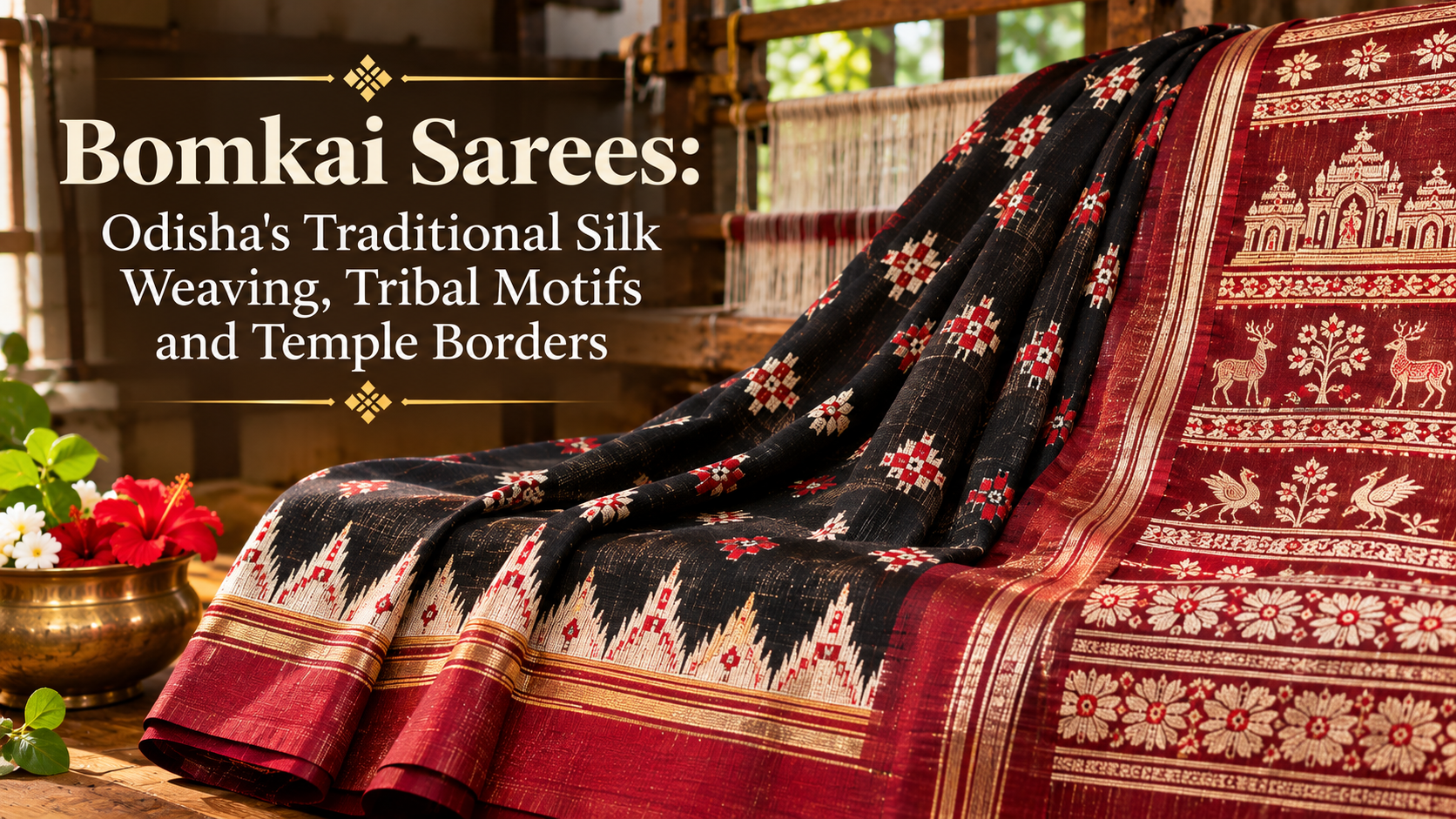
A Bomkai saree is easy to spot once you know what to look for. The body is often plain or lightly patterned, the border carries contrasting colour and sometimes a temple-inspired outline, and the pallu is covered in thread-worked motifs that seem to sit on top of the cloth. Many shoppers meet the Bomkai saree under a second name, the Sonepuri saree, and wonder whether the two are the same thing. Others find it listed beside Sambalpuri ikat and cannot see the difference.
This guide explains where Bomkai weaving comes from, how the extra-weft technique works, which motifs appear on the cloth and what to expect from silk and cotton versions. It also compares Bomkai with Sambalpuri ikat and separates what is documented from what is only handed down as tradition. Craft histories of this kind often repeat claims that cannot be checked, so where sources disagree, we say so.
What is a Bomkai saree?
A Bomkai saree is an Odisha handloom saree named after Bomkai, a village in Ganjam district. It is known for decorative threadwork woven into the pallu and for contrasting borders, and it is made on pit looms with a patterning technique called jala, with dobby or jacquard attachments in some workshops. Today it is woven in cotton, silk and blends.
“Bomkai Saree and Fabrics” is a registered Geographical Indication (GI) of India, listed under application number 217 in the handicraft class. A GI tag identifies a product with a place, and it is the most reliable public record of what the name covers. We return to it in the next section.
Origins and geographical identity of Bomkai weaving
The village and the district
Several independent sources agree on the basic geography. The saree takes its name from Bomkai village in Ganjam district, in southern coastal Odisha. The GI summary describes the original saree as woven in coarse cotton, heavier than ordinary cotton and silk sarees, with contrasting borders and a pallu in extra weft. Over time, weaving spread to other places. Summaries of the GI entry name Sonepur (now Subarnapur), Boudh and Dhenkanal, and other sources also mention Cuttack and Angul. The district lists differ from source to source, so treat them as indicative and check the GI Journal entry if you need an exact legal list.
What is documented
- The name comes from Bomkai village in Ganjam district.
- Bomkai Saree and Fabrics carries a GI registration (application number 217).
- The weave uses extra-weft designs worked with the jala technique, and the pallu is the main area of decoration.
- Production today is concentrated far from Bomkai village, mostly in Subarnapur (Sonepur) district, where the Bhulia weaving community is closely associated with it.
What is traditional, disputed or unverified
- The registration year. Sources give 2009, 2010 and 2012. The Odisha government’s Orissa Review lists a certificate date of 17 July 2012, which is the most specific official-style record we found. Check the GI Journal before you quote a year in your own copy.
- The age of the craft. Popular articles say the tradition goes back to the 8th century or even earlier. We found no source that documents this. One craft source says the exact origins of the weave are undated, and a textile researcher quoted in a travel blog argues that the design now sold as Bomkai was developed in the early 1980s with help from a government weavers’ service centre, working from old cotton sarees collected in Bomkai village. That is one expert’s account and should be treated as such, but it shows why a confident date is unsafe.
- Royal patronage. Some accounts say weaving was introduced to Sonepur under a ruler named Ramai Dev of Patna. This is repeated in many places as tradition, and we have not seen primary evidence for it.
- The meaning of the name. Several explanations circulate, including a link to the words for loom and hand. They conflict with each other, so we do not rely on any of them.
The connection between Bomkai and Sonepur’s weaving tradition
Sonepur, in Subarnapur district on the Mahanadi, is a long-established centre of handloom weaving in western Odisha. It is known for cotton ikat as well, and that overlap explains much of the confusion between Bomkai and Sambalpuri styles. When Bomkai designs were taken up by Sonepur weavers, the saree began to be sold as the Sonepuri saree, and the two names are now used almost interchangeably in shops and listings.
Two points are worth keeping in mind. First, the Bhulia community of Subarnapur is widely credited as the main weaving community behind today’s Bomkai output. Second, some craft specialists distinguish between the original Ganjam Bomkai, woven in coarse cotton, and the contemporary Sonepur version, which uses silk, finer cotton and zari and looks quite different. A Sonepuri saree is therefore a Bomkai saree woven in Sonepur, but it may not resemble the cotton original in Bomkai village. When you read “Sonepuri saree” in a product listing, check the fibre and the technique before you assume anything else.
How Bomkai weaving works: extra weft, jala and the creation of motifs
The basics of the loom
Bomkai sarees are woven on handlooms. Sources mention pit looms and fly shuttle pit looms, and one source also mentions frame looms. The weaver sits at the loom, throws the shuttle by hand and controls the warp with foot pedals. This is a slow process, and the pattern work in the pallu adds to the time it takes.
What extra weft means
In ordinary weaving, the weft is the set of threads that runs across the width of the fabric, crossing the warp threads that run along its length. In extra-weft weaving, additional weft yarns are woven in only where a motif is wanted. They are supplementary to the ground weft that forms the cloth. The result is a design that looks as if it has been stitched onto the saree, although it is part of the weave. On the back of a hand-worked pallu you may see short floats or trimmed ends where the extra yarn travels between motifs, which is normal for the technique.
The jala technique
The traditional method for creating Bomkai motifs is called jala, also spelled jaala or jalla in different sources. Descriptions of it vary, and several describe it as a net-like arrangement of threads that guides the weaver in lifting the right warp threads for each motif. What the sources agree on is that it is manual patterning. Many weavers now use dobby or jacquard attachments, which automate part of the lifting. A craft source notes that Bomkai still keeps the jala method in some pieces, and that is one reason handwoven jala pieces are valued by collectors.
Borders and the three-shuttle method
Borders are treated differently from the body. The GI summary mentions contrast-coloured borders woven with a three-shuttle technique. A craft source says this gives a solid-looking border and links it to the local term “Muhojorha saree”. Wikipedia and craft sources also describe extra warp designs in the border and extra weft designs in the body and pallu, using dobby, jacquard or jala. In practice, a single saree can combine several of these methods.
Where ikat fits
Ikat, called bandha in Odisha, is a separate technique in which yarn is resist-dyed before weaving. A textile writer quoted by a travel magazine says ikat was not found on the Bomkai sarees of earlier times, although it can be seen on borders now, especially temple-style borders. Other sources describe clusters in Cuttack, Angul and the Sonepur and Bargarh region where ikat is combined with Bomkai solid-colour work. The practical point is this: a Bomkai saree may contain ikat in some modern pieces, but ikat is not what defines it.
Traditional Bomkai saree motifs
Motifs are the signature of Bomkai weaving, and they are concentrated in the pallu and the border. The list below draws on the GI summary and several craft sources. Names and spellings vary, so we have grouped them by type and attributed the less common ones.
Floral and plant motifs
Flowers are common, and the lotus is named in several sources. One source describes the kumbha as a pot seen on temple spires, while another calls it a water plant, so the same word is explained in two ways. We use it here as a motif name only, without claiming a single meaning.
Geometric patterns
Geometric shapes appear in borders and in the pallu. Sources describe geometric motifs alongside the tribal-inspired ones, and one source notes a recurring spire-like geometric form. The rudraksha, a bead motif, is also named in several sources as a border pattern.
Animal and bird motifs
The GI summary lists nature-inspired motifs such as the swan, deer, lion and lotus. Fish are named very often, and peacocks and tortoises appear in some accounts. A fish is frequently described as a sign of success and affluence, which is a belief repeated in many sources. We mention it as a commonly attributed meaning and do not treat it as documented fact.
Tribal-inspired and figurative motifs
Several sources say Bomkai border or pallu motifs are inspired by tribal art, and they mention designs such as dancing figures or dolls, a drum shaped like an hourglass, a chariot and the Konark wheel. A temple-influenced vocabulary sits beside these. We found no source that ties a particular motif to a named tribal community or documents what it meant to that community, so we do not assign meanings here. If a seller tells you that a given motif symbolises a specific thing, ask where that claim comes from.
Borders, pallu designs and colour combinations
Borders
Borders on Bomkai sarees are usually contrast-coloured and can be narrow or broad. A feature mentioned in several sources is an irregular, stepped temple outline along the edge. This is not unique to Bomkai. Temple-shaped borders are also a feature of Berhampuri Patta, another GI-protected Odisha weave, so a temple border alone does not tell you what you are looking at. Look at how the motifs are made. In Bomkai, they are extra-weft threadwork, while other weaves use different methods.
Pallu
The pallu is where the most elaborate weaving appears. Descriptions mention dense rows of motifs against a simpler body, and the contrast between a plain body and a heavily worked pallu is one of the quickest visual clues. Some pieces use double-shaded pallus or a different colour from the body.
Colour combinations
Sources differ on dyes and palette. One source lists red, black, mustard and light pastel shades as traditional, another mentions red, black and white backgrounds and says natural dyes were common, and a travel magazine writer says chemical dyes later widened the range and allowed bolder contrasts. One craft source links the palette to the colours used at the Jagannath temple, but we could not verify this elsewhere, so we leave it as one account. What can be said with confidence is that contrast is typical: a bold border against a quieter body, and a pallu that stands apart.
Silk and cotton Bomkai sarees: not every piece is the same
A frequent mistake in listings is to assume every Bomkai saree is silk. It is not. The original Ganjam style used coarse cotton, and the GI description reflects that. Sonepur later added silk, finer cotton counts, tussar and zari, and Bomkai-style dress material and furnishings now exist as well. Wikipedia notes that cotton Bomkai sarees are mostly used for everyday wear and silk ones for ceremonies and sacred occasions, which is a useful rule of thumb, though not a fixed rule.
This means you should read each listing for the actual fibre. A Bomkai silk saree is a different purchase from a Bomkai cotton saree in weight, drape, care and price. Some pieces are blends too, and if you want to understand how a cotton-silk combination behaves, our guide to cotton silk sarees explains the fibre mix, care and price factors.
The cotton and silk choice also depends on climate and use. Cotton is generally lighter and more breathable, while silk gives a richer finish. If you are deciding between them for a particular occasion, our comparison of cotton vs silk sarees sets out comfort, cost and care side by side.
Bomkai sarees for festivals, weddings and traditional occasions
Sources describe Bomkai sarees as suitable for special occasions, with the heavier pallu work making silk pieces a choice for weddings and festive events. Wikipedia and Odisha handloom promotion material report that silk sarees are worn at ceremonies and sacred occasions, and cotton at other times. Some craft writers add that Bomkai is popular with dancers and that it is worn at rituals, but we treat those as general descriptions and not as documented customs of a specific community.
A practical way to think about it is by weight and finish. A cotton Bomkai with a bold border works for daytime functions, temple visits and everyday wear. A silk Bomkai with a densely worked pallu suits weddings and major festivals. Neither category requires a specific festival, and we have found no evidence that Bomkai is tied to one. If someone tells you a particular colour or motif is required for a rite, ask for the source.
Bomkai vs Sambalpuri ikat: what is different
Both are Odisha handlooms, both are GI-registered and both are woven in western and central Odisha, so confusion is common. They are made differently. Sambalpuri Bandha, known as Sambalpuri ikat, gets its pattern from yarn that is tied and resist-dyed before it goes on the loom. Bomkai gets its pattern from extra weft threads added during weaving.
The Odisha GI summary describes Sambalpuri Bandha as combining extra warp and ikat, often in a checked pattern in the body with a broad, elaborate border, and it names conch shell, wheel, flower and fish as common border motifs. The same summary describes Bomkai as an extra-weft weave with jala technique, contrasting borders and a threadwork pallu.
| Feature | Bomkai | Sambalpuri ikat (Bandha) |
| How the pattern is made | Extra weft threads woven in during weaving, using jala, dobby or jacquard | Yarn is tied and resist-dyed before weaving, then woven to reveal the design |
| Where the design sits | Mostly pallu and border, with the body often plain or lightly patterned | Often across the body and borders, in patterns such as checks |
| Look of the motifs | Threadwork that looks raised or stitched onto the surface | Soft, slightly blurred edges typical of ikat |
| Back of the cloth | Short floats or trimmed ends may show behind motifs | Design is generally visible on both sides |
| Typical motifs named in sources | Fish, kumbha, rudraksha, flowers, birds, animals, figures | Conch shell, wheel, flower, fish and others, often on borders |
| Original fibre | Coarse cotton in the Ganjam tradition, with silk and finer cotton in Sonepur | Cotton and silk both used |
| GI registration | Bomkai Saree and Fabrics (application 217) | Sambalpuri Bandha Saree and Fabrics (application 208) |
| Main clue | Look for threadwork on a plain ground | Look for dyed-yarn patterns with feathered edges |
Remember that real sarees can combine techniques. Some Bomkai pieces now carry ikat borders, as described above. If a saree shows both, ask the seller which technique makes the pallu and which makes the body.
How to recognise and buy an authentic Bomkai saree
A few checks help, whether you shop in a store or online.
- Look at the pallu. Extra-weft motifs should look woven into the cloth, with a consistent texture. Printed or embroidered imitations look flatter or sit on the surface.
- Check the back. Hand-woven extra-weft work often shows floats or trimmed ends. That is normal.
- Read the fibre. Ask whether it is cotton, silk, a blend or an art silk, and whether the zari is real, tested or metallic.
- Ask about the weaving method. Handloom, powerloom and printed versions can be labelled loosely. Ask for the weaving place and technique.
- Look for handloom and GI information. A GI tag identifies a product by place, and genuine sellers can explain what the tag covers.
- Expect small variation. Handwork is not perfectly uniform.
For a broader framework covering fabric, weave, price and finishing across all types of sarees, see our complete guide to buying sarees for women.
If you plan to order a handloom saree online, photographs and descriptions matter even more, because texture is hard to judge from a screen. Our online saree shopping guide shows how to read listings, ask the right questions and check policies before you pay.
Frequently asked questions
What is a Bomkai saree?
It is an Odisha handloom saree named after Bomkai village in Ganjam district. It is known for extra-weft threadwork in the pallu, contrasting borders and motifs drawn from nature, temples and tribal-inspired designs. It is woven in cotton, silk and blends.
Is a Sonepuri saree the same as a Bomkai saree?
Usually the names refer to the same style. Sonepuri indicates a Bomkai saree woven in Sonepur (Subarnapur district), where much of today’s production takes place. Some specialists note that the Sonepur versions can look different from the original Ganjam cotton sarees, so check the fibre and weave.
Is every Bomkai saree made of silk?
No. The original Ganjam style used coarse cotton, and cotton Bomkai sarees are still made. Silk, tussar, fine cotton and blends are also used, especially in Sonepur. Read the listing for the actual fibre.
How is Bomkai weaving different from Sambalpuri ikat?
Bomkai patterns come from extra weft threads added during weaving, usually concentrated in the pallu and border. Sambalpuri ikat patterns come from tying and dyeing the yarn before weaving. Some modern pieces combine both.
What motifs are common on Bomkai sarees?
Sources name fish, flowers, lotus, swan, deer, lion, peacock, kumbha, rudraksha, dancing figures, a chariot, the Konark wheel and geometric patterns. Names and spellings vary, and meanings are often attributed rather than documented.
Does the Bomkai saree have a GI tag?
Yes. Bomkai Saree and Fabrics is registered as a Geographical Indication under application number 217. Sources give different registration years, and the Orissa Review lists a certificate date of 17 July 2012.
How old is Bomkai weaving?
The exact age is not documented. Popular articles cite very old dates, but we found no verified evidence for them, and one expert argues the current design was developed in the early 1980s. It is safest to say the origins are undated.
Can I wear a Bomkai saree to a wedding?
Yes, silk Bomkai sarees with a rich pallu are commonly chosen for weddings and festive occasions, while cotton ones suit daytime and everyday wear. Choose by fabric, weight and the setting.
Conclusion
The Bomkai saree is best understood as a weave with a clear technical identity and a more cloudy history. Its extra-weft threadwork, contrast borders and heavily worked pallu set it apart, and its GI registration anchors the name to Bomkai village and the weaving clusters that followed. Silk and cotton versions both exist, Sonepur is now the centre of production, and Sambalpuri ikat is a different technique even when the two sit side by side in a shop.
When you choose a Bomkai saree, look at the pallu, read the fibre, ask how it was woven and be cautious about confident claims on age or motif meaning. Handloom pieces reward a careful eye, and an informed buyer gets the most from them. If you want to see sarees in person, visit Mahavir Cloth Center in Shirol, Kolhapur, or browse the saree range on the website.
